The Grow Awards 2026 🏆
Likes
Comments
Share
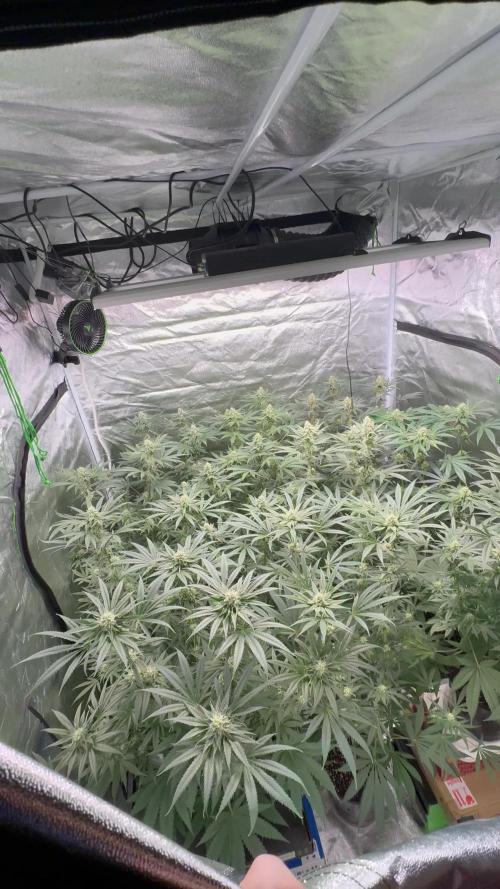
2024/05/18 : gave last shot of bio PK yesterday and let plant do its thing alone until the end. Smell is more present with a subtil "wet dog" touch.😅 I'm glad to see first sugar leaves turning purple! While reseting plant after flush, I may have half-broken one of the main colas, it's still alive for now. The height is 50cm so I had to move up LED : thanks to secret jardin system, I still have room with 30cm between lamp and plant. I cranked up DLI to 38~48 : TS1000 is almost at max. As it is, fan leaves are 27°C and colas 28°C : perfect. Leaves that were yellowing are still yellow but it seems there are no new ones : I don't like to see yellow before late flowering. Maybe 20cm was not enough for higher leaves.
Likes
3
Share
Topping was made on Saturday 08/09. She's flying! Took a clone from her with the topping, we'll see if it will survive. Fast and strong strain this one! ✊
Likes
8
Share
Entree dans la 4 eme semaines de Flo Ajout de Greensensation
Likes
47
Share
Going well except for the cbd critical cure. Few brown spots. It should rebound with nutes added at 1/8 strength.
Processing
Likes
3
Share
@AxlWeed
Follow
2019-06-07 to 2019-06-13 - F1 to F6 Flipped to 12/12 on june 8th Defoliated it a bit.
Processing
Likes
33
Share
Very excited this week with Christmas and everything going well for my family at the end of the year! This is my entry in into the Christmas fun hope you enjoy it as my wife and I did Playing around.
Likes
13
Share
@GeOMaTTiC
Follow
Still weeks from a harvest, if it doesn't freeze by then
Likes
11
Share
Likes
17
Share
@foxbberg
Follow
Day 22: Drain EC 3 feet high and risin'😅( average 3.3 to be exact...) dunno how much whatever-salt is building up in that pots, but it obviuosly doesn't bother the ladies. Dark green colour, very few 'claws', no signs of tipp-burn, new foliage appears in a juicy green and turns dark in an instant, leafs point upwards....... looks like they're happy😊. Planns for this week: - Install the scrog-net - Obsereve plants/soil ( when do i have to feed nutrients again?) otherwise there will be no changes...... Thoughts: These bushy babies will be kind of a challlenge to create this scrog the way i'm used to (basically bending the 4 main main colas to the corners of the tent, upper branches to the walls and spaces between the pants, lower branches to the very center). Now these ladies make so many branches, so close togehter and so equal in length, underneath huge fanleafs..... i'd love to have them in a 100 square meter canna-crib....but in a tent...????? I really hate doin' things without having them planned - but in this case i guess i will have to install the net, start weaving and see what's happening😯 Day 23 Let's keep it positive...... indoor-climate of 64% rh is perfect for my health💪😁!!! ......but in my tent it's killing the vpd😖. at a lousy 24 degrees C, i'm readin' about 60-64 % rh wich results in about 0.7 to 0.8 kPa.* More figures? Here come the crazyones👻!: pH 5.5; EC 4.2😨 but thats only drain from plant 3....... average was 6.1/3.6 The girls busy produce roots, shoots and leafs....... still very green, still not unhealthy.......few claws, no tipp-burn. Basically a comfortable place to be: It's not bad yet - no work but watering - and it can only get better!!!😁 *VPD issue solved: The sensor hung too close to a fanleaf - didn‘t expect this thing beeing so sensitive 😅. Day 24 Climbed new hights this morning: Plant 1 had an EC of 3.8 - the others didn't climb any higher than yesterday. So maybe we've reached the climax..... 😇 Visible growth now - so i installed the scrog-net and will start bending and weaving these days:-) Thoughts: Did beeing out of VPD-range for one day harm my plants? How exact can my sensor measure VPD? after a bit of research i found out: Whatever you buy for less than 200 bucks is far from beeing exact! Even professional sensors have a margin of about +/- 1% in relative humidity. Thermometers at least +/- 0.5 degrees C. This could give some a good guess of the actual VPD BUT: Leaf-temperature-offset is absolute key! Many of our trusted homegrow-equippment isn't even able to measure it (some offer default temp-offset) ....don't wanna go further here - but there's no way to achieve something like a precise VPD-measurement in homegrowing. So why caring for VPD? Even with those less accurate instruments, you may be able to keep your plants in something like a comfort-zone. Way better than only guessing 👆!!! In case i ran a much higher VPD than planned, yesterday (due to a missplaced sensor) , it will not harm or kill my plants. they might have had a bit of stress from dry air - but nothing to worry about! Day 24: Decreasing salt-levels in the drain - excepting plant 4, wich had an EC of 4.0 - so i guess i'm slowly draining exess-salts from top to bottom and might have collected some build-up. The girls seem to be quite okay. Root-growth is vigorous (there are thick, white roots penetrating through the pots, everywhere), the stems are relatively thin. removed the LST-lines. the Sc.r.o.g: only materiels needed, were a climbing-net for gardening (HDPE) cut to 90x90 for my 1x1 tent, 4 cable-ties and 2 meters of strong rubber-cord. Pre-installed the net with the cable-ties, then weaved the cord around the outter cords of the net, led it aroud the posts and pulled tight. Then brought the net into it's final position. Not as sturdy as with a wooden frame - but i had less than half the work and a bit of freedom to move things if necessary. Any shoot will now be put to the next outter square (relative to the center of each plant) as soon as can be held by the net, without harming the top. Once i moved all of the dominant colas to the next square, i'll have to take 10-15cm steps (vertical growth), to reach the next square. As soon as i have about 70 of my 81 squares filled, i'm going to flip to 12/12. Since i'm plannin' to have them full of sugar when flippin', i don't expect too much of a stretch. This way i hopefully have the longest and strongest shoots framing the shorter ones in the center - so the canopy shapes like a bowl, in order to achieve the most even light distribution possible. Day 25: The main colas visibly reached out for the light - but yet i only moved 1 single shoot to the next square. Girls look good, EC is dropping slowly, climate fine. CU tomorrow👋 day 26: on Track... nothing to worry about...... till day 28....... Due to high EC levels in the soil, i couldn't do much more than pour out some water and prepare the scrog this week. Next week i will have to do some weaving. If the nutrientlevels allow, i'll do some defoliation.
Likes
10
Share
Week 3: Vegetative Stage – Training, Defoliation, and Entering Full Flower The Apricot Autos have really taken off this week. I’ve been doing a little defoliation here and there, but over the course of training and tucking, I sometimes get a little heavy-handed and manage to break the odd leaf. Even with these occasional slips (you can see it in the pics), the plants are still shaping up nicely and getting huge, though not as much as my previous grow, which was also Fast Buds autos. By the end of the week, the plants have started to noticeably stretch, which I’m happy about since it makes them easier to train. At this stage, I like to train using mental pegs, gardening wire, and leaf tucking. I rarely remove any leaves until I have a clearer idea of the plant’s final shape, which did evolve quickly this week, prompting me to take action. On day 27, one of the plants is entering full flower, while the one with the misshapen leaf is a couple of days behind. The difference between the two is becoming less noticeable, although one is still bigger. Current Setup: Medium: 70/30 coco/perlite mix with Great White Mycorrhizae added during transplant Lights: DLI set to 22 Nutrients: Big Plant Science (introduced midweek) Despite breaking a leaf or two during training, both plants are progressing well, with flowering now fully underway.
Likes
15
Share
@tokesly
Follow
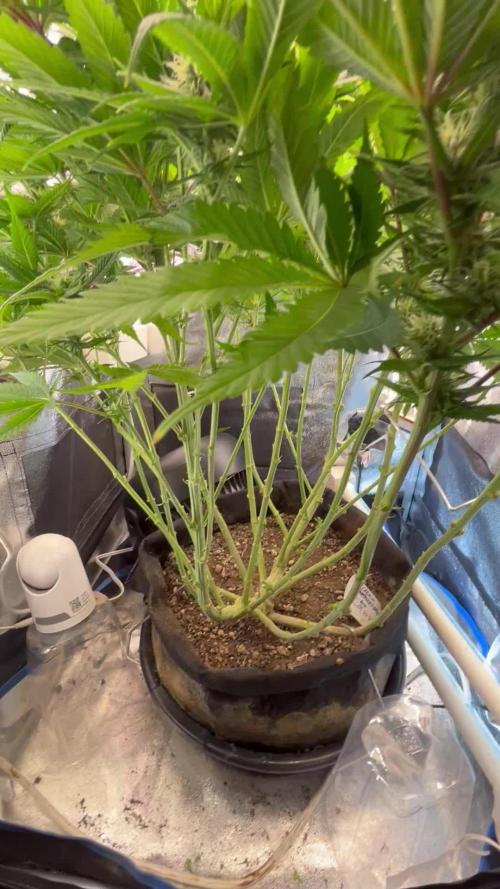
Realized just how intense manual feeding for coco is. Takes up to 3 hours to mix the nutrients, water, and wait to empty the saucers. And I'm just doing this once a day, imagine the experienced growers feeding 3+ times a day. Definitely would be ideal to have a drip/drain system installed in the future. Pheno 2 got so lanky and heavy it fell over! A scrog and bamboo sticks would've helped a ton. Placed a peony cage to support the branches but it's hard to get it angled properly with the branches grown out. Boosted the PK again this week and halved the Bloom Nutes.
Likes
3
Share
@CoC407
Follow
The plants are growing fast, we forgot to check pH in this week but no problems.
Likes
55
Share
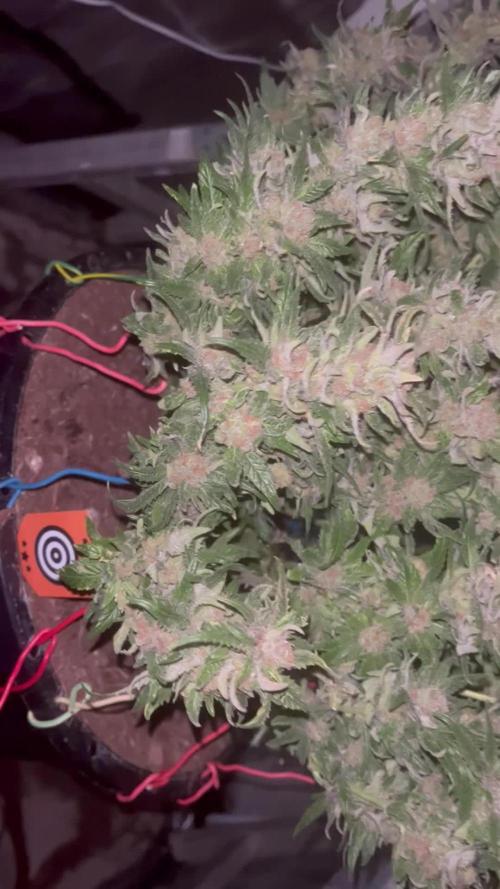
2nd net is up. Early bud formations are promising. holding up to the extremes pretty well, some leaves taking minor damage, but overall, she is holding up, gave her 1 night at 50F see how she would react, stressful. Not advised as it messes with her metabolism, but I want to see if it triggers any anthocyanin response. Love to see her purp up but no signs yet. Remember, For every molecule of glucose produced during photosynthesis, a plant needs to split six molecules of water. This process provides the hydrogen needed for synthesizing glucose and other organic compounds, while oxygen is released as a byproduct. Homework. If Rubisco activity is impaired and it cannot properly function or regenerate its substrate, the plant's leaves are likely to turn a pale green or lime green, a condition known as chlorosis. Essentially, Rubisco activity is highly regulated and susceptible to various environmental and metabolic factors that can cause it to become inhibited, leading to an apparent failure in RuBP regeneration due to a lack of consumption. Rubisco regeneration is intrinsically linked to nitrogen supply because Rubisco is a major sink for nitrogen in plants, typically accounting for 15% to over 25% of total leaf nitrogen. The regeneration phase itself consumes nitrogen through the synthesis of the Rubisco enzyme and associated proteins (like Rubisco activase), and overall nitrogen status heavily influences the efficiency of RuBP regeneration. RuBisCO is a very large enzyme that constitutes a significant proportion (up to 50%) of leaf soluble protein and requires large investments in nitrogen. Insufficient nitrogen supply limits the plant's ability to produce adequate amounts of RuBisCO, thereby limiting the overall capacity for photosynthesis and carbon fixation. Maintaining the optimal, slightly alkaline pH is crucial for the proper function and regeneration of Rubisco. Deviations in either direction (too high or too low) disrupt the enzyme's structure, activation state, and interaction with its substrates, leading to decreased activity and impaired RuBP regeneration. (Lime/yellowing) Structural Component: Nitrogen is an essential building block for all proteins, and the sheer abundance of the Rubisco protein makes it the single largest storage of nitrogen in the leaf. Synthesis and Activity: Adequate nitrogen supply is crucial for the synthesis and maintenance of sufficient Rubisco enzyme and Rubisco activase (Rca), the regulatory protein responsible for maintaining Rubisco's active state. Nitrogen deficiency leads to a decrease in the content and activity of both Rubisco and Rca, which in turn limits the maximum carboxylation rate, Vmax, and the rate of RuBP regeneration Jmax, thus reducing overall photosynthetic capacity. Nitrogen Storage and Remobilization: Rubisco can act as a temporary nitrogen storage protein, which is degraded to remobilize nitrogen to other growing parts of the plant, especially under conditions of nitrogen deficiency or senescence. Nitrogen Use Efficiency (NUE): The allocation of nitrogen to Rubisco is a key determinant of a plant's photosynthetic nitrogen use efficiency (PNUE). In high-nitrogen conditions, plants may accumulate a surplus of Rubisco, which may not be fully activated, leading to a lower PNUE. Optimizing the amount and activity of Rubisco relative to nitrogen availability is a target for improving crop NUE. Photorespiration and Nitrogen Metabolism: Nitrogen metabolism is also linked to the photorespiration pathway (which competes with carboxylation at the Rubisco active site), particularly in the reassimilation of ammonia released during the process. To increase RuBisCO regeneration, which refers to the process of forming the CO2 acceptor molecule Ribulose-1,5-bisphosphate (RuBP) during photosynthesis, the primary methods involve optimizing the levels and activity of Rubisco activase (Rca) and enhancing the performance of other Calvin-Benson-Bassham (CBB) cycle enzymes. Biochemical and Environmental Approaches: Optimize Rubisco Activase (Rca) activity: Rca is a crucial chaperone protein that removes inhibitory sugar phosphates, such as CA1P (2-carboxy-D-arabinitol 1-phosphate), from the Rubisco active site, thus maintaining its catalytic competence. •Ensure optimal light conditions: Rca is light-activated via the chloroplast's redox status. Adequate light intensity ensures Rca can effectively maintain Rubisco in its active, carbamylated state. •Maintain optimal temperature: Rca is highly temperature-sensitive and can become unstable at moderately high temperatures (e.g., above 35°C/95F° in many C3 plants), which decreases its ability to activate Rubisco. Maintaining temperatures within the optimal range for a specific plant species is important. •Optimize Mg2+ concentration: Mg2+ is a key cofactor for both Rubisco carbamylation and Rca activity. In the light, Mg2+ concentration in the chloroplast stroma increases, promoting activation. •Manage ATP/ADP ratio: Rca activity depends on ATP hydrolysis and is inhibited by ADP. Conditions that maintain a high ATP/ADP ratio in the chloroplast stroma favor Rca activity. Enhance Calvin-Benson-Bassham (CBB) cycle enzyme activity: The overall rate of RuBP regeneration can be limited by other enzymes in the cycle. •Increase SBPase activity: Sedoheptulose-1,7-bisphosphatase (SBPase) is a key regulatory enzyme in the regeneration pathway, and increasing its activity can enhance RuBP regeneration and overall photosynthesis. •Optimize other enzymes: Overexpression of other CBB cycle enzymes such as fructose-1,6-bisphosphate aldolase (FBA) and triose phosphate isomerase (TPI) can also help to balance the metabolic flux and improve RuBP regeneration capacity. Magnesium ions, Mg2+, are specifically required for Rubisco activation because the cation plays a critical structural and chemical role in forming the active site: A specific lysine residue in the active site must be carbamylated by a CO2 molecule to activate the enzyme. The resulting negatively charged carbamyl group then facilitates the binding of the positively charged Mg2+ion. While other divalent metal ions like Mn2+ can bind to Rubisco, they alter the enzyme's substrate specificity and lead to dramatically lower activity or a higher rate of the non-productive oxygenation reaction compared to Mg2+, making them biologically unfavorable in the context of efficient carbon fixation. The concentration of Mg2+ in the chloroplast stroma naturally increases in the light due to ion potential balancing during ATP synthesis, providing a physiological mechanism to ensure the enzyme is activated when photosynthesis is possible. At the center of the porphyrin ring, nestled within its nitrogen atoms, is a Magnesium ion (Mg2+). This magnesium ion is crucial for the function of chlorophyll, and without it, the pigment cannot effectively capture and transfer light energy. Mg acts as a cofactor: Mg2+ binds to Rubisco after an activator CO2 molecule, forming a catalytically competent complex (Enzyme-CO2-Mg2+). High light + CO2) increases demand: Under high light (60 DLI is a very high intensity, potentially saturating) and high CO2, the plant's capacity for photosynthesis is high, and thus the demand for activated Rubisco and the necessary Mg2+ cofactor increases. Mg deficiency becomes limiting: If Mg2+ is deficient under these conditions, the higher levels of Rubisco and Rubisco activase produced cannot be fully activated, leading to lower photosynthetic rates and potential photo-oxidative damage. Optimal range: Studies show that adequate Mg2+ application can enhance Rubisco activation and stabilize net photosynthetic rates under stress conditions, but the required concentration is specific to the experimental setup. Monitoring is key: The most effective approach in a controlled environment is to monitor the plant's physiological responses e.g., leaf Mg2+ concentration, photosynthetic rate, Rubisco activation state, and adjust the nutrient solution/fertilizer to maintain adequate levels, rather than supplementing a fixed "extra" amount. In practice, this means ensuring that Mg2+ is not a limiting factor in the plant's standard nutrient solution when pushing the limits with high light and CO2. Applying Mg2+ through foliar spray is beneficial to Rubisco regeneration, particularly in alleviating the negative effects of magnesium (Mg) deficiency and high-temperature stress (HTS). While Mg can be leached from soil, within the plant it is considered a mobile nutrient, particularly in the phloem. Foliar-applied Mg is quickly absorbed by the leaves and can be translocate to other plant parts, including new growth and sink organs. Foliar application of: NATURES VERY OWN MgSO4 @ 15.0g L-1 in a spray bottle. For those high-intensity workouts when 1 meal a day is just not enough! Foliar sprays are often recommended as a rapid rescue measure for existing deficiencies or as a supplement during critical growth stages, when demand for Mg is high. Application in the early morning or late evening can improve absorption and prevent leaf burn. The plant was getting a little limey yellow in the centre. Shortly thereafter, she was back in business, green mostly regenerated. The starting point [of creativity] is curiosity: pondering why the default exists in the first place. We’re driven to question defaults when we experience vuja de, the opposite of déjà vu. Déjà vu occurs when we encounter something new, but it feels as if we’ve seen it before. Vuja de is the reverse—we face something familiar, but we see it with a fresh perspective that enables us to gain new insights into old problems. Confidence is evidence... nothing more. You are confident because you have driven 10,000 times, you are confident because you have spoken 10,000 times. People think confidence is a feeling, but it's not. If you want more confidence, then you need to create evidence, take more shots, collect more data, build more experiences, take more risks; fail, confidence doesn't come first; it is the reward you get for doing the work. no one else wants to do.
Likes
95
Share
Me gusta hacer estos seguimientos y ver para atrás siempre si está creciendo o no y cómo lo viene haciendo día a día, la outlaw arranco mal, yo la pase de agua y de humedad porque era época de mucho frío y no calefaccionaba el ambiente, la planta fue desarrollando buenos tallos, musculosos, pero no ramificaba, si no le hacía una poda apical los laterales hubieran sido pobres, al resto de la planta en cuanto al olor y al sabor que tiene es realmente un 10 Para ver todos mis otros diarios https://growdiaries.com/grower/juanhaze-arg/diaries
Likes
5
Share
Phenotipos muy similares pero con problemas de Hermafroditismo, tuvimos que cortar los bajos para que no se polenize lo demas.. Producto final increíble! Terpenos a auténtico Gelato dulce y cremoso con toques Gassy que la hace casi perfecta en mi paladar! Planta pequeña con pocas ramas y cosecha poca-media de calidad top!
Likes
7
Share
Likes
10
Share
43 dias de vida en el proyecto B. También se estan estirando bastante aunque se nota la diferencia con el proyecto A ya que en este no hay macetas y estan directas al suelo, aunque las geneticas se ven iguales en ambos se puede diferenciar la rubostidad que estan cogiendo en el Proyecto A
Likes
Comments
Share

Diesmal wieder ein paar mehr Bilder. Hat sich aber auch n bisschen was getan. So langsam streckt sie sich nach oben und wird größer. Bisher ein sehr gutes Wachstum, saftig grüne Blätter und gute Nodien Abstände.
Likes
72
Share
@Roberts
Follow
Auto Maxi Gom is growing good. She got her first lst today. She is under the Medic Grow Mini Sun-2, in Xpert Nutrients. The feed chart might be a bit strong for autoflowers. I think I got it better figured out now. Everything is looking really good. Thank you Xpert Nutrients, Medic Grow, and Seeds Mafia. 🤜🏻🤛🏻🌱🌱🌱 Thank you grow diaries community for the 👇likes👇, follows, comments, and subscriptions on my YouTube channel👇. ❄️🌱🍻 Happy Growing 🌱🌱🌱 https://youtube.com/channel/UCAhN7yRzWLpcaRHhMIQ7X4g
Likes
53
Share
@Pr3m_85
Follow
We approach the late friends !!! Peace to all ✌️🏻✌️🏼✌️🏿✌️🏾✌️✌️🏽
Likes
12
Share
Don't have a lot of time these days to take pics so I'll sum things up. CO2 got outta control and the plants took tf off literally. The video is around middle of week 3, I had to flip at week 4 BC I literally ran out of room and I had to constantly defoliate.