The Grow Awards 2026 🏆
Likes
Comments
Share
@Kickdrum
Follow
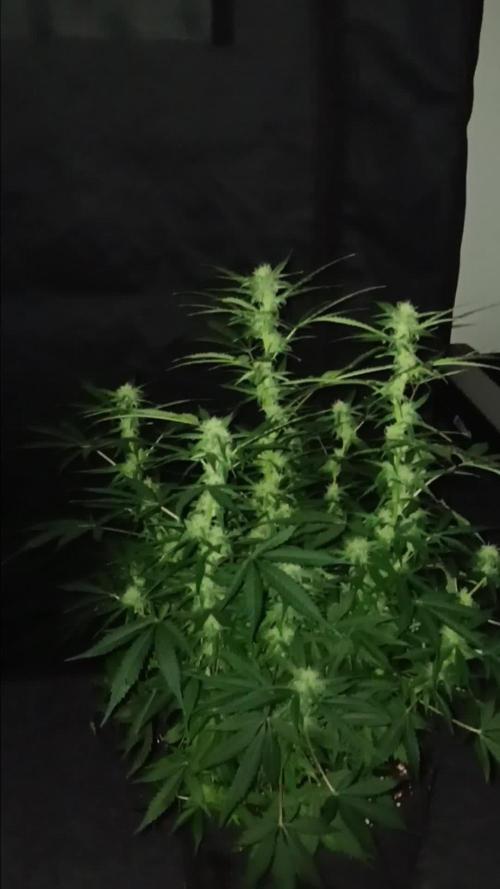
Came home from vacation to gorgeous ladies and their light fragrances. More to follow soon.
Likes
9
Share
Se realiza transplante a maceta definitiva de 20 LT AIRPOT Sigue el riego día por medio
Likes
47
Share
@GrowGuy97
Follow
Day 29 - All the ladies are now in flower & starting to stretch like crazy! The Rock Machine has a very nice natural canopy, can’t wait to see how these buds turn out! They are seem to be very healthy which has me wondering if I should even bother with any nutrients?? Any opinions please let me know! Thanks for following & happy growing friends!✌️🏼🌱🙏🏼
Likes
20
Share
Well,all i hve to Say is she Still growing well.😏😊😊 Well but there are some lil brown marks on a few leaves so i must hve overfeed her a bit,i'll do my research. ✌️✌️✌️
Likes
45
Share
2nd net is up. Early bud formations are promising. holding up to the extremes pretty well, some leaves taking minor damage, but overall, she is holding up, gave her 1 night at 50F see how she would react, stressful. Not advised as it messes with her metabolism, but I want to see if it triggers any anthocyanin response. Love to see her purp up but no signs yet. Remember, For every molecule of glucose produced during photosynthesis, a plant needs to split six molecules of water. This process provides the hydrogen needed for synthesizing glucose and other organic compounds, while oxygen is released as a byproduct. Homework. If Rubisco activity is impaired and it cannot properly function or regenerate its substrate, the plant's leaves are likely to turn a pale green or lime green, a condition known as chlorosis. Essentially, Rubisco activity is highly regulated and susceptible to various environmental and metabolic factors that can cause it to become inhibited, leading to an apparent failure in RuBP regeneration due to a lack of consumption. Rubisco regeneration is intrinsically linked to nitrogen supply because Rubisco is a major sink for nitrogen in plants, typically accounting for 15% to over 25% of total leaf nitrogen. The regeneration phase itself consumes nitrogen through the synthesis of the Rubisco enzyme and associated proteins (like Rubisco activase), and overall nitrogen status heavily influences the efficiency of RuBP regeneration. RuBisCO is a very large enzyme that constitutes a significant proportion (up to 50%) of leaf soluble protein and requires large investments in nitrogen. Insufficient nitrogen supply limits the plant's ability to produce adequate amounts of RuBisCO, thereby limiting the overall capacity for photosynthesis and carbon fixation. Maintaining the optimal, slightly alkaline pH is crucial for the proper function and regeneration of Rubisco. Deviations in either direction (too high or too low) disrupt the enzyme's structure, activation state, and interaction with its substrates, leading to decreased activity and impaired RuBP regeneration. (Lime/yellowing) Structural Component: Nitrogen is an essential building block for all proteins, and the sheer abundance of the Rubisco protein makes it the single largest storage of nitrogen in the leaf. Synthesis and Activity: Adequate nitrogen supply is crucial for the synthesis and maintenance of sufficient Rubisco enzyme and Rubisco activase (Rca), the regulatory protein responsible for maintaining Rubisco's active state. Nitrogen deficiency leads to a decrease in the content and activity of both Rubisco and Rca, which in turn limits the maximum carboxylation rate, Vmax, and the rate of RuBP regeneration Jmax, thus reducing overall photosynthetic capacity. Nitrogen Storage and Remobilization: Rubisco can act as a temporary nitrogen storage protein, which is degraded to remobilize nitrogen to other growing parts of the plant, especially under conditions of nitrogen deficiency or senescence. Nitrogen Use Efficiency (NUE): The allocation of nitrogen to Rubisco is a key determinant of a plant's photosynthetic nitrogen use efficiency (PNUE). In high-nitrogen conditions, plants may accumulate a surplus of Rubisco, which may not be fully activated, leading to a lower PNUE. Optimizing the amount and activity of Rubisco relative to nitrogen availability is a target for improving crop NUE. Photorespiration and Nitrogen Metabolism: Nitrogen metabolism is also linked to the photorespiration pathway (which competes with carboxylation at the Rubisco active site), particularly in the reassimilation of ammonia released during the process. To increase RuBisCO regeneration, which refers to the process of forming the CO2 acceptor molecule Ribulose-1,5-bisphosphate (RuBP) during photosynthesis, the primary methods involve optimizing the levels and activity of Rubisco activase (Rca) and enhancing the performance of other Calvin-Benson-Bassham (CBB) cycle enzymes. Biochemical and Environmental Approaches: Optimize Rubisco Activase (Rca) activity: Rca is a crucial chaperone protein that removes inhibitory sugar phosphates, such as CA1P (2-carboxy-D-arabinitol 1-phosphate), from the Rubisco active site, thus maintaining its catalytic competence. •Ensure optimal light conditions: Rca is light-activated via the chloroplast's redox status. Adequate light intensity ensures Rca can effectively maintain Rubisco in its active, carbamylated state. •Maintain optimal temperature: Rca is highly temperature-sensitive and can become unstable at moderately high temperatures (e.g., above 35°C/95F° in many C3 plants), which decreases its ability to activate Rubisco. Maintaining temperatures within the optimal range for a specific plant species is important. •Optimize Mg2+ concentration: Mg2+ is a key cofactor for both Rubisco carbamylation and Rca activity. In the light, Mg2+ concentration in the chloroplast stroma increases, promoting activation. •Manage ATP/ADP ratio: Rca activity depends on ATP hydrolysis and is inhibited by ADP. Conditions that maintain a high ATP/ADP ratio in the chloroplast stroma favor Rca activity. Enhance Calvin-Benson-Bassham (CBB) cycle enzyme activity: The overall rate of RuBP regeneration can be limited by other enzymes in the cycle. •Increase SBPase activity: Sedoheptulose-1,7-bisphosphatase (SBPase) is a key regulatory enzyme in the regeneration pathway, and increasing its activity can enhance RuBP regeneration and overall photosynthesis. •Optimize other enzymes: Overexpression of other CBB cycle enzymes such as fructose-1,6-bisphosphate aldolase (FBA) and triose phosphate isomerase (TPI) can also help to balance the metabolic flux and improve RuBP regeneration capacity. Magnesium ions, Mg2+, are specifically required for Rubisco activation because the cation plays a critical structural and chemical role in forming the active site: A specific lysine residue in the active site must be carbamylated by a CO2 molecule to activate the enzyme. The resulting negatively charged carbamyl group then facilitates the binding of the positively charged Mg2+ion. While other divalent metal ions like Mn2+ can bind to Rubisco, they alter the enzyme's substrate specificity and lead to dramatically lower activity or a higher rate of the non-productive oxygenation reaction compared to Mg2+, making them biologically unfavorable in the context of efficient carbon fixation. The concentration of Mg2+ in the chloroplast stroma naturally increases in the light due to ion potential balancing during ATP synthesis, providing a physiological mechanism to ensure the enzyme is activated when photosynthesis is possible. At the center of the porphyrin ring, nestled within its nitrogen atoms, is a Magnesium ion (Mg2+). This magnesium ion is crucial for the function of chlorophyll, and without it, the pigment cannot effectively capture and transfer light energy. Mg acts as a cofactor: Mg2+ binds to Rubisco after an activator CO2 molecule, forming a catalytically competent complex (Enzyme-CO2-Mg2+). High light + CO2) increases demand: Under high light (60 DLI is a very high intensity, potentially saturating) and high CO2, the plant's capacity for photosynthesis is high, and thus the demand for activated Rubisco and the necessary Mg2+ cofactor increases. Mg deficiency becomes limiting: If Mg2+ is deficient under these conditions, the higher levels of Rubisco and Rubisco activase produced cannot be fully activated, leading to lower photosynthetic rates and potential photo-oxidative damage. Optimal range: Studies show that adequate Mg2+ application can enhance Rubisco activation and stabilize net photosynthetic rates under stress conditions, but the required concentration is specific to the experimental setup. Monitoring is key: The most effective approach in a controlled environment is to monitor the plant's physiological responses e.g., leaf Mg2+ concentration, photosynthetic rate, Rubisco activation state, and adjust the nutrient solution/fertilizer to maintain adequate levels, rather than supplementing a fixed "extra" amount. In practice, this means ensuring that Mg2+ is not a limiting factor in the plant's standard nutrient solution when pushing the limits with high light and CO2. Applying Mg2+ through foliar spray is beneficial to Rubisco regeneration, particularly in alleviating the negative effects of magnesium (Mg) deficiency and high-temperature stress (HTS). While Mg can be leached from soil, within the plant it is considered a mobile nutrient, particularly in the phloem. Foliar-applied Mg is quickly absorbed by the leaves and can be translocate to other plant parts, including new growth and sink organs. Foliar application of: NATURES VERY OWN MgSO4 @ 15.0g L-1 in a spray bottle. For those high-intensity workouts when 1 meal a day is just not enough! Foliar sprays are often recommended as a rapid rescue measure for existing deficiencies or as a supplement during critical growth stages, when demand for Mg is high. Application in the early morning or late evening can improve absorption and prevent leaf burn. The plant was getting a little limey yellow in the centre. Shortly thereafter, she was back in business, green mostly regenerated. The starting point [of creativity] is curiosity: pondering why the default exists in the first place. We’re driven to question defaults when we experience vuja de, the opposite of déjà vu. Déjà vu occurs when we encounter something new, but it feels as if we’ve seen it before. Vuja de is the reverse—we face something familiar, but we see it with a fresh perspective that enables us to gain new insights into old problems. Confidence is evidence... nothing more. You are confident because you have driven 10,000 times, you are confident because you have spoken 10,000 times. People think confidence is a feeling, but it's not. If you want more confidence, then you need to create evidence, take more shots, collect more data, build more experiences, take more risks; fail, confidence doesn't come first; it is the reward you get for doing the work. no one else wants to do.
Likes
134
Share
@Roberts
Follow
Number 10 has been flowering strong. Has about a week left for feeding then to a 2 week flush. I gotta work with what the plant tells me. Thanks again fast buds Thank you grow diaries community for the likes, follows, and subscriptions on my YouTube channel. 🌱🤜🤛 Happy growing
Likes
7
Share
Flushing week, i have overwatteres her and let her drain to wash off the roots, fruit and mature week it seems like in another week she well be done ☺️
Likes
19
Share
@BB_UK
Follow
These 2 are doing amazingly! The synthetic one is close behind as she’s 3 days younger! But the Zamnesia nutrient one is showing so Much vigor! These are going to veg for a while until my others are done and then I’ll switch over into the flower tent when my others are done!
Likes
1
Share
@Dabcik
Follow
I fiori diventano sempre più compatti e incominciano a sentirsi sempre di più i profumi delle cime Sono riuscito a stabilizzare la temperatura a 24.5 gradi con la lampada al 100% di intensità luminosa a 45cm dalle cime Questa settimana per pulire un po’ il substrato ho dato 2 irrigate a ph 6.4 e circa 100ppm
Likes
6
Share
Likes
148
Share
@BioBuds
Follow
She seems to thrive in the new soil, I'm checking her regularly because of the darker ridged leaves, could I have overdone the bloodmeal content? It should not have overfeeding effects with organic super soil. But we'll see. The FIM seems to have taken hold with her and today I started training, although it is more main-lining. For this, I just used some microwaved bamboo from the garden. Now we go towards flowering and I'm getting more excited after the first few weeks were a bit sad. Some of you might have seen my super soil recipe in my other grow, the Orange Hill Special, if you didn't, check it out here in the images! I designed it out of frustration that products like Fox Farms etc are not readily available in Europe. Those who saw my Gelato Monstercop grow, know that soil was pretty good, that soil became the base for this recipe, amended with some organic precursors to make it less dependent on feeding and after amending. I would recommend amending some before flowering starts without the bloodmeal. Hope you can use it!! Thank you very much for checking me out again this week! Hapy growing and big hug BioBuds and Sunshine
Likes
62
Share
So this is how things are looking for the ladies at the end of Week 4 of Flower, not much to update, I have uploaded a video for you guys with all the information you need. Any questions just ask away guys 👍🏾🌱💚
Likes
79
Share
Salutations, fellow cultivators! It's time for our Week 3 Veg Report, and let me tell you, the Epsilon F1 is turning into a botanical masterpiece. This week has been all about finesse and guidance as we've introduced some gentle training techniques to keep this green goddess on the path to greatness. First things first, let's talk about the art of bending and guiding. Picture this: a ballet of leaves and stems, a choreography where we gently encourage our Epsilon F1 to embrace the contours of the pot. I've been bending and guiding her with the precision of a dance instructor, keeping her close to the soil as if whispering, "Roots, meet Earth." Why, you ask? Well, my friends, it's all about maximizing exposure to light and ensuring an even canopy. By keeping her low and wide, we're promoting more bud sites and creating a lush, green carpet of potential harvest. It's like sculpting a masterpiece with each bend and twist. Now, let's talk about the environment. Room temperatures and humidity remain the same as last week – a cozy haven for our growing beauty. Consistency is key, and our Epsilon F1 is thriving in this stable atmosphere. Happy plant, happy grower! As for the feast, we're sticking to the nutrient regimen that has brought us this far. The Aptus Holland super soil mix continues to work its magic. Micromix Soil, Substrate Buffer Powder, All-in-One Pellet – it's like a gourmet meal for plants, and our Epsilon F1 is dining like royalty. And let's not forget the star players – Mycor Mix, the microbial maestro, ensuring our plant has the best support crew in the root zone. These endomycorrhizae are like the backbone of our operation, fostering a symbiotic relationship that's pure botanical harmony. Our Epsilon F1 is not just growing; she's thriving, loving every minute of the training sessions and nutrient banquets. Shout-outs to Royal Queen Seeds for providing the genetic canvas for this masterpiece, and major props to Aptus Holland for crafting nutrients that turn our grow space into a botanical symphony. Stay tuned, dear readers, as we continue this journey of horticultural excellence. The Epsilon F1 is on track to be a green goddess of epic proportions. Happy growing, and may your gardens be evergreen! As always thank you all for stopping by and for supporting me on this journey, i am super passion about growing and fell blessed to have you all with me on this new journey
Likes
117
Share
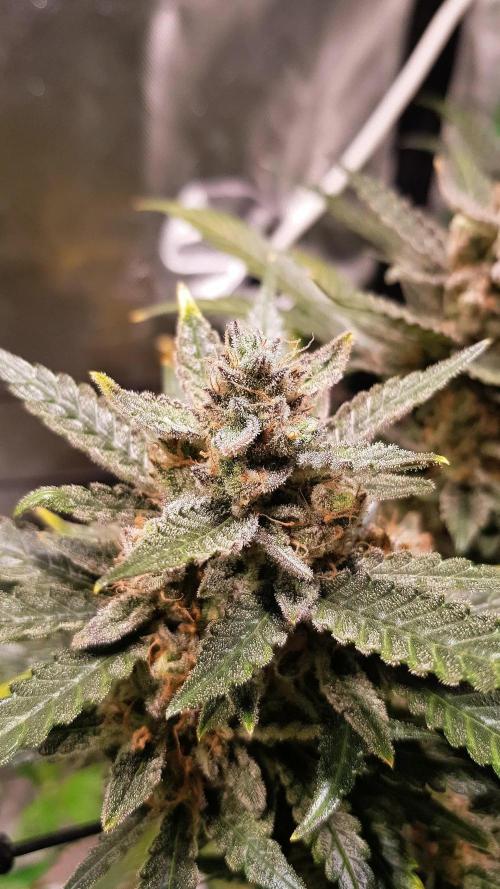
Hello everyone. sisters and brothers gardeners! You missed me? here I am for you in a new explosion of colors in my contents .... I hope you like them holy god .... how much glue I see on those fantastic shoots feel free to leave any comments or questions. the best harvests at all
Likes
10
Share
Day 43 of flower - I start counting when I see pistils so for some people it would be day 50 of flower, maturing really fast they are just about done! This will be my last update until they are dried, trimmed, and out in the scale! Thank you all for following along! Last week I did still give them their fish shit and silica watering because I wasn’t expecting the trucks to turn so suddenly ! We also had some beautiful colorful fade and got some nice dark purple from the 2 permafrost ! Well that’s about it and I’ll be back in a couple weeks for the final post and conclusion of the grow!
Likes
59
Share
@Jsammy09
Follow
9/9 (Day 84)- Things are wrapping up I believe! Have continued to mainly just monitor and keeping the res topped with just the full tilt. Monday we be going RO water ph to 5.8 until finish. The leaves are starting to change to a yellow and the front and dive have been packing on! Looking forward to the finish and have ordered a rosin press so excited for it all and ready and looking forward to improving and learning from my mistakes this run. 9/11 (Day 86)- Did my final flush this morning and now just running RO water to flush. Just hoping I am not flushing too early. Everything is looking good. Dry tent is set up and ready to roll. I am able to get my area down to around 64. I am actually moving my set up after these girls finish to the room with my dry tent and have a better work area! I’m excited for the next run already! As always any tips or recommendations always appreciated!
Likes
7
Share
@Zaphod420
Follow
Been Flushing since day 60 and she has finally reached the end. REALLY like how she turned out and I think am about to but something really special in a jar!
Likes
25
Share
Thorium (chemical symbol Th) is a naturally occurring radioactive metal found at trace levels in soil, rocks, water, plants and animals. Thorium is solid under normal conditions. There are natural and man-made forms of thorium, all of which are radioactive. In general, naturally occurring thorium exists as Th-232, Th-230 or Th-228. The atomic number of 90 - Thorium 1. Dobereiner’s Triads German chemist Johann Wolfgang Dobereiner attempted to classify elements with similar properties into groups of three elements each. These groups were called ‘triads’. Dobereiner suggested that in these triads, the atomic mass of the element in the middle would be more or less equal to the mean of the atomic masses of the other two elements in the triad. An example of such a triad would be one containing lithium, sodium, and potassium. The atomic mass of lithium 6.94 and that of potassium is 39.10. The element in the middle of this triad, sodium, has an atomic mass of 22.99 which is more or less equal to the mean of the atomic masses of lithium and potassium (which is 23.02). 9 controls the 6 and 3. The Limitations of Dobereiner’s Triads are : All the elements known at that time couldn’t be classified into triads. Only four triads were mentioned – (Li,Na,K ), (Ca,Sr,Ba) , (Cl,Br,I) , (S,Se,Te). 2. Newland’s Octaves English scientist John Newlands arranged the 56 known elements in increasing order of atomic mass in the year 1866. He observed a trend wherein every eighth element exhibited properties similar to the first. This similarity in the properties of every eighth element can be illustrated as follows. Classification of Elements and Periodicity in Properties Newland’s Law of Octaves states that when the elements are arranged in increasing order of atomic mass, the periodicity in properties of two elements which have an interval of seven elements in between them would be similar. Azomite has an average of 180ppms of THORIUM...........I'm fucking mindblown Alot if big things happening this weeeeek plants final form starts to take shape, light defoliation on lower parts of the plants I know make the cut later in life. Going to restrict defoliation to week 2-3. Going more cautious this time round as my excessive defo last grow was tooooooo much and effected yield greatly. Added steel weights 💪. Big buds require a solid frame, I'm still trying to find balance for this part, I'd like to have had the reinforcement done earlier. Ever learning. Can already tell by early flower formations these are going to be madness : AZOMITE: Most farmers have not had a proper understanding of what is azomite and how to use it in gardening, especially if you practice organic farming. Continuous propagation and leaching effects of water deplete the essential minerals and micro-nutrients from the soils. Such soils remain weak, not able to support the production of fruits and vegetables. Azomite mineral contains micronutrients that supplement the soil. It also balances the minerals for growth and overall productivity. Constant use of this mineral rejuvenates your soil renewing its potency again. Azomite is a naturally mined mineral product that is ready to use. It’s a unique rock that comes from a mine in central Utah. Azomite requires no mixing or special preparation before use. It is derived from volcano ash that spewed out millions of years ago. It contains the widest range of minerals of all the rock dust in the world. Azomite provides the plants with 70% essential elements. These elements include magnesium, calcium, potassium, and silicon for plant growth. Facts About Azomite Fertilizer It’s a natural mineral – 100% natural with no fillers or additives Does not contain any harmful elements Requires no special preparation before use It’s odorless – very friendly to use Does not restrict water penetration or aeration Is easily broken down and absorbed into the soil Does not burn plants GREENSAND Espoma Greensand, love Greensand. If you have never used the product (or never heard of it) Greensand is a mineral called glauconite, which is found on the ocean floor and mined for use as an organic fertilizer and soil conditioner. Greensand supplies marine potash, silica, iron oxide, magnesia, lime, phosphoric acid, and 22 trace minerals. Greensand works great on Southern “hard as a rock” clay soil this spring, to help improve its texture, and enrich the nutrient content of my soil without using chemicals. Greensand is one of the oldest and most generally useful tools in the organic gardening tool box. Greensand has been used since the eighteenth century as a soil amendment and slow-releasing fertilizer (0-0-3). It is one of the best certified organic sources of potassium. It comes from sandy rock or sediment containing a high percentage of the mineral glauconite (greenish-black to blue-green). It contains potash, magnesium, iron, silica and can contain as many as 30 other trace minerals. The recommended usage is to broadcast 50 to 100 lbs. per 1,000 square feet. It improves plant health in general and is also be used to loosen heavy, clay soils. It will also improve the moisture retention of sandy soils. Greensand is OMRI listed for organic use. Sea Kelp – Ascophyllum Nodosum Sea kelp, also known as brown algae, is the generic name for the seaweeds that make the order Laminariales. Kelp grows in huge underwater forests in shallow parts of the ocean, with some forests covering over 2230 square miles! Kelp thrives in cold and turbulent ocean water with strong currents that bring enough nutrients for the algae to grow. The coasts of Norway, Japan, Mexico, and California are some of the most abundant in terms of natural kelp density. Sea Kelp BenefitsSea kelp is rich in a wide range of nutrients, minerals, and active compounds. Some of them have great nutritional value, others show antioxidative and anti-inflammatory properties, help with diabetes, and may even fight off some types of cancer. In other words, sea kelp is jam-packed with health benefits. Let’s explore some of them in more detail one by one! Macronutrients in sea kelp Energy – 43 kcal Protein – 1.68 g Total fat – 0.56 g Carbohydrate – 9.57 g Fiber – 1.3 g Sugars – 0.6 g Minerals in sea kelp Calcium – 168 mg Iron – 2.85 mg Magnesium – 121 mg Phosphorus – 42 mg Potassium – 89 mg Sodium – 233 mg Zinc – 1.23 mg Copper – 0.13 mg Manganese – 0.2 mg Selenium – 0.7 mcg Vitamins in sea kelp Vitamin C – 3 mg Vitamin B1 – 0.05 mg Vitamin B2 – 0.15 mg Vitamin B3 – 0.47 mg Vitamin B5 – 0.642 mg Vitamin B6 – 0.002 mg Vitamin B9 – 180 mcg Vitamin A – 6 mcg (116 IU) Vitamin E – 0.87 mg Vitamin K – 66 mcg