


Likes
Comments
Share


@JohnnyBarrel
Follow
Week 15 - flo 6 weeks
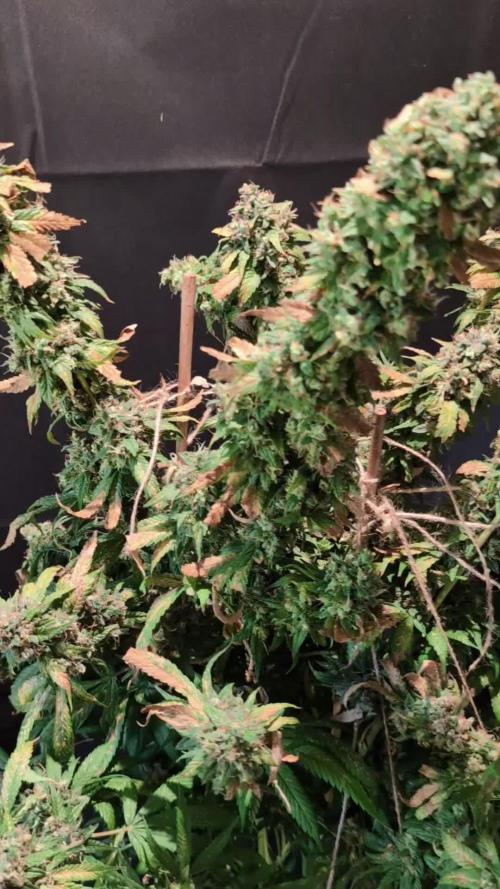
Satisfying period: maturation time. No really problems, just a doubt about the final result in terms of quantity and buds size. Even if’s not a goal to produce big colas : I would have a bigger result with a little bit more work on the plants., like LST. The TS 1000 (150W) led was too low (for the room size) during the end of vegetative and preflowering period now it’s a 250W led).
Every plants are healthy , still green (just few classical yellow leaves on base), producing lot of pistils and resin. The indigo Berry Kush is really appetizing: Frosty and meaty. Criminal+ and Special Queen shows lot of dense little flowers everywhere and some correct main buds. The NYC turn orange and flowers become thicker.
Each plant develops a pronounced and singular aroma. I will have a choice of different flavors and tastes.
Watering around 1,5L every 3 days.
- rain water + cal/mag + bud XL + diamond sugar
- rain water + cal/mag + overdrive (NPK-1/5/4) + diamond sugar
Ventilation + carbon filter Ok for smell
Now it’s question of patience. I will start to flush next week.


Likes
28
Share


@Endzo
Follow
Girls well into pre-flower. Saw some nute burn from last feeding so backed off and just watered with ph balanced water and small dose of calmag. Small defoil of the bottom fans and small off chutes.
Likes
9
Share


@Josh9260
Follow
Had the seed capsule stick to the seedling, making it bend but it fixed itself and had no issues afterwards.

Likes
13
Share


@4F1M6
Follow
I started germination of 3 Sweet Zkittlez beans on 29/12/2020 (now sweet zenzation). I pre moistened my rockwool cubes with ph balanced water to 6.4. Made sure the plugs were just damp and not soaked. Using a small wooden dowel I increased the size of the plugs pre made holes. Than I sowed my beans into the holes. Ripped off a small piece of rockwool and mulched it up. Lightly filled the holes in with the mulched rockwool. Than stuck the plugs into a misted humidity dome, to complete germination.
Shouldn't take anymore than 4-5 days to see some sprouts. Once I see some cotlydon leaves bursting to the surface. I will get the plugs planted into some 1 gallon pots. Plus get these ladies situated into their home. Cant wait!
Some background information on my experience with Sweet Zkittlez. I've only grown this one out once. Did her up in a 1 gallon SOG grow. It had a very impressive main cola. With quality bud structre and trichome production. The plant had a very luring sexy odor. I was very satisfied with the results.
The variety got extra hungry for both p and k mid flower. A little bit needier but definitely worth the extra attention. Very excited to see the results in a full size plant. Giving thus a variety a chance to show me full swing.
Likes
20
Share


@TenerifeCultiva
Follow
Peleando un poco con la temperatura y humedad pero de resto perfecto, hemos hecho una defoliacion bastante sutil.

Likes
18
Share


@MrJones
Follow
Mandarin XL Auto
🔸🔸🔸04/29/23🔸🔸🔸
Day 38 - Above Ground - Target 65 Days
📝Saturday 06.10.23 - As this week comes to an end, I am seeing signs that the plants need a bit of calcium, so today was a topdressing day with a 70/30 blend of Bloom to Grow, watered in with H20 PG to 6.2 with CalMag at 5ML per Gallon of H20.
📝Thursday 06.08.23 - This week is going well, and the ladies are stretching out nicely and loving the Flower Setting that increases the far reds in the LEDs
🔸🔸🔸🔸🔸🔸🔸🔸🔸🔸
◾Mandarin XL Auto
◾Grown By: MrJones
◾Light Source - Medic Grow Smart 8 LED
◾Light Settings - @40% and V1 (Veg-1)
◾Soil - ProMix HP
◾INSTAGRAM - @medicgrow420 - @ganjafarmerseed - @gaiagreenorganics
🔸🔸🔸🔸🔸🔸🔸🔸🔸🔸
📝 Seed Details - Ganja Farmer Cream Mandarine XL Auto is a 4th generation auto-flowering strain. A tall and very productive plant created by combining Cream Mandarine Auto and Super Tai '98. It offers delicate, spicy notes of Super Tai wood and nuts and a sweet, citrus aroma of Cream Mandarine. Produces buds and resin abundantly.
🔸🔸🔸🔸🔸🔸🔸🔸🔸🔸

Likes
3
Share


@Joaka
Follow
se ve un incremento en tricomas, ya el olor esta muy penetrante. ademas algunos brazos se doblaron lo que provoco que las amarrara para poder sostenerlas. en la proxima semana se sacara todo nutriente que contenga nitrogeno, dando ya el engorde final.
Likes
16
Share


@Mopish
Follow
17 Jan - 23 Jan
19 Jan
Kush del Arriero: Looking good in color and size, planning to flush next week, hope those possible nanners don't develop enough, not removing due to harvest time being so close and this one being the one that will probably give me the best yield. Some buds and leaves getting purple colors.
Choco Cookie: Still very small, hope they grow a little more before harvest. Some buds and leaves getting purple colors.
Banana Cake: Small buds, decent trichomes.
I hope that KDA won't cause much trouble to the other two plants, I hope I'm wrong about the nanners... Keeping my plans, finish with nutrients this Sunday and flushing for 7-14 days after that.
I'll add a few more pics later today.
Sat 22
Yesterday a friend with more experience in these things took a look at my plants, he seemed impressed by what I've accomplished on my first grow so far. He also confirmed that the weird things on the KDA buds aren't nanners... phew !
He also confirmed my plans for flushing tomorrow are good.
Likes
1
Share


@negyhusztv
Follow
She started the flowering weeks. We removed few leaves from the plant lower part.

Likes
22
Share


@Grass_castle2020
Follow
Day 22 girls got watered today with double nutrition and are doing great
Day 23 we had a few without yellow tips so we thought they could use a flush but some to realize it’s probably low on something so normal water tomorrow
Day 24 today we found out we were not putting enough cal mag the instructions said 2ml for one liter not gal. So today we hooked them up and started some LST
Day 25 we started LST on all the girls
Day 27 still working on LST I over watered the girl yesterday so today the got a day off
Day 28 girls got watered today bottom was a little dry everyone is handling LST well so happy to see all the bud sights

Likes
21
Share


@KentuckyOG60
Follow
Growing nice and easy. No issues just doing a little lst and letting it grow

Likes
60
Share


@BOMbolenath
Follow
First week of flowering. The plant will stretch, so i adjusted the LED dimmer to 100%. Did a good defoliation too. Doing good, very healthy.
Processing
Likes
1
Share


@Dunk_Junk
Follow
Not much vertical height change this week, 15cm. Flowering stretch slowing down. That's bad news for me after her first 3 weeks being very slow growing. I missed the window for good veg growth by (I think...) low temps in the tent. As a very small plant cold roots stunts growth. Being an auto you cannot extend the veg period so I'm stuck with her being a very small plant.
Nutrients as above added to 10L water along with 5g of 20-20-20 powdered fertiliser.
Still... if we're always learning nothing is lost. Just data in the memory bank.
Likes
62
Share


@OwlGang_Uk
Follow
Week 7 - Oh Mehn There’s So Much To Say About These Girls, I’ll Start With The Purple Power, It Is Ready To Be Harvest Anyday Now But I’m Looking To Push It To Week 8, It Has A Strong Aroma Of Sweet Berries. The Stardawg And Girls Scout Cookies (3gal) Are Putting On Some Dense Nuggets I Like How They’re All Looking Identical That’s A Good Sign. The Stardawg Has A Lemon But Earthy Scent And The 3gal Girls Scout Cookies Smells Like A Citrus Lemon With A Hint Of Pine, The Buds Are So Hard And Sticky Mehn I Cant’t Wait To Taste These Girls. The Other Don’t Have A Scent And The Gorilla Glue Having Start To Flower Yet Probably Gonna Steal The Show In The End! And I Would Like For MSNL To Acknowledge I Grew There Auto Lemon OG Up To A 100cm
Be Sure To Like My Grow Diary.
Height Chart:
Girls Scout Cookies: 30 1/2 (3gal)
Purple Power: 29 1/2 inches
Stardawg: 34 1/2
Girls Scout Cookies: 37 1/4 inches
Gorilla Glue: 24 inches
Lemon OG: 39 1/4 Inches


Likes
7
Share


@tutankhamun
Follow
пока што могу сказать 2 дния назат родьилис етьии чудесние девачки💚🌱🌱🌱🌱💚

Likes
23
Share

@GoodTimesOrganics
Follow
Hi liebe Community and Welcome Back! 💚
Woche 15 (Tag 115) im Vergleichsgrow!
Bio Tabs NL. vs. Weedefix (Stuttgart/ Germany)
Blütetag: 63 (BW9)
Heute war Erntetag! Und die Ergebnisse sind trotz Phosphor überschuss super zufrieden stellend!
Wir haben eine super gewachsene Pflanze mit ordentlich Loadup und einem Aroma, welches auch sehr für sich spricht.
Nun zum eigentlichen Vergleich: Ich muss sagen, ich messe weder Drain noch PH da ich rein Ökologisch mit Bio Tabs bei dieser Pflanze gearbeitet habe.
Und dennoch war es wohl zuviel des guten. Nach der Zugabe des Komposttee und des zwei Wochen zuvor angewandten PK Boosters ist der Bodenhaushalt etwas gekippt.
Daher auch die verwelkenden (verbrannten) Blätter.
Ich denke dass nicht beide Komponenten in der Blüte angewendet werden sollten.
Weniger ist wohl doch insgesamt mehr.
Ich habe die Pflanzen die letzten 48 Stunden im dunklen stehen lassen um nochmal einen kleinen Stressboost hinein zu bringen.
Die Bedingungen im Growzelt waren bis zuletztin Top!
—————
🌞 Temp: 26
🌚 Temp: 18°C bis 19°C
💨 RH: 54%
VPD: 1,71 kPa
💡ppfd: 830 mpm
—————

Processing
Likes
10
Share


@RivenWaters
Follow
Hot and humid week, training canopies, hope to see buds soon!


Likes
34
Share


@BelSun_420
Follow
I would like to express my gratitude to Plagron and Zamnesia for organizing this incredible contest, providing the community with the opportunity to participate, showcase their skills, and learn from one another for free.
Initiatives like this strengthen the spirit of the community and highlight the talent of so many unknow dedicated growers.
I am BelSun, a 34-year-old guy who started planting in 2018, mainly focusing on autoflowers,indoor setups and organic grow .
Hope you enjoy my Journey on Eternity Grow Cup 2025 🏆💚
The main setup and a simple recipe on this journey as a thank you to Plagron and Zamnesia 👨🏻🌾
Runtz Automatic Zamnesia (3 seeds)
Fabric Pot 3x15L
RoyalRoom Classic C100
Electric Sky 180w v2
Plagron - Seeding & Cutting Soil
Plagron - BatMix Soil
Plagron - Perlite
Plagron - MegaWorm
Lurpe - Earth Vibes Super Soil
Lurpe - Volcanic Ash
Cultivers - Basalt Powder
THC - Epson Salt
THC - Delomite
Vithal - Bokashi
Mycoterra - Alfalfa Meal
Canna-BioRHIZOTONIC
Agrobactérias - Bactomatik Rex
Plagron - Alga Bloom
Plagron - GreenSensation
*Plagron Schedule 100% Natural
*Topdress amendments along the way if needed.
*Light Schedule: 20h
*Watering System: Manualy
*Paper Towel MethodI
I'm going to start in the middle of January, for now I still have some plants finishing flowering in the tent.
Good luck for all!
💚
-------------------------------------------------------------------
#10/01/2025
I’ve prepared my Super Soil mix, and it’s now cooking until I start germination, which will be in about 3 weeks.
-------------------------------------------------------------------
#03/02/2025
For germination, I leave the seeds in a bottle of water for 12 hours, then transfer them to a paper towel until they sprout a root. This method has worked well for me!
-------------------------------------------------------------------
04/02/2025
I’ve transferred the seeds to the paper towel method!
Now it's time to Pot preparation!
For my pots, I use a three-layer method, filling each layer while shaping them with different-sized pots:
- First layer: Super Soil
- Second layer: Regular fertilized soil (BatMix by Plagron in this case)
- Third layer: A light soil with mycorrhizae (Seeding Soil by Plagron)
-------------------------------------------------------------------
#05/02/2025
I’ve planted the seeds!
I'm using a cheap LED light from Amazon just to kickstart germination and gain a few extra days to finish flowering the plants in my tent. As soon as they sprout, I'll transfer them to the tent, where my old but fantastic Electric Sky 180W is waiting for them!
-------------------------------------------------------------------
#08/02/2025
Two of them have already germinated, but one still hasn’t. I’m struggling with low temperatures, as it's been only 12°C during the day and between 3°C and 7°C at night.
Unfortunately, I had a bit of bad luck—my lamp fell onto the pot, disturbing the soil and seeds of two plants. One of them is the one that hasn’t germinated yet.
Just in case, I’ve put two more seeds in the paper towel method as backups. If I don’t need them, I’ll give them to a friend!
🙂
-------------------------------------------------------------------
#10/02/2025
I placed them in the tent on the 10th. Two of them germinated on the 8th, while the other was affected by the lamp falling.
I’ll probably replace it with one of my backup seeds and offer #R03 to a friend, but it all depends on how things go in the next few days.
-------------------------------------------------------------------
#12/02/25
I replaced the seed that went into shock with one of my backups. So, from now on, #R03 will be the backup seed, and it will be about a week behind the others.
---------------------------------------------------------------------
#13/02/2025
The backup seed has sprouted! 🌱
---------------------------------------------------------------------
Likes
16
Share


@AestheticGenetics
Follow
4/9/25
This plant is beyond frosty. Stacking up super nicely. Seems like she will yeild quite a bit.
My only gripe is that she has like no smell at all.
Using the foil as a soil cover is working quite nicely. the top soil is getting filled with roots quite well.
Top dressed 1tsp of Bloom
1tsp microbe charge
1tsp bloom

Likes
73
Share


@Ferenc
Follow
Day 58, 7th of November 2020:
The 6th day since the lamp switched to be 12/12...
I raised up the nutrition intake as it can be seen above only the BioBizz family 2ml/l and removed some LST because the plant remains in shape or just set a bit but nothing significant....
....strech is on the way..... 😅
Big fan leaves and strechy plant she looks pretty tho ;)
Nothing really to report there is crazy 2-3 weeks from now ;)
;)
