


Likes
Comments
Share


@Hattiwatti
Follow
Holaa horses 🐴
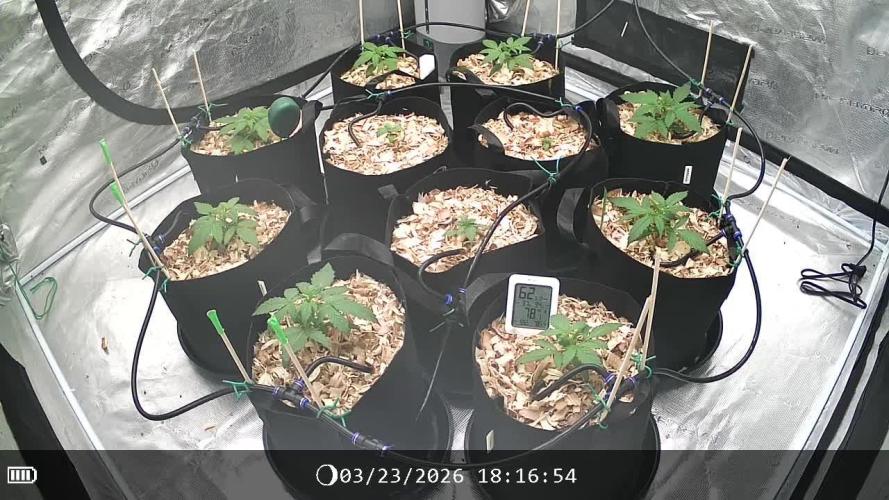
Nice stretch for last week. Auto Kabul just hit 47 DLI marker 🤝 drinking and eating pre flower nutrients. Last week i was thinking how to raise it and now i have to start think how to lower it 😅 Becoming Monster.
Andy's project suffering a bit. Going to move it away from boombox so auto kabul gets more space. It was nice first dripfeed test grow.
16.6 Looks pretty good at the moment.
watered 2L with 1.4ec. Andy moved away.
With High Hopes 🍀



Likes
29
Share


@TonyTrichomes
Follow
Not an overly impressive strain and I would say she was not that hard to grow. If I even grew this one again I would let it go naturally with some LST. Wanted more grape flavours but they don't really come through in the smoke. There's a bit of a sharp fruity smell that's sort of piney with a hint of fuel at the end. The smoke is not too flavourful in my opinion but that just means I didn't grow it well. Super tight nugs so be careful with humidity as stated above. Also she's a bit of a light feeder so be careful with your nutes. As you can see I burnt her tips and over fed her a lot. Not a bad yield though! I've only really smoked the lowers on this one so far so that gave me a bit of a racey high, just slightly racey. I would accredit that to the lowers not being mature enough at chop. The plant is super dense and since I mainlined it the lowers didn't receive enough light. I tried to let the lowers mature more but the plant stopped maturing when I chopped the tops, this caused stress and the plant just shut down basically. Not sure if I would grow Blimburn's GDP again until I grow the real GDP.

Likes
76
Share


@DogDoctorOfficial
Follow
🌸 Week 8 Flower – The Trichome Symphony Begins 🌸
Eternity Grow Cup
This week… it’s all about the frost. ❄️
We are diving deep into the universe of trichomes, those magical crystal-like structures that define potency, aroma, and visual beauty. Each pheno this week is presented with its own dedicated video — so everyone can witness the uniqueness and evolution of these genetics firsthand. The photos? Focused close and true on the trichomes and their stalks, the very essence of the plant’s protective and expressive language.
💎 What Are Trichomes?
Trichomes are tiny resin glands that cover the surface of cannabis flowers and sugar leaves. They’re responsible for producing and storing cannabinoids (like THC and CBD), terpenes, and flavonoids — the compounds that create the plant’s effects, scents, and flavors.
They act as the plant’s natural defense — from UV rays, pests, and environmental stress — and in return, they gift us with beauty, medicine, and art.
Why So Many Trichomes Here?
This room has turned into a crystal forest thanks to a harmonious mix of tech, care, and nature:
🔹 Spectrum Tunings:
Using the TrolMaster system, we’ve dialed in a spectrum rich in reds, far-reds, and UV at precise times to stimulate trichome production. The plants are responding in full.
🔹 Lighting:
The under-canopy power of the ICL 300s, combined with the canopy-level intensity of the Model 1s, is creating full-spectrum saturation from top to bottom. Buds are stacked, frosty, and glowing from every angle.
🔹 Nutrition Synergy:
The tag-team of Aptus Holland and Plagron has been flawless. The clean base, balanced micro and macro elements, and biostimulants have driven these girls into full expression mode. You can see the nutrition working in every crystal.
🌿 Where Are We Now?
We’re likely one week to ten days from harvest, but of course we’ll follow the plants’ signals. They’re still swelling and building — it’s the final stretch, and they’re sprinting.
Nerdy Note:
Trichomes can be bulbous, capitate-sessile, or capitate-stalked — and in this run, the capitate-stalked ones are standing tall and loaded. Expect a full cannabinoid and terpene profile when it’s time for analysis.( bro talk not lab hihihihi)
🌟 Let’s take a moment to recognize that we’re witnessing the peak of this cycle. This is living art, frozen in time by a camera lens but alive in scent and energy.
This Week’s Feeding Program
To support this explosive trichome production in Week 8 Flower, we’re feeding with precision and purpose. Every drop counts now, and here’s the clean, efficient mix we’re running:
• Aptus Holland – Regulator: 0.15 ml/L
• Aptus Holland – System Clean: 0.25 ml/L
• Aptus Holland – RO Water Condition: 0.8 ml/L
• Aptus Holland – All-In-One Liquid: 1.25 ml/L
• Plagron – Green Sensation: 1 ml/L
• pH set at 6.2
💧 We’re keeping it clean, clear, and consistent. No extra PK boosters or unnecessary additives. Just smart nutrition, tuned spectrum, and stable conditions to let the plants express themselves naturally. The synergy between Aptus Holland’s Clean Program and Plagron’s Green Sensation is clearly showing in every frosty bud.
This week, we’ve fine-tuned the spectrum to push the plants into full resin-production mode. I’ve reduced the white light intensity to 40% while keeping the reds and UVs running at 100%. This shift focuses energy on the wavelengths that directly stimulate secondary metabolite production—especially trichomes. Red light enhances flower development and density, while UV exposure encourages plants to produce protective compounds, like cannabinoids and terpenes, as a natural defense. This balance between lower photosynthetic pressure and high-spectrum stimulation is helping the girls finish strong, frosty, and full of character.
🙏 Massive thanks to all sponsors, followers, friends, and growers in the community. To the ones competing, to the ones just watching — THANK YOU. This is almost the end of the road, and every diary, every plant, every effort deserves respect.
💬 Don’t forget to follow the full 4K experience on YouTube, and for behind-the-scenes action and updates, join us on Instagram.
With Grower’s Love,
DD 🌱
Genetics - Runtz https://www.zamnesia.com/6000-zamnesia-seeds-runtz-feminized.html
Nutrients - Plagron https://plagron.com/en/hobby
- Aptus Holland https://aptus-holland.com/
Controls - Trol Master https://www.trolmaster.eu/
LED - https://www.futureofgrow.com/en
LED - https://www.thinkgrowled.com
Soil - https://www.promixgardening.com/en
Germination - Cannakan https://cannakan.com/?srsltid=AfmBOopXr-inLXajXu3QFgKXCXXos4F1oEvScjMKIB5MR5dk8-GJ-F49
DOGDOCTOR 15% off
Smoking Papers - https://ziggioriginal.com/
Terpene saver - https://grovebags.com/
As always thank you all for stopping by, for the love and for it all , this journey of mine wold just not be the same without you guys, the love and support is very much appreciloved and i fell honored with you all in my life
With true love comes happiness Always believe in your self and always do things expecting nothing and with an open heart , be a giver and the universe will give back to you in ways you could not even imagine so
As always, this is shared for educational purposes, aiming to spread understanding and appreciation for this plant. The journey with nature is one of discovery, creativity, and respect. Let’s celebrate it responsibly and continue to learn and grow together!
Growers Love To you All 💚
#EternityGrowCup #RuntzHunt #GrowersLove #CannabisCommunity #AptusHolland #ProMixSoil #TrolMaster #Zamnesia #Plagron #ZiggiPapers #Grovebags


Likes
111
Share


@DreamIT
Follow
There is little to say yet. I recommend everyone to try this technique at least once. Maximize your harvest and increase your personal experience. If you want more serious proof of how mainlining works, take a look at the diaries of @Canamatoes, my teacher and mentor. More updates later, stay high🤘😁🦄
Likes
11
Share


@TechDCo
Follow
12/02/2024
13/02/2024
MS is growing funny 😁
TF has exactly the same feed mls.
Shes looked forever hungry
14/02/2024
Lite Defoll.
Midday.
TF has never looked the healthiest with the first time using HydroSol + H202 water soluble feed.
I think i have the ratio/some sroted to where I've seen improvements.
First improvements i have seen are:
1. NO Nutritional burn or Lockout!
(non-salt based). P.s ignore the over salas 12% HP at the start (no idea what i was thinking).
Sometimes being ahead; means i am a being with a head that makes human errors. Oh, the joys of plant-discovery. Sorry side tracked lol
2. Quicker Absorbing witb water soluble food. As long as she's hydrated she's eating!
3. No idea yet
Have a ball!!
Listening to this relaxing and i started thibking about Spirituality and how its included in all faiths. But if say "Jesus Christ is a façade and all religions are based on astrological events painted with fictional characters to repent the Christological doctrine to "date" the past.
21 Ways Archaeologists Date Ancient Artifacts are mostly flawed because they only have the "present" to date decay from. They miss the mark and the professionals deliberately push the religious artifacts to match up to the hollyword.
So who's to say what "Date & Time" we are currently living in!
In reality; we can only measure and date time from the the last natural apocalypses or near misses, dor we are the surviours from such events..
Look round at real history! What mordern day academics just brushed under the rug with some made up theories of what they like us to believe happened. Even they are in a Dilemmas (government's) have the knowledge of these such events.
SpaceX and Nasa are all doomsday preppers! As for India going to the moon 🌙 seriously 😐 who's buying this stuff?
I've let go so much that the whole world is my own intention and floods my brain with endorphins of being the observer. The reason we are all "consciousnesses" and in sudden alert of awareness of this world and being alive is because we are in the end time again! We have all woken up to everything because the omens of the apocalypse alerts and kicks in certain parts of the DNA to force memories to the soul like "hey you need to remember this and get somewhere safe"
17/02/2025
Vast improvements
18/02/2025
Defolled to make way for fast growth

Likes
5
Share


@cookingwithninja
Follow
This is week 8 day 4 video. I have tried about 30g in testers rapid 1:05 dry. I’m waiting on seeds to finish. Plants are 7ft tall super cropped 3x on some branches and monsters just pop up. I highly don’t recommend super ripping or manipulating breaking stems. You will have jungles and delicious harvest. Some tops were touching doides so lights were raised to maximum tent ceiling. Every day is 2tbsp soluble pk into 5 gal water, 1/2-1tbsp folvic acid, sometimes humid acid, sometimes fishsh!t, sometimes microbial mass. 2 times only I added 1tbsp of magnesium phosphate into5gal. Every watering in 5gal has 2tbsp of carbs, I don’t use black molasses but it’s bluesky organic booster. Buds smell sweet, 2 and 3 are where the terps are but no1 is frosty af. 2 is og. As numbers left to right. Split between the middle bar. Running about 840w. 640is my reg along with 5x 20w blurples and my friends 100w “lm301h” but I beg to differ. My 640w is lm301h. I wish I had more light but I am not a facility. I just have a 4x8x7h. I’m very happy with this grow. Everything is to the max been flushing last week and it’s burning my plants lol. Just 1tbsp ph down. I have not been using ph down in my entire flower because the soluble pk 1-1.5 tbsp per 5gal water is enough to lower and make things happy. Every day is watering and every plant gets 1gal water daily. They could do a lot more but I don’t have the space as you can see ❤️


Likes
4
Share
@Gorillagrower
Follow
Week 3 and they are starting to take off. I used some Recharge by Real Growers. Instant compost soil amendment ingredients. Great stuff.

Likes
3
Share


@Halsk8
Follow
This is week 13 and the cookies is still maturing I have harvested the top half because they were ready I've still got half a plant to go. I've never had any purple on my buds it seems to be happing to both plants in there so I'm not sure if it's the slightly colder temps at night can't wait to cut the rest down very pleased of how this one has gone should hit a good Oz and a half maybey two these buds are my fattest yet
Likes
5
Share


@BombBuds
Follow
Erntezeit!
Getrocknet wurde 9 Tage bei ~55% Luftfeuchtigkeit und 20 grad.
Trocken getrimmt.
Alle Popcorn nugs und Verschnitt zu Hash weiterverarbeitet.

Likes
12
Share


@CanadianFillmore
Follow
Flip mode squad in the house! LSD and Green Crack move to the 4x4 room, under the Samsung strip's. Both plants were topped and defoliated. All four ladies look happy and healthy, I can't wait to see how they grow under this light.
Thanks for stopping by growfessors 👽🌳💚


Likes
35
Share


@FreshCoastOrganics
Follow
This strain just looks and smells amazing. I have a feeling that this is Iced Gushers or another similar strain. The reason I say that is because she smells just like a bag of gushers 👌
She’s looking about ready to harvest so I’m going to keep a close eye on her throughout the week.
Roc Bud definitely killed it with this stain!
Likes
10
Share


@Budhunter
Follow
Unfortunately I spotted one bud with bud rot on my gelato plant. I flushed it on day 91 of cycle, day 54 of flowering. Today is day 94 and it seems it has not spread out to any other buds(happy days) .. I am watching it closely everyday and also to see how the trichomes are going.. breeder says 65-70 flowering days to be ready.. let’s see.. if I spot another bud rot I will probably harvest it.. I hope that will not happen.. let’s go
Likes
78
Share


@Hou_Stone
Follow
Hello friends, another beautiful day for growing indoors🌞
Here are my 4 plants which are continue to grow 🌿
✂️This week I am doing a light defoliation on my Bana Krumble🍌, I will continue in the coming weeks to reduce the humidity in the tent starting with the leaves and new shoots from below which capture less light from the lamp
⌚️At the end of this week I start to reduce the schedule where my lamp is on by 1 hour per day to reach 12 hours of day and 12 hours of night next week and start flowering.
------------------------------------------------------------
💧Watering each pot:
Day 25 : 0.5 L
Day 28 : 0.5 L
I use tap water, adjust the ph to around 6 and water
------------------------------------------------------------
🔥❄️Temperature of the week :
Day : 19-23°C (Humidity : 60-75%)
Night : 14-17°C
------------------------------------------------------------
🚀Equipment of the week ⭐️ :
Light FC3000 Mars hydro. power 95% at 50cm
Extractor 6 inch Mars Hydro. power 1/10. ON 24/24h
2 fans to circulate the air inside the tent. Each on for 30 minutes then off for 1 hour. this rhythm repeats itself in a loop
Heating mat 95x95cm. ON 45 minutes. OFF 30minutes. In a loop. The day only
------------------------------------------------------------
🌎 I created my discount code on Mars Hydro.
Get 5% off with my code: houstone5
By using a code, in addition to getting a discount, you directly support the creator who shares it.🙏
So if you make purchases on Mars Hydro don't forget to enter a code😀
Mine is "houstone5" 😉
https://www.mars-hydro.com/?acc=hou-stone
-----------------------------------------------------
My instagram 👨🚀🌱 :
https://www.instagram.com/hou_stone420/
------------------------------------------------------
Thanks for your visit 💚😀

Likes
2
Share


@PalmaGrow
Follow
22 - 28 septiembre
En mitad de la 7ta semana de floración olor crítico delicioso
El banco recomienda de 7 a 8 semanas esperaremos a observar su mejor punto sin pasarnos


Processing
Likes
21
Share


@Dunk_Junk
Follow
She's growing well.
Maybe 1 more week in this pot then I intend to repot into a 20L airpot.

Likes
9
Share


@SeseGrows
Follow
Home Indoor 90x90 //
Do Si Dos 33 - Barneys Farm + Sour Diesel + Roadawg
⠀⠀⠀⠀⠀⠀⠀⠀⠀
// Week 6 // Pre-flowering
⠀⠀⠀⠀⠀⠀⠀⠀⠀
- Grotek Nutrients.
- Lumatek LEC 315w+💎.
LEC 315w --> 80%
+ LST