


Likes
Comments
Share


@TheGreenGroomer
Follow
Hello fellow growers,
I harvested my plant on Day 68 of the flowering stage. The buds are now hung up and drying in an environment with a relative humidity (RH) of 55-60% and temperatures ranging from 18°C to 21°C, I've set up two fans to keep the air moving gently around the drying space. Today marks Day 6 of drying, and I'm aiming for a nice, slow dry to preserve the quality of the buds, followed by a dry trim.
Reflecting on this grow, I can see areas where I could have improved, but considering it's my first time, I believe I've done a commendable job. There are quite a few larfy buds underneath, but the top buds, which were closest to the light, turned out great. I initially thought I had nailed the training techniques, but as soon as I flipped her into the flowering stage, she got out of control. This experience has taught me the importance of being even more disciplined with my training methods in future grows.
Overall, I'm thrilled with the outcome and have learned valuable lessons for my next run. Can't wait to see how these buds turn out after curing!
Wish me luck as I move into the final stages of this journey. Let's Grow!


Likes
58
Share


@pifflestikkz
Follow
Day 65
Day 15 Flower
06/07/24 Saturday
Water de-chlorinated tap pH 6.2 today.
I have had to do a deep defoliation, and light LST, she just climbed last week 🤦♂️😅 and air flow was becoming a problem finding wet spots under leaves is no go at this stage in flower .
So here is her update, she is absolutely huge 🤩 thank you SSSC for allowing me this run, I'm going to dedicate my whole space to a full auto run for her next. She has un tapped potential 👌.
Updated pictures and a video today.
Day 66
Day 16 Flower
07/07/24 Sunday
no water/feed today letting her dry off a little more.
Updated with a short video 🤩
Single plant monster ✌️💚
Day 68
Day 18 Flower
09/07/24 Tuesday
She seems happy and dark green so just a water today, 3L. Updated a short video 😁
Day 69
Day 19 Flower
10/07/24 Wednesday
Big feed today, de-chlorinated tap water pH 6.0 5L feed. Run off 5-10%.

Likes
2
Share


@EyeMKing
Follow
Started the first top dressing of Gaia Green All Purpose and Power Bloom at a 50/50 ratio of 1tbsp/gal each.

Likes
14
Share


@Cannabot
Follow
Transplanted in final pots,one is a 25l and the other a 35/40l.Seen some decent growth since I transplanted.Weathers been great bar one or two days of shitty wind.Started lst

Likes
16
Share


@DeepRootsGrowTrees
Follow
GORILLA MELON / 420FASTBUDS
WEEK #11 OVERALL
WEEK #1 FLOWER
This week she was flipped to 12/12 she's doing good for the most part a little nitrogen boost to help with the health and she looking good. She's been trained up to this week trying to get a many bud sites as possibly for this lady!! Stay Growing!!
Thank you for stopping by and taking a look it's much appreciated!!
THANK YOU 420FASTBUDS!!
BUDTRAINER.COM BUD CLIPS/ BUD
CUPS
420FASTBUDS GORILLA MELON
Likes
18
Share


@BudMunchies
Follow
09/03: Im pleased with their progress this week. They did indeed start growing nicely after their slow recovery adjusting to the removal of the humidity domes.
I have my light at 60% and still about 18 inches away.
My humidifier is never getting the humidity pas 59 when i want it to be in the mid 60s. And so i ordered the big AC Infinity humidifier and hoping it will do a better job.
I was low of my typical nutrients and so i decided to try something new and bought an Advanced Nutrients stack. Going with the three part and B-52 and will mix in Big Bud, Overdrive, and Bud Candy later in the grow. Excited to see how this works out as i have seen a lot of great grows on here with these nutrients. I am just following their feeding chart recommendations until I dial in what i like.
I plan to transplant them to their large 7 gallon auto pots sometime this week. Maybe as soon as tomorrow.
09/05: Transplant day! Today I transplanted them to their final 6.9 gallon pots. They all had great root systems that had not reached a root lock yet. I added some dynomyco to the transplant holes to help with root production.
I will continue to water from the top for about a week before turning on the autopot drip system.
09/08: Decided to do an aggressive topping today, this was done at the 2nd to 3rd node, depending on the plant. I have not yet decided how i want to train them, but this will leave me with options while i decide over the next week. I know it looks like i took down half the plant, but trust me, we good. I may actually go with a form of main-lining that ive wanted to do for a couple years now.
Likes
6
Share

@CannaArchive
Follow
Environment:
Temperature: ~26 °C
Humidity: ~65% RH
Light intensity: ~350 PPFD
Watering / Feeding:
Watering frequency was adjusted to the plant’s needs. The pot was watered once it felt noticeably lighter.
RO water was used, and one application of Greenhouse Bio Enhancer was added this week. Watering volume was slightly increased, as Amnesia Zkittlez showed a higher demand compared to the other plants 🙂
Observations:
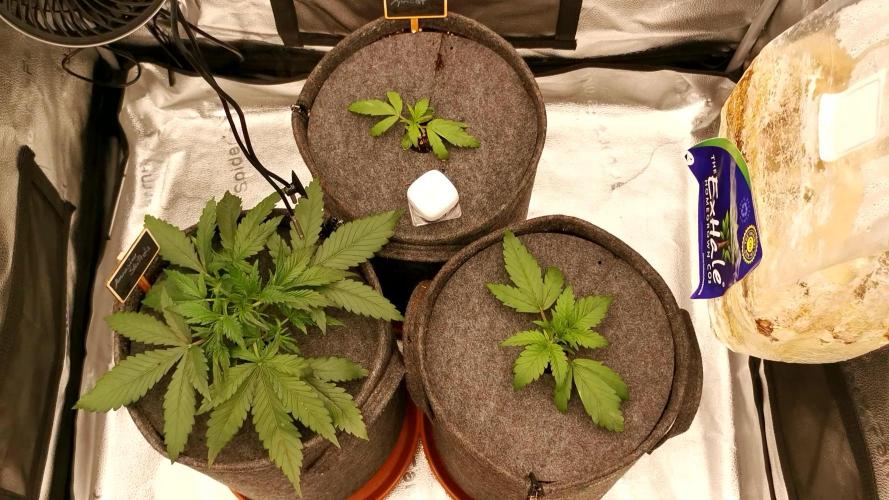
During week 3, Amnesia Zkittlez showed very healthy and steady vegetative growth. Leaf color remained a deep, healthy green, and the plant continued to be the most vigorous one in the tent. 🌿
The structure looks compact and balanced so far. No training was applied; instead, only light leaf tucking was done to improve light penetration while keeping stress to a minimum.
Overall, the plant responded very well to the increased light intensity and stable environment.
The focus this week was on maintaining stable conditions and letting the plant develop naturally. Everything looks on track heading into the next phase 😊
Likes
4
Share

@Furet
Follow
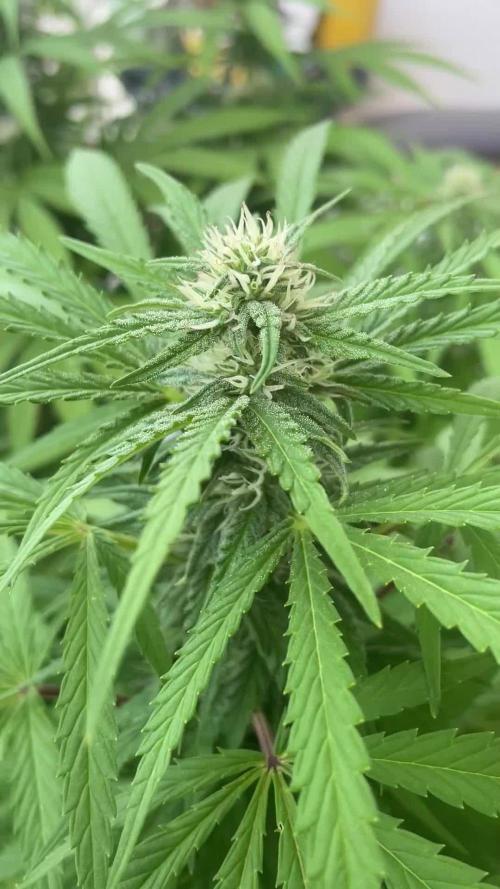
August 31 : The buds have really grown this week, and I’m going to start adding PK 13-14. The smell is starting to develop and is really sweet and mellow. I think I should be able to harvest around September 20–25, October 1st at the latest. Final run !!! Hopefully everything goes smoothly !

Likes
1
Share


Likes
12
Share


@GrowMyMeds
Follow
Welcome!
Week 7 flower!
I'm dying in anticipation.
Part of me just wants to stare at it forever, because I'm pretty sure the color will get darker when its dried
Pistols are turning orange top, so getting closer.
I took a few videos this time. One shows the Mars Hydro lights, and my tents I'm using.
The other is the best I could do to capture the beauty of this plant. I wish I had a tent full of only her.
I cut way back on nutes, I only plan to feed one more time and will be checking the trichome color next week.
Overall I'm super happy 😄
If you have some colorful grows going let me know and I will check it out
Thanks for checking out my med grow, see you on week 8. Follow and subscribe if you like my content and want more
Peace
Likes
5
Share

@DogDoctorOfficial
Follow
🌱 Sour Diesel — Week 8
(Flower Week 3) — Strategic Reset Week
⸻
🔁 Quick Recap — Where We Are
• Genetics: Sour Diesel
• Timeline: Week 8 from seed
• Flowering: Week 3
• Height: ~60–70 cm (compact structure)
• Room Temp: 28°C
• RH: 65%
• Feed EC: 2.9
• pH: 6.5 (kept above 6.0 intentionally)
• Lighting: LED
• Action this week: Strategic defoliation
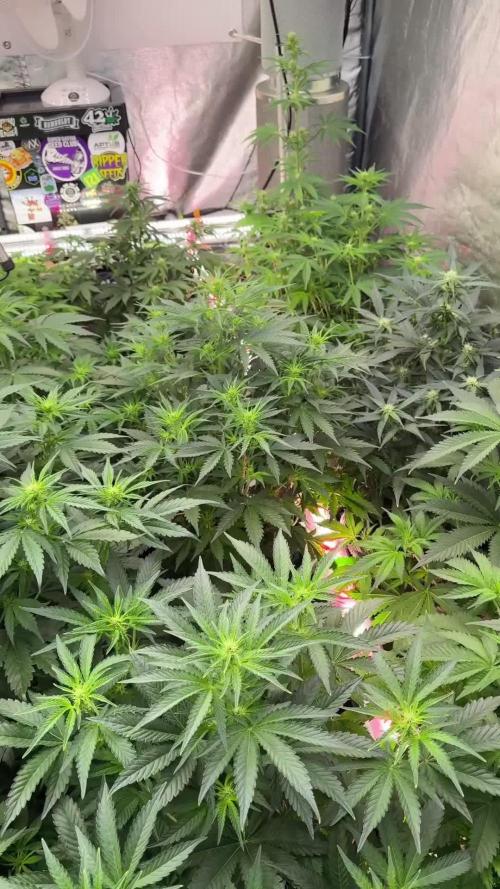
This plant is not tall — she’s compact, dense, and structurally tight.
Which means airflow and internal light penetration become critical early.
And that’s exactly why this week mattered.
⸻
🍃 The Defoliation — Not Aesthetic. Architectural.
This was not cosmetic trimming.
It was:
• Removing large fan leaves blocking interior bud sites
• Cleaning inner congestion
• Opening airflow channels
• Resetting light distribution across the canopy
• Helping the entire room environment (not just this plant)
The room needed air — this plant was advanced enough to handle stress.
That’s key.
Week 3 of flower is the transition window:
• Stretch is slowing
• Bud sites are set
• Energy shifts toward stacking
At this stage, a strategic defoliation:
• Improves transpiration efficiency
• Reduces microclimate humidity pockets
• Prevents internal leaf-to-leaf condensation
• Encourages bud site activation below the top canopy
This was structural architecture. Not haircut vanity.
⸻
🌡️ 28°C in Flower — “Too Hot?”
Let’s Go Deep.
People panic when they hear 28°C in flower.
But here’s where most growers confuse:
🔥 HPS vs LED Heat Behavior
Under HPS:
• Radiant heat warms leaf surfaces directly
• Leaf temperature often equals or exceeds room temp
• 28°C air under HPS can mean 30–32°C leaf temp
• That pushes VPD dangerously high
Under LED:
• Less infrared radiation
• Leaf surface temp is typically 1–3°C LOWER than room temp
• So at 28°C room temp, leaf temp might be 25–26°C
And VPD calculations depend on leaf temperature, not air temperature.
⸻
🌿 What Is Leaf VPD?
VPD (Vapor Pressure Deficit) measures the difference between:
• Moisture inside the leaf
• Moisture in the surrounding air
But if you calculate VPD using only room temp, you’re missing the real transpiration dynamics.
With:
• 28°C air
• ~25–26°C leaf surface (LED)
• 65% RH
Leaf VPD sits in a very workable mid-flower zone.
Not extreme.
Not stress-inducing.
Not shutdown territory.
We’re driving metabolism, not cooking terpenes.
⸻
💧 Why 65% RH Isn’t Dangerous Here
Context matters:
• Good airflow
• Opened canopy
• Compact but cleaned structure
• Early-mid flower (Week 3, not Week 7)
At this stage:
• Pistils are forming
• Bud density is still moderate
• Transpiration is active
High humidity becomes dangerous when:
• Bud mass is dense
• Internal airflow is poor
• Late flower resin traps moisture
We’re not there yet.
And we just improved airflow with defoliation.
⸻
⚡ EC 2.9 — Aggressive but Intentional
That EC is strong.
But:
• Plant is compact, not oversized
• Sour Diesel can eat
• pH 6.5 keeps availability wide (Ca, Mg, P balance)
The key will be:
• Watching leaf tips
• Monitoring runoff behavior
• Watching for clawing or salt stress
Right now, if she’s praying and stacking, she’s handling it.
⸻
🔍 What To Expect Next Week (Flower Week 4)
After defoliation:
You may see:
• Slight pause (24–72 hours)
• Increased vertical bud push
• Better lower-site activation
• More defined pistil clustering
• Stronger apical dominance response
If recovery is clean:
• Buds begin early stacking phase
• Internodes tighten
• Resin production initiates at bract level
If stress appears:
• Slight leaf droop
• Tip burn acceleration
• Reduced upward leaf angle
But based on structure and timing — this looks calculated, not reactive.
⸻
🧠 Why This Week Matters Long-Term
This week determines:
• Airflow pattern for late flower
• Mold resistance later
• Bud density uniformity
• Final trim efficiency
• Light-to-bud conversion efficiency
This wasn’t about now.
This was about Week 7 and 8 survival.
⸻
🙏 Appreciation Section
To:
• The OGs here since seed
• The new followers discovering the journey
• The silent readers
• The critics
• The skeptics
• The lovers
• The haters
• The platform
• The sponsors
• The community
• Grow Diaries itself
Everyone has a place here.
Growth happens in public.
And that takes courage.
Respect to all of you.
📡 Please stay tuned they can try and take us down but we never quit https://www.youtube.com/@DOGDOGTHEDOCTOR NEW
🙏 Thank you for your patience and continued support.
FOR DISCOUNT CODES AND MORE JUST FOLLOW THE LINK https://website.beacons.ai/dogdoctorofficial
📲 Don’t forget to Subscribe and follow me on Instagram and YouTube @DogDoctorOfficial for exclusive content, real-time updates, and behind-the-scenes magic. We’ve got so much more coming, including transplanting and all the amazing techniques that go along with it. You won’t want to miss it.
GrowDiaries Journal: https://growdiaries.com/grower/dogdoctorofficial
Instagram: https://www.instagram.com/dogdoctorofficial/
YouTube: https://www.youtube.com/@dogdoctorofficial Deleted by Youtube
Vimeo : https://vimeo.com/dogdoctorofficial Under construction stay tuned ⸻
Explore the Gear that Powers My Grow
If you’re curious about the tech I’m using, check out these links:
🔆 Lighting & Environmental Control
• Future of Grow — Advanced LED lighting technology
https://www.futureofgrow.com/
DISCOUNT CODE: DOG20
• Lumiflora — Under-canopy LED lighting
https://lumiflorade.com/
• TrollMaster — Environmental controllers and automation gear (past collaboration)
⸻
Genetics
• Zamnesia Seeds — Genetics used in this project
https://www.zamnesia.com/
⸻
🌱 Soil, Substrates, Boosters & Root Support
• Plagron — Substrates, bio mixes, and supportive products
https://plagron.com/en/
⸻
🎒 Storage, Curing & Preservation
• Grove Bags — Curing and storage solutions
https://grovebags.com/
⸻
📸 Photography Equipment & Tools
(Not sponsors, but part of my creative toolkit)
• Sony A6700
• Sony full-frame macro lens + few more
• Stacking photography workflow - learning
• iPhone (for behind-the-scenes shots)
We’ve got much more coming as we move through the grow cycles. Trust me, you won’t want to miss the next steps, let’s push the boundaries of indoor horticulture together!
As always, this is shared for educational purposes, aiming to spread understanding and appreciation for this plant. Let’s celebrate it responsibly and continue to learn and grow together.
With true love comes happiness. Always believe in yourself, and always do things expecting nothing and with an open heart. Be a giver, and the universe will give back in ways you could never imagine.
💚 Growers love to all 💚
📸 P.S. – The Eye Behind the Lens
All photos in this diary (for now — except for the ones showing the camera, which I took with an iPhone) are taken with a Sony A6700 paired with a Sony full-frame macro lens and a few more.
Photography is part of the story — it’s how we share the fine textures, the glow, and the quiet details that words can’t always capture.
I’ve also started experimenting with photo stacking — a technique where multiple images, each taken at a slightly different focus point, are layered together to create one perfectly sharp image from front to back.
It’s not digital enhancement or AI; it’s pure photography — a way to reveal the plant’s beauty in microscopic depth, from trichome to petal.
You’ll even see a few shots of "ghost me" capturing the shots — camera, lens, setup — because every grow deserves not just to be cultivated, but documented like art.
FOR DISCOUNT CODES AND MORE JUST FOLLOW THE LINK https://website.beacons.ai/dogdoctorofficial
NEW DISCORD - Official Server Invite Link : https://discord.gg/ksjAkA5T74


Likes
12
Share


@Northern_Ent
Follow
June 22: planted peat pot in final Fast Buds 4 gallon bag after ripping bottom off and tearing sides. Forecast to be quite warm overnight so she’ll be outside tonight for first time.
June 23: in direct sun but under shade cloth for today.
Likes
6
Share


@Fullmeltalchemist
Follow
D63/F15 - 11.21 - easily the most vigorous plants in the tent. The passion berry has unbelievable structure and stretch. She stands about 6 inches taller than all the others today. I have 5 more fem'd Passion Berry seeds. 😈Depending on how this one finishes and the bud profile, they might get their own tent next run.
D66/F18 - 11.24 - Little LA sunset that was such a runt for so long is starting to put on buds all nice. Gonna defoliate her in 4-5 days. More pics to come of the big girls tomorrow after they get defoliated 👍
D67/F19 - 11.25 - Defoliation is complete! Everything is looking great!
D69/F21 - 11.27 - the little LA Sunset is looking just dandy, a few more days until the last little defoliation session.


Likes
4
Share


@alexb420
Follow
painted the senecas for sure, culled the male. both turkish are pretty well seeded out, i’m thinking maybe 20-30 seeds each, 15 fully formed and good. the senecas look lightly pollinated, maybe 15-20, 10 fully formed and good. still will be usable beans. next run after this will be good, hopefully stable genetics. gonna try for a turkish male and focus on the turkish x afghan cross, while saving the seneca x turkish for later.

Processing
Likes
45
Share


@SupaDank
Follow
End of day 41 flower and will be flushing both girls on day 42 flower. Overall the buds don’t seem as fat as it should be but hopefully during the flush they should gain some weight. I took a bunch of clones so those will be going to flower soon and now I have a better understanding of how to treat these girls during the flowering stage. Also popped two Blueberry seeds so I will have a journal on that soon.

Likes
11
Share


@sellem
Follow
Done.
Harvested ALL on Day 72 - one LCC was very heavy on amber trichomes, one BPP and one LCC were what i consider optimum, and one BPP was VERY milky, like peak potency. very few amber. Interested to try them all!
Total Drying time was 7 Days for both LCCs and 8 Days for both BPPs.
I decided to do my first proper dry trim. For two plants i hit the spot and could just shave off the remaining leaves. For the other two it was much more of a hassle.
They already smell way better than my previous runs where i dry trimmed. Also the colors are awesome for both plants that purpled.
Smoke review will have to wait some time. Right now, all of them are curing.