


Likes
Comments
Share


Likes
1
Share


@Mofumbo273
Follow
She recovered pretty good
3rd day of veg week 8 I changed the light to 12/12

Likes
2
Share

@DudeGrowsWeed
Follow
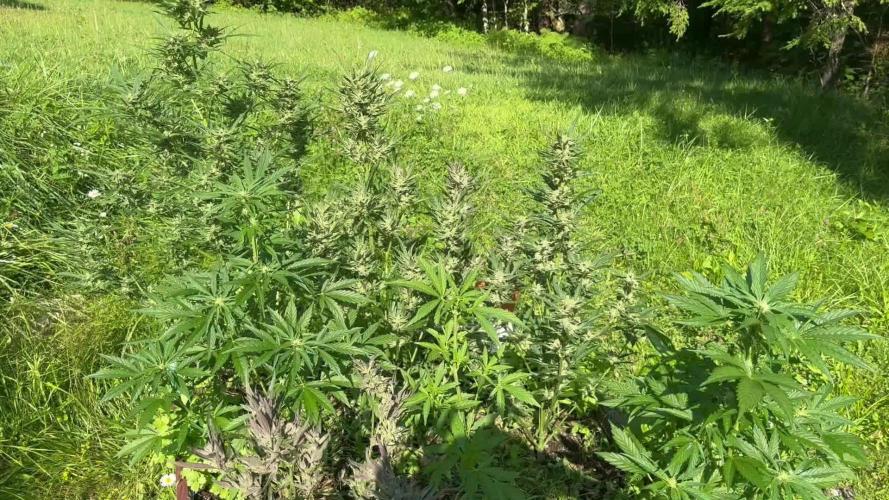
Well… Night Owl DDOS OG has been disappointing. I chopped the ugliest one outside and fed it to the soil. The DDOS inside has been chopped and put into my new VCure (first dry/cure w/VCure). The remaining DDOS outside will get chopped and washed this weekend. I’ll reserve final judgement until the dry/cure has finished and I’ve had a sample, but so far I’m not impressed. FWIW I have emailed with Daz about his plants growing poorly and with lots of 1 and 3 finger leaves. He initially responded saying this is normal in flower as the plant focuses energy on bud development. Users in the Night Owl Discord community say it’s the ruderalis traits showing up. Daz has stopped responding to my subsequent emails with additional information and pictures. I was really expecting better from Daz and Night Owl.
Banana Basecamp and Chem Town are doing much better even though they are showing some signs of heat stress outdoors.
Star Froots Auto from MVG is the star of the grow so far. Beautiful proud plant with great structure and chunky bud development!👍👍
Likes
10
Share


@simps
Follow
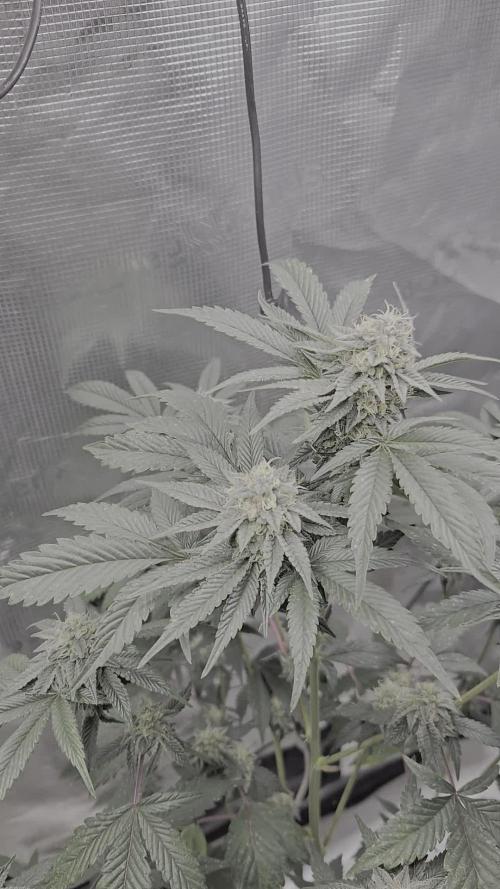
This plant is coming back strong 💪🏻 I was getting a lil worried there for a second bet I’m not now do well growing fast she will be a nice bush in no time
I’m doing some LST on her
Topping
And pulling a few big leafs out of the way so the under growth come up nicely
I did some more topping Monday and I put a layer of Hi nitrogen compost on top they are growing at a rapid pace now witch is good to make up for starting so late


Likes
3
Share




Likes
9
Share


@Northstar_cannabis
Follow
Healthy and consistent growth. Plant is a little smaller, i think that's due to location in the tent. Buds look good.

Likes
22
Share


@Smith420
Follow
It’s really difficult trying to figure out the watering at this point. Besides that and the lighting everything else seems to be easier to control due to the technology. The human nature aspect and learning about my medicine and how the plants start to develop more growth and require different needs and attention in each stage is fascinating. It’s my first time and trying to mash up all the information I read online. Well anyways to everyone reading and doing their thing, thanks for all the support and here’s my part 2…
Currently feeding distilled water every time I feel my fingers in the dirt are dry about 4” down.
I’m scared to water till run off at this point as the roots are still young.
I Fed 1/2 cup great white on 12/8
12/11 morning, showed first sign of vegetational stage(7sets of true leaves).
12/11 pm fed nutes(called advance and the guy was great very informative and helpful. Said for autoflowers to give half the dosage that is printed because those measurements are for photo’s)
2mil sense grow ph perfect a
2mil sense grow ph perfect b
4mil voodoo juice
4mil b-52
Mix all these into 1 gallon distilled in order from top to bottom. Then I fed 1/2 cup of that mix to each plant.
Used cheap Amazon test kit
270ppm/ water temp 67 / water ph 5.75
12/12 am low stress training
I forgot to mention that I increased the dimming from 4-6 on my light which gives the plants 420par ;) and I think 17000lux gotta learn how to use yet another cheap Amazon tool. Hey it works to give a general idea and as long as the numbers are consistent then why not use it as a reference.

Likes
10
Share


@BR1CK_SANCHEZ
Follow
Still hadn't really figured it out this week... I was making a lot of mistakes, but the deficiencies weren't showing yet so I had no idea.
Likes
5
Share


@HoffmanShulgin
Follow
Hoy quiero compartir mis pensamientos sobre el estado de mis plantas. Sinceramente, quería creer que no habían sufrido mucho por el frío, pero desafortunadamente la realidad resultó ser diferente. Algunas de ellas parecen un poco deprimidas y su crecimiento se ha ralentizado. Pero no me doy por vencido y sigo esforzándome por su recuperación. Además, no me gusta el régimen de luz que se ha utilizado desde el inicio de la siembra de las semillas, 12/12. La próxima vez utilizaré 18/6. Espero que esto ayude a estimular su crecimiento y desarrollo.
Ayer empecé a darles a las plantas PK13/14 en una dosis de 1 ml/l y Diamond Nectar en una dosis de 2 ml/l. Espero que estos aditivos les ayuden a obtener los nutrientes necesarios y a estimular el proceso de floración y crecimiento. A pesar de algunas dificultades, no me doy por vencido y sigo cuidando de mis plantas. Creo que con el cuidado adecuado y las condiciones apropiadas, podrán superar las dificultades y crecer saludables y fuertes. Sigo siendo optimista y seguiré creciendo junto con ellas.
Likes
11
Share


@L0R3N
Follow
Após 24h de papel toalha, as sementes já apresentam uma leve abertura onde passará a radícula
Likes
56
Share

@Natrona
Follow
Strawberry Trop Cherry - STRNG Seeds
W9 01/04-10
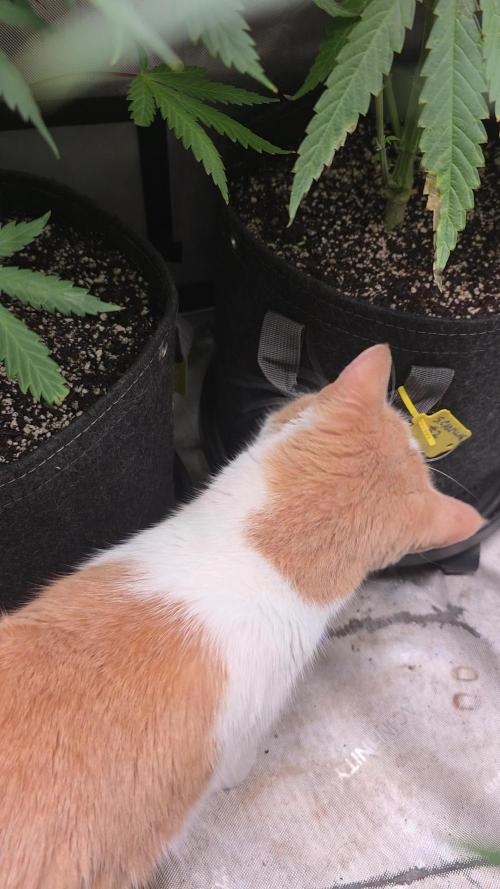
These strawberry collection gals are growing steady during this early stretch. I gave water only last week to contain the stretch. I also turned the lights down to 80%. Other than Cadillac1 all the plants look the same so I tied ribbons to the pots as identifiers for pictures. Kitties lost interest in my leaves, now is play with the pipe cleaners.
I’ll have to tighten them up as I found one on the grow room floor.
Strawberry Cadillac -Purple
Straw-Trop Cherry-Red
Straw-Lectric Lemonade-Yellow.
01/05 Supercrop Last week I indicated I might supercrop Cadillac1 since she is so tall. Well, you will see pics during the process of bending the stem and taping the position. I pinched the stem in my fingertips and rolled it a bit, then bent the stem, (notice the outer casing is not broken) applied tape to the joint to keep the branch from completely bending over. Each side had at least 3 nodes.
1/06 the side nodes on the branches have turned up and made more tops.
All gals show the beginning of white hairs identifying they are female.
1/9 Strawberry Cadillac #1 46” #2 37“
Strawberry Trop Cherry #1 24” #2 41”
Straw-Lectric Lemonade #1 33” #2 35
Important dates
11/9 Germination
11/25 Transplant to 1.5 gal,
12/1 Topped, Pinned and removed 2 large center leaves
12/5 Repositioned pins and removed lowest fan leaves
12/16 Topped 4 tops on each plant except Cadillac1 (first topping) and put manuka honey on the cut.
12/24 Transplant to 5 gal
12/27 Defoliate all
12/28 Flip to 12/12
01/05 Supercrop Cadillac #1 at the joint where I topped her.
Stay green, growers love 💚🌿
💫Natrona💫
Likes
89
Share


@Zurban_Poison
Follow
Hello Friends!
Well!? How do you like my tropical poison?) at the beginning of the report, I promised that the report would be interesting and with a surprise! this week is just the beginning of this surprise)) You can see the paraphernalia in the photo in the form of a skull of a certain animal .. and she will actively take part in the growth process and will become the main feature so to speak .. I will not reveal all the cards in advance, but I think you and you can guess exactly how I'm going to use this skull!))


Likes
1
Share


@Cannerd
Follow
How ya doing mates?? Awesome week last week - all photos and logs have been added so be sure to check it out! This week is going great so far! I've switched to an early vegetative state nutrient system. As you'll see in the daily logs early this week, this bumps up the micro and grow nutes, and keeps the bloom at 0.6ml/gal. A quick note about last week - I'm unable to update the measurements, but please note that those nutrient amounts are measured in ml/gal, NOT ml/l.
Anyhow, this week I'm just waiting to get my order of diatomaceous earth so that I can make up another batch of soil. I'm still debating between topping this week before repotting or letting them take root in the new pots first. Decisions decisions lol. I think at the very least I'll clean up some of the lower growth to make sure the energy is being spent at the right places. I've been switching back and forth between just LST and mainlining in the past - but I think I really like the ease and cleanliness of mainlining. The draw back is the recovery time they take in the process haha.
UPDATE:
The D.E. has come in, and I repotted the girls this week. I mixed in about 1.5-2 cups D.E. for the whole pot, as well as some Bat Guano and Kelp Meal for micro and macro nutrients to use on dry cycles.
I've also included some photos of the mother plant to give an idea of what's to come! I've just started to flower it, which is the first time for this strain - so I'm pumped!
Day 15:
M.C. 01-21 After reviewing the last set of photos from last week, I figured I'd play it safe and dimmed the light back down to 25% strength. The mother plant is almost ready for flower, and I'm down some tents so she'll be taking this one over shortly. These photos were taken shortly after the lights went off, and they look quite happy! You can see some of the side branch developement in today's photo for MC-01. The pots are fairly dry now, and I've decided to move to the next stage in the nutrient regime. This kicks up the Micro and Grow nutes, while maintaining the Bloom amounts.
M.C. 02-21 A nice top photo for MC-02, you can really see the lighter green in this photo. Not to worry though, as these will darken back to a vibrant green as long as I give her what she needs shortly! The pots are fairly dry now, and I've decided to move to the next stage in the nutrient regime. This kicks up the Micro and Grow nutes, while maintaining the Bloom amounts.
M.C. 03-21 Look at that little leaf poking out from the 2nd node! Some slight yellowing you can see too, but again, not to worry. The new mix should rectify that. I've decided to move to the next stage in the nutrient regime. This kicks up the Micro and Grow nutes, while maintaining the Bloom amounts.
Day 16:
M.C. 01-21 Today is the day - for the mother! I've cleared out some space and moved plants around. So back out to the grow room these girls go! MC-01 seems much better today with the reduction in light. The 5th node is almost flattened out and the 6th coming through still. Most notably though, you can really see the work she's put into the side branches! The branches at nodes 2 and 3 are starting to produce more leaves - great sign! The new growth at the top is also a nice dark green. Added 500ml water to the tray.
M.C. 02-21 MC-02 seems to have liked the adjustment of light as well. She's got nice dark green growth at the top, and the little branches at the 2nd node seem to have a full leaf! Added 500ml water to the tray.
M.C. 03-21 The photo from today is cool, because you can see how close MC-01 & 03 are, even though there's almost a full node difference. MC-03 is stretch out a bit to compete with her sister for the light haha. She's also put some more effort into the side branches that you can see. Added 500 ml water to the tray.
Day 17:
M.C. 01-21 I figured a video would be the best way to illustrate the changes today! They've been back in the grow room under the Veg dedicated light for a day now and seem to be loving it! MC-01 has its' 5th node out, splitting the 6th node, and I can JUST see the 7th node coming in. I don't think they'll get too much more height, as you can see that the side branches are starting to stretch now! She's definitely going to be well tangled in the roots by the end of the week when I hope to repot her.
M.C. 02-21 MC-02 is doing great despite the difference in height! You'll notice the side branches stretching out at nodes 2 & 3. The pots are also still fairly wet at their center, so I'll hold off on water most likely. At least this clone will have time to root more while we wait for the supplies!
M.C. 03-21 MC-03 also has great side branching! If you take a look at the group photo from today, you'll see that both MC-01 & 03 are practically the same height, but MC-03 snuck in there by the stretch haha.
Day 18:
M.C. 01-21 My order of D.E. came in last night, perfect timing! As you can see, her roots have fully reached the bottom, and have started to migrate upwards with the water that's absorbed. The soil was a little dry for my liking, which made things a little difficult/dusty but still no mishaps! Watered around the root-zone before covering with more soil to keep the gnats down.
M.C. 02-21 Not quite as much lateral root growth as MC-01, but still plenty enough for a repotting! Her soil was a little dry as well. Ideally I should have given them a light misting from the top of the soil and let is drip down to keep the dusty bits together haha.
M.C. 03-21 Nice and thick root growth, no issues with repotting, and strong stalk. The extra spacing in the nodes may prove to be helpful during the training phase.
Day 19:
M.C. 01-21 Some nice top shots today as they slowly get acclimated to their new homes. Once I see them push out a new node, I'll probably top them. This is to make sure that they're taking to the new pot without causing any extra stress before they can take it. Today I watered them with an early veg nutrient. I like to stay cautious with nutrient boosts since they're in soil - not to mention the added nutrients from the repotting.
M.C. 02-21 Top shots for the girls today. Not much change, but also no immediate signs of shock either, so I'll take it.
M.C. 03-21 You can't really see it in this angled shot, but the small branch at the second node is coming along nicely! I think the girls are happy that they each have their own tray not haha.
Day 20:
M.C. 01-21 Definitely noticing some slow changes to the top nodes when comparing the pictures from the previous day. The leaves are slowly starting to separate, and I'm not noticing too much yellowing yet which is good. Watered with 500ml water to keep water migrating upwards to meet the roots.
M.C. 02-21 Not noticing much change in this girl today, but that's okay. She's most likely focusing on the root developement instead which I can't complain about! Watered from the bottom.
M.C. 03-21 Maybe seeing some separation in the top leaves, however more notably are the small branches at the 2nd node that you can see better here. Still a bit of stretching with them as they get longer. I might even keep them on for clones later on. Watered from the bottom.
Day 21:
M.C. 01-21 Looks like she gained some distance last night, as the top node is now above the fan leaves, unlike 2 days ago. I'm really getting eager to top them, as I don't want them to waste too much time and energy growing tissue that I'll just end up cutting off. I'll be bumping the nutrients up starting next week to keep the progress going, moving to a mid-veg stage shortly. I'm going to let things dry up tonight for a fresh boost of water tomorrow to give it a dry cycle as the pot is still a bit heavy.
M.C. 02-21 MC-02 really worked hard last night it seems, as she almost completely flatted out her top leaves! I think she's ready for a topping, but I'll let her benefit from the headstart and let the other two catch up and root before. dry cycle for her tonight as well.
M.C. 03-21 MC-03 was busy last night too and is now slowly flattening out the top node as well! Maybe tonight they'll have enough progress to go topless afterall haha. Dry cycle in prep for watering tomorrow.
Processing
Likes
4
Share


@Hangonfarm
Follow
Week 6. Installed a individual sog for this single plant. Is only one so lets get the more of it.
The buds are starting to multiple very fast.


Likes
9
Share


@GrowingisFunkO
Follow
Week 15 - 06/21 - 06/27
Light - 200 W HPS & 265 W LED
Day Temperature - 78 F
Night Temperature - 68 F
Humidity - 40 +/-5
D50 Flower - Fed the ladies and raised the HPS and LED lights up and turned the HPS down to 200 W, I am trying to emulate fall by lowering the amount of light.
D53 Flower - Fed the ladies again, I think this may have been the last feeding of nutrients. The next watering I will hopefully start flushing.
D55 Flower - Noticed some of the leaves are starting to fade and turn yellow. Hopefully, that means they are getting close to harvest, I should be cutting them down next week.
D56 Flower - Was on a trip and had to water the ladies with a timer and pump, thankfully everything worked fine. Started flushing with FloraKleen.

Likes
1
Share


@GERGrowDesigns
Follow
Welcome to Flower week 1 of Sweet Seeds Mental Rainbow F1
I'm excited to share my grow journey with you from my
Sweet Seeds Project . It's going to be an incredible ride, full of learning, growing, and connecting with fellow growers from all around the world!
For this Project , I’ve chosen the Feminized Photo strain Mental Rainbow F1 :
Here’s what I’m working with:
• 🌱 Tent: 120x60x80
• 🧑🌾 Breeder Company: Sweet Seeds
• 💧 Humidity Range: 50
• ⏳ Flowering Time: 7-8weeks
• Strain Info: 22-30%THC
• 🌡️ Temperature: 26
• 🍵 Pot Size: 16
• Nutrient Brand: Narcos
• ⚡ Lights : 600W x 2
A huge thank you to Sweet Seeds for allowing me to try my Best with this amazing collection from Photo Strains they managed to Sponsore . Big thanks for supporting the grower community worldwide! Your genetics and passion speak for themselves!
I would truly appreciate every bit of feedback, help, questions, or discussions – and of course, your likes and interactions mean the world to me as I try to stand out in this exciting competition!
Let’s grow together – and don’t forget to stop by again to see the latest updates!
Happy growing!
Stay lifted and stay curious!
Peace & Buds!
Likes
2
Share


@CannaIGrow
Follow
Topped this girl this week, she’s growing pretty good. Very nice looking plant to my eye.
Likes
25
Share


@XperencdGmanXG
Follow
She seems to be doing a lot better since the foliar spray last week. Leaves are a dark green now and the stalks are more malleable due to the silica. Did another Silica foliar spray this week as well. 12 gal of water and it is supposed to rain on them today. Fingers crossed!
