The Grow Awards 2026 🏆 










Likes
27
Share
@AsNoriu
Follow
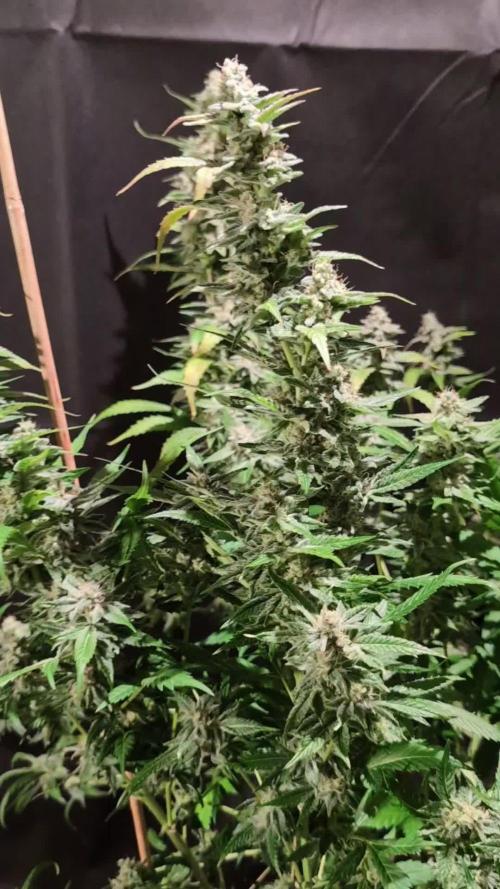
Approximately day 72 since seed touched soil. Such a relief is this part of garden. All girls will be harvested next friday, only one weakest Trainwreck is about a month behind, but she was looking sad and weak all the time, catches up others, still underdeveloped and small buds. Other two Trainwrecks are very nice, one is forming huge top, fat, sparkling, did few photos of her even. Both cheeses run nice too, rainbow smells so sweet, should be lovely smoke. We had huge rains , almost like summons, no signs of bud rot, but bottom branches are covered in soil and sand, will have to wash them before hanging.
Sun was still raising, i was blinded by it, so quality of photos is very poor. They sparkle !!! and smell is around the forest, really sweet and i cant wait to try them out !!!
Last 10 days or so left till chop.
Happy Growing !!!!!

Processing
Likes
9
Share
@EskereWMaGirlz
Follow
Seed found in the same bud, but have different pheno aioi
Likes
1
Share
@lucascontre89
Follow
Sufrió stress por sofocacion a caus de rotura de cooler.
Se corrigió indoor intracción y extraccion...
Solucionado en el día
Ventilando la maceta

Likes
3
Share
@GoodTimesOrganics
Follow
Hi liebe Community and Welcome back! 💚
Jetzt war es Zeit für den Trichomcheck und ja, es sieht genau so aus, als wäre die Pflanze exakt in der 8 Wochen Blüte Range.
Nächste Woche ist es dann endlich soweit und die DMO Grapefruit kommt unter die Schere ✂️.
Ich habe die Pflanze nochmal Stark ausgedünnt und es zeigt sicher eine sehr stark ausgeprägte Blütenstruktur. Absolut im XL Bereich.
Es lässt sich beobachten, dass die Blütenbildung im mittleren Bereich der Colas stark ausgebreitet hat und die Pflanze Richtung Spitze eher etwas dünner wird.
Sie bildet die Blüten sehr vielseitig aus, von dünner kompakt bis hin zur breiten dichteren stellen.
Ihr Geruch ist nun sehr stark ausgeprägt und eine Grapefruit Note zeichnet sich als markante Hauptnote ab.
Bei diesem Typ nochmal etwas intensiver als bei der #2.
Abgerundet wird dass ganze durch etwas skungige, Säure und etwas Zwiebel/Pfefferigel Noten. Auch eine leichte Süße Komponente kommt etwas hindurch.
Die Wachstumsbedingungen im Growzelt sind aktuell wieder super!
———————
🌞 Temp: 23°C
🌚 Temp: 20 °C
💨 RH: 53%
VPD: 1,00 kPa
😎PPFD: 830 mqm
———————
Stay Tuned! 💚
Likes
19
Share
@CookiesAndCake
Follow
Week 11
Day 71 (15/03/2021):
No time to take pics today ✌️
Day 72 (16/03/2021):
Looking good but more and more leaves are drying up or turning yellow. But at this point there is definitely no point in stressing the girls by removing them. Although the colours definitely look nice!
Day 73 (17/03/2021)💧:
Today will be the last watering for the girls so they have a few days to take up the last bits of moisture before harvest. I can’t believe how fast this grow went but I have definitely learned a lot from it.
Day 74 (18/03/2021):
They look so nice and colourful, definitely an interesting bunch of girls :D Can’t wait for the harvest and cure
Day 75 (19/03/2021):
No time to take pics today ✌️
Day 76 (20/03/2021):
No time to take pics today but harvest day tomorrow!!!!
Day 77 (21/03/2021):
HARVEST DAY! What a great journey it has been growing these girls. They were so resilient and only started showing symptoms of deficiency in the last few weeks. They are absolutely covered in trichomes and smell very pungent. I think they will be super hard hitters! And it still amazes me how different they all are. Echo is even completely purple! Can’t wait to trim and dry these girls and will definitely make some bubble hash from all the trichomes on the leaves too 🤤 Will follow up with a review soon! (after they’ve cured for a bit)

Likes
50
Share
@Igrowneil
Follow
Hey growers
Day 35
This run is sponsored by VIPRASPECTRA LEDS
XS4000 480W AND P2000 X2 400W
TOTAL POWER RUNNING 880WATTS
Hey guys and girls this week hasn't been the best I overwatered , underwatered and then underwatered again , shit these girls express some amount of water , I literally flooded there plants to get a somewhat of a recovery response which isn't going the quickest either , some roots where exposed ( small amount ) wow they look healty white and fuzzy looking with plenty of hairs which indicates the bio roots worked extremely well even the terra aquatica TRI PART as this is synthetic it has charge ions the plant will uptake (N) continuously if overdone I've held back on as I don't want to damage the root zone with a build up of salts as we will ruin any microbial life with salts locking out important nutrients uptake also
Noticed the fade on some bottom leaves losing colour but I've been holding bk on (N) as some looked dark !! What to do next I'll take step by step and observe the situation for a while before acting to fast
.seedbanks involved ZAMNESIA, E.T.S , RQS
ZAMNESIA
GORILLA GLUE AUTO
This girl is growing pretty well with a good vigour even through this.bad week , staying pretty compact with an abundance of pistle formation indicates this is going to be decent size dense nugs and hopfully keep good airflow around these girls . The outsider gorilla glue over with the newer plants is hitting a good rebound, nothing special but not a total waste anyways which shows strong resistance overall which is a good incentive when picking which genicitis you would run in smaller space this is definitely the square ⬛ 10liter S.O.G / ScrOG method with these plants being smaller and Bushier
GIRLS SCOUT COOKIE'S AUTO
Growing the most compact with very big pistle formation 🙌
explosive pistle formation , I think using buddy from early flower in lower dosage has increase the amount of flower sites with abundance of pistles as this is starting to happen on all plants growing but these girls are taken that to the extreme and would also suit the 10liter square pot method
RUNTZ AUTO
girls are growing big and formation of lots of tops and lateral branching is great 👍 pistle formation isn't as quick bhy these girls didn't flip as quickly to flower , they did take the underwatering pretty bad plus some leaves being remove cause some more shock , lol its been a shit week but nothing we won't be able to fix over the next few days I need to start getting watering correct
ROYAL QUEEN SEEDS
DO SI DO AUTO .
the girls aren't doing to bad and looking better after being dryer than normal when I underwatered them , needless to say there coming bk to life and branching out continues to go on forming lots of viable tops and plenty of flower sites , might be a slow starter but never let that full you
EMERALD TRIANGLE SEEDS
BLUEBERRY AUTO
yes this girl is doing well , the other sister looks like a basil plant and nothing much will come of her . I can't wait to try this girl out and most of the seeds I had 4 blueberry I only got one viable seed , disappointed but the one that's growing is doing well so the taste is what will sway my decision
HEADLIGHT KUSH AUTO
doing well and getting to a good size and keeping on par with the ZAMNESIA seeds this is a good strain
LEMON HAZE AUTO
hopfully I'll contain any stretching untill the girls reach SCROG height
So hopfully the girls will do better from today and I can update with these girls praying 🙏 again , going to set DLI to 45 , temps to 23oC and water upto 0.33 liter a day this week day 36 onwards

Likes
9
Share
@Orange_bud
Follow
Coronavirus is keeping me away from my garden, but my friend is taking care of everything, i hope in a good harvest


Likes
12
Share
@farah4weed
Follow
Hello guys 😍👽
This week is the most exciting time of my cultivation.
After we grew 10 og creams, today in the third week of flowering, all the seeds showed that they are feminized😍😍
My project has given the right result
But more important than this is the final product, which we compare with the father (og kush) and the mother (cake n cream) and the traits it inherited😍😍
Thanks for your comment🙏😍👽
"farah4weed"
Likes
1
Share
@mauigrown
Follow
Week 9 is here and we are looking at harvesting! After checking the trichomes of just the top colas, I decided this week I was going to harvest. I am updating this post after I have dried and harvested the plant so do not have much more details. I flushed the plant this week with Flora Kleen along with terpinator and microbes.
I cut down the plants and hung them up in the tent to dry using a clothes hanger with clips I got off of Amazon. It took 10 days to dry the bud and my temps and humidity would fluctuate throughout the day and night. I stayed in the mid to low 70s for temperature and humidity was at 50% at first. Then I added a humidifier and had it dry in 60% humidity.
Will update the rest in the harvest update.
Likes
15
Share

Indoors flowering nicely, brown hairs starting to show.
Outdoors still one of the Ultimate still hasn't started to flower. I'm starting to wonder if it's not an auto at all. The gelato is forming nicely, with a little visitor a bee. The other ultimate is also flowering nicely.
Day 75, due to hothouse damage the three outdoor plants are now indoors


Likes
3
Share
@MrPipi
Follow
looky looky good👌
Mr. Pipi tried to talk in Video. He weird.
day 34:Frank really stretches. I removed Pedros LST ties so he can chase Frank.


Likes
5
Share
@Ninjabuds
Follow
My Rainbow Saltz plant has some lighter green leaves, so I gave it a dose of calcium this week, hoping they'll darken up. One of the branches wasn't keeping up, so I pruned it off. Now the shape of the plant is perfect for fitting against the wall in the tent.
It's been a challenging week with the constant rain and ridiculously high humidity. Keeping things dry indoors has been a real struggle. Despite the weather, I managed to flip all my feminized photoperiod plants to flower this week. I'm hoping the switch will go smoothly, but with this humidity, it's going to be tough.

Processing
Likes
22
Share
@MELs_Garden
Follow
Del 5 al 12 de julio
Buenas a todos otra semana más.
La cosa avanza bien y Esta va a ser la última semana que actualizamos únicamente una vez por semana, volveremos a las actualizaciónes diarias.
Continuamos con nuestro LST diariamente.
8 y 9 de julio
Usamos el quemador de azufre alrededor de unas 5-6h como preventivo ante posibles plagas.
10 de julio
Hoy a tocado poda (bastante severa) podamos algunas hojas y seguimos doblando las ramas. Las dpblamps entre si, por debajo, por arriba... Por todos lados, es una salvaje.
Las temperaturas están siendo muy buenas en comparación a lo que me llegan en cuanto a los indoors de mi alrededor y de otros compañeros.
Tenemos unos 25 - 26°C en On cpn Max de 27.8°C y mínimas en pdf de 23°C.
Preparados porque viene lo bueno.
11 de julio
Regamos vía foliar 1 ml aceite de nem + 10ml spruzit + 1 ml de un producto que nos dieron para probar como preventivo e insecticida. De este mismo liquido inundamos la bandeja unos centímetros para realizar un riego vía absorción.
¿ Por qué ?
Pues porque los trips se alimentan en la superficie pero viven en la tierra, y muchos de estos están en la parte inferior de la maceta por lo que no tendran salida estos bichillos. Mi guerra con ellos ya viene de tiempo atrás y quiero mantenerlos a raya.

Likes
19
Share
@T1000
Follow
The plant has grown a lot since last week and I'm starting to struggle with LST because of the numerous leaves that I don't find very important. So I want to do some research about defoliation which didn't interest me at first since it's high stress but I think it will be needed here.


