




Likes
10
Share


Likes
1
Share

@Phaticus
Follow
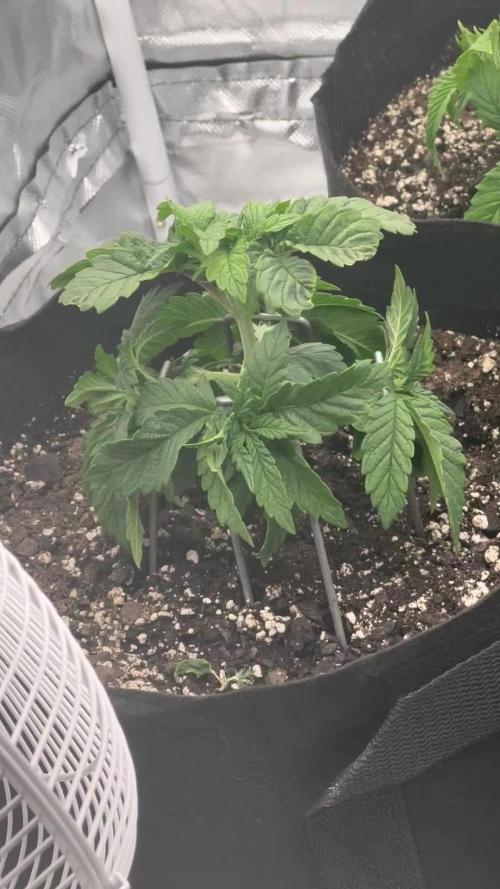
The smallest plant 1 in front actually broke but somehow managed to catch the elders who are roughly 1.5 weeks older
Likes
20
Share


@DabbertGlobberfield
Follow
For the Herbies contest - https://growdiaries.com/diaries/157348-grow-journal-by-dabbertglobberfield#gallery=6777378 - Grandmommy Purple is guilty multiple noise violations for being too loud and for stanky funk.
Harvest - 169 days / 66 days in flower
Well, we did it. I made it to the end. All I can think is...WOW that was A LOT of work. But I think I had very good results for a first time grower. I
For harvest, we took Plant B and D and prepared them for immediate freezing. Altogether, I ended up with 1212g wet on plant B and 1089g wet on plant D. I ended up freezing 1816g of this. There was some from each of these plants that was set aside from freezing because, for whatever reason, I thought they were not worthy of washing because of how progressed the leaf damage was from the root rot battle. So that was cut up and dried as nuggets instead of hanging like the rest. Sawtooth and Plant C were both harvested and hung in the tent to dry for 12-13 days. I think I overdried by 1-2 days because when I jarred them they struggled to raise up to 55%. So I am using rh% packs.
After drying Sawtooth and plant C, I ended up at 459.8g for dried flower and 170.8g in dried trim. So just over 1lbs between the 2 plants and 4.15lbs wet between the other 2 plants that was washed for hash.
So... are you for real with the effort involved with washing bud for bubble hash? I don't think I would do this in the warmth. I only pursued doing bubble hash cause it's cold right now and I figured that would really help. Even in the 30s(fahrenheit) stuff would stick. It's hilarious how sticky of a process this is. I hope you have a bunch of gloves, water, and ice to burn through. I went through over 60 gallons of distilled water and 80lbs of ice to wash the 4 lbs. I am envious of people in videos using a hose to collect, clean, and refill. Also, doing this as a 1 person show is the definition of insanity.
I broke the washings up into 3 parts. The first part was was the tester wash. I broke off 420g of plant D's 848gs available. I used 7 bags to see where I would end up. I used 220, 160, 120, 90, 73, 45, 25. What I determined was that if I was hunting a specific micron with a lot of material this would help find what you can get. But for the next washing I reduced the amount of bags to 4; 220, 160, 45, 25. The time, with the 4 bags, I washed with 809g. I had a much more favorable experience and return this second time but I had green fast and probably used too much ice. The 3rd wash was the remaining 631g and I found an extra 137g I added of sugar leaves and trim, brining the 3rd wash to 768g. I used 5 bags this time; 220, 160, 73, 45, 25.
By the 3rd wash I have become an expert in collection but also never want to do it again. lol.
2 of the 3 washes have dried and I have 43.4g of bubble and 2.8g of dry sift. 37.4g of that bubble is able to be pressed into rosin. I will probably press that dry sift as well. The other stuff is 25u or 160u that I will experiment with or cook with. The other stuff is drying so I can't add it all in.
I pressed a bunch of trim and some flower. The trim presses nice and the dab is decent. I am working out a good temp for the flower. But the problem with all these tests to find the sweet spot is that I have all these testers to go through but want to keep pressing and trying that! I think I will need to work on a better storage solution.
I can't wait for the fresh frozen bubble hash rosin pressing... I have over 20gs of bubble to put in one bag. I am really looking forward to this. But I will need to work up to that pressing since I have never pressed hash/kief/bubble before in my rosin press. So this should be really fun.
I will 100% post an update of the hash pressing once I do that and also after the 3rd wash session is done drying.
In closing, saying I learned a lot from this grow would be an understatement. I fully expect to start it back up in a few weeks after some R&R then some R&D. There's some things I will need to work on before I start again, such as: having a single external reservoir that feeds multiple plants, hard to clog and easy to use ebb and flow system, miscellaneous final run stuff like space for drying. So thanks everyone for hanging out and perusing the photos and or reading all my huge rambling updates and thanks to those for the help along the way.

Likes
5
Share


@Do_it_Dan
Follow
Been a great germination week with plenty of growth, let's hope the next 2 weeks will provide enough growth, it will be interesting now I've amended the ph over the whole garden, ph was at 6.6 run off on other strains in the same medium, started to see some deformities, let's see if this fixes them issues before they arise with this baby 👶


Likes
23
Share


@Gordy
Follow
Beginning of week 4(Bloom)
Plant has been neglected for the past few days. I’ve been super sick since Friday. That being said picture quality this week will be less than preferred, not much effort was put into this since I’m feeling like trash.
She’s looking good, a little droopy, I let her reservoir dry out for a day. She should bounce back well though. She’s really starting to produce crystals.
This week I’m doubling the amount nutrients. Up until now I’ve only been feeding her at half the amount recommended by the manufacturer.
I’m hooking up a 7 gallon reservoir this week as I’ll be on vacation for the next week and a half. I hope she does alright being completely unsupervised for that amount of time. Also I hope that my clones/mother survive the entire ordeal. No more vacations for a while.
Thanks for checking out my diary. Good luck with your grow! 😊
Feb 26:
Feeling better today, so I gave her some love/abuse and took some better pictures. This girl is beautiful and exploding.
I cleaned a lot of the lower leaves/buds off. I should have stayed on top of it more while it was younger because I feel I took quite a bit off. It hurts to remove buds, even if they’re really small and won’t really amount to anything decent.

Likes
7
Share


@DisTentAint4Campin
Follow
Growing great I open my tent smells like dead fruit love it 😀 can't wait for these flowers to form and show the true character of this cultivar


Likes
24
Share


@nonick123
Follow
Día 73 (12/08) Riego 500 ml H2O pH 6,55
Todas las plantas muestras las preflores hembras! (excepto LemonPaya)
Día 74 (13/08) Riego 250 ml H2O pH 6,55 . Están muy bien hidratadas
Pequeños ajustes de LST
Día 75 (14/08) Hoy día de lluvias torrenciales
Riego 250 ml H2O pH 6,55
Día 76 (15/08) Detecto mosca blanca en varias plantas. Aplico Spruzit a 10 ml/l ahora que aún no estamos en floración
Riego 500 ml H2O pH 6,55
Día 77 (16/08) Riego 500 ml H2O pH 6,55
La mosca blanca ha desaparecido completamente
Día 78 (17/08) No riego. Mañana a primera hora aplico Top Dress y riego profundo
Va a empezar la floración!
Día 79 (18/08) Alimentemos el suelo con Top Dress! 💥 Aplicamos 4 g/L sustrato de Tasty Flowers TD by Lurpe Solutions.
Total = 84 gramos / maceta
Riego con 1 Litro H2O pH 6,5 con 25 ml/L de Humus de Lombriz Liquido
Aplicación foliar Kelp hidrolizado de Lurpe Solutions a 0,25 ml/l
💦Nutrients by Lurpe Solutions - www.lurpenaturalsolutions.com
🌱Substrate PRO-MIX HP BACILLUS + MYCORRHIZAE - www.pthorticulture.com/en/products/pro-mix-hp-biostimulant-plus-mycorrhizae

Likes
16
Share


@goodcall
Follow
This week has been all smooth sailing, I have adjusted my feeding practices a bit and stuck with the 12/12 light. The only main difference is I have moved the light higher and cranked the intensity, this means I can get more coverage.
LSD-25;
I can not get enough of the colour on her, my last run wasn't great and I had a not so purple pheno so this is a pleasant change. I am thinking 2 - 3 more weeks on nutes then another couple weeks flushing till chop day
Lemon OG Haze;
Plenty of growth, almost a bit more than I wanted but the sativa genes are in full force. Plenty of bud sites and I am going to plan on 6 weeks till she's good.


Processing
Likes
7
Share


@Mission420
Follow
Well this week is progressing well. My time lapse star is the runt of the litter, but is still doing well. All my girls are doing well again, and I think I have the watering schedule dialed in a little better this time around. Of course I will be watching it closely this time.
Had an issue with the time lapse stopping if there was a power fluctuation, so I put in new batteries, and have unplugged the usb cable as aux power, so hopefully we get a full week of lapse next week.
I also think I have the temps dialed in and the room is keeping a good temp and humidity.
Likes
11
Share


@Colonel420
Follow
Week 5 - This's first week for flowering. I choose the nutrient for flowering It's 🌎Earth Juice - SeaBlast Bloom.🌿This week the plants are growing very fast.
Likes
6
Share


@Elmike
Follow
Généralement satisfait de mon setup et de la gamme de nutriment que j'utilise. Mon donner des résultats a la hauteur de mes attente.


Likes
4
Share


@Ieiogrow94
Follow
Eccoci qui...
Tutto va per il meglio, questa settimana ho eseguito Lollipopping e Defoliation per far si che le cime principali sprigionino al meglio il loro vigore.
Siamo verso la fine del progetto ora bisogna solo aspettare la fine...
Grazie a tutti per il supporto🔥🌲❤️

Likes
11
Share


@Hawkbo
Follow
Day late on the update, pics/vids were taken on time tho just been a crazy week of harvests and trimming and keeping up with these. I linked up with Rain Science Grow Bags on Instagram and got them to offer all my followers and friends a discount of 10% off entire order from their site with the code ' bangdang ' so if anyone is in the market for a pot upgrade use that code. I got them in the mail 3 days after I ordered. Reason I went with Rain Science is because they offer identical air flow for rapid growth as the radicle bags, just using a different material and a tighter knit so water doesnt flood out the sides during feeds and when you pick these up when the coco is dry, it wont fly all over the tent like with the radicles. They're the optimal bag for autoflowers especially. This one stayed small it got the late transplant and started flowering early but overall is healthy.


Likes
55
Share


@Hempy_The_Kid
Follow
01/12/22 irrigated 1 gallon water PH 5.85 TDS 403 gave 2 quarts recharge.
01/13/22 irrigated 1 gallon water PH 6.04 TDS 403. Topped 4 more spots. Growth has picked right back up after the PH mishaps.
01/14/22 re-potted to #5 nursery pot. Set up watering system. Now irrigating itself 1 time per day @ 50 gallons. Set PH 6.03 TDS 520.
01/15/22 adjusted TDS to 499 PH 6.0
Currently have 16 tops
01/16/22 PH 6.03 TDS 505
01/17/22 PH 5.93 TDS 520
01/18/22 PH 5.95 TDS 499 topped 4 more spots.

Likes
38
Share


@Green_Mountains
Follow
Another good week! I fed them once on Monday. A final shot to boost them for finishing up. I am pretty certain they will finish within 2 weeks.I also watered them on Thursday and today (Sunday).
I defoliated both plants earlier this week as well. For one, I needed to open the canopy up to help keep the humidity down but, there were a lot of leaves yellowing and turning brown. I was not feeding them correctly... in the sense that I wasn't watering enough in between feeds. There were excess nutrients built up in the soil and I believe that led to the nutrient burn. Also, this was my first and only feed without the Grow Big due to flushing for week 9. I followed the Fox Farm feed schedule... but, I think I needed to understand my plants better!
I also believe I stunted these girls! One is about 24" tall and the other is 21" tall. Both on the very low end of the growth chart.
Overall, I am very happy!! So much to experience and learn in such a short window of time! I've thoroughly enjoyed this grow!
I look forward to the harvest and experiencing all that is to come!
One last thing... Anyone use GrowBuddy and any word on what is going on with the current download? I've followed the drama around taking so long and all that (the new hardware soon to be for sale for 2.0)... but, the website now says the software is available for free and working on Macs and Windows.... So, I downloaded it last night and I cannot activate an account. Everything has a greyed over kind of look... So, I assume they took some part of their servers offline... Anyone know if this is accurate and has anyone else activated a new account recently? Thanks for any insight!!
Peace!