


Likes
Comments
Share


@Fat_Olsh_Farms
Follow
Day 94. Almost ready for flush.
Some of the most beautiful purples I've ever seen in a plant.

Likes
26
Share


@THC123
Follow
Day 71 (August 26th): Watered the ladies again today, everything is still looking great. Pheno 1 is starting to get yellow leaves, still diagnosing the issue.
Day 73: The soil is drying out super fast. The roots are coming up through the soil now. These girls are root bound for sure. Next grow will be 20 gallon pots for sure.
Day 74: I’ve got a nitrogen deficiency on one of my phenos. Added a bit more Power Bloom 2-8-4. It’s a bit too early for these girls to be starving for nitrogen. A couple more weeks and I’ll let it fly.
Day 77: That’s a wrap on week 5 of flower. 3-4 weeks until harvest!


Likes
8
Share

@tsf_homegrow
Follow
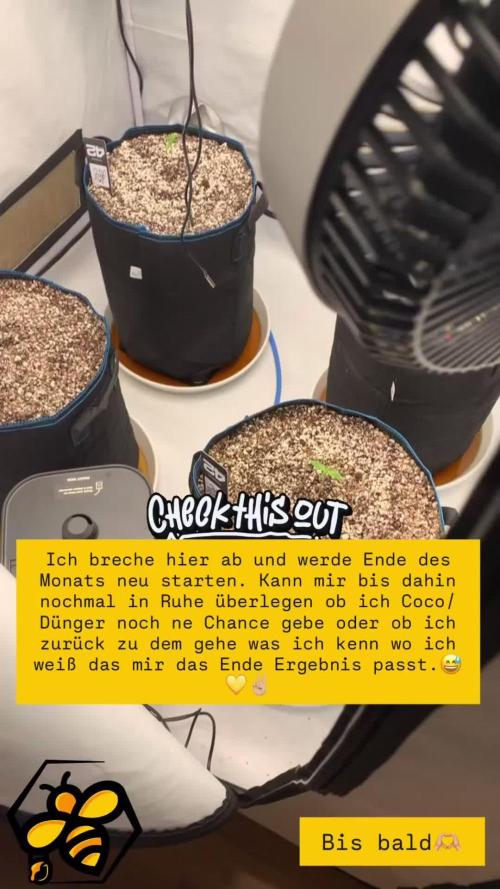
🇩🇪2.9.25 - sie sind alle oberhalb des Substrats.🎉 die Papaya Cookies hat es eilig und war als erstes da die Frost Banger kam als nächstes und die beiden Z-Ups waren gestern Abend und heute Morgen auch am Start.
Passend dazu war es zum dritten Tag an dem sie in der Erde stecken nach dem angießen heute auch wieder Zeit zum Gießen es gab etwas mehr diesmal gute 200ml pro Topf, möglicherweise etwas viel aber das verteilt sich im Topf ja gut und ich möchte auch vermeiden das die Wurzelen auf trockenes Substrat treffen.
8.9.25 - ❌Abbruch nachdem ich bemerkt habe das ich mich nicht ordentlich genung vorher über coco als Substrat informiert habe, dementsprechend hab ich zu wenig gegossen und nach 5-6 Tagen schon bemerkt das etwas nicht stimmt und sie auch nicht mehr großartig retten kann. Werde Ende September wieder auf Erde mir einem light mix neu starten.💛🏼
🇬🇧 9/2/25 - they're all above the substrate.🎉 The Papaya Cookies are in a hurry and arrived first. The Frost Banger came next, and the two Z-Ups were also in action yesterday evening and this morning.
On their third day in the ground, it was time to water them again today. I added a little more this time, a good 200ml per pot, perhaps a bit much, but it distributes well in the pot, and I also want to avoid the roots coming into contact with dry substrate. 😅💛
9/8/25 - Cancelled after realizing I hadn't done enough research beforehand about coco as a substrate. As a result, I watered too little. After 5-6 days, I noticed something was wrong and couldn't really save it. I'll start again at the end of September on soil (light mix). 💛🏼

Likes
38
Share


@Cariboo_OG
Follow
Utopia Haze is a rare heavily sativa dominant hybrid (90% sativa/10% indica) strain created through back crossing Brazilian Sativa strains. This tasty little bud took home 1st Place for Best Sativa in the 2008 High Times’ Cannabis Cup and for good reason – with its potent 18-22% average THC level and long lasting cerebral effects, Utopia Haze is one powerhouse smoke. The Utopia Haze high comes on soon after you finish your first toke, hitting you with a strong cerebral lift that infuses you with a sense of hazy relaxation.
Type: Feminised/Photoperiod
Cultivation: Indoor/Outdoor
Flowering Time (days): 70-75
Indoor Yield (g): Up to 650
Feminised Outdoor Harvest Month: October
Feminised Outdoor Harvest Month Week: 3rd-4th week
Aroma: Citrus, Woody, Pungent, Mint
Effect: Cerebral Lift, Hazy Relaxation, Sleepy
Welcome Everyone to the Final Entry of my Utopia Haze Grow !
There is so much to discuss ! I have been extremely busy as of late trying to get this Harvest together, but i am happy to have it here for you now !
I Seriously under estimated the amount of time, help from others, and my own necessary skills to pull this off.. and i still kind of screwed it up lol !
But its worth noting i have never actually done this before and trying to document it during....was extremely hard.
It is next to impossible to work an iPhone with rubber gloves on !
First I want to discuss everything step by step so before you jump straight into the comments on how the end product is so small in "quantity"
Rest assured i am happy with its"quality"...and thats all that matters to me because Life is a journey not a destination! and i have learned so much from this grow that I couldn't be any happy even if i messed some things up :)
But at the very least I hope you read through this entry in its entirety with an open mind and focus more on the process, rather than just the outcome!
I ran out of Ice & i was only able to wash three times..(normally I've heard you should go sometimes 5-6 washes)
Preparation is Key & things will be much better next round :)
Photos 1-22
These are pretty self explanatory but for those of you just tuning in now.. this is what happens to a very happy plant when you don't have the necessary tools to monitor key components of growing cannabis.. Ph, as well as EC levels play a very key role in the outcome of your grow lol that being said I was just able to save this plant by purchasing both tools but that doesn't mean the plant didn't suffer because of the prior events.. This was a Huge reason behind me choosing to turn this harvest into what i would consider
"Solventless Hash Rosin" from "Ice water extracted Bubble hash".
Pictures 23
The idea here is the process of using "fresh Frozen Cannabis" this has been discussed many a time online on such sites as instagram and here on grow diaries as well.. I personally have Never tried the process so i decided to try it out and make a judgement for myself..
Video 24
The Cannabis has now been in the freezer for 72 hours making it very well frozen.. as you can tell i struggled getting it all into the 25u Screen Wash Bag. One thing of note i would do differently is i will de-stem my next batch as i also believe this played a part in the amount of plant matter that escaped through the sieves.
Photo/Video's 25-28
The idea here is "ice water Seiving" & especially with the bags that I am using here that are only have screen material on the bottom portion of the bag it is very important to have spaces in-between the screens to allow the water to pass directly through the screens into the bottom bucket with the least amount of resistance.. because the hash is so extremely temperature dependant if it gets warm on the side of the bag.. it will stick there and not make it to the bottom to become use able product..
29
You do not need to use as much Ice as i used here lol... the idea is to keep everything very cold..i certainly achieved that but at the sacrifice of using so much that i ended up grinding product and producing "contaminants" but in the end they are just plant matter that i would be smoking when i rolled up my joint either way so.. I'm not super disappointed..
But it should be noted that what you want to achieve here is a Layering effect where you have the wash bag between two small layers of ice while the "water current" washes the Trichomes away allowing them to be separated by the screens setup below :)
Before Starting the machine you should allow some time (i.e.;10-12minutes pre soak to allow the product to become saturated) before the first cycle.
By video 32 I have just ran out of ice lol..
Video 33-34
Here I have a tip for you.. to separate the screens that you sieve through.. cut 5 gallon buckets to stretch them across nice and tight.. it'll make scooping your Bubble that much easier ! i learned this from the many "Frenchy" videos I have watched :)
Picture 35
Here in lays the problem for most people.. drying your hash without loosing vast amounts of "Terpenes" whilst also stay ever vigilant against mold !
Thanks to all those videos I've watched on youtube.. id like to think this was one of my most successful parts of this process..
Things to Note; Terpenes start to seriously evaporate at temperatures 68F or 20C
you need to stay as cold as possible whilst bringing the Relative Humidity in the space down into the 40-30% to stay away from that nasty mold !
I used my cold storage room in the basement.. with a dehumidifier running to keep the space at 45% RH & staying at a constant 15c.
All while spreading the hash as thin as possible across parchment paper, on top of the white screens with a fan moving air across both sides of the paper.
Pictures 36-38
These are some macros i took in the middle of my drying session I fell in love with the colour.
Yes i know the black spots are plant material but they will get caught when i bag the hash & squish the oil out.
Thing to Note; at this stage it is important to ensure you 'micro plane" the hash down as fine as you can whilst staying weary of the temperature... any "chunks" will hold pockets of moisture.. that lead to potential problems..ie; mold ...
Picture/Video 39-41
Successfully planed bubble hash ready to be bagged and Squished !
Picture 42
Ive decided to follow Pedro.. from Pedros Grow Room and double bag to be on the safe side so i don't have any blow outs.
So thats One 25u bag inside one 160u bag ! :)
Pictures 43
This is almost 3 grams of the bubble hash from above, already melting in the bag.. this is where i ran into trouble again lol things started getting to warm in the house and i was only able to get one of the three squish's i did on video :( things started getting sticky.
Picture 44
This is basically just a photo of the equipment I'm using; 3x5 LowTemp Cage in the frame I built myself, with a 20Ton bottle jack.
Something to note here is this is an older Lowtemp model with only a single heating zone which is which i have it closed here heating Both sides of the press :)
As well as the importance of having adequate pressure on your plates.. my rig is very overkill for the size of hash bags..lol
Video 45
Here is the lovely press video.. its didn't quite work the way i wanted either lol my directional folding wasn't quite tight enough for a big "drip" :)
&the Press was set to 65°c
Photo's 46-50 are pretty self explanatory :) I had a blow out.. but still managed to pull an 80% return from the hash once squished...& yes it tasted amazing :)
Was it worth it in the end... that could be debated.. for some..i understand..its not your thing, but for those of us that are interested in making our own concentrates.. free from Solvents...
I wouldn't make it any other way :)
If even ONE of you reading this diary finds it helpful to reference for ANYTHING.....even if its "what not to do" ill consider it a success !
Thanks again for tagging along on this garden adventure.. its been one heck of a journey !
Much Love from B.C. Canada,
Until Next time,
Cariboo

Likes
11
Share


@Styx231
Follow
Wow ten weeks already. Haven’t
Seen Any sex traits yet
Thinking girls. Been
Have issues with temp. My grow area has been warm. High 80 (87-89.). Tips are showing some like heat stress and correlation to high temps. Did some lst in areas
My solution now is to try and and keep ey adjust fans open door and so on.
But later. My next grow. I
Will Be adding legs to the box to get it up off the floor more. More air circulation.

Processing
Likes
7
Share


@Kushizlez
Follow
Day 56-63
(Day 57) I might have to fix the light to the roof of the tent so I can get another 3 inches up. The ppfd is just too intense at this height. The node stacking is super tight, I’m seeing some droop on almost every plant and the plants just look stunted. I might have to take out the big shelf I just paid 90$ for and raise the light to get the ppfd level down. This happened my last grow as well. It’s a great light for flowering but sucks ass for veg unless it’s hung 5’ above the canopy. I’ve seen videos of others with the same light and they have to fix it to the roof. The dimming function only works with a master controller I don’t have the money for right now.
Pulling bbb #2. I’m seeing very small but clear pollen sacks. It’s also drooping like crazy. The roots don’t look as healthy as some of the other males I pulled earlier. They have a slight brown tinge but still mostly white. I wonder if I accidentally gave top dressed it too many times when I mixed them all up a while ago.
I’m going to transplant bbb’s #1, #3, #6 & #7 into my 10 gallon destiny/coco pots lightly water. This is kind of a gamble because 2 of them are not showing definitively. Although I’m about 75% sure they’re fems. If not, I got my two backups.
(Day 58) I was reading about symptoms of high PH and I definitely have it indicated by the twisted and stunted growth on top. I’m going to try to water in a full gallon at 5.8 and see if I get a good response. I sprayed the pump nozzle directly into the soil after it was empty to put some oxygen into that big 10g pot.
The blackberry I gave the lowered PH water too noticeably responded within a few hours. The clawing has pretty much stopped and it now looks like the healthiest plant in the tent. I’m going to see how it responds over the next few days then try it with my other plants if everything looks good.
I’m going to try it with bbb #5 in the 1.7g pot and see if it responds in the same way. I ran a gallon of 5.8 water through 1.7g and got less than a 100ml of runoff which is a little surprising. The runoff measured 1750ppms which seems a little on the high side but isn’t insane for peat based soil.
(Day 59) Wow. The plants responded to that little PH adjustment insanely well. #5 isn’t dropping at all and the leaf wrinkles are actually flattening out. It’s starting to look like one of the healthiest plants in the tent. I’m still hoping for #5 to show female. 5 plants would cut my veg time down and give me another opportunity for a keeper pheno.
All 4 plants are looking like they’ve already recovered from their transplant. #1 in particular was drooping like crazy yesterday and today it’s bounced back and looking happier than ever. I’m seeing a bit of tip droop on a few plants but they still seem fine
I wonder if because my soil is 50% coco I should try watering on the acidic side, around 6.0-6.2 from now on. I’m almost certain that solved all the issues I was having.
(Day 62) Plants are all looking really healthy. They all seem to have outgrown the initial light stress actually but node stacking is still really tight and I hope to raise the light up next week sometime.
I’m going to drop the humidity to 60% for the rest of veg.
These pots are massive and I’m still a little worried about dry downs but they aren’t showing any signs of overwatering or lack of oxygen.
BBB#3 is starting to show some weird discoloring like an mag or nitrogen deficiency. Which is weird because it’s freshly transplanted into nitrogen rich soil. Guess I will give it a kelp foliar spray.
I’ve been looking for a good organic source of K without an absurd amount of magnesium and sulfur like langbeinite has. I found some 0-0-15 kelp/seaweed extract in soluble crystal form. So from time to time I will water that in at half strength or with compost teas to keep my soil K dominant.
(Day 63) I’m still waiting on #6 to show sex. I am shocked it hasn’t shown sex yet. Although it was started a week and a half after the others but still. I’m going to be so pissed if it ends up being a male. I’m taking a gamble but I’m confident it will show female when the time comes.
bbb#3 got a little more color back from that foliar spray. Hope that doesn’t get worse because it’s my favorite pheno so far. I will give a N boost in the form of compost tea tomorrow afternoon to both of my tents.
I’m starting to utilize the scrog net and boy does it make training way easier. This seems to be a much smarter style of growing for yield and quality.
I’m getting tired of these pH fluctuations every time I water. I’ve been eyeballing for the most part and I need a consistent formula. I found the perfect mix to stabilize my RO water and stabilize the pH at 6.2. I moistened the top soil of each plant and will watch for any reactions.
Water recipe:
60ml bottled water
2000ml RO water
3ml calmag
2ml microbes
Likes
11
Share


@ganjaman24
Follow
It’s bern roughly two months these guys have been growing! Lst’d Both but untied the gg because I wasn’t sure she was benefiting from it so I’m going to do it over. These ladies (I hope) will start their flower journey next week when I revive my new flower tent 😎..stay tuned for some epic buds..I hope!!


Likes
18
Share


@Luca90
Follow
Today 23/07/22 We are two days into week 5, never talked about nutrient or water’ problems I had some leaves with few yellow marks but very small one beside that I always saw my plants green and happy, here you can see the scrog I set up yesterday not sure if this will work better but I think will help the branches grow further from the others increasing the light they riceve! I made it myself I will order one for the next grown when I will get my grow box! The watermelon is already flowering but the northern light no so today I started feeding the plants with different preparations.. I kept on giving the grow booster with a bit of bloom booster and viceversa for the watermelon! If you have any tips anything you think I’m doing wrong or you see it’s not ok let me know I don’t grow in a box I grow between the curtains and my window so the environment wasn’t always the perfect one

Likes
3
Share


@Thirteen13
Follow
Looking really good. And got like this crazy mango smell like that solero icecream ... 🤤🤤 They are in day 38 blooming now.. So 17 to 20 more days till pey

Likes
5
Share


@CannaIGrow
Follow
This plant seems to have grown much denser and better than my first plant. I just got the ac infinity ventilation setup with controller 69 for my 2x2, still trying to learn, hopefully grow #3 goes even better. Stay tuned
Likes
5
Share


@AustinRon
Follow
IRIE Genetics 4 Grow
IR1Q Veg Week 4
Cultivars
Purple Heart [5] (Cherry Jelly CBD X Afterglow)
[Fem/Seeds]: PH1Q24, 65 Days
Scarlet Begonias [1] (Haze X William’s Wonder) X Arise)
[Reg/Seeds]: SB1Q24, 70 Days
Lemon Jeffery [2] (Lemon Skunk X Golden Goat)
[Fem/Cut]: LJ124, 70 Days
Environment Plan
Vegetation
- Temp: [ 82,°F]
- RH: [ 72, %]
- VPD: [ 0.85, kPa]
Fertigation Plan
- Seedlings
- RLA Light Week 4: EC: [ 1.5 mS] (0.8 Nutrients + 0.3 Filtered Tap Water)
Biology: # (One of…)
- Photosynthesis Plus: [ 6, ml, gal]
- King Crab: [ 0.5, ml, gal]
- Mammoth-P: [ 0.6, ml, gal]
Line & Res Maintenance:
- SLF-100 Enzymatic Cleaner: [ 5, ml, gal]
Foliar Feeds
- RLA Foliar Schedule
Start of Week: [ Wed 28 Feb, 2024, IRIE1Q24 29:V:4:1]
End of Week:
[ Tue 05 Mar, 2024, IRIE1Q24 35:V:4:7]
__
Wed Mar 6, 2024
IRIE1Q24 29:V:4:1
Planning on flip today - we still need to deal with Topping and sufficient start height.
- [ ] REDO Diary Index once Flip DETERMINED
- [x] Rooted Leaf Foliar: CalMag Fuel: [ 20, ml, gal], Lush Green: [ 5, ml, gal]
- [x] Post Grow Diary
Fertigation 330 ml/plant
1845: 120 * 8 (960 ml)
- Fertigate 120 ml/plant
2200: 210 * 8 (1680 ml)
- Fertigate 210 ml/plant
2640 / day
330 / plant
Irrigation Calibration
Line 0: 100 ml, 12 second lime fill +120 sec, 775 ml 7 lines
Line 1: 100 ml, 225 sec, 650 ml 7
Line 3: 100 ml, 208 sec, 750 ml
lime 4: 100ml, 215 sec, 725
__________________________
Target 440 ml/ Day
4 Fertigations/Day
11 Hour Duration
2h 45m Frequency, Lights On
2.16 sec/ml/plant feed rate
Fertigation Duration: 235 seconds
Once Running - We need to calibrate on RUNOFF.
DURATION PER EVENT 200s (3 min, 20 sec) ( 92 ml/fertigation/plant)
Event 0 3/6/24 19:00
Event 1 3/6/24 21:45
Event 2 3/7/24 00:30
Event 3 3/7/24 03:15
RLA HYDRO: EC 1.8, 2 Gallons to Res
Primer A & B: [ 16, ml]
Silica Skin: [ 8, ml]
__
Thu Mar 7, 2024
IRIE1Q24 30:V:4:2
Prep Reservoir: # 2 Gal, EC: 1.5
- [x] Primer A: [ 8, ml, gal], [ 16, ml]l
- [x] Primer B: [ 8, ml, gal], [ 16, ml]
- [x] Silica Skin: [ 4, ml, gal], 8, ml]
- [x] King Crab: [ 1.0, ml]
- [x] Dr. Bronners Soap: [ 10, drops]
- [x] SLF-100: [ 5, ml, gal], [10, ml]
- We’re attempting to assure we ONLY use low sediment inputs (clean lines). ONLY Low/Non-Precipitating inputs . . .
Messed up initial mix, Only achieving EC 1.5/No Change … ok for a day or two . . .
1100 - Ran total of 320 sec. 320/2.16: ~ 148 ml
@220 sec per fertigation, we should be delivering ~92 ml/event
Or 368/plant/day.
This implies
- Deliverered to Tent: 2944/day
- 10% Runoff: 294/day
We’ll be looking for ~300 ml runoff @ Lights on @ 1900
- [ ] ADJUST Fertigation Duration to achieve
294 ml/day
__
Fri Mar 8, 2024
IRIE1Q24 31:V:4:3
I’m pretty much sure we’re delivering significantly less Fertigation than we think. Ran pump for a FULL 9 Minutes at noon. There has been no runoff, and plants are not terribly happy. I think we’re severely under watering.
Solution - Buy pump with advertised 6’ HEAD,, 35 Watt SICCE Syncra 2.0.
- [x] Order SICCE Syncra 2.0 from Amazon
- [x] Order 3/4” NPT Male to 3/8” Barb
Fertigation Observations
We need to be able to irrigate in minutes per event, NOT 10’s of minutes. The Little GIANT transfer pump LACKS sufficient HEAD to consistently deliver across the irrigation rings. The new pump should be able to provide sufficient pressure to do . . .
Pressure (psi) = .433 * Height (ft)
Alternatively
2.31 ft/psi
The Syncra 2.0 has a 6.5’ Head, delivering ~ 2.8 psi, 10% of the max flow at the manifold, meaning the pressure restrictor, won’t.
Ex.
- If we Deliver @4ft, we have (2.8 - 4(.4333)) or 2.8 - 1.7 or 1.1psi
IFF We’re not getting decent flow, will have to RAISE TANK 2.3 Ft to achieve 2.0 psi or more …
- [ ] Rooted Leaf Foliar: Solar Rain: [ 20, ml, gal], Peak Bloom: [ 5, ml, gal]
ONCE WATERING IS RESOLVED and we have obvious Vegetative growth . . .
- [ ] Top to Node 4
- [ ] Clone Tops
- [ ] CLIP Growth Tips Nodes 1 & 2 (Leave node 3 tips for clones in 2 weeks)
- [ ] FLIP TO FLOWER: Drop Intervening Dark Hour (Tent Light Controller)
- [ ] RE-Index Grow Log to Flip ‘This’ date . . .
__
Sat Mar 9, 2024
IRIE1Q24 32:V:4:4
Removed Pressure Restrictor from XeriBird8 Manifold and cleaned well.
Replaced Little Giant pump with SICCE Syncra 2.0 (6.5’ head). The little giant was probably fine . . .
__
Sun Mar 10, 2024
IRIE1Q24 33:V:4:5

KEY Problems were the back flow protector on the Little Giant that reduced flow 1PSI, and flow restrictor on Xeribird8 for 10x the pressure of our little system. We’re lucky to have a couple of PSI at the emitters. That said - we produced ~1.5 gallons of runoff yesterday. To maintain runoff (but less than 1 GAL!), I’ve HALVED delivery times. Goal is to reduce runoff to ~10% of estimated delivery …
Current Fertigation Run: 5 min Duration, 4 times in 11 hours.


We’ll FLIP on Week Change - give a couple of days for root development, some more height.
We need to
- [ ] Would like to grow to middle bar of tent BEFORE topping.
- [ ] VERIFY ROOT POPULATION AT BOTTOM OF CONTAINERS BEFORE FLIP. (If we’re well populated, we’ll rock - delay FLIP UNTIL All containers need to demonstrate significant root development around periphery of the bottom of each airpot.
__
Mon Mar 11, 2024
IRIE1Q24 34:V:4:6
- [ ] Rooted Leaf Foliar: Solar Rain: [ 20, ml, gal], Silica Skin: [ 20, ml, gal]
__
Tue Mar 12, 2024
IRIE1Q24 35:V:4:7
Runoff: [ 700, ml], [ 1.0, mS]
During Dark - Flushed RLA CalMag Fuel, ~ 450 ml/plant @ EC: 1.8 mS
- I’m not convinced I properly buffered the coco. Will do this weekly if Coco induced Calcium deficiency observed.

Likes
5
Share


@Hydroponicfarm7
Follow
Terminamos la 2ª semana de floración, pese a estar a 30cm del lec, estiró más de la mitad de la anterior semana, solo hay que ver las primeras fotos que son al comienzo de la 2 a ver el vídeo que es el día que terminó. El único inconveniente es la humedad, no consigo bajar del 60%. Para ello haré una defoliación agresiva para evitar hongos, espero no arruinar el cultivo por culpa de la humedad. Seguimos firmes 🤟🏼☄️

Likes
35
Share


@Ganjagrandaddy
Follow
Hi all. Here we are with a full 7 days behind us in flower. The decision to flip was a necessity so i am hoping to still get a hint of the terps and potentcy of the small ladies.
Sweet Afghani is not looking too bad fornher size now , she has been stretching and trying to get her size to catch up. I dont expect a great yield from her at all.
Red Hot cookie is still really struggling. She is trying but i dont think she will bring much to the game now. Her colour is an indicater of her root damage i feel.
This issue with the NFT and root rot has given rise to another opportunity to try the new sp3000/out fully amd with a focus on the big soil grown Amnesia haze.
Amnesia haze has flown during the stretch so far and still has a few days left to go with it. I have been training her flat amd now am close to letting her go vertical. She is approx 3ft across now with growing tips coveringnjer while frame. She has sent a few decent sized bramches to the top but these have been retrained again. Her stems are solid with a near perfect quad guiding their frame. She is in 60L of living organic soil and sips a good 8L per watering. I amended with the ecothrive stuff and also added another layer of manure mulch today as they are going to need a boost to finish the stretch. She is smelling nice and fruity now with a slight tacky feel to her stems too. She possibly has at least 50 tops that are in good light. By using the sp3000 amd sp250 in combination this way i am hoping to keep her well spread with plenty of high par for all the bud stacks i hope to see. I am impressed with this strain and will be growing it again sometime. The living soil is also proving a winner yet again for me.
Until next week. Be safe and well.
Likes
23
Share


@ILoVeThiSpLaNt
Follow
Giorno 35
Tutto perfetto 👌
Ec a 1,74 piante in salute qualche insetto innocuo qua e là.
Ci vediamo settimana prossima 🖐️
Likes
11
Share


@4_Pro2Bono_0
Follow
Everything after germination has been pretty smooth. The plants in veg had a couple small brown spots due to under watering but no extreme signs or any abnormalities.

Likes
14
Share


@BOMbolenath
Follow
We are very close to the harvest. One more week and it's good to go.
Feeding with water only. No more nutrients. Aroma from this plant its incredible, its like a very good man's perfume. Musky with fruit like tangerine and mango. Incredible.

Likes
8
Share


@Area420
Follow
87 days from 🌱 and frosty as heck. Wet trimmed and hanging to dry now. Just starting to to notice a little more smell but definitely not loud yet. 60 grams into jars. Taste earthy, piney, berries and citrus. Overall a great growing experience and I'm glad I have more of these beans!
Likes
59
Share


@HarrysOG
Follow
lovely OG to grow, touched my plants with oil on my fingers dumb move hey see video. This is 1 of the easiest strains I have ever grown in 0ver 30 years, topped once no lst and thrive at a ph of 6.7 they use everything around 5litres in 4 days the pots are light and dry but not bone dry.

Likes
16
Share


@Mopish
Follow
Correct Math
- 185w * 56 days of veg (18h)
- 390w * 70 days of flower (12h)
- 46g dry material
- Total space around 37.5% of the tent
Veg cycle:
185w / 1000 = 0.185 kW/h
0.185 kWh x 18 hours per day = 3.33 kW per day
3.3 kW per day x 56 day veg cycle = 186.48 kW per veg cycle for the whole tent
186.48 * 0.375 = 69.93kW for the area covered by the plant
Flower cycle:
390w / 1000 = 0.39 kW/h
0.39 kWh x 12 hours per day = 4.68 kW per day
4.68 kW per day x 70 day flower cycle = 327.6 kW per flower cycle for the whole tent
327.6 * 0.25 = 122.85kW for the area covered by the plant
Total:
69.93 kW (veg) + 122.85 kW (flower) = 192.78 kW per entire cycle for the area covered by the plant
46 grams dried / 192.78 kWh = 0.23 grams per kW
---
Total Harvest
Total Harvest = 11g Choco + 66g KDA + 46g BC = 123g
Total kW = 186.48 + 327.6 = 514.08
123g / 514.08 = 0.23 grams per kw