Likes
10
Share


@TiRobotProds
Follow
Les plantes sont totalement givré,une forte odeur se dégage de la tente je ne serais dire ce que c'est. Une tige c'est brisé sous l'effet de la chaleur par conséquent changement d'ambiance pour ces dames.
- cette semaine j'ai enlevé les petites têtes qui n'allait pas gonflée pour permettre à la plante de rédiger l'énergie vers les colas principaux. Pour finir une des gorilla sherbet a des teintes rougeâtre violet a voir.
Likes
19
Share


@pifflestikkz
Follow
Day 8
08/07/24 Monday
Light water with De-chlorinated tap pH 6.2 with half t spoon of DyNoMyCo.
They seem to be loving it!!
Germination week complete, Let's start the VEG 🤩
Updated short video

Likes
44
Share


@MadeInGermany
Follow
Unfortunately, I had to find out that my account is used for fake pages in social media.
I am only active here on growdiaries.
I am not on facebook instagram twitter etc All accounts except this one are fake.
Hi everyone :-) .
The lady explodes from day to day :-).
In the next few days she will be trained again (topping), then introduced into the network and in 5-10 days already open to flowering.
Most of the time, at Aerophonic, 1-2 weeks of vegetarian food are enough to fill the entire tent at the end :-).
The water tank was completely remixed and filled 👍.
The Ph / Ec measuring device was calibrated and the whole tent was cleaned.
The lady was examined for diseases and animals and everything is great 👍😊.
I wish eucb a lot of fun with the update and everyone stays healthy 🙏🏻
You can buy this Strain at
www.Zamnesia.com
Type:
Runtz
☝️🏼
Genetics:
Zkittlez
X
Gelato
👍
Vega lamp: 2 x Todogrow LED CXB3590 COB 55 W
1 x Sanlight S2W 62 W
💡
Flower lamp : 2 x Todogrow LED CXB3590 COB 55 W
1 x Sanlight S2W 62 W
💡 ☝️
Grow Aero System : Growtool 0.8
☝️
Fertilizer:
Canna Aqua Vega A + B , Canna Aqua Flores A + B , Rizotonic, Cannazym, CANNA Boost, Pk 13/14, Canna Cal / Mag, Canna Ph - Grow, Canna Ph-Bloom
☝️🌱
Water:
Osmosis water mixed with normal water (24 hours stale that the chlorine evaporates) to 0.2 EG. Add Cal / Mag to 0.4 Ec Ph with ph- to 5.2 - 5.8
💦 💧

Likes
54
Share

@MadeInGermany
Follow
Hey guys :-)
We come to the end of the diary and thus to the penultimate update before the Smoke Report.
As always, the lady was hung upside down to dry.
At temperatures of 18-21 degrees and 54-60 % humidity.
After 14 days they were neatly hand trimmed and placed in jars for remote harvesting.
Report:
I am very happy to write this report.
The lady's overall growth was perfect from start to finish.
And I don't just mean perfect, I've never seen such a beautiful variety with such beautiful flowers 😍.
She had no problems with training ( topping ) and was very easy to grow.
The yield was above average, which plays a minor role.
In the end, the best yield and the most beautiful appearance of the buds mean nothing if the taste doesn't match.
And here is exactly the miracle where all 3 features not only fit but are perfect.
Now we come to the third and most important feature the taste :-).
It not only smells incredibly delicious but tastes just as delicious ☺️😍.
In the smell you can clearly see the choco notes as if you were opening a pack of chocolate.
In the taste, this tone comes into its own a little more easily, but the notes of cheescake and fruit are all the stronger.
It really tastes extremely delicious and has a very strong terpene profile 💚.
I absolutely love it and will be making more phenotypes of this strain.
Clearly deserves 10 out of 10 stars and a huge compliment to the Amsterdam Genetics Team 🙏🏻💚.
The smoke report with the finished flower pictures will follow shortly.
Until then, I wish you lots of fun with the update and stay healthy 💚🙏🏻
👇🏼👇🏼👇🏼👇🏼👇🏼👇🏼👇🏼👇🏼👇🏼👇🏼👇🏼👇🏼
‘Powered by GreenHouse Feeding’
Copy the link for 10% off all Nutrients 👇🏼
http://shop.greenhousefeeding.com/
affiliate/madelngermany_passiongrower/
👇🏼👇🏼👇🏼👇🏼👇🏼👇🏼👇🏼👇🏼👇🏼👇🏼👇🏼👇🏼
You can buy this strain at :
https://www.amsterdamgenetics.com/product/choco-cheesecake/
Water 💧 💧💧
Osmosis water mixed with normal water (24 hours stale that the chlorine evaporates) to 0.2 EC. Add Cal / Mag to 0.4 Ec Ph with Organic Ph - to 5.8 - 6.4
MadeInGermany

Likes
2
Share


@mkannon10
Follow
The white residue is from Epsom salt foliar spray...
Hydroponic buds (Banana Daddy) are getting noticeably denser than soil (Pluto Runtz)

Likes
46
Share


@SwissKush
Follow
Day 64 - time to ripen these monsters up
a. the buds are hard as rocks
b. the FloraKleen flush for 24 hrs always helps get ready for the ripening bomb
c. pumped out DWC, and installed new Ripen nutrients, 15L
Day 65 - growing more
a. buds will become even fatter over the next two weeks
Day 66 - ripening
a. added 5L to the DWC, smaller buds are getting larger
b. observed the trichomes under microscope, still too many clear trichome heads for my liking
Day 67 - hardening up
a. the main colas are becoming very hard, this i like
b. they are finishing up, we are in the home stretch for sure
Day 68 - beefing up more, they are ripening nicely
a. the main top buds are becoming more round barrel like
b. they really look like pineapples, the smell is very berry/tropical like.
c. she is drinking 5L a day right now
Day 69 - still maturing nicely
a. thirsty as hell
b. frosting up all over the place, most all stigmas are orange
c. the buds are rock hard
Day 70 - amazing plant
a. she is drinking 5L a day
b. frosting all over the place, the buds are getting longer and fatter
c. looked at the trichomes, almost ready, a few clears are left, we are going longer


Processing
Likes
14
Share


@Mr_Og_GreenThumb
Follow
Week 12, Day 83 from seed and 3rd day of flower.....The 5 day of this week officially marked the start of the flowering season!! So I flushed both of these bad boys with ph'd water for two days and then today I switched them to 12/12. I gave them their first dose of bloom nutrients and then lollipoped them as you can see, pixs . Grateful no issues to report for the past 3 weeks have been trouble-free!! I'm going to leave the MH bulb in for an additional 2 weeks to prevent any stretching before switching to the HPS. But so far they are still loving their environment. I'm also in the process of keeping clones of fat banana and hulkberry while i try this new strain of Peanut Butter Tree.

Likes
6
Share


@King_of_Autos
Follow
gestern 40ml Bananen PK von Biotabs auf 3Ltr gemischt und jeder Pflanze diese Dosis verabreicht....
Rest ohne Worte!
Likes
3
Share


@Kokot
Follow
First week to flower (i think all plants stopped growth and only flower) should i be adding Growth nutrients? Also i m going to vacation again, if i come back and the flowers are underwatered again… i will knockout the shit out of my roommate and kick him out.
Also i wrote to every single plant what strain i
Think it is… just my guesses
Likes
2
Share


@toriyama
Follow
Wie man sieht, haben die beiden F1-Samen ein enormes Wachstum gezeigt, während das Apple Flitter langsames Wachstum zeigte. Ich baue zum ersten Mal F1-Autoflower-Samen an und die Wachstumsrate ist wirklich beeindruckend. Nach drei Wochen habe ich Holzstäbchen zur Unterstützung hinzugefügt, und die Wachstumsrate der F1-Samen ist weiterhin beeindruckend. Sie sind bereits bereit, Blüten zu bilden.
ご覧の通り、2つのF1種は驚異的な成長を見せたのに対し、Apple Flitterは遅い成長を示しました。私は初めてF1オートフラワーの種を育てていますが、その成長速度は本当に驚異的です。3週間が終わった時に木の棒を挿して整理しましたが、F1種の成長速度はやはり驚異的です。すでに花を咲かせる準備ができています
Likes
34
Share


@ClubRiot
Follow
BCN Power Plant
Week 15
11L Pot
LED: SP250 (245W) for Flow. Stage
Canna COCO
Mineral Nutrients:
👇
Sensi Cal-Mag Xtra: 1 ml/L
Power House Part A: 1.5 ml/L
Calcium Plus Part B: 1.5 ml/L
Stimulus: 1.5 ml/L
Bud Explosion: 1.5 ml/L

Likes
14
Share


@CURATI_DA_SOLO
Follow
Veramente incredibile, la quantità di tricomi è indescrivibile! L'odore e fortissimo le cime sono durissime!!! I tricomi sono tutti bianco latte...finiró la settimana e poi inizierò a fare il risciacquo finale!!! Non vedo l'ora di assaggiare questa prelibatezza di fast buds!!! Come il solito rimango sempre allibito dalla qualità delle genetiche di questi ragazzi secondo me questo è uno dei migliori ceppi che ho coltivato entrerà sicuramente nella mia top teen!!! Grazie per essere passati da qui peace and love!!!
Processing
Likes
Comments
Share


@Hexus
Follow
Days 78-84 - Been lax in updates, but I still log every week to completion. Back injury in addition to The Nineteen, Rona Style, has been a bit of a pain in the posterior. (That means ass) Plants are gigantic and sassy. Had Dangergirl come out and defoliate/lollipop the bottoms out of the girls, saving me painful labor and increasing my yields, so yay for her! Plants are happy, pompoms are getting thick, and everything looks good. Switched FF01 to flower on day 84.

Likes
57
Share


@Kmikaz420
Follow
Bonjour a toute et tous alors voilà première plante couper normalement je lui aurait laissé encore 5 jours mais la plante commencé à tomber par terre et j aime pas que les tête trainent dans la poussière 😀 donc j ai couper hier la première cherry cola et demain la 2eme suivi de la gorrila x purple punch mais pour les prochaine j ai le temp (elle tiennent debout encore) je vais completer le journal cette après-midi voilà voilà bonne journee..
Et voilà la 2eme cherry cola à été couper aussi et quel beauté !!! Cristallisation au top , odeur sucrée que j adore (vraiment c est une de mes autofloraison fast bud que je préfère !! Si vous ne l avez pas tester je vous conseille de le faire (ils ont pas menti en disant (modern master pièce)
Bon comme dit sur le journal gorrila x purple je ne peut pas peser le poids humide (plus de pile dans la balance)
Mais je vous mettrez le poids sec dès 3 plantes qui sont entrain de sécher..
Et d ici la les strawberry x gorrila et dos i dos auront fini leur flusch ..
Voilà c est tous pour aujourd'hui les amis..
Petite update vue que j vien de mettre la première cherry cola en bocale avec un jolie 88g sec et trimer se qui est pas mal du tout si on prend en compte que j ai du la recolter une semaine avant sa sœur vue quel ne tenais plus
Voilà voilà les plantes on été sécher et mis en bocale j ai obtenu 170g (sec )
De têtes bien dense et couvert de trichomes vraiment un bag-apeal de folie!!
Likes
15
Share

@Rangaku
Follow
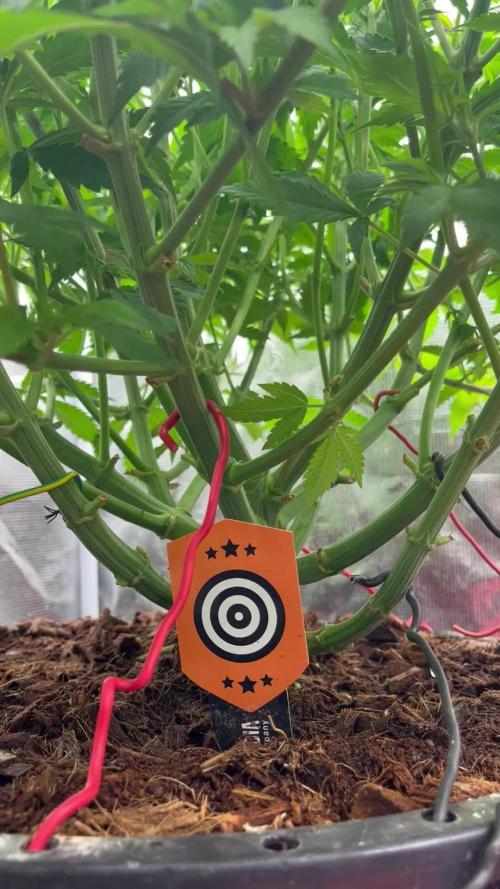
Switched to 12-12 4 days ago and she’s bushing up and taking off . Just gonna keep up the defol and tie down next week and watch her stretch .

Likes
12
Share


@Jays_Not_Here_Man
Follow
This was an easy grow, and had some amazing results. This is some of my best homegrown to date ❤️ the ladies were easy to manage, no PM, pests or disease. The root balls were enormous, wasn’t much soil to recover. They got heavy in the end from the weight but managed to stay upright for the most part. They were big stretchers , prepare for that, scrog was a good way to go but some of the eager beavers got away from me, which ended in some massive colas. Overall easy to grow, no surprises and you won’t regret the results! 10/10 ❤️👊🤤

Likes
12
Share

@Mannirumpel420
Follow
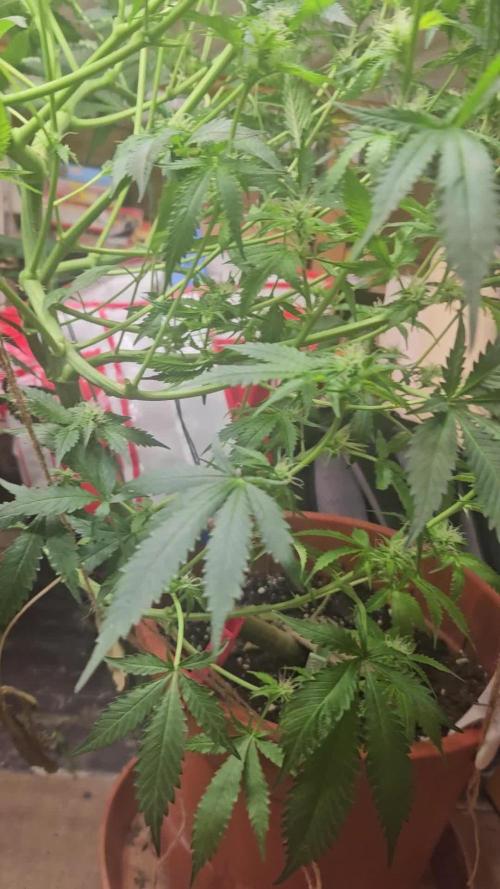
Ich habe wirklich Probleme mit ihrer Größe.Ich probiere heute sie mit einem scrog Netz etwas kleiner zu bekommen.Ich habe sie nun doch runtergebunden und supergecropt,da beim Versuch das Netz zwischen 2 Hockern zu spannen einer auf eine pflanze gefallen ist und ein trieb beschädigt wurde.Ansonsten bekommen sie weil sie jetzt so breit sind an manchen stellen wenig licht ab.Sie sollten sich aber wieder etwas aufrichten.