


Likes
Comments
Share


@BruWeed
Follow
18/10 - comienza su quinta semana en etapa de floracion. Su evolución fue muy rapida, apenas entro en flora cambio totalmente la planta. Los cocos están perfectos, super resinosos con olor muy fuerte.
El banco de semillas recomienda que este en flora de 8 a 9 semanas. Seguramente la deje hasta la semana 8. Esta bastante avanzada. No tuve problemas en ninguna etapa. Sin dudas es una genetica que volvera a cultivar. Cabe aclarar que esta planta genera mucha resina por que es ideal para extracciones.
Podes seguirme en instagram como @bruweed_arg

Likes
3
Share


@tontodedoverdee
Follow
So finally this week the plan was looking strong enough to be trained, initially I've lift the plant from his seedling bed, i moved her more on the side of the tent to have more space to bend her and give more open space to the lowest branch, after just 12 hours the plant was already fighting the training pointing the top cola to the closest source of light

Likes
1
Share

@ElCapitol
Follow
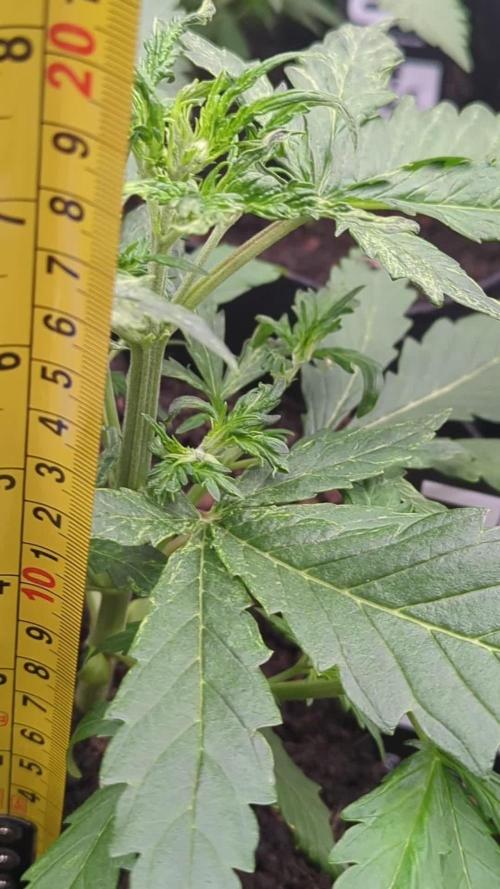
Well, I can only apologise to 42fastbuds I top watered and left a small pool in the crown of the plant by mistake and now she's taken some damages. Learn from my mistakes people, don't leave feed solution on your plants:(
This is my fault and not a genetic issues. User error 😆
Despite my mistake she has still doubled in a week and now she shows signs of recovery so all is not lost yet.

Likes
83
Share


@RunWithIt
Follow
What a fun experience! This was my first time trying a mixed grow style of synthetics and organic. I think I may have found my new go-to strategy. This definitely wasn't a perfect run by any means - as a matter of fact, I botched the feedings earlier in her life. However this grow definitely taught me a lot more about how to treat this strain properly. Now I'm running her clones in the 3x3x6. So the legacy will continue! Let's see how this strain does during the summer months!
Cheers everyone! This has been an awesome grow. What I'm lacking in yield, I yet again make up for in quality. And I don't think yield will be an issue with the clones, they're week 6 veg - and quite massive!
- RWI out!! 😁 😶🌫️🤑

Likes
16
Share


@DeepRootsGrowTrees
Follow
Week 11 I though she was gonna be done this week only gave her RO water for the last 2 weeks but looking through the loop her trichomes are still mostly clear so I think I'll give her one more week. She looking great, smelling great, buds look amazing. Tried to get some good video so you can see how lovely she is!!
Likes
121
Share


@NuggetPawn
Follow
Left and right have both been topped for the second time on D31.
Increased the EC and the plants seem to be growing very well!
Have started to train the plant in the middle out, the other two I am not going to train until D33.

Likes
2
Share


@Aleks555
Follow
Our beauty is now 6 weeks old and has officially entered the flowering stage! She has gained noticeable height and bushiness, showing off her healthy growth and vibrant energy. We've installed a net and gently guided her underneath to maximize the potential of each branch and ensure even light distribution.
The light schedule remains 12/12. Daytime temperature is a steady 28°C, nighttime drops to 21°C, and humidity stays at 65%. We continue feeding her with Xpert Nutrients, providing all the essential elements she needs during flowering. CO2 supplementation also continues, supporting her vigorous development.
A huge thank you to Xpert Nutrients for their top-quality fertilizers — it’s thanks to them our girl is entering the flowering phase with such strength and confidence!
Likes
2
Share


@BenandLippisfinest
Follow
100% Krönungsrate wie immer bei Fastbuds bisher, wir sind wieder sehr gespannt auf die terps
Likes
8
Share


@DWCpaqy
Follow
New week! Tips and help from last week, I had around 1500 ppm and I did flush my roots in water and change everything. Now is around 1000 ppm and dropping 150 ppm a day.
Did read about water level in DWC and how to increase the grow with water. I had the water almost up to the root or the level of there the basket is. Now I have 1-2 inch (2-5 cm) below where the roots come out. This create air roots. I'm not sure if it's the air roots or the ppm but my flower is boosting. Can se buds grow!!
Trimming so I can keep the same hight.
Have any tips or rekomandation?
Only have one question for next week and this is: it's looking a bit thigth between the buds and all of the leaf is cristal on it. Should I cut some more leaf? And what leaf should I trim? Is so thigth in there. Or will it grow fine?

Likes
7
Share


@CampaCavallo
Follow
1📆 Fioritura:
Uuu che bellezza la ciliegina perduta😍🍒 è cresciuta parecchio in dimensioni ed ha iniziato a produrre dei bei peletti bianchi🤪


Likes
20
Share


@TiRobotProds
Follow
- Super semaine plante vigoureuse boit beaucoup d'engrais pas de signe de brûlures. Elles ont doublée leurs tailles durant cette semaine affaires à suivre..
🌍 🌎 🌏 Frère cultivateurs cliquez et suivez venez partager vos connaissances. #LoveUnityAndPeace 🙏 🤲

Likes
39
Share


@Dapper_Buds
Follow
What’s going on lady’s an gentleman. We got the GSC going into week 2 of flower an week 12 from seed. She is booming everywhere with pre flowers, training her out as she stretch’s to the outer edge of the tent. She is currently in a 7 gal fiber pot with living soil ph to 6.5 an thriving all the way. Stoked to she how the flower stage goes. Thank you for viewing an happy growing.

Likes
10
Share


@Barzenegger
Follow
It's been 8 weeks already, I had practically lost 4 weeks due to the "anonymous" debacle and the plants weren't looking too great - aside from Sour Strawberry, which was odd looking, because it kept topping itself but otherwise perfectly healthy.
So I decided to flip to flower.


Likes
Comments
Share

@AkatsukiVirtue
Follow
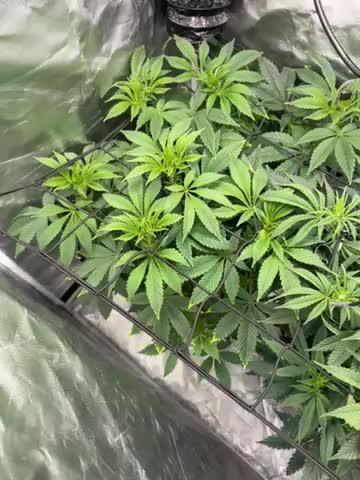
Started Flowering GPA Cookies and Money Maker.
Left the Chocolate Skunk clone to get bigger before flipping to flower since I know the plant doesn’t stretch much during flower.


Likes
14
Share


@Redbud66
Follow
Lots of bud sites coming out.
Day 46 Gaia green top dressing for the 3 Gelato’s

Likes
15
Share


@BastiFarm
Follow
Actualización semana 11 de vegetación, cómo se pueden ver en las fotos un cambio notable en los clones, ya casi listos para pasar a floración, han crecido bastante desde la última publicación.
Las 2 plantas Kukulkán muy robustas y vigorosas, tienen un aroma muy dulce y fuerte, hay unos de los clones que los deje en maceta de 1 L para ver la diferencia de crecimiento con los clones que están en maceta de 7 L,
Ya empecé estimulando las 2 que labra amas grandes agregando 2 Ml de fertilizante de floración y disminuyendo el de vegetación, ya está otra semana pasó a floración así que metabólicamente estarán preparadas para el cambio de ciclo 12/12 , tengo pensado sacar otros clones de los mismos clones ya hechos, así que espero salga todo bien para mantener esta hermosa genética en mis manos.
Temperatura indoor: 20-24 grados
Temperatura agua de riego: 20 grados
Humedad relativa 50%-60%
Ec 2.0 ( clones 0,9)
PH 6,5 (clones 6,3)

Likes
40
Share


@Ukfarmer420
Follow
Hi guys
lost track of where i am now lol so we will run until there done lol I got a seprate dry tent now so makes my life easier.
1 purple startdawg lst
1 green startsawg lst
1 cheese lst
1 cheese oh natraul grown with polyploid
2 x pot noodle blueberry
1 x blueberry lst
3 x baby photo period big budha cheese.
Leave me a comment let me know your thoughts so far.
Likes
28
Share


@Uwish
Follow
Not much to say about this week.
I still have not taken over ORGA Bloom which is my base and I will not do it until the end of the culture.
We see that the resin is present and that the heads grow. I’m not going to leave it at that, so I’ll tell you what I’m going to do for week seven of flowering.
So I do not take back my base but I keep my additives and I add two products to make my heads swell, Nirvana and Overdrive from Advanced Nutrients to the recommended dosages.
I will also increase my watering volume to 6L of nutrient solution for 14L of substrate.


Likes
13
Share


@IQuSX
Follow
Hi, topman!
Now at after 11 day and 10 week, because couldn’t added report- media and over last report.
We have problem with leaf-yellow! WTF-may be, because system worked in ones every time…
Check next, and thank you for your time!
