The Grow Awards 2026 🏆 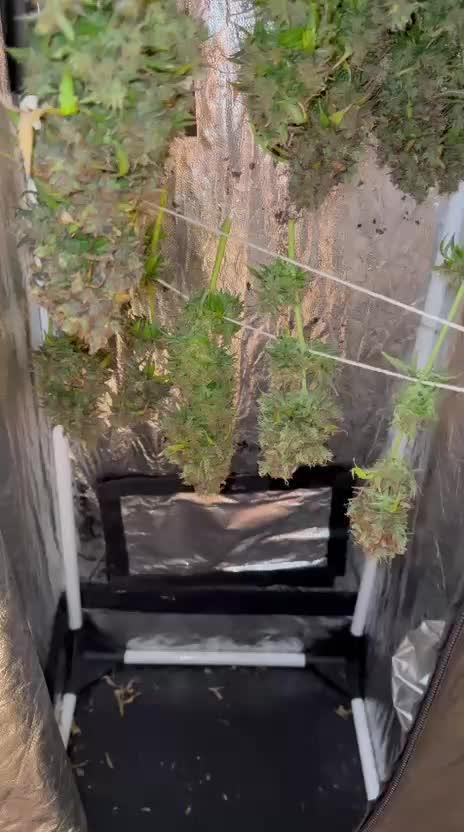








Likes
2
Share
@LIPANJA
Follow
KKKK omg
986 g wet with branches, and trimmed only the parts that were very dry. The smell is moderately strong, very sweet and pleasant. I believe that once dried, trimmed, and cured it will yield around 160-200 g.
For the flush I did the following:
I used 15 L of water with Flawless Finish and left it for 12 hours. After that, I rinsed with 5-liter increments until the runoff PPM was below 250, which took 100 L of water. I let it dry for 72 hours and harvested today.
________________________________________________________
15 days later....
170g weight dry
sweet+coffee smells
8/10 low high

Likes
63
Share
@Wyregrasser
Follow
START WEEK 4/17/22
Not doing anything real crazy. Over time I seem to have removed most of the bigger fans. I am beginning to get an idea of how I want to defoliate what I want the canopy to look like. Having said that... these girls have been very hard to keep under control. I have definitely had some great OJT on my first grow and I still have a lot left to learn. All the plants are "icing up" real nicely, combined with the silver reflective walls everything looks and feels real CoooooooooooooL.🙏😱🙏
+I think the garden is doing well and overall is very healthy
+ppm 1200
+pH 5.9
+temp and humidity are all over the place according to the passing cold fronts. The other day temp was 79 F and Humidity was 74% Today it is 54 F and 58 %
*Ordering seeds today
*Looking at one of the close ups, I think my plant looks like the description of Platinum OG that I have read about and viewed... I must be doing something right. Hey, the Neon Carrot colors are super pretty.
*Oddly enough the smell is beginning to change... at least on the lemon tipped plant, from gas to fruity. Go figure.
? Out of Terpinator, might throw some Bud Candy at them. However, I may be getting close.
AS ALWAYS ANY COMMMENTS, GOOD OR BAD, OR ADVICE, ONLY GOOD :) ARE ALWAYS WELCOME.


Likes
Comments
Share
@Papapeyote
Follow
Traspaso a nueva carpa, por el momento misma luz, para floracion de usara un sodio en cambio de la LED

Likes
15
Share
@SmokingDwarf420
Follow
18/09/2023
I'm very eager to harvest, especially since they all seem ready for harvest except for number 3. Like in the previous weeks, I'm hardly cutting anything, just removing the yellow/brown leaves that come off easily when I pull on them. Regardless, I think I'll harvest next week because the small buds in the lowers parts of the plant and not just the sugar leaves are starting to turn yellow/brown.
I forgot to take a picture of the main cola of number 2.
I still can't upload great quality vidéo idk why sorry for that ridiculous amount of pixel in the video.
20/09/2023
I was watching a guy on Youtube talking about harvesting when this idea (See the last picture) came to me... I feel so DUMB for not doing this WHEN I did the LST... SEVEN WEEKS AGO, and right now I would not be struggling with the little delay on number 3.

Likes
6
Share
@CalGonJim
Follow
1/19 1am MONDAY...TOO STONED TO TYPE..WHAT THE HELL IS THIS THEN..HEY SHUT UP....WAIT...IS THAT ME?😂
1/19 5 AM.🚨 I GOT THE HOLY TRIANGLE OF WEED THE WHOLE FUUCK'N TRAILER PARK IS HERE!!!!! Finally got black tea Tangie in the ground so Julian bubbles and Ricky are all growing with Montel and ice t.
1/20 1:20PM VEGING PERFECT AT 30 WATTS!!!
1/21 10:11 AM. The whole fucking park is here. Julian sprouted!!! Bubbles and Ricky are doing great. I’m gonna top them and then I’m gonna start them over from clones so they grow roughly the same time as Julian and I’ll keep the Ricky and the bubbles others as mother plants and I’ll just keep them going.
1/21 10:15 AM vegging 12 inches 30 W Samsung LED Mars Hydro light perfect
121 1:10 PM I moved black tea Tangie into the germination station. The 2 gallon fits in here just fine. This will be fine for germination.. She’s sprouted only after about 40 hours so she’s really strong.
1/21, 2:54 PM. I made a my own Star Wars movie. Special effects are incredible. It’s very removing made my own Obi-Wan.A CalGonJim Production 🎥🍿
1/21 11:56PM Stoned Genie bong arrived today. my 2nd from them. Nice, this one has an ice catcher. got here in 2 days. 👍


Likes
17
Share
@mistercaqp
Follow
This week the leaves were removed again so that the flowers all get the same amount of light. I had to tie down one of the two plants, otherwise it would grow too close to the light. The growth phase is now definitely underway and the plants are concentrating on forming the flowers. The flowers have already become much thicker and the first leaves are sugared :) No fertilizer was added this week, just 2ml/l Neem Oil.
Likes
21
Share
@OGTrauma
Follow
Ill write from pc but as im trying to add a new nutrient i need to see if bulk ups without od
The update, and some source of knowledge - sadly the product is not registered .
https://www.growbaratochile.cl/thc-fertilizantes/sales-de-epson.html
https://www.royalqueenseeds.com/blog-epsom-salts-a-natural-hack-to-grow-healthy-cannabis-plants-n837
Thus: big gas leaks homies have nice halloween, the reason i'd flooded with photo this week was i needed to record any negative reaction caused by the incorporation of epson salts on the watering as i understand this shit also adds sulphur and be spreaded on soil for slow release, fixing too light or weakened soils , something i can't do with cal mag from bac, but that product has other sceneario where i can both water or spray on veg until early flowering so i wanted to try it but i didn't know the ratio, and the purposed spoon i used it on 1.5lt of water on 9 x 11lt Killer Kush that were soft to mild on specific carencies , additionaly, of using a very demanding food schema by boosters can accentuate the lack of specific nutrients like Calcium and Magnesium , so this add thick kick of Mg prevention as it pretty neat it's understanding, except on instructing the dosage and application. I did some barrier as is the last week i can do foliar spray as these bastards but furthermore is really a red flag as u can create the conditions for contract some fungi.
By a lot of having still figuring out the perfection of both illumination & thermals , still trying to enhance the light spectrum , and doing the first interaction with uv exposition to check that plants dont stress or physically burn, as i want to do the uv shit for late flowering as i expect by genetics this shit SHOULD BE A QUICK FLOWERING so, im entering to late flowering and do it for entire 4 weeks and then consider if plants show that are ripe enough, considering there is a quick underdeveloped automatic at bottom on a 12/12 scenario, and thus that motherfucker will not be forgiven by it unstability of this batch. 👻
Also i noticed i had slight fox-tailing that was quite provoked by messed up outside weather, so i still may need to ellaborate on lights to prevent excess of generated heat as well, as can incur in some penalty . I have a faint idea how to deal with as HEAT HERE WILL BE HELL.

Likes
4
Share
@TegridyCal
Follow
Now we are at exceptional levels. The plant is very florid, healthy with large leaves and large and resistant branches, the trunk is really scary, I hope everything promises super branches. In my opinion the topping is true that slows down the harvest but because it slows down the forging and the plant manages to grow very well when it starts. We are using for the protection of Neem oil + potassium soap at the right doses plus a nutritious foliar Lord Grow that protects, nourishes from from Co2 via leaf.

Likes
4
Share
@SuperGluedGrow
Follow
This week was also uneventful, growth has been slow and I'd say its half my fault with PH issues and over feeding which I'm correcting moving forward; and two unstable genetics. I dont have much info on growth patterns for this strain but its supposed to look a beautiful dark purple so I'm gonna breed a male and female hopefully. I'm also looking forward to the fourth phenos straits, I kind of hope its different just to have fourth completely unique phenos.


Likes
Comments
Share
@eldruida_lamota
Follow
Vamos familia, actualizamos la segunda semana de vida de esta Amaretto Tarmac de Seedstockers.
Empezamos abonando ya con varios productos de la gama Agrobeta.
Temperatura y humedad dentro de los rangos correctos, 18 horas luz, 6 oscuridad.
Una lástima que de todas solo aguanto una, aún así seguiremos con el diario hasta el final.
Está próxima semana trasplantaré a sus 7 litros definitivos.
Agrobeta:
https://www.agrobeta.com/agrobetatiendaonline/36-abonos-canamo
Hasta aquí todo, Buenos humos 💨💨💨

Processing
Likes
36
Share
@Island
Follow
After many weeks believing that I have mites in my cultivation, I start to believe that my real problem is my soil.
Apparently my soil still has decomposing material and it has affected the leaves.
Waiting the flowering goes and how will plant react of it.
I hope it not serious thing.
My leaves problem look like excess of nutrient in soil formulation.
On this week I turn lights on.
Now there will be 360W full power to flowering stage.
Likes
42
Share
@MrGrow
Follow
30.11.2021
48 giorni di vegetativa, purtroppo in settimana mi sono accorto che tante foglie di una delle 6 piante presentavano strane macchiette bianche, e sulla parte bassa vicino alla base c erano delle piccole ragnatele.
Da un paio di giorni sto trattando le piante con olio di neem, spero di risolvere in pochi giorni per poi applicare lo scrog e passare alla fioritura.
Aggiornamento la pross settimana🙏💚

Likes
11
Share
@GrowerGaz
Follow
Just water and a little bio bizz flower feed this week , the blackberry gum really showing the potential of the spider farmer. Smell really sweet , dutch kush cake is still not showing any trichomes and is slow and a little runty.

Likes
12
Share
@Froggman
Follow
Flowering nicely now. Not drinking a ton of water but I attribute that to lower temps lately.
Likes
16
Share
@420chris
Follow
Durch mein ADHS sind die Beiträge leider etwas knapp geraten. Aber ich habe es geschafft mit der Medizin eine neue Arbeit zu finden.
Likes
14
Share
@eldruida_lamota
Follow
Venga familia que ya viene la cosecha de estas Punch Pie de RoyalQueenSeeds , que ganas que tenia ya de darles machetazo.
No veas que pinta que tienen estas plantas.
Las flores aparte se ven bien resinosas.
a sido una genética con la que disfruté mucho cultivarla, es algo complicada cultivarla pero merece la pena si eres cultivador con experiencia no te será problema cosechar.
Agrobeta:
https://www.agrobeta.com/agrobetatiendaonline/36-abonos-canamo
Mars hydro:
Code discount: EL420
https://www.mars-hydro.com/
Hasta aquí es todo , espero que lo disfrutéis, buenos humos 💨💨.
Processing
Likes
84
Share
@Beans
Follow
Gaining some big momentum this week. Ladies and gentlemen....it appears we have ourselves a diary!🤘
