


Likes
Comments
Share


@ThickFreakness
Follow
Leafs are fading and purpling. She is drinking less. Trichomes are mostly cloudy. No amber yet.

Likes
46
Share


@Hellhazard
Follow
Flushing with Flawless Finish here on out starting today. The 3 girls are looking ripe now. They smell of sweet fuel.
I was expecting fatter buds to be honest, but these seem fairly dense, and the colours are beautiful.
I microscoped the sugar leaves last night. There is hardly any clear trics left, yet very little amber ones, so I'm sure I'm roughly a week out until harvest day give or take a day. The girls grew decently during flower but are starting to show signs of stress, and age.
Middle and left side plants have purpled, yet the far right plant remains green fading to yellow
There will be no 24/48 hours of darkness.....I have tried that and did not see ANY improvements.
There will be no Ice Cube Flush...I tried that and also did not see any improvements.
Well, next week's update will be final shots before harvest.... YAY! Cant wait to smoke some SUGAR BREATH!

Likes
18
Share


@Sonic_Y
Follow
Day 85 / Flip 46 / 24.3
Flushed them again with EC 0,0 water.
EC Drain is now on 0,0.
The next step is to let them dry out.
Nutrients will get soaked out of the leafs now, which will make them turn yellow.
Letting the plant die now with full light power.
I'm planning to harvest in 1 week.
Grow is running nice,.
Plants look super frosty and will even get more in the drying stage now..
yayyy.....:)
Day 91 / Day 52 / 30.03
Additional stress with a 48 hours no light stage.
harvest will be at 1. APRIL
HARVEST!!!!
1. APRIL 1. APRIL 1. APRIL 1. APRIL 1. APRIL 1. APRIL 1. APRIL 1. APRIL 1. APRIL
HARVEST!!!!
1. APRIL 1. APRIL 1. APRIL 1. APRIL 1. APRIL 1. APRIL 1. APRIL 1. APRIL 1. APRIL
HARVEST!!!!
1. APRIL 1. APRIL 1. APRIL 1. APRIL 1. APRIL 1. APRIL 1. APRIL 1. APRIL 1. APRIL
HARVEST!!!!
1. APRIL 1. APRIL 1. APRIL 1. APRIL 1. APRIL 1. APRIL 1. APRIL 1. APRIL 1. APRIL

Likes
36
Share


@TheGreenLeopard
Follow
had a bit of a nightmare. bit much on over water and may have had a nutrient lockout. took one sweet cherry pie out and replaced with seedsman northern lights auto. also added a few more of those in the tent 5th dec. was unfortunate as this week was for topping. went ahead and did it. will be very careful next week. Purple berry Kush came on strong this week. took the nutrients fine. less damage from over water.


Likes
14
Share


@edaricogardens
Follow
The temperatures in my city finally dropped so my plants are responding way better to the lower temps. I began with a little LST at the end off the week because this Strawberry Pie Auto grows compact with little node spacing, so I did some LST to open her up and get more light onto the little baby budsites :)

Likes
2
Share


@wasgehtsiedasan
Follow
super week everything went good. Love how the buds turn very dark purple and it smells very sweet 😋😋😍😍😍
Likes
12
Share


@Hawkbo
Follow
Soaked 7.27 for 36ishhrs, into paper towel for 12 hrs then into a solo cup with greentree garden supply pro ultra (coco/perlite). First feed was a diluted leftover feed from my other auto youngins. Basically about 1 ml/g of grow, 7ml/g humid acid, 1ml/g more roots, 1ml/g orca, cannazyme, hydroguard and a sprinkle of living organics in the nutes and on the top of the coco. Usually the ppm will be higher than I want it so I just dilute with r/o water until I'm down to 200-250. It makes it so I cant be accurate on ratios so that's why I'm tellin ya, but it's how I always do it no matter what nutes I use. This is from the same seed pack I grew out 3 years ago so let's see if these have some longevity.
Likes
18
Share


@RadDad
Follow
Hey y'all sorry I've been a little slow with the updates but life is busy... You know.
Anyway let's check in on our Indoor girl.
The flowering stretch is waaaaay under way she's grown almost double her height in the last two week. I've had a bend quite a few tall stems down. To keep her flat but there's flowers every where.
Since we're only two weeks from harvest it's time to put away the Dutch Science and begin our flush. Lots of water and regular TDS checks of run off are the mission, a TDS value of less than 250 ppm is the goal.
Week eight also means it's time to defoliate ,which is awesome cause this girl was looking very shabby. Now shes got that nice breezy up do.
Looking forward to seeing what those Big Bud genetics can do for our beautiful Northern Lights. 😎🇨🇦
Likes
12
Share


@CeezarMoolawn
Follow
Going into the second week of Earyl Veg , Will post pictures around 7pm est, Thing ae going along swimmingly
with temperatures around 75-81 , And humidity at around 41-58 percent, im sitting around 1.3 vpd . (Ideally want 0.8-1.1 Vpd.
Having an issue with Holding temperatures during its light off state , Tried to close up the tent 5-10 mins before lights off , and turn off humidifier , to hopefully hold temperatures, Will also update this comment, on Temps when light turns back on.
May need to add a heater outside the tent's vent to keep temperatures above 65 during Light off.
Lights off appears to sit around 67 and 50-70% humid ,
Lights on Still ranging from 77-81 and 35-50% humid,
Added a humidifier to help increase humidity, as well as turned off my Filter/Fan , and just have clip fan as outtake , and one clipped on the Tray blowing towards the ladies

Likes
Comments
Share

@PurpleBeen
Follow
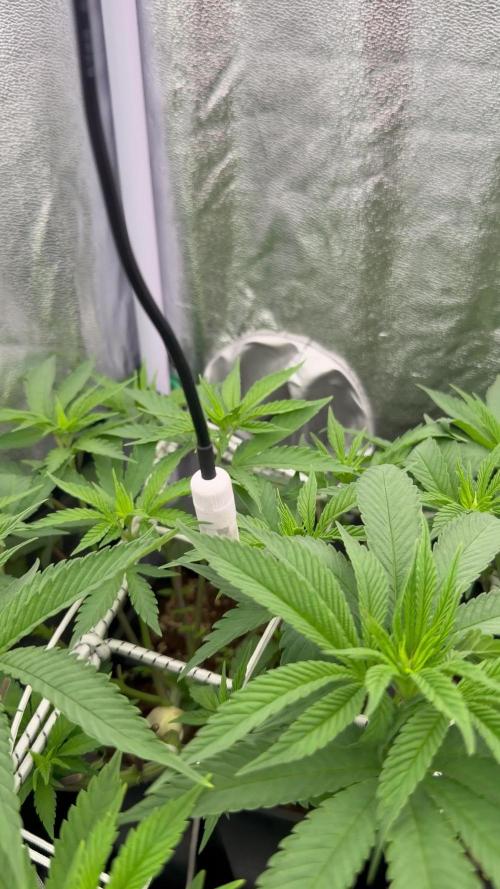
Week 1/ Flo
24-26 degrees / 45-70 % hygro / 55 cm
Dimmer 70 % Lampe
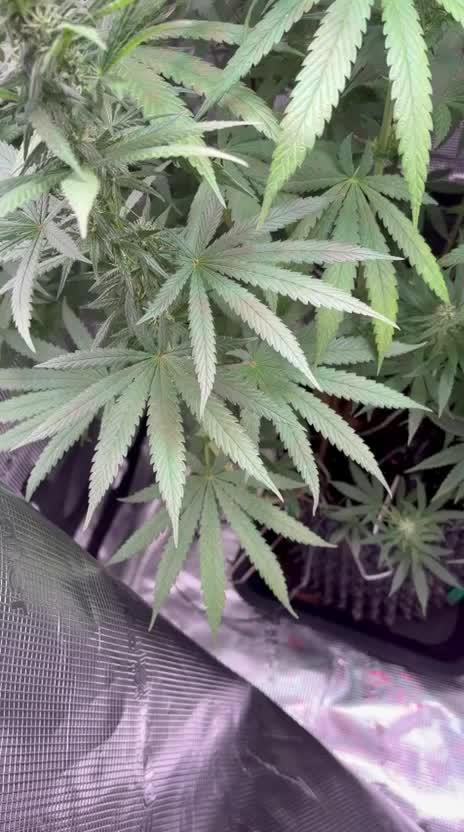
Flo has been switched on and shows good stretch. Start nutrient applications gradually while closely monitoring lamp distance. Bring the light up to 100% as soon as conditions allow.
They’re looking great. I’ve done as much training as I could using hooks and wire.
12/12 switches : 12/06/2026
Back: Frosted Grape
Front left: Purple Cookie
Front right: Stick Berry
Watering remains moderate: ~600 mL for the larger plants and ~300 mL for the smaller ones, with 1 L being the maximum applied so far.


Likes
15
Share


@SelfCultivationGrower
Follow
I think we are almost at it. Maybe one more week until harvest.

Likes
60
Share


@SooSan
Follow
Mars Hydro m'a sponsorisé, je vais donc tourner à 100% en Mars Hydro !
J'ai donc une nouvelle tente, la 2in1 90x60x140 Mars Hydro !
Et le FC-E 4800 est arrivé ! 😍
Quelle puissance... A ce stade de croissance je n'utilise que 15% de la puissance
La lumière est vraiment belle, elle paraît plus pure, plus claire et intense que les TS1000
J'ai divisée la 90x60x140 en 3 parties (et donc 3 Diaries) :
1️⃣
🏠 60x60x140
☀️ FC-E 4800
🍁
1x Black Bomb / Philosopher Seed
2x Amnesia Lemon / PEV Seeds
1x Blueberry / PEV Seeds
1x Blueberry / 00 Seeds
1x Wappa / Paradise Seed
1x Dark Phoenix / Green House Seed
1x Quick Sherbet / Exotic Seeds
1x Mango Cream / Exotic Seeds
1x Banana Frosting / Sensi Seed
1x Hindu Kush / Sensi Seed
1x Fast Mix / Sweet Seed
📎 https://growdiaries.com/diaries/122084-grow-journal-by-soosan
2️⃣
🏠 30x60x90
☀️ TS1000
🍁 4x Fast Mix - Sweet Seed
📎https://growdiaries.com/diaries/124052-grow-journal-by-soosan
3️⃣
🏠 30x60x50
☀️TS1000
🍁 4x Quick Sherbet
📎 https://growdiaries.com/diaries/122080-grow-journal-by-soosan


Likes
3
Share


@Peaceweed
Follow
From seed to harvest in 68 days photos dont do it justice the plants suffered alot of stress due to my inexperience but delighted to get 29g dry off hmbd and 6gish off dr feelgood in the same resoirvoir and a total usage of 70w for full set up the dr feelgood didnt yeild so much due to root rot cause lack of oxygen but all in all im impressed 70w usage over a oz of hmb of coffee shop looking and tasting
taste pukka smell unique like blueberry and diesel left that nice taste
I was high like the haze family not like the usuall blueberry that doesnt get you high truely amazed how this turned out for my 1st grow will post the feelgood diary soon will 100% only use shortstuff seeds cant wait to get the shortstuff haze wonder how strong will that be considering this is as the import haze i get local 29g for me was enough probly last me a month and 2weeks so happy days i made some cannaoil outa the trimming and that was super strong the trics were 70cloudy and about 10% clear and about 10% amber i just couldnt wait to chop since i had tastes the bud i would highly recommend it great for stealth and believe me as strong as anything i have smoked00


Likes
43
Share


@Sabac
Follow
Plantas sanitas 11 semanas.
Se ven bien saludables con flores recinosas
Y grandes.


Likes
15
Share


Likes
20
Share


@Hashy
Follow
Week 4
Light cycle=18/6
Light Power=120w
Extractor controller settings
High temp= 25c
Low temp= c
Temp step=0c
High Rh= 58%
Low Rh= %
Rh step=0%
Speed max=7
Speed min=1
Smart controller settings (during lights on).
Lights on=06.00am
Radiator on= below 21c
Radiator off= above 22c
Smart controller settings (during lights off).
Lights off=00.00am
Radiator on= below 18c
Radiator off= above 19c
VPD aim=0.6-1.3
DLI aim=28-34
EC aim=1.7
PH aim=6.3
Thur 18/1/24
#2 (Day 22)
📋
💧💧💧💧💧💧💧💧💧💧💧💧💧💧💧💧
Method= manual
Total volume made=10L
Neutralise=0.1ml/L
Roots=0.25ml/L
Easy Ph down=0ml/L
Feed=Water
Volume=2.5L
Ec=0.2 PH= 6.5/6.6
Time=8.00pm
Runoff.
Total runoff=120ml
Ec=2.28 PH=5.6/
💧💧💧💧💧💧💧💧💧💧💧💧💧💧💧💧
11.00pm Increased light power from 100w to 120w.
Fri 19/1/24
#2 (Day 23)
📋 Looks ok
Cold spell seems to be going now.
Sat 20/1/24
#2 (Day 24)
📋 Lst the 4 colas.
H=26cm D=45cm DLI=29.5
Sun 21/1/24
#2 (Day 25)
📋 Broke a cola off and stuck it back on.
💧💧💧💧💧💧💧💧💧💧💧💧💧💧💧💧
Method= automatic
Feed=nutes
Test run while setting drip rates.
Total volume made=12L
Total volume left=1L
Neutralise=0.1ml/L
Silicon=1.0ml/L
Calmag=1.0ml/L
Terra grow=3.0ml/L
Roots=0.2ml/L
Easy Ph down=0.125ml/L
Volume=2.75L (Est)
Ec=1.7 PH=6.3/6.4
Time=7.00pm
Runoff.
Total runoff=3L
Ec=4.6 PH=5.6/5.7
💧💧💧💧💧💧💧💧💧💧💧💧💧💧💧💧
Mon 22/1/24
#2 (Day 26)
📋 H=31cm D=40cm DLI=36.2
Raised light 8cm
H=31cm D=48cm DLI=29.0
Snapped cola is recovering.
Tues 23/1/24
#2 (Day 27)
📋
Wed 24/1/24
#2 (Day 28)
📋 H=36cm D=43cm DLI=32.2
She is doing OK considering what she been through. So the cola I broke off and grafted back on looks like its going to be fine, I'll have to be careful with it from now on.
Back soon.
Take it easy.
Likes
95
Share


@Ferenc
Follow
Day 80, 2nd of December 2020:
Wao one week she changed a lot. Buds are nice getting there to be read. The whole plant is great nice genetics but this time it seems that I will miss the red colour and she is a green pheno. Well, let's see it may turns to be red in the last 2 weeks of her flower cycle. However, I am super happy even if she remains green lol.
All good the lamp is now on 11 hours and off 13 hours. Every week 15 minutes was taken off and after 4 weeks here we go. Strated 12/12 and now 13/11 wanted try to imitate the nature as the light days are getting shorter.
Fertilization has changed no more epsom salt from this week and I will stop giving nitrogen as well from next week.
Great job Sweet Seeds. Nice genetics :)
Likes
13
Share


@gr3g4l
Follow
Por norma general no soy de podar hojas pero esta vez voy hacer una excepción y quitaré las que más sombra hacen , las grandes, a los 30 dias a 12/12h. Pasados 7 dias de su última poda de bajos, tercer y cuarto nudo. Entonces ya solo me quedará ir quitando algunas yemas de los nudos inferiores
Parecen haberse estabilizado y no crecen al mismo ritmo que vinieron haciendo estos 30 primeros dias a 12/12h.. A principios de semana la más pequeña, la OGKush nºI serian 70 ctms y las más alta , la AnimalCokes nºVII, 100 ctms.
Pasados 6 dias del último tratamiento contra la araña roja le volví a dar y esta vez con Plant Vitality Plus de Bac. Total hasta ahora, un lavado con agua corriente, una de Mactina (químico ), dos de Solabiol y una cuarta con el Vitality.
Llevo dos semanas viendo las puntas quemadas y estoy observando que va en aumento, posiblemente sea un exceso de nutrientes debido también en gran parte a que el agua de base sale a 0,85 EC y 8,02 de PH unos valores muy altos.
Miraré de correjirlo ahora con un par de riegos solamente con agua y cambiando al Top Candy la próxima semana manteniéndome con dosis bajas. Sobretodo se nota en las OGKUSH , las más pequeñas.
A la vista está que fué demasiado regarlas dia si dia no con TopBloom a 1,8 EC. Ahora toco madera para que no afecte demasiado al resto todo y que ya se ven afectadas.

Likes
128
Share


@Tropicannibis_Todd
Follow
💩Holy Crap We Are Back At It And Loving It💩
Growing in a 11 ounce pot 👈 👀 👀 👈
Growmies we are at DAY 49 and she's just killing💀it👌 TALK ABOUT FROSTY 👈 Amazing results thus far for the Tiny Pot 😀
👉Added straws within the Tiny pot to help watering in week 4 👈
So I'm starting to see she needs watering every single day and now need nutrients 🙃
Lights being readjusted and chart updated .........👍rain water to be used entire growth👈
WATERING SINGLE TO TWICE DAILY 😋
👉I used NutriNPK for nutrients for my grows and welcome anyone to give them a try .👈
👉 www.nutrinpk.com 👈
NutriNPK Cal MAG 14-0-14
NutriNPK Grow 28-14-14
NutriNPK Bloom 8-20-30
NutriNPK Bloom Booster 0-52-34
I GOT MULTIPLE DIARIES ON THE GO 😱 please check them out 😎
👉THANKS FOR TAKING THE TIME TO GO OVER MY DIARIES 👈