


Likes
Comments
Share


@Bud_Koenig
Follow
Yo, what’s up, friends! Harvest day is getting closer 😍 Cannalope Haze is pretty much ready, but I’m holding off until Sleepy Joe catches up — I think just a few more days. The trichomes are mostly milky, with a few amber ones showing, which is exactly how I like it for a more uplifting effect to keep me productive throughout the day.
For drying, I’ll hang the plants in my tent and aim for 20°C and 60% relative humidity. Let’s see how it goes—I’m excited to see the final result. Stay tuned for updates!


Processing
Likes
8
Share


@ThatoneAKguy
Follow
I have a little issue with some clawing going on here. But only on these 3 plants. These are the ones closest to the circulation fan which was right on them so I pointed it upwards a bit last week to not hit them so hard. Granted it’s not been a problem before. They are in coco and the run pretty dry every other day and they get a reasonable 800ppm water of nutrients from floraflex with cal mag and some micros from ghe. I can’t imagine it’s a nitrogen toxicity in the second week of flower especially with these nutes. Now only on the middle one I also have a large fan leaf as the photos show starting to yellow. What do you think??

Likes
4
Share


@Bncgrower
Follow
Another week almost over, the girls are beautiful and smell great. Apparently everything is under control, I'm really looking forward to the results.
Happy growing! 🌱🌱🌱


Likes
10
Share


@ZweetZkittlez
Follow
Unos días más de Vegetativo y ya pasamos a florar. Antes de pasarla voy a hacer esquejes de todas las plantas para cuidar los fenos más potentes y ricos 🤑
Hoy 10/7 voy a realizar una poda de bajos, un poco de defoliación y sacar los esquejes.


Likes
3
Share


@Gewaltmann
Follow
Entlauben und Lollipoppen
Es ist wieder eine Woche vergangen. Die LCC hat sich nun bei 110cm eingefunden und angefangen die Buds schwellen zu lassen. Der Top wirkt leicht mutiert. Der Zucker nimmt deutlich zu, sowie der Geruch. Das hieß nun für mich, da es Zeit technisch auch dran war, zu Entlauben und Lollipoppen. Da unten rum sehr wenig hängt, war es eine schnelle Geschichte. Oben rum sind einige Fächerblätter der Schere zum Opfer gefallen. Licht ist also genug vorhanden, für die unteren Etagen. Das restliche Gesamtbild der Blätter, lässt aber zu wünschen übrig… Farbtechnisch sind in an den Buds, ganz zarte Pinktöne wahrzunehmen – ob sie noch ein saftiges Lila bekommt? Das Kirsch-Zitronen Aroma, so spritzig und Mund wässrig machend, wird von einem erdigen, Keks artigen Ton eingeholt… Es haut einen aus den Socken. Der Gesamtgeruch ist noch „Schwach“, aber beim entfernen der unteren Popcorn Buds wurde deutlich, das es bald vorbei ist mit „Geruchsarm“
Die PH ist fleißig am Stretchen. Ich kann noch etwas derigieren und so gut die Fläche ausfüllen. Sie hat leichte Anzeichen, dass ich es etwas zu gut gemeint habe...aber sonst ist alles saftig. Einige Triebe haben sich doch abgehoben von der Gesamtfläche und bilden mehrere Hauptcolas. Die PH wird nächste Woche entlaubt und gelollipoppt. Dort ist dann einiges wegzunehmen. Momentan hat sie ca. 35cm an Höhe, wenn man die höchste Top nimmt. Ansonsten spielt sich viel auf 25 cm Höhe ab. Ich bin gespannt wie sie nächste Woche aussieht. Sie hat mittlerweile auch eine hauch feine Zuckerschicht bekommen. Und wenn ich sie sanft berühre, kann man das leise „öffnen einer Flasche Sprite“ hören. Farbtechnisch macht sie aber ihrem Namen noch keine Ehre – egal!
Die BPP ist auch durch mit ihrem Stretch. Sie baut richtig Masse auf an den Buds und daher wird auch hier die Tage gelollipoppt und entlaubt. Hier ist auch etwas Arbeit von Nöten. Das Gesamtbild ist Top. Die Buds bekommen ein kräftiges Lila. Der Zucker ist sehr deutlich erkennbar und nimmt zu. Der Geruch wenn man die Popcorn Buds berührt ist unbeschreiblich. Süß, fruchtig irgendwie, wie ein blumiges Gummibärchen. Die gute hat eine Größe von ca. 60cm.
Nur die LCC bekommt etwas mehr, außer der Reihe. Ansonsten bleibt alles Nähstoffmäßig so wie vorher. 3ml CalMg/L und 1ml/PK13/14/L – Es wird alle 2 Tage gegossen, 1 mal die Woche gefüttert. Die Luftfeuchtigkeit habe ich nun bei 45-55% je nach Ecke – passt.
Nun steht etwas Arbeit an zum Weihnachtsfest – dafür bekomme ich hoffentlich dicke Geschenke im neuen Jahr! Also bis zur nächsten Woche und ein Fröhliches Fest!

Likes
4
Share

@Trinidad
Follow
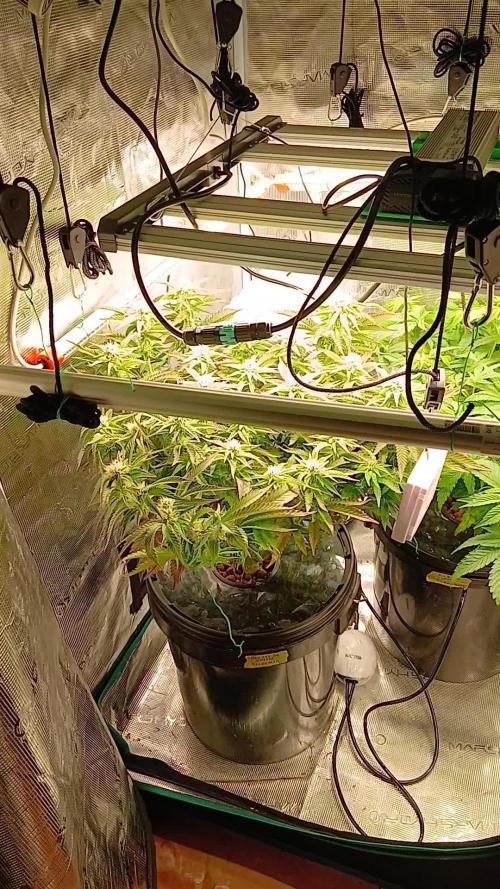
Day 110
Day 47 since badazz og cheese 12/12. She is looking good.
All 3 clones at the end are big budda cheese 2. In soil 1 in hydro. 1st time planting in soil. Using coco and worm casting with terra aquatica nutrients.


Likes
2
Share


@CannaIGrow
Follow
Plant is growing good. Still really pretty to me. Hoping to flip around day 60
Likes
4
Share


@Ctsbestsmoke
Follow
Looking good lowering temps to keep my terps from burning off remember once you smell it their gone forever lol! I did run through a few little problems you can see rip burn and some stretching one was a experiment and one was my own fault. As of right know tho I’m very happy for this harvest!

Likes
12
Share

@Rhah420
Follow
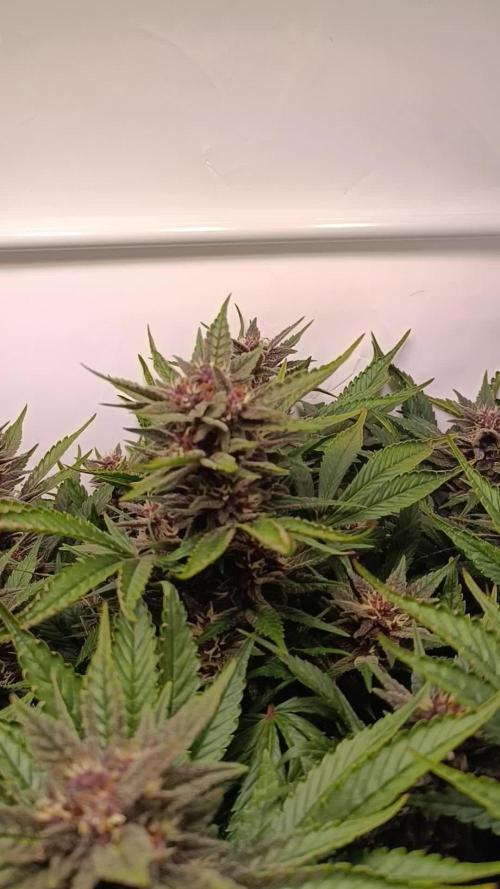
Die Damen bekommen gerade ihre 5-8 Tage anhaltende PK 13/14 Kur. Danach wird die Nährstoffe Zufuhr für 10-14 Tage gesenkt, um dann bis zur Ernte mit Wasser zu spülen.
Insgesamt sehen sie noch fit aus und Grün aus. Auf den Fotos sehen die Ladys immer Gelber aus als sie sind, liegt wohl an der Lampe. Die Buds beginnen momentan auch ganz gut anzuschwellen, mal sehen was am Ende bei rum kommt.
Likes
4
Share


@Hustle786
Follow
This John Snow
Slow Grow
Hope Fully Gets Vegged Bit Longer
To Grow It Tall
420💨💨💨
Likes
2
Share


@Ultraviolet_
Follow
Topped once, turned off IR @ nights, slowed vertical growth back down, and took off both of the very lowest internodes on each plant.
Eisenia fetida
Stratiolaelaps scimitus
Armadillidium vulgare
Red wigglers (Eisenia fetida) are highly beneficial. They are considered an ideal choice for "no-till" or container-based organic growing because they live in the upper layers of soil, feeding on organic mulch rather than the plant's root system. Red wigglers accelerate the breakdown of organic amendments and produce high-quality, nutrient-dense worm castings directly in the root zone. Clover is another exceptional component of an organic rhizosphere, offering a sustainable, self-sustaining alternative to synthetic nitrogen fertilizers produced via the energy-intensive Haber-Bosch process. By forming a symbiotic relationship with Rhizobia bacteria, clover converts atmospheric nitrogen N2 into ammonium NH4, providing a steady, slow-release nutrient source that enhances soil health and reduces environmental impacts. Red clover offers superior nitrogen fixation and biomass production compared to white or yellow clover, making it the premier choice for maximum soil vitality, particularly for improving soil structure and providing a high-volume nitrogen credit for subsequent crops.
If it is fully functional and efficient soil, the rhizophagy cycle is superior long-term than any synthetic delivery when it comes to preventing deficiencies, not because it's "better," per se. The medium will require a very high CEC to make it to harvest without re-fertilization. The rhizosphere acts as a dynamic, interactive exchange where plants and soil microbes trade resources based on immediate needs. When a plant lacks a specific nutrient, it changes its physiology and releases specialized chemical cocktails—root exudates—into the surrounding soil. These exudates, which include sugars, amino acids, and organic acids, serve as a "shopping list" to attract specific microorganisms, which in turn return higher levels of desired nutrients. There is nothing in comparison when using synthetic delivery, which can cause plants to stop producing exudates, effectively "starving" the beneficial soil life, over time turning the soil barren and void of microbial life. Responsible use, applying the right amount at the right time, can minimize these negative effects. Relying solely on synthetic fertilizers without replenishing organic matter is what typically leads to exhausted soil. The use of synthetic fertilizers can utilize the Cation Exchange Capacity (CEC) of the soil, but without a robust rhizosphere and active microorganisms, the efficiency of this process is significantly reduced. This makes synthetic growing more difficult to prevent deficiencies overall compared to an efficient organic living soil with a robust rhizophagy cycle, as there is no "one size, fits all" when it comes to different nutrient profiles of strains/genetics, making it trickier to "guess" and prevent creeping deficiencies.
CEC does not contribute towards EC. Add more CEC using biochar, problem solved. If you keep pH between 6.3 and 6.7, hydrogen is exudated to cycle the medium's CEC for its needs. Keeping the pH between 6.3 and 6.7 creates an environment where plants release H+ to displace positively charged nutrients (like Ca2+, Mg2+, K+ held on soil particles or within artificial media this cycle through nutrients via the medium's Cation Exchange Capacity (CEC)
Microorganisms generate a stable potential of approximately 0.5 V EC. The rhizosphere creates its own food, similarly to chelation, using 1000's of varying combinations to create its own food.
Start to finish, just add water. Eventually, more materials will need to be added at the beginning of each new grow, but very attainable to go from seed to harvest without ever fertilizing.
ATP is important when it comes to biomass accumulation. Cellular root respiration and cellular respiration are essentially the same biological process, the breakdown of glucose to create usable energy (ATP) in the presence of oxygen, just taking place in different parts of the plant. Synthetic (salt-based) grows have significantly lower levels of total rhizosphere respiration, often referred to as root-zone activity, compared to organic living soil grows. While the plant roots themselves may respire in both systems, the surrounding soil ecosystem in a living soil setup is vastly more active, teeming with bacteria, fungi, and beneficial microorganisms.
2 pools of ATP, it won't double in growth buuuut, but improving root respiration by ensuring high oxygen in the soil is crucial. Good aeration ensures roots can fully utilize glucose to generate the ATP necessary for nutrient uptake, leading to healthier and more productive plants, even if growth isn't exactly doubled. The ATP created using root respiration is dedicated to rootzone growth; the ATP created using regular cellular respiration in a synthetic system would have to dedicate a lot of ATP to the roots when there is little or no root respiration. It's true that there is less of an initial ATP cost in breakdown when nutrients are already in their final form (synthetic), but you lose a solid chunk of ATP when the entire plant is reliant on cellular respiration alone; a large portion of ATP is dedicated to root zones for "forced" nutrient uptake rather than traded. Making it overall less efficient, even if the initial cost of breakdown is higher. Not sure if I butchered that but one can hope It makes sense.
Oxygen is of critical importance when growing in living soil compared to synthetic soil because it supports the metabolic needs of the microbial, fungal, and insect ecosystem, rather than just the root respiration required by the plant itself. While synthetic grows can survive in lower-oxygen environments with precise mineral feeding, living soil systems rely on aerobic microbes to decompose organic matter (microbial mineralization) to create plant-available nutrients, which is an oxygen-intensive process. While a specific fair percentage is difficult to guess, my experience points to a massive, compound difference between the two methods and the amount of oxygen required. All the ATP spared is used on more biomass, not only that, but the extra root respiration can achieve a much higher CO2 compensation point naturally than you could with synthetic and atmospheric CO2 alone.
As a plant grows faster and increases in size, its demand for nutrients to support that growth increases, requiring a higher rate of nutrient uptake. As plants enter phases of rapid vegetative/floral growth, their metabolic demand for nutrients increases exponentially. Without a robust buffer zone—whether in the soil (cation exchange capacity) or in a hydroponic reservoir—deficiencies will occur rapidly because the instantaneous demand for specific nutrients can quickly exceed the rate of supply.
A growing body of evidence suggests that organic living soil provides superior long-term soil health and environmental benefits compared to synthetic fertilizers, which are often criticized for promoting a cycle of dependency and degradation. While synthetic fertilizers offer short-term convenience and high yields, they often come at the expense of long-term soil health, sustainability, and increased corporate control over growers/ farmers. Organic living soil, while slower and requiring more care to establish, creates a sustainable, resilient, and, ultimately, more fertile environment.
We don't really grow; we facilitate energy conversions, and energy is just numbers. Because the universe works the same way today as it did yesterday, there is a single, fundamental mathematical quantity that remains constant. We call this quantity energy. You cannot put "energy" under a microscope. You observe matter and forces (like heat, motion, or light), but energy is just a scalar number calculated to help predict how these things will change and interact. When an object falls, or when a battery powers your phone, matter shifts and changes form. Through it all, the universe ensures the "total score" of the numbers remains exactly the same.
Once all water is removed, approximately 95% to 97% of a plant’s dry matter consists of carbon, oxygen, and hydrogen. These three elements form the structural backbone of all plants. NPK & all the rest 3-5%.
Indigenous Amazonians created, or at least significantly enhanced, the fertile, dark soil known as Terra Preta de Índio (Portuguese for "Indian Black Earth") by incorporating biochar and other organic materials into the soil. This anthropogenic (human-made) soil technique, which dates back roughly 2,500 to 8,000 years, allowed ancient civilizations to flourish in regions with naturally poor, acidic, and nutrient-poor tropical soils.

Likes
34
Share


@RFarm21
Follow
REGAS: 21 e 25 janeiro so com agua.
À espera que o solo seque para colher.
Likes
7
Share


@CanadianFillmore
Follow
Fed and defoliated to start week 7. The plant looks good, with a bit of yellowing, but the buds are on point and look as expected at this stage.


Likes
17
Share

@MyWetPussy
Follow
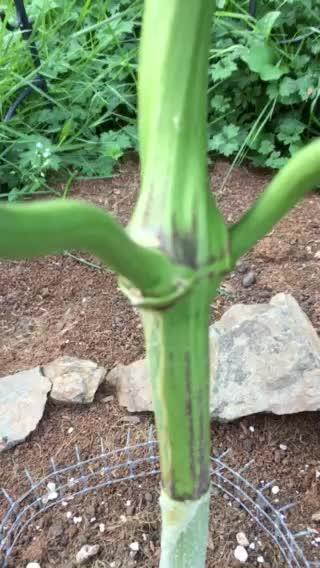
I have been busy and been off gd for a while. Time to finish up on this diary. Plant has done good all summer long. She is getting some good frost to her and is smelling amazing! She had 1 good watering this past week.😍
Processing
Likes
27
Share


@Hawkbo
Follow
Day late on the update, pics/vids were taken on time tho just been a crazy week of harvests and trimming and keeping up with these. I linked up with Rain Science Grow Bags on Instagram and got them to offer all my followers and friends a discount of 10% off entire order from their site with the code ' bangdang ' so if anyone is in the market for a pot upgrade use that code. I got them in the mail 3 days after I ordered. Reason I went with Rain Science is because they offer identical air flow for rapid growth as the radicle bags, just using a different material and a tighter knit so water doesnt flood out the sides during feeds and when you pick these up when the coco is dry, it wont fly all over the tent like with the radicles. They're the optimal bag for autoflowers especially. I figured out why the one stayed so short compared to the others, the base of the stem did a 360 so it's like a loop then it grew vertical.
Likes
1
Share


@south420terps
Follow
Super smelly i relley like this strain cant wait to finish blueberry smell dank


Likes
42
Share


@Latrodectus
Follow
hi everyone ,
the finaly start to flower properly :) still a lot slower than indoors but they´ll get there xD ... it
definitively smells nice now 😍 hope the weather will stay as dry as possible for the next two month 😅 but probably it wont 😁 we will see how they´ll do
happy growing and till next week 😇

Likes
9
Share


@Jbuttch
Follow
Aquí ya en mi 8va semana después de cambiarlas a unas macetas más grandes de un aproximado de 15 litros. Bueno, se preguntarán dónde está la tercera si eran tres y ahí se ven dos. Resulta que se murió, aconsejo de mantener lejos a tus gatos. Sí, mi gato macho orinó en su sustrato (aconsejo siempre mantener limpio su arenero para que no busque otros lugares donde orina) y pese de hacerle su lavado de raíces y cambio de sustrato, no sobrevivió. Aquí fue la única vez hasta ahora que pasó algo así. Hasta ahora sigo renegando con el gato, pero bueno no es culpa de ellos, sino de uno mismo. Hay que ser más precavidos. Buenos humos!