


Likes
Comments
Share


@Growinglikenoone
Follow
God guys, so mad I am so disappointed. Cookies seedbank -1000 stars. Die brand cost me so much money. Imagine startet with 16 plants now 6/6 lemon cherry pop are ladyboys. 4/6 hollywoods ladyboys the other two know under control but looking already sus. Tie die 1/3 didn’t sprout 1/3 killed today because ladyboy the other one also under control and looking sus. Only last real men fighter is Trump Runtz. It’s so sad grow looked pretty good and know noting left.

Likes
16
Share


@710Lino
Follow
My only problem this run was a nitrogen deficiency, 5 gallon pots 2 plants this big is was hard to plan ahead for nutrients when ur running 100% organics (trying at least) so I grabbed some 10 gallon pots and I'm switching to LED next run this is going to be excited after 10 years I'm hanging up my HPS I'm going to miss her it's like old habits die hard but seeing the nana glue stacked and happy with a low end one I can't imagine the possibilitys

Likes
2
Share


Processing
Likes
1
Share


@nausicaahime
Follow
week 7
first flowering week
when I finally discovered my princess was actually a prince.
12/12
flowermind ferts (6ml + 0.5g)
LST + defoliation
started seeing some thrips again, but just a few, nothing to worry
so, the plant stayed for 4 weeks in the tent, under COB LED 200W.
Likes
2
Share


@Selkot
Follow
after only 10 1/2 weeks, ready for harvesting 👌
they could have matured for another 1 or 2 weeks but I would like to have a high effect here as well,
my insides ones will give me the stone.
result for the 3 girls in 3 litre pots: 153g wet.
Dry result in 10 days, and surely a first impatient smoke test 😏
Even if they didn't suffer from pest attacks, it was impossible to avoid the little ones and their eggs from sticking to the leaves and buds;
I did a buds washing to get rid of them.

Likes
6
Share


@BigGGrows
Follow
This week was a big week for the candy cush. I noticed upon watering her to run off, that in the same day the pot would go super dry and light weight. I also noticed stress in the leaves and roots poking out the bottom of the pot. It was time for a transplant. So far so good! Upon transplanting i performed more LST to help her fill in the pot. She went from a 1 gallon to a 5 gallon. She was also defoliated thia week.


Likes
12
Share


@HIAZ_urbanbudfarmer
Follow
Saturday 16-11-24 , Flowering day # 53 week 8. Harvest day!
Cut branches off plants & hung the 2 front plants off the light.
Put scrog net back in with a large flyscreen laying on top, & spread branches from the back plant over it. This allows complete air flow around the buds. Running a single oscillating fan beneath pointing to the bottom.
Temperature is around 24°C & RH is 55%

Likes
16
Share


@Bread_n_Buds
Follow
I needed some CDB, I really push a lot of THC in my body and I feel the need to balance this thing a bit.
I asked my friends at Zamnesia cpsa for advice on growing and I got this really beautiful plant, a pleasure to grow in the F1 Hybrid Automatic version and we have two plants.
The one you see in most of the photos that was worked with a main lining that I would say was successful is very beautiful in structure and has a fast flowering such that we are moving on to the green sensation. Unfortunately we have been a bit over fertilized and we are carrying some aesthetic defects,
but nothing particularly worrying I am sorry for the unsightly yellowing of the tips of the leaves.
Of the other one left to grow straight I will only put a few photos in the growbox and as soon as it is ready however it will have the full service like the others, the plants worked with the techniques have stolen a bit of the scene from the plants left to grow straight which are naturally finishing a bit earlier.
We are still using 100% organic soil, fertilizers and all the additives recommended by Plagron. We are still in the early flowering program that keeps the same additives Power Roots, Sugar Royal, Pure Zym and adds the flowering stimulant Power Buds. Of course the basic fertilizer is now Alga Bloom.
The Green Sensation hero of the late flowering will arrive and at the same time it will be time to remove power roots and a week later the enzymes. (The plant left to grow straight and straight in advance has been taking it for a while)
---- Decide on the right soil and calculate your fertilization program based on the soil on the official website. -- www.plagron.com
Try a seed of this variety that drives us crazy..
---- https://www.zamnesia.io/en/10672-zamnesia-seeds-green-cure-cbd-f1-automatic.html
Description Zamnesia // Zamnesia's breeding team has harnessed F1 genetics to bring you Green Cure CBD F1 Automatic. This autoflowering cultivar is easy to grow, accessible and reliable for all levels of experience. Ready in just 11 weeks, growers can expect impressive yields of tasty buds with a clear-headed effect that's ideal for meditative moments.
All the best that mother nature can offer is on ---- www.zamnesia.com
Likes
31
Share


@Kim_Jong_High
Follow
Stopped weaving to leave them about 6-8 inches above the canopy. Will be defoliating at some point next week to improve light penetration.

Likes
9
Share


@Midterm
Follow
🤙🏼 🤙🏼
Sawasdee, Now 60 day
I changed watering 1L to 1.3L this week and watering every other day, nutrients every sunday on schedule photo.🗓️
First starting feed all nutrients last week but it to late so i will feed nutrient more quantity.
P.S. Compared photo to same fame and angles of weeks betweens.📸
See you next week.

Processing
Likes
3
Share


@Kushizlez
Follow
Day 28-35
(Day 29) I had some leftover pH 5.5 water from my other grow, it’s a little acidic but my medium is pretty base so it should balance itself out soon.
(Day 30) Plants didn’t respond well overnight. They’re drooping and not looking very happy anymore. I’m guessing they will still recover in the next few days though. I’ve got to stay more consistent with the water. I’m going to make a water formula and consistently use it every time. I don’t like these pH fluctuations.
(Day 33) I’m going to sprout 8 more plants today to help fill out the tent before I flip. I will be using pretty lame genetics but I will probably still find something I like. Got x2 SM Jack Herer, x2 SM Blueberry, x2 SM The White OG, x2 SM Badazz OG cheese. Last time I ran badazz og cheese it grew fine and yielded well but it got some pretty bad powdery mildew and the quality was lacking. I will make sure to give as many preventative sprays as possible before flip. This whole tent is highly susceptible to powdery mildew so I might be in for some issues later down the road. I will make sure to vacuum frequently and spray down the tent and my equipment as much as possible.
The slurricane has recovered from its topping and is producing two new main stems. Its going through water quite fast so I’m going to transplant into a 1.7g pot.
(Day 35) Dropped the ball hard today and accidentally knocked over the tray with all my new seedlings. Good news is they just got watered and were firm enough to keep all 8 seeds rooted and in place. Bad news is I mixed up almost every single container..... The only plant I am certain of the genetics is one of the cheeses. The other 7 are all mixed up! I’m sure I can tell all 4 apart by late mid-late flower, but this just sucks. I guess I will number them like prisoners 😭😭
I overwatered the slurricane a bit and it is looking like it has a lockout of some sort or it could be from the foliar spray. I’m going to back off and let it do it’s thing for the next week. I hope all the stress I’m putting it through will slow it down to the level of the locos and garlics.
Garlics are looking happy so I’m going to transplant them into 1.7s today. Might as well get this slurricane, guava and locos transplanted too. Guava appears to be growing quite healthy but has had interveinal chlorosis since it has sprouted. If it doesn’t green up in the next week I will pull it.
Man, I can’t help but feel this grow has been cursed since the beginning. Although a rough past don’t always make for rough future.
I found a way to consistently pH my water to 6.2 every time. I’m starting with 60ml of chlorine free bottle, adding in 2000ml of RO water and just that alone gets me to 6.2. I can also add in 3ml of remo nutrients calmag, 2ml of EM1 microbes, 2ml of 0-0-15 kelp extract and the pH will stay stable at 6.2.


Likes
4
Share


@4F1M6
Follow
Shes booming through the stretch! Got branches rowing up great as she fills right out. Did a big defoliating of most the leaves under the first net. Allow some air flow through the under skirt. Did a preventative treatment using dr zhymes. Than gave her a good shower to wash off any residual build up.
I'm just starting to see pre flowers coming in at the nodes. So she will still have some stretching period to go. I'd say atleast another week of stretching out and filling up my net. Before I start seeing those white stigma pom poms coming in at the bud sites. Lets see what this lady can do.
Until next update. Happy growing and stay lit fam.

Likes
5
Share


@CelticSmokey88
Follow
Going into flower
very strong smell stretching like mad and needing watered more frequently
Likes
13
Share


@NanoLeaf
Follow
Follow my grow to see full grow cycle. Happy with what I learned during this run. Only going to get better and better!


Likes
20
Share


@Robin87
Follow
Day 62! Not long left at all now with the 🍋🍒🍪 they smell amazing! 🦍🍪 setting a decent pace now too, the first defoliation session I’ve had on them too, wasn’t sure if to just leave them , but I’m more than happy with them now, everything’s looking and smelling 10/10.. untill next week! 👊🏻
Likes
10
Share


@Chubbs
Follow
Little late on the update. These 3 are absolutely beautiful. They'll be getting the chop this week and wow it's been a pleasure growing them. Super fast and easy not requiring any special treatment. Super frosty and have a pungent smell. Happy
Likes
11
Share
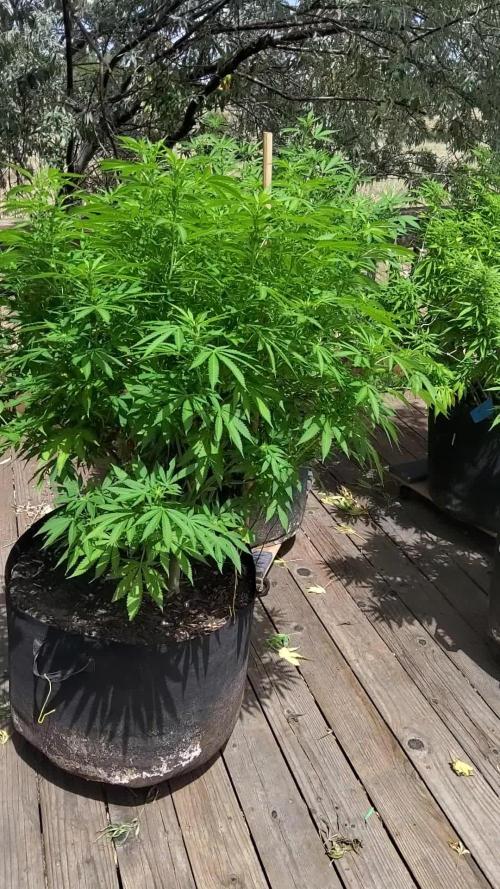

@bkickstand
Follow
Grow Diaries: Week 22 Journal Entry – The Durban Poison Quartet
* Date: August 14, 2026
* Location: Eastern High Plains, CO
* Stage: Photoperiod Vegetative / Early Transition
We are officially hitting week 22 with the Durban Poison quartet sitting in their 25-gallon bags on furniture dollies out on the deck. The growth and vigor across all four plants continue to impress, filling out their canopy space with deep green, healthy foliage.
Sunlight Optimization & Layout Adjustments
With the sun tracking differently as we push deeper into August, maximizing every hour of direct light is critical. Today, the entire quartet was carefully rearranged on the deck. Shifting the positions of the 25-gallon containers ensures that the peripheral branches and lower growth get their fair share of unfiltered exposure, keeping the canopy uniform and preventing any shaded bottlenecks.
Feeding & Nutrition: Sea Kelp Tonic
Today marks an important milestone in the weekly feeding schedule: it is sea kelp tonic day. Applying this organic tonic provides a rich array of natural micronutrients, trace minerals, and beneficial growth hormones to support root vigor, enhance stress resistance, and fuel sustained vegetative health as the plants continue their upward push.
Phenotype Notes & Observations
* DP4 Progression: A special callout for DP4 this week—she is really starting to step up her game, showing fantastic structure and officially beginning to build out her colas. The low-stress training (LST) and welded stakes are doing their job, opening up the inner sites to catch maximum light.
* The Quartet: DP1, DP5, and DP6 are keeping pace right alongside her, showing dense foliage and strong branching throughout the 25-gallon setups.
Update 8.15.26
Durban Poison Update: Transition to Flower!
The Durban Poison crew is officially making the shift! After a solid vegetative phase since sprouting back in mid-March, the girls are starting to show their first exciting signs of flower.
* Early Pistils & Cluster Development: Tight cluster formations and fresh white pistils are popping up at the top sites, confirming that the photoperiod crew is transitioning right on schedule.
* Nutrition & Care: Following recent top dressings like the seabird guano applied earlier in August, the plants are looking robust, healthy, and ready to pack on weight as bloom sets in.
* Training & Setup: Sitting comfortably in their 25-gallon bags on furniture dollies, all four plants have responded exceptionally well to low-stress training (LST).
Things are really starting to ramp up for the outdoor setup. Stay tuned for more updates as these flowers start stacking!

Likes
11
Share


@Jokey4
Follow
Explosion of leaves from the 15th to the 17th day, then on the 18th day we start to see "normal" leaves, and on the 20-21st day we have hope that it will become a normal plant 😄
Likes
20
Share


@apmcfly76
Follow
Surprised by the size and can’t wait for It wtf they growing big let’s go 💪
Processing
Likes
15
Share


@NorCalCloset
Follow
At 84 days from seed, 29 days into bloom, she is drinking about a liter (1/4 gal) per day. The stretch has stopped. I continue to defoliate lightly so light and wind can get to the bud sites. Her harvest window will start in another 30 days so there is not much to do but wait. Highest temps in the tent this week were 79F, lowest were 73F. I read somewhere that purplish tones are more likely to show themselves if you have cool nights. Unfortunately, as I'm growing during the summer without AC, I don't think I'll be able to create cool enough nights to see purple leaves. She smells great though and is putting on weight well. I am excited to watch her develop.
I am also trying out Terpinator for the first time. I am using it at much lower dosages than recommended. I plan to increase the amount I put in when I get comfortable that it won't burn my lady.
