The Grow Awards 2026 🏆 











Likes
Comments
Share
@ao_grows1978
Follow
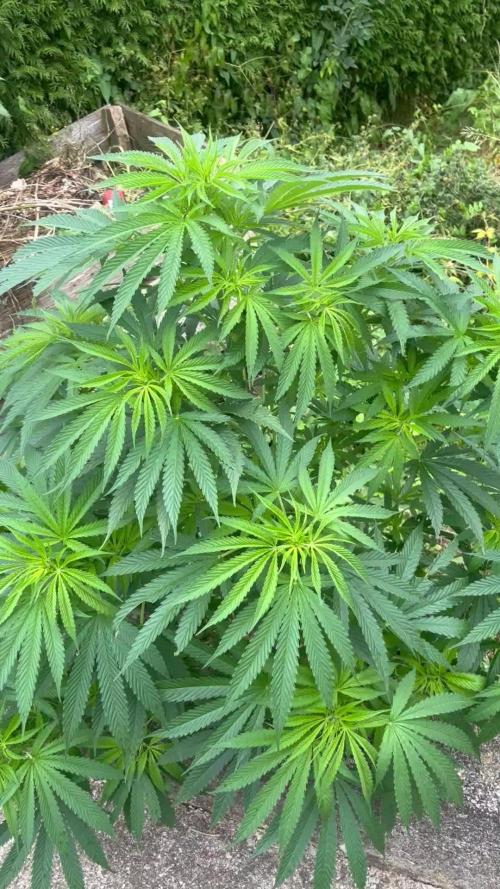
Cruise control for the OG Kush. Heading into the final weeks, so I'll be removing odd fan leaves here and there and giving her one last light top dressing. She's drinking water daily now and trichome production is finally ramping up.

Likes
32
Share
@ThatoneAKguy
Follow
Well NO ONE on this site reached out to try and help and I was kind of disappointed in that with so many great artists. I had to take my issues over and join ILGM. The veins were dark on MOBY and yellowing from the middle and it turned out to be a potassium deficiency and a potential build up but I don’t have my new ppm meter to get the whole truth. I upped my Demeter’s destiny and my hurculean harvest and let it run off more than usual. This lady is out of lock out and reaching for the sky in one day with leaves coming back to color!!! Hopefully the stall didn’t set me too far back. Going to switch away from the HLG 60 and mars 300 and put them under a brand new HLG 550 v2 this weekend in the main tent!

Likes
6
Share
@Herbz_Unkraut
Follow
another week of great growth
check www.sr-organics.com for some topnotch 5 in 1 fertilizer!
root, growth, bloom, micro-organisms, enzymes & vitamins all in one!
CODE: "Unkraut10" for 10% Discount! 😊

Likes
67
Share
@AwfulBuddy
Follow
Hi all buddies!
First crop from hydro nft growth.
Growth went well, I had some management problems in changing nutrients from veg to bloom which delayed the harvest for a week or two.
Sensi Seeds' Skunk # 1F is incredibly resistant to mold and insect attacks, very close internodes ensure low height and compact buds.
Unfortunately I chose the mother phenotype wrong, I found the lowest as I wanted but I lost the fatness of the buds present in other phenotypes, but the game was worth the same and I am very proud of it!
I collected after 94 days of flowering, the last 72h 20kg ice cubes in the tank and total darkness which the last 24h without irrigation.
After cutting I hung the whole plants in the tent for 24 / 48h 19 ° C 55% HR.
Two days of wet trim to 8 girls and I hung their colas in the tent to continue drying.
With a girl i tried dry trim but i will avoid next time.
After a week in the tent I cleaned the colas and removed all the sticks, I placed everything in airtight bags in the refrigerator for 5 days 12 ° C 65% HR (daily check).
Now dark storage room at a temperature of 18 ° C 65% HR.
At the last weighing a few days ago it was more than 500g, from now it does not lose any more weight.
Next week I will take pictures of the weigher and the finished harvest🍀🍀🍀
target!!🍀500g dry/cured🔥
Thank you GD community you are precious for everything, criticism, advice, curiosity, thanks 💚🌱✊🏼
Awesome people here on GD🔥🔥🔥



Likes
2
Share
@LittleBigTrees
Follow
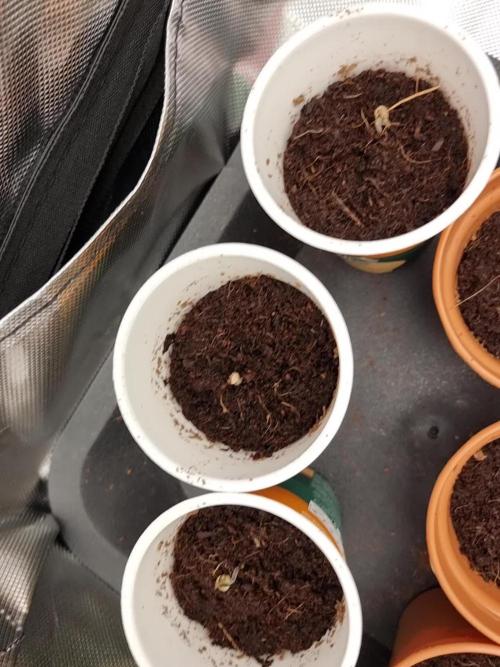
Wet yhe coir and put the seeds about 5-10mm deep.
Took 3/4 days to germinate

Likes
8
Share
@Santica_Garden
Follow
My Ayahuasca Purple are looking absolutely beautiful 😁 not much to update on, I have uploaded a video for you guys with all the information you need 👍🏾 Happy Growing

Likes
44
Share
@Jays_Not_Here_Man
Follow
This was the girls 1st full week of flower. They have done great, lots of stretch, small buds starting to form, and lots of praying 🙏 They have been pretty easy so far, I hit the barrier for these girls with nutrients, burnt the tips a bit , despite that, they have shown no issues. Looking forward to these girls finishing (as always) but they have been lab tested by other home growers who hit 3-4% terpenes, and close to 29% thc

Likes
6
Share
@I_Identify_As_A_Dan
Follow
Week 9 for GMO 8 by atlasseed
The indoor smaller plant is really starting to bulk up on the flower size for sure seems like maybe it has another week maybe 2 before being done. While the other plant is now outdoors because i ran out of room indoors & the bud on the outdoor one looks completely different likely because of the 40+ degrees sun outdoors ATM but doesn't have any burn leaves so that's great. Actually looking forward to seeing how she smokes... maybe she gets ran again in a few weeks? 😎

Likes
15
Share
@Siriuz
Follow
I was very busy and couldn't upload content earlier but here we go
Day 20 and ahead
Likes
Comments
Share
@OB-GYN-Kenobi
Follow
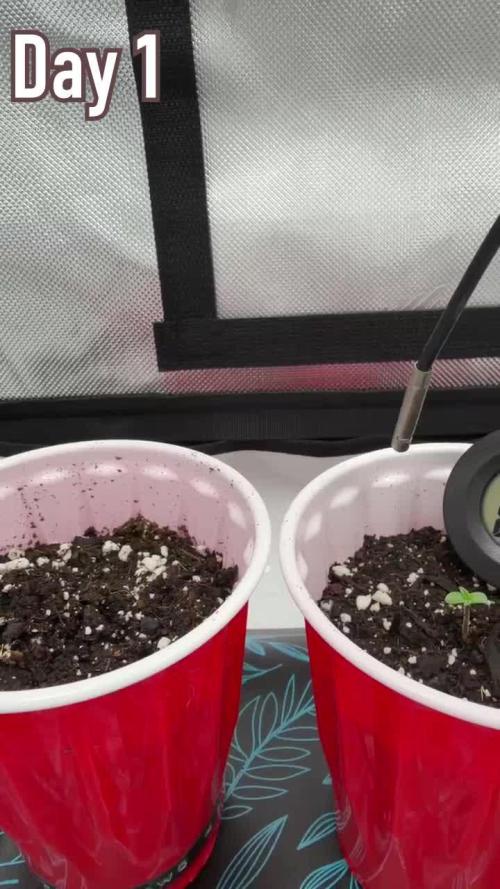
She broke through the surface already free of her seed coat, standing tall within the day and growing quickly throughout the week. This is only my second grow, but it already seems much faster this time around.
Tent stats:
- Lights: started the week around 220 PPFD, ramped to 300 by end of week.
- Temps: seedling heat mat kept in the mid-80s (30 C).
- Humidity: VPD has been set to 0.6 kPa.
Growth is already looking surprisingly broad-leafed for a "sativa", maybe she's falling back on her cookies genetics...
Likes
7
Share
@Kushizlez
Follow
Day 52-64
(Day 54) I’m going to thoroughly inspect each plant and remove bananas if found. So far it’s only been the one on #7 but I don’t want to take a chance.
I’m also going to give a watering with some runoff.
(Day 55) Can’t find anymore bananas but that one. I will probably find a few bag seeds but who knows. It’s way too late for pollen to really have effect anyway.
These 5 plants finish nice and early compared to my other tent flipped on the same day. I would never take this strain 65+ days like last time. I would do 56-60 days next time I flower this strain
(Day 58) Holy shit this tent is fading like crazy now. They are starting to show some beautiful autumn colors. #1 #5 and #7 are definitely done. #3 and #6 could use a little more time so I’ve decided to take them down on the 24th.
I haven’t seen anymore bananas and the one that popped out on #7 has shriveled up and receded.
(Day 63) I’m seeing what look like seed pods starting to form in some of the main colas on my picture perfect pheno. #7 is showing 3 or 4 little bananas too. All of the top buds are definitely done so I’m going to harvest as soon as the lights come on tomorrow. I’m going to give one last watering right now and then harvest. I’ve noticed that harvesting a watered plant will extend the dry time by a few days and that’s exactly what I’m looking for. A nice slow dry. Plants are being full plant hung + dry trimmed and tent is being kept at 60-65 degrees and 60-65% RH.
Cutting everything down was a pain in the ass. I had to individually cut each square the scrog net so it wouldn’t contract and squish all the buds. I chopped down my other tent as well so I have no other plants in flower right now.
Likes
38
Share
@Snakeking
Follow
chopped
I will update about the weight
Sweet like candy and awesome taste
For the first real growth i think i did good.
Our building smells like skittles:)
Gz#2 520g dried bud
Gz # 1 470 g
Gz # 6 425 g
Gz # 3 350 g
Gz # 5 460 g
Likes
1
Share
@DrGL_Thumb
Follow
Dropped the 3 seeds in water bath with a little HESI rooting mix, little mycorrhizae.
On a heat mat, covered for complete darkness. 24 Hr soak -
then seeds moved into own Seed Germinator - Karl’s Bubatz Popper 😂
24 hrs after 22 degrees and 90-95% humidity seeds developed long enough roots to hit the soil. To avoid any chance of damage the cotton pads hit the soil too.


Processing
Likes
9
Share
@Kushizlez
Follow
Things are looking decent. Bud sites are starting to get nice and hairy. The blackberry breath pheno in the center of the room is chunking up like crazy and quite a bit faster than the rest. It might finish early or just be a super thick pheno. I’m going to give a fish fertilizer nitrogen boost to all plants that are yellowing, including the nice blackberry breath pheno.
I’ve started a new living soil pile. I took the left over super soil from some of the male plants, mixed in a generous amount of dry compost, worm castings and natures pride bloom, sprinkled a shit ton of great white and mixed it all up. I also recently got another brand of beneficial bacteria called Dr. Mary Janes. Mixed a good amount of that in. I also found a good mychorizzae called WOW Organics. I mixed up a ton and then sprinkled a layer on top. I grinded up some oatmeal and sprinkled another layer over the mykes. I then mixed up a full strength feed of some Alaska fish and molasses and then saturated the medium. In a month or so there should be a nice layer of mycelium over the top layer

Likes
13
Share
@einamio
Follow
Day 36 I guess I can call it bloom. Nice strong pistils shooting all over. She is the tallest so far making me raise my lights a little more.
Day 38 Now Californian Snow is the tallest :) Ztrawberry stopped at a perfect height, it looks like she's gonna develop into a beautiful lady. Fat white pistils all over 😻
Day 39 Happy girl got 2500ml cm bg bb bh 6.3ph ~1EC She is perfect, symmetrical, stopped stretching at about 50cm, flowers are mostly leveled, branches are strong, leaves point up unless I water. I think she's also turning purple. Beaut 😻
Day 42 I think I saw some burnt tips but she still looks super happy and healthy. The most vigorous plant I've had.
Likes
6
Share
@pzwags420
Follow
Week 5 flower is progressing well. bud sites are getting bigger with more pistils and trichs on leaves everyday. This will not be a 8 week strain I'm thinking 10 but will calibrate if necessary to get the full potential of this genetic as I can see she is a special one already!

Likes
3
Share
@DrewZenRox
Follow
Into 2nd day of week 3.
Jealousy/Green Poison inside the Epic Attic Tent 1.2x1.2x1.6. Growing Under 'Karma EVO 3'
SkyWalker OG Inside unbranded 60x60x120 Tent. Growing under 'Karma Stealth 1000'


