


Likes
Comments
Share


@Shmoopy_me
Follow
Getting close to the finish and it’s very pungent smelling it’s hard to pin a nose on her! Still filling out and getting dense towards the end!


Likes
4
Share


@JefyKennedy
Follow
Jack herer bloom 56 flush 🌿
Süper silver haze bloom 65 - overdrive 4.dose 🤔

Likes
6
Share


@Cultivandomedicinanatural
Follow
En esta ocasión tenemos algunas plantas más grandes que otras, tenemos las red hot cookies miden 17 y 20 cm. Las tropicanas 15 y 20 cm y la purple punch og 16 cm.
Vamos a hacer una agua con concentración de 1.35 para las grandes y de 1.2 para las que son un poco más pequeñas.
Seguimos con un ph de 5.8 y se va notando ya la corrección de las carencias iniciales.

Likes
4
Share


@pzwags420
Follow
Week 7 is going smoothly so far. The flooding issue has subsided and the clones seem to be really taking off now. I'm excited to get back from vacation and really see my girls and my reservoir conditions after a 2 week hiatus.

Likes
5
Share


@most_dope
Follow
Did some lst on one of the taller main colas because I started 2 more and needed the smaller light for them. I turned my 150w Marshydro the way it normally goes so it can cover both plants and tried to get an even top canopy for both plants to get the most out of the lamp. I think the 1 is gorilla zkittlez I was thinking stardawg at first but the leaves are very similar to the gorillaz. I keep worrying about giving higher doses of nutrients because it looks like I burned them a little bit feeding twice in 1 week. It’s hard to tell the difference between defeciency and burn sometimes which is making me want to switch to organic lol. The leafy one is starting to bud finally it seemed like even after pre flower was in full bloom it was still pushing out too many Leaves and almost no trichomes compared to the zkittlez. I’m thinking that one may be an afghan kush or something. It was really woody smelling hazelnut almost and now I’m getting some pine hints now that the buds seem to be getting back on track
Likes
56
Share


@Cannabeast40
Follow
Welcome back to yet another short update☺️
Transplanted and filled with tender care and love 🤗 A bit colder temperatures then inside the veg tent , but I’m not worried at all🤩
Videos show the process, hope you enjoy 💯💚
See you next week🤩
------------------------------------------------------------------------------------------
Light source:
Medicgrow SpectrumX
880W LED
Build in PPFD
4 controllable spectrums V1, F1, VS, FS
Visit https://medicgrow.com/ for more informaton.
Light measurement:
Apogee MQ-610 & Apogee DLI-600.
Fertiliser:
Organics Nutrients
https://www.organicsnutrients.com/en/
Green Buzz Nutrients
Discount Code: GD42025
Grants 25% with a minimum Order value at 75 Euro.
https://greenbuzzliquids.com/en/shop/
Likes
2
Share


@Ultraviolet_
Follow
67 days since April 16th, 2026
We become aware at such times of man's wonderful ability to bring seemingly unrelated elements into harmonic balance, and receive a glimpse into a world where everything exists in conscious sympathetic attunement to everything else. When we listen to a piece of music that seems to strike a beautiful chord somewhere inside us, or view a painting that simply glows with harmonic awareness well executed, we probably do not spare much time to contemplate the wonderfully intricate combination of vibrations that our sensors make it possible for us to perceive. We tend to appreciate the relationship between the parts of something by an awareness of the harmony or dissonance of the whole. This ability enables us to say "what a beautiful house!" instead of "analysis has proven that this collection of building materials exhibits certain elements of harmonic proportion." While this ability to instinctively appreciate the beauty of true harmony has an important role to play in evolution, a more analytical understanding of the laws involved can be most useful. This is especially so if we wish to create works of art where each part exists in true harmony, not only with the other part of that particular whole, but with the universe within which the creator and the created exist.
Everything vibrates. From the most dense matter to the most subtle cosmic rays, everything which our senses allow our thoughts to become aware of, can be specified in terms of wavelength or frequency of vibration. These two terms define the same thing, but from different points of view.
The following are the approximate wavelengths of various energy carriers:
Cosmic rays 0.000,000,001 mm
Gamma rays 0.000,000,1 mm
X rays 0.000,500 mm
Ultraviolet rays 0.003 mm
Visible light 0.006 mm
Infrared 0.01 mm
Sound waves 1 meter
Radio waves 300 meters
Violet light 400 nm to 450 nm
Blue light 450 nm to 500 nm
Green light 500 nm to 570 nm
Yellow light 570 nm to 590 nm
Orange light 590 nm to 610 nm
Red light 610 to 700 nm
1 nanometer (nm) = 0.000,000,1 cm = 1/10,000,000 cm
If a guitar string is plucked and we hear a sound, it is not too difficult for the human mind to associate this sound with the vibration of the guitar string. With color it is quite different. It is difficult for us to conceive that the color of a substance is not an inherent property of the substance itself, but an indication picked up by our senses of that substance's ability to absorb or reflect the light which happens to be shining on it at that moment. Neither the matter nor the light is colored. What happens is that the brain learns to differentiate between the frequencies reflected or transmitted by the substance the eyes are focused on. The same thing happens with sound. When we say "Oh! Listen, they're playing my favorite song," what we really mean is: "My brain has stored within it a particular pattern of frequencies. I have compared the new information being received with this stored pattern and have deduced the answer that the two patterns are similar within certain specified tolerances." The 'pleasure' involved could have something to do with our running the pre-recorded pattern at the same time, in 'sympathy' with the new pattern as it is received.
The word sympathy describes very well our ability to appreciate color and sound. It also describes the reason behind certain elements of harmony. For instance, if a substance vibrating at 100 cycles per second (tone 1) is in the proximity of another substance vibrating at 200 cycles per second (tone 2), we could perceive, if we had the right equipment, a certain sympathetic relationship between the two.
We will see from this that there is a uniform doubling of the first tone seen in the second. At various points along the waves, the two are the same in amplitude. At other points, they are at opposite poles to each other. This doubled frequency has more points of similarity to the original than any other frequency except the original itself. If the equipment we had available for measuring these two frequencies was a soundboard amplifier and a pair of ears, then we would hear what would sound to us like one tone. If we had the opportunity to hear one at a time, we would hear that although they sound the same, one is higher in pitch than the other. This characteristic of 'the same but different in pitch', musicians have called the octave. Any two tones produced where one has exactly doubled the frequency of the other is called an octave. Speaking in ratios, an octave would appear then as the ratio 2:1 or 1:2, depending on whether we are talking of an octave up or down.
A single note produced by almost any instrument will contain more than one wavelength or frequency. It will have a dominant frequency, the wavelength of which we would call the note's 'fundamental' or 1st harmonic. It will also have a varying number of upper harmonics, gradually fading in intensity into infinity or silence.
Natural harmonics always have the same pattern of intervals between them. The interval between the 1st and 2nd harmonic is a perfect octave; between the 2nd and 3rd a perfect fifth; between the 3rd and 4th a perfect 4th; and so on, the intervals becoming smaller and smaller until they lose any relationship with the western 12 tone scale as it exists at the moment. Just as an octave has certain elements of sympathy with its fundamental, so some intervals have been noted to be more perfectly in sympathy with the fundamental than others. The ratio of the 'perfect 5th' or interval of 7 semitones, as it occurs in the harmonic series, is 3:2 or 2:3, while that of the 'perfect fourth" is 4:3 or 3:4. All the tones in the western 12 tone scale can be expressed in terms of the ratio between the upper tone and its fundamental. This would seem to be an ideal way of generating a scale from any given fundamental and several attempts have been made to do this, the Pythagorean system being probably the most well known. Although when working with a single tone instrument playing on its own, the Pythagorean formula works wonderfully well, if we had several instruments tuned this way together and asked them to play almost any western music, we would find that at times they sounded quite out of tune to each other.
The lack of flexibility of the various scale systems based on the harmonic series has led to what is known as the 'tempered' scale. This uses as its primary unit of interval the ratio of the octave or 2:1. It then proceeds to divide the interval between any fundamental and its upper octave into 12 smaller intervals by applying the ratio: two to the one-twelfth power, to one (21/12:1). This equals 1.059463094, so by multiplying any frequency by this number, we will obtain the tempered semitone next up from our fundamental. We will also find that any tone twelve semitones up from any other tone, in a scale generated in this way, will have exactly double the frequency.
If we took the note middle C on a piano and halved the wavelength, we would have the note C one octave above. If we halved this, we would have the C above, and so on. However, within about 6 octaves, we would find that although a 'sound' was being produced, no human ear could perceive it. If we kept on going, halving and producing upper octaves of our fundamental C, we would proceed through the infrared band, into the visible light spectrum. If we happened to be outside during the day, we would, for one octave only, see the note C with our eyes. The next octave above would already be in the ultraviolet band, and outside the eye's sensitivity range. If we can think of color as being an indication of a substance's vibratory rate or wavelength, we may begin to see a relationship that could exist between the color and sound spectrums.
The logical extension of what has so far been said is that there exists a scale in the color spectrum that corresponds exactly to the scale in the sound spectrum, each color tone being an octave of the equivalent note in the sound range.
This is not the end of the story but only the beginning. If we can for the moment accept that any wavelength in one band has upper and lower octave stretching out to infinity, then the next question is 'fine, but what shall we use as our fundamental? A particular color? A particular sound frequency?' The musicians among us will probably say 'A 440'. This means that the note A should vibrate at 440 Hertz, or 440 times per second. They would tell us that this is standard pitch has been adopted by most orchestras around the world; pianos are tuned to it, instruments are constructed to formulas based on it, and so to them it would probably seem the most appropriate place to begin. Some of these musicians may know of the battle that is still raging with regards to this being the standard, but few would know why A = 440 Hz was chosen except that it worked when it was set to be a suitable compromise between the many different pitches in use at the time.
432 Hz is said to be mathematically consistent with the patterns of the universe. Studies reveal that 432 Hz tuning vibrates with the universe’s golden mean PHI and unifies the properties of light, time, space, matter, gravity, and magnetism with biology, the DNA code, and consciousness. When our atoms and DNA start to resonate in harmony with the spiraling pattern of nature, our sense of connection to nature is said to be magnified.
Another interesting factor to consider is that the A=432 Hz tuning correlates with the color spectrum, while the A=440 Hz is off. Audiophiles have also stated that A = 432 Hz music seems to be non-local and can fill an entire room, whereas A=440 Hz can be perceived as directional or linear in sound propagation.
Once you adopt the idea that sound (or vibration in general) can have an equalizing and harmonizing effect (as well as a disturbing effect), the science of harmony can be applied to bring greater harmony into one's life or tune to specific energies. There is a form of absolute and relative harmony. Absolute harmony can, for example, be determined by the tuning of an instrument. The ancients tuned their instruments at an A of 432 Hz instead of 440 Hz - and for a good reason. There are plenty of music examples on the internet that you can listen to in order to establish the difference for yourself.
Attuning the instrument to 432 Hz results in a more relaxing sound, while 440 Hz slightly tenses up the body. This is because 440 Hz is out of tune with both macro and micro cosmos. On the contrary, 432 Hz is in tune. To give an example of how this is manifested microcosmically: our breath (0,3 Hz) and our pulse (1,2 Hz) relate to the frequency of the lower octave of an A of 432 Hz (108 Hz) as 1:360 and 1:90.
It is interesting to note that 432 Hz was the standard pitch of many old instruments and that it was only recently (19th and 20th century) the standard pitch was increased. This was done in order to be able to play for bigger audiences. Bigger audiences (more bodies) absorb more of the lower frequencies, so the higher pitch was more likely to “cut through”. One of the oldest instruments of the world is the bell ensemble of Yi Zeng (dated 423 BC), tuned to a standard F4 of 345 Hz, which gives an A= 432 Hz. The frequency of 345 Hz is that of the platonic year! Similarly, many old organs are tuned in A=432 as well; for example, St. Peter’s Capella Gregoriana, St. Peter’s Capella Giulia, S. Maria Maggiore in Rome.
Maria Renold’s book “Intervals Scales Tones and the Concert Pitch C=128 Hz” claims conclusive evidence that 440 Hz and raising concert pitch above scientific “C” Prime=128 Hz (Concert A=432 Hz) disassociates the connection of consciousness to the body and creates anti-social conditions in humanity.
The difference between concert pitch A=440 Hz and Concert A=432 Hz is only 8 cycles per second, but it is a perceptible difference of awareness in the human consciousness experience of the dream we share called existence.
Likes
8
Share


@Yukon_Pico
Follow
So far so good. Seems to have taken well to the LST. I did notice the early signs of CO² deficiency and added an organic CO² producer on day 37. Hopefully that spurs the growth.
Last frost is in a little over a week. After that I hope the power of the Yukon sun can really give it a boost in its final weeks.
Likes
10
Share


@AMNESIAHAZEPK
Follow
OKAY SO I KEPT THEM IN MY DIY SETUP FOR A WEEK AND GAVE THEM THEIR FIRST SUNSHINE TODAY 04/28 NOW THEY ARE ON A 24HR LIGHT SCHEDUELE. SUNRISE IS 5:30AM AND SUNSET IS 6:45PM.
I SHIFT THEM OUTDOOR AT 2:00AM AND THEN GET THEM INDOORS AT AROUND 6:30PM UNDER CFL LIGHTS SO NO LIGHT TIME IS FROM 2:00AM TILL SUNRISE WILL KEEP THEM LIKE THIS THROUGH OUT THEIR VEGETATION.
ATM I HAVE'NT ADDED ANY NUTRIENTS OR SOIL. BUT I WILL BE ADDING LIQUID NUTRIENTS NPK 40:20:20 FOR VEGETATION IN THE NEXT WEEK.
I NOTICED A YELLOW DECOLOURATION ON THE EDGES OF THE COTYLEDONS OF ONE PLANT BUT SINCE IT WAS THE FIRST DAY OUTDOORS I THINK IT IS HEAT STROKE PLUS I HAD TO MAKE A MAKESHIFT DOME TO KEEP THE BIRDS AWAY (OUTDOOR PICTURE ATTACHED) TOMORROW I WILLSHIFT THEM IN A GLASS MADE GREENHOUSE WITH VENTILATION SO WON'T BE NEEDING THE DOMES.
KEEP IN MIND THIS IS MY SECOND GROW IN MY REGION (PAKISTAN) AND THE FIRST ONE WAS AMNESIA HAZE AUTO FROM ROYAL QUEEN. THIS YEAR I AM PLANNING TO PLANT
SOUR DIESEL
AMNESIA HAZE
NORTHREN LIGHTS
AK 47
YOU CAN CHECK OUT MY DIY INDOOR GROW SPACE IN THE PICTURE ATATCHED IT'S MADE OUT OF SOME MATERIAL I HAD FROM MY PHOTOGRAPHY STUFF
I HAVE ALREADY STARTED WITH THE SOUR DIESEL FINGERS CROSSED AND I'LL START PLANTING THE OTHER ONES IN THE COMING WEEKS.
Add me on Snapchat! https://www.snapchat.com/add/amnesiahazepk!!

Likes
11
Share


@GREENPHOENIX6262
Follow
Week 5 - 08/27
Seedsman - Critical + 2.0
Blimburn - Apple Fritter
All running smoothly, Introduced the exhale C02 bag last week thus far no issues or signs of deficiencies.
Light defo - Heavy feed to start the week (Nutes)
*Mid-Week Update* Week 1 -Early Flower* 08/30
Both have grown significantly since last update, Flowering has begun.
Introduced Raw NPK (Potash/Phosphorus)
*End of week recap* 09/02
39-40 inches in height
Week 1 of flower went smoothly
Introduced Raw NPK Phosphorus and Potassium


Likes
4
Share


@horrifiedonlooker
Follow
This week the blueberry exploded with growth. It's spreading out and covering the other two plants. It's a little droopy in the picture because I photoed it after it was in the dark for six hours.
Even with its rapid growth this week, overall, the blueberry lags behind the critical mango CBD and the cream plants which are flowering. There's also a little bit of brown on the upper fan leaves indicating a possible Mg deficiency. Until recently, I've had a very conservative nutrient solution. I've increased the Mg from 2.5ml/gal to 4.0 ml/gal which is well within the limits others have used with good results. My total ppm is still less than 1000..
I've been having problems with my ph meter this past week so bought a new one. When I compared the two within a specific standardized ph solution, the meter I was using was off by .3, meaning, I've been using water that's at about 6.1 instead of 5.8. I'm not sure how long, but I calibrated it a couple weeks ago. Moving forward I'll see if this helps. I just received some Armor Si (silica) to add to my mix. Next time I'll use it throughout my entire grow.
Otherwise, the plants are doing well. The cream and critical mango are stacking buds on their main cola and the branch colas are starting to form. Trichomes are forming on the flowering plants.

Likes
15
Share


@Spirit4i20
Follow
It is a fantastic plant, very strong in its growth, easy to cultivate, root system is not comparable to the others I have here...💪
It has an incredible fullness predominating over the others 😏
The productivity is really great being the heaviest I have harvested 😎
Now it's waiting to try it out 👌
Thanks to everyone who enjoyed this girl...
And good vibes and trips to all!🙏🙌
👊

Likes
24
Share


@Firepharmer
Follow
Rock hard buds Miicrobialmass for the win and the new led is killer. The knobs like knots grow out of the sides of the buds are something to look at wow !!! Monkey berries is in flushing mode , slurricane won’t be far behind in the next week or 2 I’ll flush


Processing
Likes
28
Share


@Elysian_gardens710
Follow
Days 33-35
Both ladies have been transplanted and moved into the Veg tent! If you look in the video you can see the setup.
Both are in 10.5"x10.5" square nursery pots approx 3Gal each. Both were put into happy frog soil using azos and recharge during transplant.
I have them under an optic 8+ with a cob as supplemental lighting
Day 37:
A light defoliation day today, especially for #1. I removed all the mature fan leaves that were blocking any bud sites or nodes at all. Essentially leaving the top 2 mature leaves in tact. I honestly did not want to do this! It was heart wrenching to mutilate such a beautiful naturally growing plant 🤷♂️ practicality wins in the end tho. I removed the 2 oldest lowest fan leaves from #2 as well. More for sanitation reasons. They werent8blocking anything but the uh were dragging in the dirt and starting to fade anyhow. I actually kept 1 leaf. My 1st time ever doing this. The leaf is so neat, overlapping itself.
*transplant update day 37*
In my very green opinion they look to be struggling a bit with the transplant. I like to wet my medium prior to placing the rootball in, sometimes it's great and the roots chase it. Sometimes they get a little water logged and it takes a week b4 watering. I'm thinking it's the latter in this scenario.
Day 38; #1's top fan leaves are rolling in again. I figured it was heat but the surface area doesn't get above 78° which from what I've read is fine. Maybe it's a strain issue? Looks very imdica, ma uh be is accustomed to a cooler climate?
Day 39:
I lowered #1 about a foot further from the light. She is still all curled up tho. It isn't heat. I watered them at transplant per my usual routine. 2 other plants stranded extremely bad and these 2 are acting goofy. I probably over did it that day
Day 42 and 43
In day 42 CMOG #1 needed some water. It's her 1st drink since transplant. #2 on the other hand is drinking a bit less. I also took 2 upper fan leaves off #1(I hate doing it, but gotta promote those bud sites!! Day 43nothing really to report. I videotaped myself plucking a couple lower fan leaves. I'm raising the fan a bit more above #2 to keep wind stress down.
Day 44: 🚨⛈️Emergency!!⛈️🚨
Power is out! My light cycle is as follows: on at 6pm off at 12pm.
Its 2:45am right now and the power has gone out. Which was wierd because it went out b4 the storm hit! It was fricken midday when the outtage happen!! My poor Chocolate Mint OG 😖 keeping humididty down is gonna be hard and my grow is very far from and natural light source even if they were on the same cycle as nature 🤷♂️🤦♂️ if ur reading this say a quick prayer! Thanks!!🙏✌️🌱


Likes
7
Share

@DogDoctorOfficial
Follow
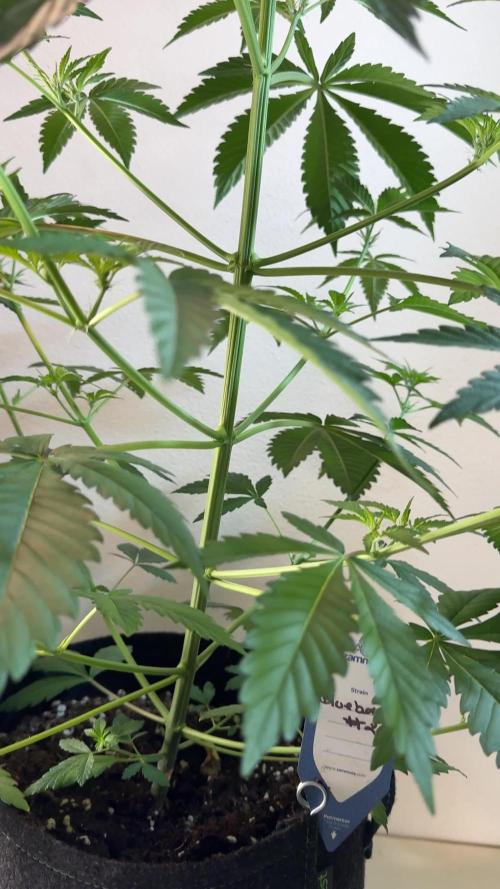
🌺 Week 1 Flower – Full Speed Into Bloom
Grower’s Journal – BlueBerry by Zamnesia Seeds | Entry 006
The shift has begun, and our BlueBerry girls didn’t wait for permission.
By the end of the week, they were already showing pistils popping and bud sites forming, not just the promise of flowers, but flowers beginning to shape up already.
We’re still in what some would call pre-flower, but let’s be honest:
These girls are on the move.
⸻
🌱 Structure, Height & Symmetry
Both girls are clocking in around 57 cm, with near-mirror symmetry in structure and development.
Their growth is tight, lush, and beautifully balanced, like they were clones of each other.
📣 Shout out to Zamnesia
This is what great genetics look like.
Stability, vigor, and uniformity that shows their heritage proudly.
⸻
🌍 Genetic Roots – A Quick Nod to the Legend
We touched on it before, but it’s worth a reminder, BlueBerry is more than a name. It’s a landrace-influenced legend, blending Thai, Afghan, and Purple heritage into a profile that’s nostalgic, rich, and full of stories.
This isn’t just a plant.
It’s a revival of history, growing in a modern tent.
⸻
Nutrient Transition – Start Booster Out, Top Booster In
As we move into flower, we’ve adjusted the feeding plan accordingly:
🌼 Current Feed (per liter):
• Regulator – 0.15 ml
• CalMag Boost – 0.25 ml
• 💧 All-in-One Liquid – 1 ml
• Top Booster – 0.25 ml (NEW this week)
Why Top Booster now?
Because with bud sites forming, we’re shifting the nutrient profile to support:
• Phosphorus + Potassium demands
• Bloom hormone signaling
• Tight flower stacking
It’s a small change, but the timing is everything.
And the girls are loving it.
⸻
Environmental Stats – Riding the Heat Wave
• Room Temp: 31°C
• Humidity: 50.3%
• VPD: 2.23 kPa
Yes, it’s a little high—but we’re monitoring closely.
Plants are adapting well, leaves are still perky and expressive, and the structure remains lush.
✅ Coming soon:
AC unit incoming to help dial this environment into a more stable and optimal range. Until then, the genetics are showing great resilience.
⸻
💨 Airflow, Extractions & Gear Overview
Even with summer heat, airflow remains dialed:
• Exhaust:
• 6” Spider Farmer inline with carbon filter — managed via Spider Farmer GGS Controller
• 6” AeroFan inline with carbon filter — connected to TrolMaster Tent-X
• Intake:
• 6” fresh air intake, passive-cooled and filtered
• 💡 Lighting:
• Black Series 600 LED (Zone 1)
• ThinkGrow Model One LEDs (Zone 2)
Both managed by TrolMaster ecosystem, alongside:
• 🧠 CO₂ Sensors
• Temp/Humidity Probes
• 💡 PPFD Sensors for real-time light data
📹 Video Room Tour Available
We’ve uploaded a generic grow room tour this week, showcasing the entire grow setup, including gear, layout, controllers, and environment flow.
⸻
🌸 What’s Next – Stretch & Structure
We expect:
• Stretch to continue in the next 10–14 days
• Node stacking to tighten
• Early trichome shimmer possibly appearing toward Week 2–3
This is a critical window for:
• Monitoring internode spacing
• Light height and spectrum adjustment
• Fine-tuning VPD as flowering kicks into high gear
⸻
🚫 What Not to Expect Yet:
• No defoliation or major training—structure is too delicate right now
• No aggressive boosts—flower development is just beginning
• No topping or stress—focus is now on upward and outward bloom formation
⸻
💬 Final Thoughts – BlueBerries in Bloom
This run has always been about balance:
Classic genetics. Modern precision. Beautiful biology.
With pistils out and the tent full of energy, it’s time to watch this legendary strain write her next chapter.
From landrace roots to LED-powered flower—our BlueBerries are in full stride.
Let them shine. 🌸✨
With love, care, and growing admiration,
Your ever-faithful garden friend
DD (DogDoctor)🌱💚
📲 Don’t forget to Subscribe and follow me on Instagram and YouTube @DogDoctorOfficial for exclusive content, real-time updates, and behind-the-scenes magic. We’ve got so much more coming, including transplanting and all the amazing techniques that go along with it. You won’t want to miss it.
• GrowDiaries Journal: https://growdiaries.com/grower/dogdoctorofficial
• Instagram: https://www.instagram.com/dogdoctorofficial/
• YouTube: https://www.youtube.com/@dogdoctorofficial
⸻
Explore the Gear that Powers My Grow
If you’re curious about the tech I’m using, check out these links:
• Genetics, gear, nutrients, and more – Zamnesia: https://www.zamnesia.com/
• Environmental control & automation – TrolMaster: https://www.trolmaster.eu/
• Advanced LED lighting – Future of Grow: https://www.futureofgrow.com/
• Root and growth nutrition – Aptus Holland: https://aptus-holland.com/
• Nutrient systems & boosters – Plagron: https://plagron.com/en/
• Soil & substrate excellence – PRO-MIX BX: https://www.pthorticulture.com/en-us/products/pro-mix-bx-mycorrhizae
• Curing and storage – Grove Bags: https://grovebags.com/
⸻
We’ve got much more coming as we move through the grow cycles. Trust me, you won’t want to miss the next steps, let’s push the boundaries of indoor horticulture together!
As always, this is shared for educational purposes, aiming to spread understanding and appreciation for this plant. Let’s celebrate it responsibly and continue to learn and grow together.
With true love comes happiness. Always believe in yourself, and always do things expecting nothing and with an open heart. Be a giver, and the universe will give back in ways you could never imagine.
💚 Growers love to all 💚

Likes
20
Share


@DabbertGlobberfield
Follow
For the Herbies contest - https://growdiaries.com/diaries/157348-grow-journal-by-dabbertglobberfield#gallery=6777378 - Grandmommy Purple is guilty multiple noise violations for being too loud and for stanky funk.
Harvest - 169 days / 66 days in flower
Well, we did it. I made it to the end. All I can think is...WOW that was A LOT of work. But I think I had very good results for a first time grower. I
For harvest, we took Plant B and D and prepared them for immediate freezing. Altogether, I ended up with 1212g wet on plant B and 1089g wet on plant D. I ended up freezing 1816g of this. There was some from each of these plants that was set aside from freezing because, for whatever reason, I thought they were not worthy of washing because of how progressed the leaf damage was from the root rot battle. So that was cut up and dried as nuggets instead of hanging like the rest. Sawtooth and Plant C were both harvested and hung in the tent to dry for 12-13 days. I think I overdried by 1-2 days because when I jarred them they struggled to raise up to 55%. So I am using rh% packs.
After drying Sawtooth and plant C, I ended up at 459.8g for dried flower and 170.8g in dried trim. So just over 1lbs between the 2 plants and 4.15lbs wet between the other 2 plants that was washed for hash.
So... are you for real with the effort involved with washing bud for bubble hash? I don't think I would do this in the warmth. I only pursued doing bubble hash cause it's cold right now and I figured that would really help. Even in the 30s(fahrenheit) stuff would stick. It's hilarious how sticky of a process this is. I hope you have a bunch of gloves, water, and ice to burn through. I went through over 60 gallons of distilled water and 80lbs of ice to wash the 4 lbs. I am envious of people in videos using a hose to collect, clean, and refill. Also, doing this as a 1 person show is the definition of insanity.
I broke the washings up into 3 parts. The first part was was the tester wash. I broke off 420g of plant D's 848gs available. I used 7 bags to see where I would end up. I used 220, 160, 120, 90, 73, 45, 25. What I determined was that if I was hunting a specific micron with a lot of material this would help find what you can get. But for the next washing I reduced the amount of bags to 4; 220, 160, 45, 25. The time, with the 4 bags, I washed with 809g. I had a much more favorable experience and return this second time but I had green fast and probably used too much ice. The 3rd wash was the remaining 631g and I found an extra 137g I added of sugar leaves and trim, brining the 3rd wash to 768g. I used 5 bags this time; 220, 160, 73, 45, 25.
By the 3rd wash I have become an expert in collection but also never want to do it again. lol.
2 of the 3 washes have dried and I have 43.4g of bubble and 2.8g of dry sift. 37.4g of that bubble is able to be pressed into rosin. I will probably press that dry sift as well. The other stuff is 25u or 160u that I will experiment with or cook with. The other stuff is drying so I can't add it all in.
I pressed a bunch of trim and some flower. The trim presses nice and the dab is decent. I am working out a good temp for the flower. But the problem with all these tests to find the sweet spot is that I have all these testers to go through but want to keep pressing and trying that! I think I will need to work on a better storage solution.
I can't wait for the fresh frozen bubble hash rosin pressing... I have over 20gs of bubble to put in one bag. I am really looking forward to this. But I will need to work up to that pressing since I have never pressed hash/kief/bubble before in my rosin press. So this should be really fun.
I will 100% post an update of the hash pressing once I do that and also after the 3rd wash session is done drying.
In closing, saying I learned a lot from this grow would be an understatement. I fully expect to start it back up in a few weeks after some R&R then some R&D. There's some things I will need to work on before I start again, such as: having a single external reservoir that feeds multiple plants, hard to clog and easy to use ebb and flow system, miscellaneous final run stuff like space for drying. So thanks everyone for hanging out and perusing the photos and or reading all my huge rambling updates and thanks to those for the help along the way.

Likes
207
Share

@DogDoctorOfficial
Follow
Day 72 Flower and this cuties are almost ready to harvest but not quite there yet 😅 i will keep looking as close as possible and checking every day hehehe but for now i will keep on watering since they are keeping on drinking and the trichome are not mature to my like yet 💚💚💚😍😆🙏🙏🙏🙏
Growers love to you all , and as always thank you guys for reading my diaries , i truly appreciate your time , your love and it all 🙌🙌🙌
And with enormous honor and pleasure that i start collaborating with Zamnezia and Viparspectra
For this run i will have the pleasure of growing some Runtz genetics from Zamnezia seeds that they wore kind enough to send me for test and review 🙏🙏🙏💚💚💚🙏🙏🙏 and for the testing and reviewing i was blessed with the VIPARSPECTRA model P2000💚💚💚🙏🙏🙏 they wore amazing and send me this LED light for me to do some testing and some reviews. Special thanks to Zamnezia and to Viparspectra for this opportunity, lets make magic together 💚💚💚🙏🙏🙏
All i grow is medicine for myself, for me and for my best friend with is me 😆 nothing to sell, so don’t even ask 😅💚💚💚
All info and full product details can be find in can find @
https://viparspectra.eu/collections/grow-lights DISCOUNT CODE 5% - DOGDOCTOR ( all store )
https://www.zamnesia.com DISCOUNT CODE 10% - GROWITGD ( just for seeds )
https://aptus-holland.com/
More info and updates @
https://growdiaries.com/grower/dogdoctor
https://instagram.com/dogdoctorofficial
https://youtube.com/channel/UCR7ta4DKLFMg2xxTMr2cpIg
💚💚💚Growers love to you all 💚💚💚
Likes
226
Share


@HighTV
Follow
| 📅 Week 9 | Days 57 - 63
| 💡 750w 📏25' |
| ☔ 36%-47% |
| 🌡️️🌞 74 - 75 |
| 🌡️️🌑 73 - 74 |
01/04: I Did a complete reservoir swap on all the plants with an increased nutrient schedule. I should have done this sooner, but I feared the N toxicity. The PH on all the plants has been adjusted to 5.8 as usual. Smells are kicking in really nicely. Great White Mycorrhizae has been added in the reservoirs in place of the Hydroguard.
01/05: Topped off the focus plant only and PHed all the plants to 5.8. The temperatures and humidity has been nearly perfect for my environment. The buds are starting to swell nicely and the trichomes are filling up all over and starting to turn cloudy in some places.
01/06: Reservoirs on all of the plants were topped and and their PH's adjusted to 5.8. No changes have been made for humidity and temperatures. I removed some unhealthy leaves and adjusted plant positions just slightly. Fox tailing has begun to get severe on the focus plant unfortunately with the other two plants acting normal and temperatures around 77 its looking unavoidable and genetic.
01/07: I cleaned out the bottom of tent today from the build up of debris for a clean tent! The reservoirs were topped off and PHed to 6 to combat a dropping PH. If the PH's drop again we will look towards a reservoir swap tomorrow to avoid problems and get a fresh mix.
01/08: Thankfully the PH's have stabilized and aren't dropping drastically so I will not reservoir swap right now and will do it as schedules in a few days. I topped off all of the reservoirs back to normal and PHed them to 5.8. The smell has increased drastically over the week and its amazing right now.
01/09: Applied a small amount of foliar spray to give addition Calmag and keep humidity up today. I adjusted the PHs of all the plants to 5.8 after topping them off with tap water. I also adjusted the SCROG a slight bit and removed some old foliage. The RH levels are still in the acceptable rage for my setup so I will just refill the open containers and not add/remove any of them.
01/10: All of the reservoirs needed topped off and had their PHs adjusted to 5.8. I moved the air ducts around for better airflow. Temperatures and humidity have remained in the good zone for my environment and I look to keep it stable. I moved fans around in the tent to increase canopy airflow.
_______________________________________________________________________
This week showed very good bud and trichome development. The addition of Great White Mycorrhizae has immediately increased bud development significantly. The timelapse plant unfortunately has genetic foxtailing on the majority of its buds decreasing overall bud structure vastly. The non-timelapse plants show little to no signs of foxtailing and have nice and chunky bud structures. These plants are maturing EXTREMELY fast over the last week and a half and its looking like harvest time will be much sooner than I anticipated given the lengthy veg time we had. Week 9 overall was pretty rough in terms of growth for our focus plant because the fox-tailing however there is only so much we can do and this week was fantastic for the other two plants so that's always nice!
Feel free to leave comments/questions below or give me any feedback to improve my diaries. If you like this Diary follow along and check out my others as well 😎