


Likes
27
Share


@DeepRootsGrowTrees
Follow
GELATO-K By KANNABIA
Week #17 Mar. 1st-8th
Week #6 Flower
This week she is starting to stack and put on some weigh buds are getting dense and covered in trichomes!!


Likes
2
Share

@420DeepGrow
Follow
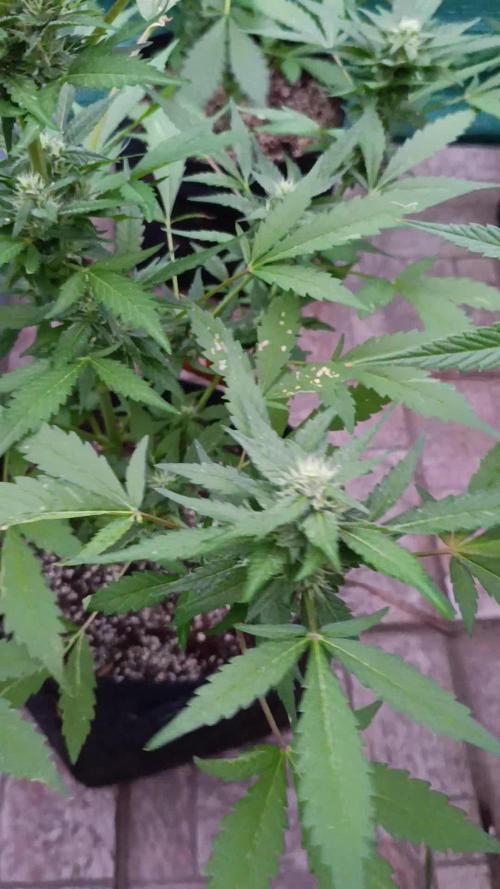
📆 Semana 5
Durante esta quinta semana de floración, los cogollos continúan ganando volumen y definición, mostrando una evolución constante. La planta mantiene un desarrollo equilibrado y un aspecto saludable, aprovechando muy bien el sol directo.
⚡ EC: 1.0
💧 pH: 6.2
🌡️ Agua: 21°C
🌫️ Humedad: 45 - 55%
💡 Intensidad: Luz directa del sol
🌱 Aporte nutricional: Se incrementa progresivamente la nutrición hasta una EC de 0.9, manteniendo Silica Force, Sugar Shot, Sticky Fingers y Bloom Booster.
🔥 Nota de cultivo: La floración sigue avanzando con fuerza, aumentando poco a poco el volumen y la definición de las flores.
Seguimos creciendo fuerte 💪!

Likes
4
Share


@AustinRon
Follow
OG 4Q24 Seedling Week 2
Orangegasm (Fem) [ IRIE Genetics ]
12/12 @ Bolt (Day 21)
Germination: 20 November 2024
#3A Earliest Harvest Date: 7 February 2025
#3B Latest Harvest Date: 17 February 2025
_________________________________________
Start of Week: [Mon Dec 2, 2024 CR2 4Q24 15:S:1:1]
End of Week: [Sun Dec 8, 2024 CR2 4Q24 21:S:1:7]
OrangeGasm Fertigation: Max EC: [ 2.4, mS]
_______________________________________
Week 2 Objectives
- Continue to root out Seedlings
- WHEN We’ve ROOTS AT THE BOTTOM - Up Plant to 1 GAL and Flip
- Restart EC Ramp (from 1.0 mS/cm2) WHEN ALL Seedlings are standing up STRAIGHT.
- Maintain Environment
Feed Schedule:
- RLA Hydro Chart, Max EC: 2.4
- RLA Foliar (Veg, No add’l PK)
- Weekly: Cytoplus or TM-7: [ 1.25, ml, gal] Through Bolt III
- Wetting Agents
- Dr Bronner’s Hemp Soap: [ 6, drops, gal]
- Quillaja 60: [ 1.25, ml, gal]
- Biology
- Photosynthesis Plus
- Mammoth-P
RLA Foliar through BOLT III
- Monday: Silica Skin, Solar Rain
- Wednesday: CalMag Fuel, Lush Green
- Friday: Solar Rain
Environment, Rooting Cuts, Week 0
- ECRange: [ 1.1, 1.7, mS]
- TempMax: [ 82, °F]
- RHMax: [ 69, %]
- VPD: [ 0.85, ±0.05, kPa]
- LightIntensityRange: [ 410, 530, µMol/m2/s]
- LightPeriod: [ 18/6] # Light Hours, Continuous Dark
Lighting Notes:
- @19.5” Canopy Distance, the dimmer shows 10% of the PPFD Delivered, i.e. 100% = 1000 µMol/m2/s, therefore we’ll maintain light distance (19.5”) and control Light Delivery from the Dimmer. Max will be 85% ( 850 µMol/m2/s)
__
Mon Dec 2, 2024
OG 4Q24 15:S:2:1
- Foliar: Silica Skin, Solar Rain
- TM-7: [ 1.25, ml, gal]


__
Tue Dec 3, 2024
OG 4Q24 16:S:2:2
- Let’s Resume EC Ramp: EC: [ 1.1, mS/cm]
- AM: Watered 50 ml/pot
- All seedlings have ‘Popped,’ Good turgidity, stems firming, big leaves . . .

Photosynthesis Plus: [ 3, ml]
Quillaja 60 Powder (Surfactant): [ 0.625, tsp]
TM-7 (BioAg, µNutrients): [ 0.625, tsp]
Starting with 9.4 EC, Diluted GH pHDown 50:1, and applied 4.2 ml. Reduced to 6.9pH. Took EC from 0.3 to 0.4. We DON’T need additional Phosphorous when phDown’g.
__
Wed Dec 4, 2024
OG 4Q24 17:S:2:3
- Foliar: CalMag Fuel, Lush Green
Ordered ph UP to address acidic Dehu Water.
Fertigation: 2024-12-04T09:32:20-0600: 50 ml/pot

Foliar:
- [X] CalMag Fuel: [ 2.5, ml, pt]
- [X] Lush Green: [ 0.625, ml, pt]
__
Thu Dec 5, 2024
OG 4Q24 18:S:2:4
EC: 1.3
After Foliar (CalMag Fuel/Lush Green), ‘mutant’ is filling in color.
We may have TWO ‘Jagged’ Girls - Serrated/Funky Leaves, TACO Leaves (Natural Fold)
Fertigation @ 1000, 50ml/pot


If so - This is Golden Goat Leaning, Frosty as Hell, Moderate Yielder

Per 0.5 gal feed water:
- [x] Primer A&B: [ 3.4, ml]
- [x] Silica Skin: [ 2.0, ml]
- [x] CalMag Fuel: [ 2.0, ml]
- [x] Lush Green: [ 1.4, ml]
- [x] Root Anchor [ 1.4, ml]
- EC: [ 1.3, mS]
__
Fri Dec 6, 2024
OG 4Q24 19:S:2:5
Foliar:
- CalMag Fuel: [ 2.5, ml]
- Lush Green: [ .0625, ml]
Fertigation:
- EC: [ 1.4, mS]
Per 0.5 gal feed water:
- [x] Silica Skin: [ 2.2, ml]
- [x] CalMag Fuel: [ 2.2, ml]
- [x] Lush Green: [ 1.5, ml]
- [x] Primer A&B: [ 3.7, ml]
- [x] Root Anchor [ 1.5, ml]
- [x] Photosynthesis Plus: [ 3, ml]

Wet Run Irrigation - 8 Emitters | Measure to assure relatively even delivery . . .
__
Sat Dec 7, 2024
OG 4Q24 20:S:2:6
- [ ] Assemble and Wet Run Irrigation
- [x] EC: 1.6

0.5 Gal Feed-water: EC: [1.5, mS]
- [x] Primer A&B: [ 4, ml]
- [x] Silica Skin: [ 2.5, ml]
- [x] CalMag Fuel: [ 2.5, ml]
- [x] Lush Green: [ 1.6, ml]
- [x] Root Anchor: [ 1.6, ml]
- [x] TM-7 (µNutrients): [ 1/8, tsp]
- [x] Photosynthesis Plus: [ 3, ml]
- [x] Quillaja 60 Powder: [ 0.125, tsp]
__
Sun Dec 8, 2024
OG 4Q24 21:S:2:7
440 x 4: 3520 ml/day (Less than 1 Gal)
EC: [ 1.6, mS/cm]

Likes
2
Share


@AngeLus
Follow
Sun Is shining short time And cold temperatures in bathroom . Transport Plant to my grow box . Smell 🤣 very hard .

Likes
20
Share


@StunFlower
Follow
She's doing very well. Gave her a little clean up today - removed some undergrowth that won't make to the top. Keeping her diet pretty much the same other than an increase in Cal-Mag this week - the other plant in my tent was showing signs of deficiency so I thought they'd both get a little boost since I've been treading lightly. She did a bit of stretching this week - grew about 5" taller! Looking forward to see some fattening of the buds! 👊
-----------
Day 65: PPM 668; PH 5.8. I think her drink is bit on strong side with PPMs increasing a bit since the rez change. Topped her off today with 3/4 gallon of filtered water to dilute things a bit. Sitting at 574 PPM; PH 6.2. Buds are starting to stack nicely and fatten.
Day 66: PPM 553; PH 6.2. Let her be. Seems to be happier now that I've watered down her drink a little. Frost is starting to form around some of the buds and she's getting more fragrant.
Day 67: PPM 584; PH 5.2. Gave her 3/4 gallon filtered water with light dose of nutes. She's now running at 553 PPM; PH 6.0.
Day 68: PPM 563; PH 6.0. Let her be.
Day 69: PPM 532; PH 5.8. Gave her 3/4 gallon filtered water/feed. Now at PPM 542; PH 6.2.
Day 70: PPM 532; PH 5.1. Discovered my PH meter is toast and has been reading much higher than it should. Got a new meter and hopefully back on track. Thank goodness this plant is resilient. Gave her some PH up and sitting at 6.1.

Processing
Likes
9
Share


@KcKush
Follow
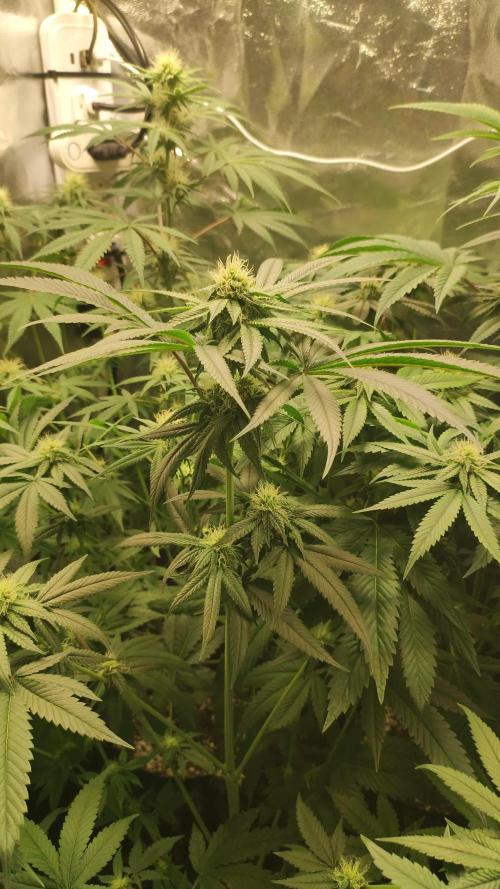
* 3 of 3 grew.
* Will transplant into 1 Gallon soon
*Might grow these inside the closet with the White Widows.
*Thinking of Purchasing a Mars Hydro SP 3000


Likes
4
Share

@Borberad
Follow
Die volle Blüte
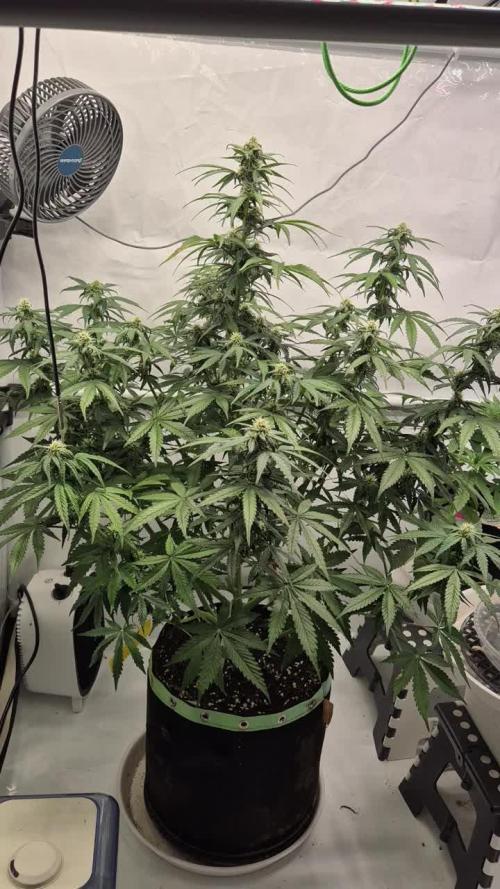
Die Blüte ist in vollem Gange! Die Pflanze streckt sich kräftig und entwickelt schöne Blütenstände. Der DLI wurde sukzessive auf 40-45 angehoben. Der Düngeplan bleibt unverändert.
* Zustand der Pflanze: Kräftiger Blütestretch, erste Blütenstände sichtbar.
* Wichtige Ereignisse: Anhebung des DLI.
* Düngung & Messwerte:
* Gießwasser: pH ca. 6,3. Leitwert 1,4 bis 2 S.
* Drain: Wir stellen sicher, dass der pH-Wert nicht unter 5,5 und nicht über 6,8 liegt und der Leitwert die +/- 500 S Abweichung einhält.
* Anpassungen: Wir haben die Blume diesmal einfach nur ohne jedes Training wachsen lassen. Ein Arm ist jedoch beim trainieren diese Woche geknickt und wurde mit einem Strohhalm geschieht. (ungewolltes HST).

Likes
226
Share


@HighTV
Follow
| 📅 Week 5 | Days 29 - 35
| 💡 562w 📏42' |
| ☔ 29%-38% |
| 🌡️️🌞 76 - 79 |
| 🌡️️🌑 73 - 75 |
12/07 Weekly Reservoir swaps on all plants to clean them and give fresh nutrients. 2 plants repeated week 4 nutrients with no micro and the other two (including the focus plant in the lapse) are accurate with the Dairy.
12/08 PHed all plants to 5.8 and updated the LST on all the plants. Spread some of plants out to get better lighting as I raised the light s few inches.
12/09 Topped off the reservoirs and PHed them to 5.6 because they have been rising alot. Rotated plants half turn. Did more LST for more light penetration.
12/10 Signs of preflower are starting to show on two plants and the tent is starting to get that flowering smell not to much longer until I need to hook up the carbon filter to stop the stench.
12/11 Updated front left and back left plants to week 5 nutrients with no Floramicro, because these plants hate nitrogen. PH in all reservoirs set to 5.6
12/12 PHed adjusted to 5.8 and topped off all the reservoirs. Did more LST and tucked plenty of leaves away for better light on new growth!
12/13 First real signs of Flower! PH adjusted to 5.8 and reservoirs topped off with water to keep the nutrient levels balanced. Lollipopped the front left plant for experimental purposes.
These plants overall are doing fine and I have 2 different phenotypes displaying. One is extremely reactive to nitrogen and taller while the shorter phenotype is slightly less reactive to nitrogen (both hate it). I am pleased with the growth at this stage and the smell is just starting There is slight purple coloration displaying with the preflowers but nothing really noticeable yet. I am excited for the flowering to start so these girls can start showing their true colors 😍
edit: changed final picture for better lighting.

Likes
5
Share


@deepsheeba
Follow
!! A genetic mutation appears! flower tip look odd and the stem is flat but no weird sprout on it. Only one stem is affected.
Some other LST done.
CO2 decreased to 1000 for saving some co2. I don't think I have enough power to use all of that CO2.
Plant is growing really well. There's only a small concern about some worms at the bottom of the pot. I need to check it further. To be sure anyway I have planned an irrigation with neem Oil just for precaution.

Likes
7
Share

@eldruida_lamota
Follow
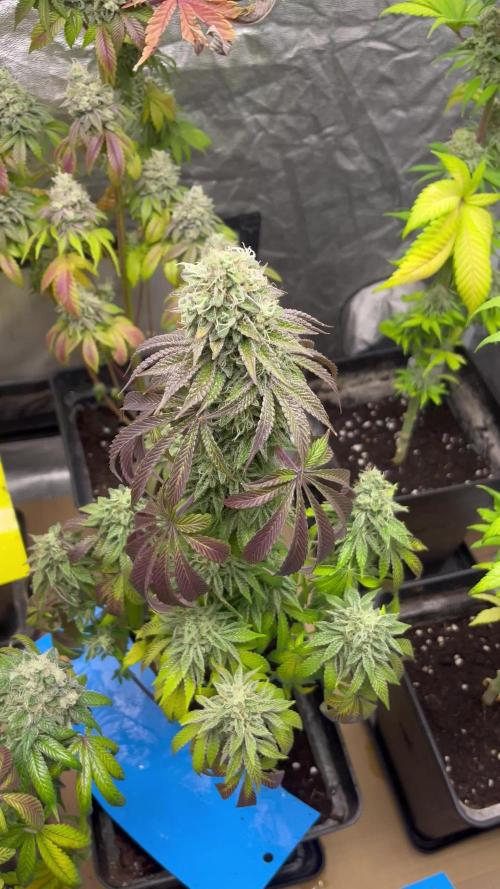
Que pasa familia, vamos con la novena semana de floración de estas Barcelona Puff feminizadas de Seedstockers.
Vamos al lío ,se trasplantaron en macetas de 7 litros definitivamente.
El ph se controla en 6.0 , la temperatura la tenemos entre 25/21 grados y la humedad ronda el 50%.
El ciclo de floración puse 12h de luz, el foco está al 100% de potencia.
De momento van creciendo a buen ritmo y tienen un buen color, la flor está madurando y a tricomado bastante, por el momento todo bien.
Agradecer a Agrobeta por el envío del kit gold series para la temporada 🙏.
- os dejo por aquí un CÓDIGO: Eldruida
Descuento para la tienda de MARS HYDRO.
https://www.mars-hydro.com
Hasta aquí todo, Buenos humos 💨💨💨

Likes
4
Share

@Zdenda
Follow
První týden v květu.. moc se toho neděje.Objevují se první samičí pestíky a začíná se to vytahovat.
Holky rostou krásně a vypadá to, že jsou spokojeny.
LST jsem dělal v tomto týdnu naposledy a už je nechám jen růst.. počkám až se ještě trochu vytáhnou a přidám síť. stále pH 6.2 a Ec 1-1.1.. začínám v květu hnojit zlehka a postupně přidávám podle toho jak se holky budou chovat. Mají docela velký listy.. chce to protrhávat, aby šlo dovnitř světlo a snížila se vlhkost.
Už je to zase prorostlé tak to zase proberu.
Celkově zatím žádný problém a s kmenem spokojenost.. hezký růst bez velkých nároků😄👍🏻

Likes
9
Share


@TheWeedPimp
Follow
Got mold in one of the buds. So I removed it... don’t think she gonna make it... so much rain no sun.... amazing smell when visiting her
But got a new problem I just discovered there’s a human path.... not far from the place I can see them they can’t see me... yet.... maybe try make some oil on here. She already really sticky

Likes
148
Share


@BioBuds
Follow
Gorilla, gorilla, my problem child. The only one popping out of 5 but she is weaker than her roommates. She stays behind compared to them. But what can I do other than TLC, she has the best conditions, which are optimal in this grow room, also judging by the other two plants. Until I have a bigger operation, which in the current political climate, is not soon, where I can make mothers and clone them, breed my own strains, and root out runts like this, we do it like life. We play the hand as it is dealt to us and we love all our children the same... although this one is special.
So not a genderfluid Silverback yet, but it ain't over till the voluptuous lady sings. We shall nurse this little runt until adulthood, who knows she might surprise us, she should have the mighty Gorilla Glue Number Fouh genes in there somewhere. Now come on out here and show daddy what you're made of...
This week we spread out the leaves and branches, some leaf tucking and gentle LST, to prepare for some higher stress and super cropping today. Two days back we made the switch and set the lights to 12/12. Now the flowering stretch will begin, thus we bend the branches further outward in preparation for the canopy. When I do this I notice the branches are thick and sturdy, with no breakage at all unlike my previous grow, the gelato 33. I snapped some branches applying the super cropping and just normal bending with those. It seems like the fan (I didn't have a good option previous grow, hence the flimsier branches there) but also this lighting and soil regime are topnotch, asides from outdoor I haven't seen such lush bushiness yet, even on a more runt-like plant.
This MarsHydro SP3000 is still performing great, such controlled temperatures, such an ocean of light. I only wish I started growing with this earlier. Thanks again @MarsHydroLED for trusting us to test your mighty flagship light. It is so well made, it oozes quality, I just want to touch it every time (also to check if it stays cool) and it is just sexy, slender, and compared to my other 300 watt light, a completely different spectrum and clarity. If you are looking for new lights, look no further. At www.mars-hydro.com they have excellent and unbeatable deals on tent and light combinations where you practically get a tent for free, it is ridiculous.
I was afraid the light wouldn't cover the sides of my tent with my 4.5-foot space. Penny at MarsHydro had to laugh at this a bit, said not to worry. What an understatement. This light could signal to other galaxies. I sincerely recommend good sunglasses with this light.
Only thing I'm adding is an infrared light Sunshine found. With this I'm going to simulate sunrise and sunset and try to prevent stress by easing the light in and out, like in nature.
We are in flowering now, very excited to see what she will do here. What can she perform? Will she cover the net? Will she deliver gorgeous buds, like she is known to do? On these cliffhangers I hope you will tune in next week for more gorilla-related plantporn... go on... you know you want it.
Hug Bud!!
Likes
26
Share


@GuerillaGorilla
Follow
17 sept.
Please let there be sunshine,
Mould had been spotted mainly in the northern part of the plant. Rain had been pouring down for nearly a week and air humidity was around 80-90 %
Plants are way to far in their flower cycle for these kind of showers and you can see it has taken its toll.
Pistils are turning brown and buds need to be checked every other day to stop mold from spreading.
She still needs a week more maybe 2 if weather allows it, but she will be chopped before the next rainy days.
I will lose a part of the harvest to mould weekly but for me the maturation of the harvest is more important than the quantitity. As you can see there are plenty of buds left that still have chance of maturing. Harvesting now would be a shame.
Simply hoping for some dry warm days for her to swell and put on some weight.

Likes
8
Share


@Inceptionist
Follow
Melonade Runtz got harvested 16/11 and I'm planning to let her dry for 14-21 days before trimming and put them in glass+boveda (58%) and grove bags for final cure.
Drying conditions are as follows:
16-18°C
55-60% RH


Likes
3
Share


@Autofutur
Follow
That girl is taking forever,but she is packed with trichomes,sticky enough that you need gloves everytime you need to touch it.smelly and fat buds everywhere.very much worth the wait but still long.
Starting the flush now.and I think I LL do that for another week by the trichome development.


Likes
38
Share


@GODSGIFT_2005_JM
Follow
For LIQUIDS ******GREEN BUZZ LIQUIDS***** organic.
Also i’m using their LIVING SOIL CULTURE in powder form!
MARSHYDRO ⛺️ has large openings on the sides which is useful for mid section groom room work. 🤩
☀️ MARSHYDRO FC 3000 LED 300W
💨MARSHYDRO 6” in-line EXTRACTOR with speed-variation knob, comes complete with ducting and carbon filter.