The Grow Awards 2026 🏆
Likes
Comments
Share
@Ninjabuds
Follow
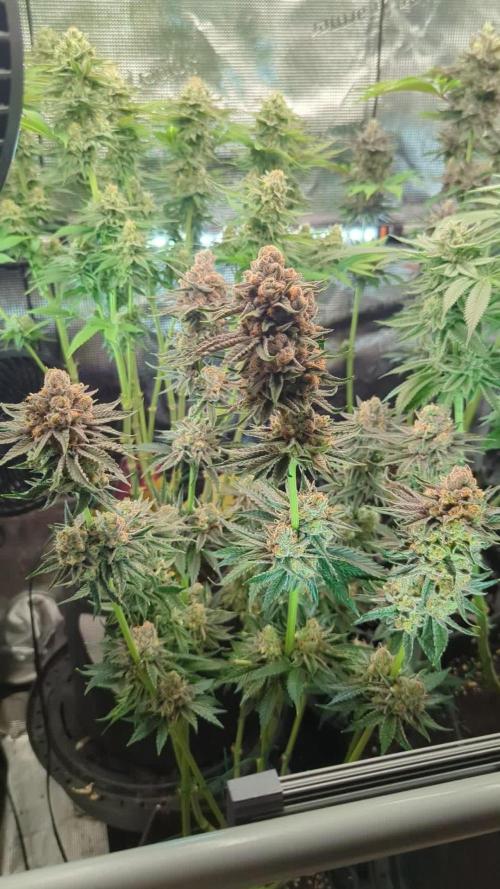
Man, it's been a crazy week. These past few days have been brutal – seriously cold with this crazy humidity. I don't know about you, but I'm sick of the chills and the way my skin feels all sticky. It's been a struggle, but I'm finally getting on top of things. I think I've figured out a good routine to dry things out around here, so hopefully, I'll be feeling a lot more comfortable soon. It's been interesting watching these permanent marker plants grow. One of them is still kinda lagging behind, but I think I've got the other one figured out. It's stacked so perfectly, and it's starting to look super sparkly, almost like it's got little crystals on it. I'm curious to see if the other plant will catch up.
Likes
19
Share
@AsNoriu
Follow
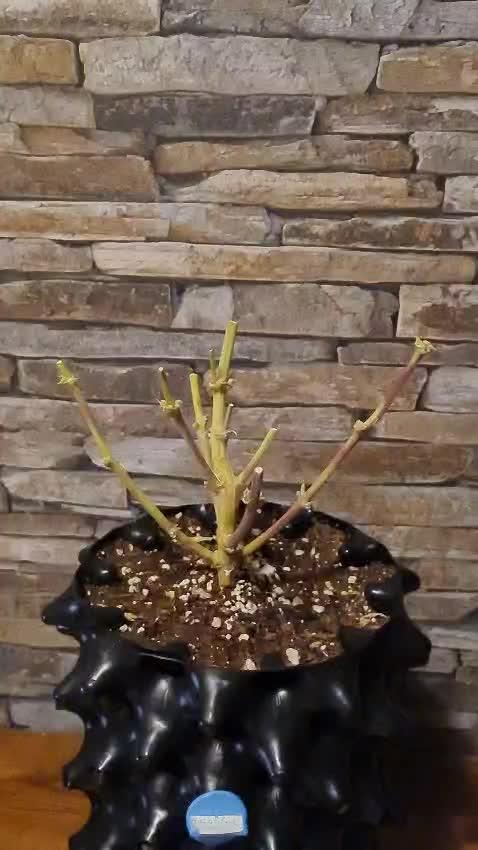
Day 50. Tallest Kush chopped by breeders recommendations, but in my conditions like a week at least away. Had max 20% milky, most clear, plant suffered some deficiency and was faiding slowly, still. Instead of Christmas flowers - 5 colas surprised my friends, colours and crystals are amazing. She was watered last 4 rounds with water and i will compare taste and effect , but i think it's a loosing tactics - such early crop. Not more than 40 expected from what left ;))) 5 out of 17 colas was taken away. I will add a third of weight, for real feel in totals. Day 67. After 24 hours of darkness all girls are chopped. Will make review and update in a week or so.
Processing
Likes
2
Share
@BigHorn
Follow
Week has gone well no support needed stock has been strengthened. New stocks coming in to replace the original 2 leaves. Looking very healthy. Trying to keep temp up a lil higher but I'm having difficulty do that currently. Just going to run the heat in my house a lil higher to help out.
Likes
16
Share
Starting to see some more amber, but minimal amounts. Definitely seeing the trichomes turning milkier though. Might end up cutting the plant down in half, maybe a week and a half tops, she's been going for sooo damn long. It's day 119 and we decided we're gonna take it down this weekend, the 19th of February will mark the 17th week since it first sprouted, so what better time to chop! We're also going to go the fridge dry method and then cure in Grove bags, hoping for some real nice smelling buds after all this.
Likes
22
Share
Started flushing both plants on 11/29, expect to harvest on the 11th or 12th of December. Trichomes are milky with ambering in WC1 so we are starting the flush on WC2 slightly early because we need the space to dry. Looking great though, very smelly and dense buds.
Likes
3
Share
@Xabii
Follow
Considering to chop in the next couple days just to end this, nothing happens, plant is sick and all, worst grow I had... so far. Values are average of the day. DATE - EC(us/cm) 20250521 1967 20250522 1903 20250523 1895 20250524 1961 20250525 2012 20250526 2047 20250527 2077 DATE - PH 20250521 5.92 20250522 6.03 20250523 6.01 20250524 6.00 20250525 6.01 20250526 6.01 20250527 6.01 DATE - ORP (mV) 20250521 232 20250522 231 20250523 228 20250524 209 20250525 193 20250526 179 20250527 167 DATE - °C - RH% (Tent Temp/RH) 20250521 25.4 47 20250522 25.5 42 20250523 24.3 38 20250524 24.8 46 20250525 24.7 53 20250526 25.0 49 20250527 25.0 49 DATE - °C (Reservoir) 20250521 21.1 20250522 20.9 20250523 19.7 20250524 20.5 20250525 21.1 20250526 21.1 20250527 21.0 DATE - CF 20250521 19.67 20250522 19.03 20250523 18.95 20250524 19.61 20250525 20.12 20250526 20.47 20250527 20.77
Likes
4
Share
@Ninjabuds
Follow
My OG Kush plant is from Royal Queen Seeds, and I know they sometimes get a bad rap, but I've grown their OG Kush before and it was fantastic. This pheno has some awesome leaves and just a really good structure overall. It's been a challenging week with the constant rain and ridiculously high humidity. Keeping things dry indoors has been a real struggle. Despite the weather, I managed to flip all my feminized photoperiod plants to flower this week. I'm hoping the switch will go smoothly, but with this humidity, it's going to be tough.
Likes
73
Share
@Roberts
Follow
Lilly x White Widow is finishing up her bulking. I did a solution change a few days ago. She has about 2 weeks left. My biggest issue will be I have 5 plants all closet done that will be all finishing at once. So I gotta spave them out to get them all in the cannatrol. Everything is going well. Thank you Spider Farmer, Athena, and Ripper Seeds. 🤜🏻🤛🏻🌱🌱🌱 . 🤜🏻🤛🏻🌱❄️ 🌱 Thank you grow diaries community for the 👇likes👇, follows, comments, and subscriptions on my YouTube channel👇. ❄️🌱🍻 Happy Growing 🌱🌱🌱 https://youtube.com/channel/UCAhN7yRzWLpcaRHhMIQ7X4g Spider Farmer Official Website Links: US&Worldwide: https://www.spider-farmer.com CA: https://spiderfarmer.ca UK: https://spiderfarmer.co.uk EU: https://spiderfarmer.eu AU: https://spiderfarmer.com.au G5000 Light Amazon Link: amzn.to/4643esa UVR 40: https://www.amazon.com/dp/B0BR7SGTHS Discount code: saveurcash (Stackable)
Likes
15
Share
Likes
37
Share
@Rob96
Follow
Plant coming along nicely, gaining weight and getting denser along the tops, really doing well. Doesn’t seem to smelly yet which is a surprise as Mimosa usually has a strong distinctive smell but not the case with this so far, buds looking nice though plenty on them and really nice and frosty glows when the flash from camera is on it, still getting bigger and bigger can’t wait to see how it all finishes. Roughly 3 week to go now so will be starting to flush at end of this week
Likes
34
Share
This strain is going to give a lot of big buds, its developing very well. It smells like sweet sour mango.
Likes
8
Share
The last week that they will receive 'veg' supplements. Next feed will have bio bloom and top max added, root juice is removed. I try to give them a feed with nutrients one or twice a week, and one without (just water).
Likes
60
Share
HARVEST DAY!!!.... What a beautiful plant.. I can't wait to give her a taste.. Was expecting to push her another week.. But a closer look showed that there were alot of amber already.. Kinda hard to see them against the purple calyxes along with with the Mars Hydro TS 1000 on as well.. But she should be perfect! Oh I cant wait!!! Will be updating with the drying and curing as I go!!! So happy!!! 😭😭😭 Drying - Day 4... Ok so humidifier is definately not needed this time lol.. For a couple days the room and box were at 70% so I took the water and filter out of the humidifier and just running it as a fan to help move the air around the small room its drying in.. The box also has a very small and weak computer fan which is just pulling the air out SLOWLY but SURELY.. Now the humidity inside the box has been reading 66% constantly for the last 2 days! This will be my first harvest that doesnt dry in 3 - 5 days without a humidifer! Maybe cuz I watered that morning?? Idk.. But this is much better.. Hoping for at least a 7 day dry.. 10 or 12 would be nice.. But I doubt that very much lol.. Anyways.. Will still be updating as I go!!! Drying - Day 5... So I went ahead and trimmed all the smaller nugs and colas.. Leaving the 3 biggest colas (back of the box) to trim in the morning tomorrow. I wish I would have lollipopped some.. Alot of larfy, leafy nugs.. But still gonna smoke that shit! Lol.. Took about 2.5 hours to trim what I did today.. Keeping the trim (duh) to make some bubble hash.. Or maybe just gather the keif and press it.. Haven't made up my mind on that yet.. Either way it's gonna be some epic shit! The smell is still so amazing! You could probably fuck up the drying and curing and still smell the citus! Lol.. But I will still keep updating as I go! Drying - Day 7.. I went ahead and put some smaller nugs into a jar to see what they were reading.. Still way too high.. In about 8 hours it was reading 84% RH so they still got at least a couple more days drying. Drying - Day 8... Ok so I was feeling the nugs I already trimmed and jarred.. They feel pretty crispy. So I'm jarring them again today. I have trimmed up 2 more of the bigger colas but I can feel that they still have some moisture.. So later today I'm going to finish trimming up the last one (which is gonna be awful lol it has alot of smaller branches that are gonna be very tedious) but that one is gonna have to be left out to dry a little longer than the rest. As of now, I have 3 jars filled.. I may even need to buy another jar.. I really wish I had some big mouth mason jars so I can buy those lids for curing! Those things look legit asf! Later that night... So I have now finished trimming.. The jars that I had already filled were reading 62% RH on the dot.. I like to have it at 65% - 68% RH to have some room to get it down to 62% after a week or two.. But this shouldnt be any issue.. Will add 62% packs when the jars get below 60%.. But since they are already at 62%.. I dont want to burp very often at all.. 62% RH is where I like my bids at. I have a sandwich bag FULL of trim.. That is gonna make some amazing bubble hash! Very airy bud.. But this strain is very beautiful.. Smells great.. Just the airy buds.. Will definately grow again.. Will update with a taste test in 15 - 30 days.. Would rather get the cure done before I taste her.
Likes
52
Share
Lacewings seemed to have mostly killed themselves by flying into hot light fixtures. I may have left the UV on which was smart of me :) Done very little to combat if anything but make a sea of carcasses, on the bright side its good nutrition for the soil. Made a concoction of ethanol 70%, equal parts water, and cayenne pepper with a couple of squirts of dish soap. Took around an hour of good scrubbing the entire canopy. Worked a lot more effectively and way cheaper. Scorched earth right now, but it seems to have wiped them out almost entirely very pleased. Attempted a "Fudge I Missed" for the topping. So just time to wait and see how it goes. Question? If I attached a plant to two separate pots but it was connected by rootzone, one has a pH of 7.5 ish the other has 4.5. Would the Intelligence of the plant able to dictate each pot separately to uptake the nutrients best suited to pH or would it still try to draw nitrogen from a pot with a pH where nitrogen struggles to uptake? Food for stoner thought experiments! Another was on my mind. What happens when a plant gets too much light? Well, it burns and curls up leaves. That's the heat radiation, let's remove excess heat, now what? I've always read it's just bad, or not good, but when I look for an explanation on a deeper level it's just bad and you shouldn't do it. So I did. How much can a cannabis plant absorb, 40 moles in a day, ok I'll give it 60 moles. 80 nothing bad ever happened. The answer, finally. Oh great........more questions........ Reactive oxygen species (ROS) are molecules capable of independent existence, containing at least one oxygen atom and one or more unpaired electrons. "Sunlight is the essential source of energy for most photosynthetic organisms, yet sunlight in excess of the organism’s photosynthetic capacity can generate reactive oxygen species (ROS) that lead to cellular damage. To avoid damage, plants respond to high light (HL) by activating photophysical pathways that safely convert excess energy to heat, which is known as nonphotochemical quenching (NPQ) (Rochaix, 2014). While NPQ allows for healthy growth, it also limits the overall photosynthetic efficiency under many conditions. If NPQ were optimized for biomass, yields would improve dramatically, potentially by up to 30% (Kromdijk et al., 2016; Zhu et al., 2010). However, critical information to guide optimization is still lacking, including the molecular origin of NPQ and the mechanism of regulation." What I found most interesting was research pointing out that pH is linked to this defense mechanism. The organism can better facilitate "quenching" when oversaturated with light in a low pH. Now I Know during photosynthesis plants naturally produce exudates (chemicals that are secreted through their roots). Do they have the ability to alter pH themselves using these excretions? Or is that done by the beneficial bacteria? If I can prevent reactive oxygen species from causing damage by "too much light". The extra water needed to keep this level of burn cooled though, I must learn to crawl before I can run. Reactive oxygen species (ROS) are key signaling molecules that enable cells to rapidly respond to different stimuli. In plants, ROS plays a crucial role in abiotic and biotic stress sensing, integration of different environmental signals, and activation of stress-response networks, thus contributing to the establishment of defense mechanisms and plant resilience. Recent advances in the study of ROS signaling in plants include the identification of ROS receptors and key regulatory hubs that connect ROS signaling with other important stress-response signal transduction pathways and hormones, as well as new roles for ROS in organelle-to-organelle and cell-to-cell signaling. Our understanding of how ROS are regulated in cells by balancing production, scavenging, and transport has also increased. In this Review, we discuss these promising developments and how they might be used to increase plant resilience to environmental stress. Temperature stress is one of the major abiotic stresses that adversely affect agricultural productivity worldwide. Temperatures beyond a plant's physiological optimum can trigger significant physiological and biochemical perturbations, reducing plant growth and tolerance to stress. Improving a plant's tolerance to these temperature fluctuations requires a deep understanding of its responses to environmental change. To adapt to temperature fluctuations, plants tailor their acclimatory signal transduction events, specifically, cellular redox state, that are governed by plant hormones, reactive oxygen species (ROS) regulatory systems, and other molecular components. The role of ROS in plants as important signaling molecules during stress acclimation has recently been established. Here, hormone-triggered ROS produced by NADPH oxidases, feedback regulation, and integrated signaling events during temperature stress activate stress-response pathways and induce acclimation or defense mechanisms. At the other extreme, excess ROS accumulation, following temperature-induced oxidative stress, can have negative consequences on plant growth and stress acclimation. The excessive ROS is regulated by the ROS scavenging system, which subsequently promotes plant tolerance. All these signaling events, including crosstalk between hormones and ROS, modify the plant's transcriptomic, metabolomic, and biochemical states and promote plant acclimation, tolerance, and survival. Here, we provide a comprehensive review of the ROS, hormones, and their joint role in shaping a plant's responses to high and low temperatures, and we conclude by outlining hormone/ROS-regulated plant-responsive strategies for developing stress-tolerant crops to combat temperature changes. Onward upward for now. Next! Adenosine triphosphate (ATP) is an energy-carrying molecule known as "the energy currency of life" or "the fuel of life," because it's the universal energy source for all living cells.1 Every living organism consists of cells that rely on ATP for their energy needs. ATP is made by converting the food we eat into energy. It's an essential building block for all life forms. Without ATP, cells wouldn't have the fuel or power to perform functions necessary to stay alive, and they would eventually die. All forms of life rely on ATP to do the things they must do to survive.2 ATP is made of a nitrogen base (adenine) and a sugar molecule (ribose), which create adenosine, plus three phosphate molecules. If adenosine only has one phosphate molecule, it’s called adenosine monophosphate (AMP). If it has two phosphates, it’s called adenosine diphosphate (ADP). Although adenosine is a fundamental part of ATP, when it comes to providing energy to a cell and fueling cellular processes, the phosphate molecules are what really matter. The most energy-loaded composition for adenosine is ATP, which has three phosphates.3 ATP was first discovered in the 1920s. In 1929, Karl Lohmann—a German chemist studying muscle contractions—isolated what we now call adenosine triphosphate in a laboratory. At the time, Lohmann called ATP by a different name. It wasn't until a decade later, in 1939, that Nobel Prize–-winner Fritz Lipmann established that ATP is the universal carrier of energy in all living cells and coined the term "energy-rich phosphate bonds."45 Lipmann focused on phosphate bonds as the key to ATP being the universal energy source for all living cells, because adenosine triphosphate releases energy when one of its three phosphate bonds breaks off to form ADP. ATP is a high-energy molecule with three phosphate bonds; ADP is low-energy with only two phosphate bonds. The Twos and Threes of ATP and ADP Adenosine triphosphate (ATP) becomes adenosine diphosphate (ADP) when one of its three phosphate molecules breaks free and releases energy (“tri” means “three,” while “di” means “two”). Conversely, ADP becomes ATP when a phosphate molecule is added. As part of an ongoing energy cycle, ADP is constantly recycled back into ATP.3 Much like a rechargeable battery with a fluctuating state of charge, ATP represents a fully charged battery, and ADP represents a "low-power mode." Every time a fully charged ATP molecule loses a phosphate bond, it becomes ADP; energy is released via the process of ATP becoming ADP. On the flip side, when a phosphate bond is added, ADP becomes ATP. When ADP becomes ATP, what was previously a low-charged energy adenosine molecule (ADP) becomes fully charged ATP. This energy-creation and energy-depletion cycle happens time and time again, much like your smartphone battery can be recharged countless times during its lifespan. The human body uses molecules held in the fats, proteins, and carbohydrates we eat or drink as sources of energy to make ATP. This happens through a process called hydrolysis . After food is digested, it's synthesized into glucose, which is a form of sugar. Glucose is the main source of fuel that our cells' mitochondria use to convert caloric energy from food into ATP, which is an energy form that can be used by cells. ATP is made via a process called cellular respiration that occurs in the mitochondria of a cell. Mitochondria are tiny subunits within a cell that specialize in extracting energy from the foods we eat and converting it into ATP. Mitochondria can convert glucose into ATP via two different types of cellular respiration: Aerobic (with oxygen) Anaerobic (without oxygen) Aerobic cellular respiration transforms glucose into ATP in a three-step process, as follows: Step 1: Glycolysis Step 2: The Krebs cycle (also called the citric acid cycle) Step 3: Electron transport chain During glycolysis, glucose (i.e., sugar) from food sources is broken down into pyruvate molecules. This is followed by the Krebs cycle, which is an aerobic process that uses oxygen to finish breaking down sugar and harnesses energy into electron carriers that fuel the synthesis of ATP. Lastly, the electron transport chain (ETC) pumps positively charged protons that drive ATP production throughout the mitochondria’s inner membrane.2 ATP can also be produced without oxygen (i.e., anaerobic), which is something plants, algae, and some bacteria do by converting the energy held in sunlight into energy that can be used by a cell via photosynthesis. Anaerobic exercise means that your body is working out "without oxygen." Anaerobic glycolysis occurs in human cells when there isn't enough oxygen available during an anaerobic workout. If no oxygen is present during cellular respiration, pyruvate can't enter the Krebs cycle and is oxidized into lactic acid. In the absence of oxygen, lactic acid fermentation makes ATP anaerobically. The burning sensation you feel in your muscles when you're huffing and puffing during anaerobic high-intensity interval training (HIIT) that maxes out your aerobic capacity or during a strenuous weight-lifting workout is lactic acid, which is used to make ATP via anaerobic glycolysis. During aerobic exercise, mitochondria have enough oxygen to make ATP aerobically. However, when you're out of breath and your cells don’t have enough oxygen to perform cellular respiration aerobically, the process can still happen anaerobically, but it creates a temporary burning sensation in your skeletal muscles. Why ATP Is So Important? ATP is essential for life and makes it possible for us to do the things we do. Without ATP, cells wouldn't be able to use the energy held in food to fuel cellular processes, and an organism couldn't stay alive. As a real-world example, when a car runs out of gas and is parked on the side of the road, the only thing that will make the car drivable again is putting some gasoline back in the tank. For all living cells, ATP is like the gas in a car's fuel tank. Without ATP, cells wouldn't have a source of usable energy, and the organism would die. Eating a well-balanced diet and staying hydrated should give your body all the resources it needs to produce plenty of ATP. Although some athletes may slightly improve their performance by taking supplements or ergonomic aids designed to increase ATP production, it's debatable that oral adenosine triphosphate supplementation actually increases energy. An average cell in the human body uses about 10 million ATP molecules per second and can recycle all of its ATP in less than a minute. Over 24 hours, the human body turns over its weight in ATP. You can last weeks without food. You can last days without water. You can last minutes without oxygen. You can last 16 seconds at most without ATP. Food amounts to one-third of ATP production within the human body.
Likes
12
Share
Gracias al equipo de AnesiaSeeds, Marshydro, XpertNutrients y Trolmaster sin ellos esto no sería posible. 💐🍁 Coco Jambo: Con una composición genética 60% Sativa y 40% Indica, Coco Jambo es tu billete dorado a un verano sin fin, ofreciéndote una escapada a un mundo donde el sol nunca se pone en tu felicidad. Con unos niveles de THC que oscilan entre un relajante 30% y un estimulante 34%, Coco Jambo es un faro de euforia que guía a sus usuarios en un viaje a través de olas de serenidad y vibrante alegría. Su aroma es una celebración de los sentidos; imagina el momento de euforia al abrir un coco y descubrir que rebosa de las frutas tropicales más suculentas. 🌻🚀 Consigue aqui tus semillas: https://anesiaseeds.com/es/product/coco-jambo/ 💡TS-3000 + TS-1000: se usaran dos de las lámparas de la serie TS de Marshydro, para cubrir todas las necesidades de las plantas durante el ciclo de cultivo, uso las dos lámparas en floracion para llegar a toda la carpa de 1.50 x 1.50 x 1.80. https://marshydro.eu/products/mars-hydro-ts-3000-led-grow-light/ 🏠 : Marshydro 1.50 x 1.50 x 1.80, carpa 100% estanca con ventanas laterales para llegar a todos los lugares durante el grow https://marshydro.eu/products/diy-150x150x200cm-grow-tent-kit 🌬️💨 Marshydro 6inch + filtro carbon para evitar olores indeseables. https://marshydro.eu/products/ifresh-smart-6inch-filter-kits/ 🍣🍦🌴 Xpert Nutrients es una empresa especializada en la producción y comercialización de fertilizantes líquidos y tierras, que garantizan excelentes cosechas y un crecimiento activo para sus plantas durante todas las fases de cultivo. Consigue aqui tus Nutrientes: https://xpertnutrients.com/es/shop/ 💻 Trolmaster Tent-X TCS-1 como controlador de luz, optimiza tu cultivo con la última tecnología del mercado, desde donde puedes controlar todos los parametros. https://www.trolmaster.com/Products/Details/TCS-1 📆 Semana 2: Gran primera semana, ella ha dado un gran estiron estos días, si sigue así será una gran cosecha. Esta semana se practica defoliacion, poda de ramas bajas y se le agrega Sticky Fingers . La carpa está ocupada al 100%, sigue una floracion explosiva gracias a @Marshydro y @Xpertnutrients y @Trolmaster con esta gran genética 💪. Potencia de la lámpara: 70%
Likes
51
Share
@urbi09
Follow
DIARY Plant was given nutrient solution every day when the sun went down in the concentration down bellow -    FloraSeries Gro-->1.8 mL/L -    FloraSeries Micro-->1.2 mL/L -    Flore Series Bloom-->0.6 mL/L When I mixed all the nutrients in the water the ppm was 840. That is quite high so I diluted the solution with tap water to 590 ppm Day 50 It was time to bend two new mains, they were long enough to be trained. Firstly I drilled two holes (parallel with mains) into the side of plastic pot. Then I bended one main at the right angle and secured it with electrical wire to a drilled hole. The same was done with the second main, but I was more careful while doing it because the main stem was already under tension and I was afraid it would split. Bend down mains that now resembled letter T were also topped, so I was left with four new terminal shoots. Day 52 Plant recovered very quickly. Two mains turned upward just after two days. Day 55 Four new shoots are growing were quickly and are already about 3.5 cm long. OVERALL PLANT CONDITION Plant recovered very quickly after topping and bending, it also didn't show any sign of stress. Before bending it was 16 cm tall after bending it measured 12 cm. Overall plant is healthy and it doesn't look like it suffers from any deficiencies. Day is about 15 hours long and plant is receiving about 8 hours of direct sun light. REPORT ON CLONES Clones are doing OK and look healthy. I watered them every other day with tap water WEATHER REPORT Day 50-51 Weather was sunny. Average daily temperature was 30 °C. Day 52-56 Weather followed similar pattern every day. It was sunny at morning and afternoon, and it was raining in the evening. Temperatures were around 26 °C during day and 19 °C during night. I also captured some clouds (mammatus clouds) with interesting shapes at day 52, they look liked child drew them.
Likes
7
Share
@x_grower
Follow
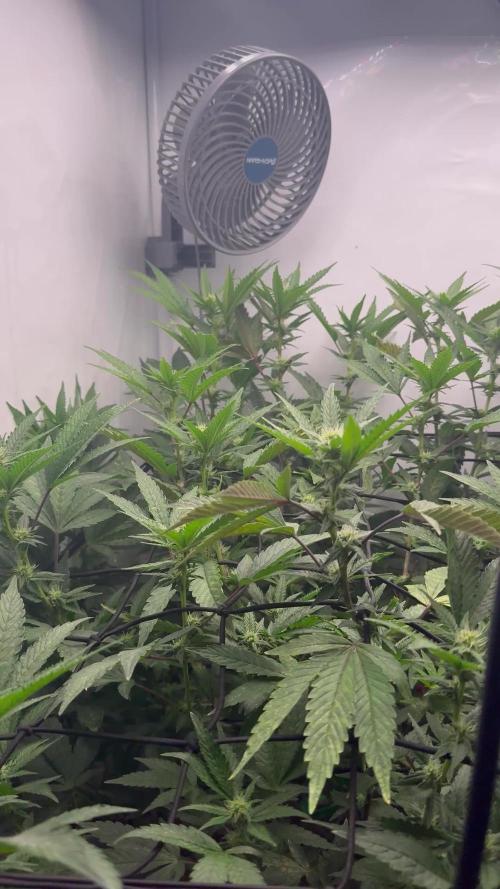
Last week plants grew very healthy, as they got bushier the humidty raised providing a better enviroment, I could even reduce the amount of water I give them. Planning to move to flowering stage very soon.
Likes
3
Share
the weather in germany is unfortunately getting very wet and cold early. The Papaya Cookies had to contend with Budrod in the headbud. This was probably also due to the enormous density of the headbud... So we harvested them after a total of 60 days to prevent worse. So far it has been one of our favourites in outdoor growing, visually delicious with its pink pistils. The plant also has an incredibly tropical, delicious smell of mango and papaya - we are already looking forward to the smoke test