


Likes
Comments
Share


@yamyam
Follow
Huge thing
26/01/2025 - defol
27/01/2025 - flushed Coco to lower the strength feed from 1.3 to 0.9 EC

Likes
25
Share


@BudHaks
Follow
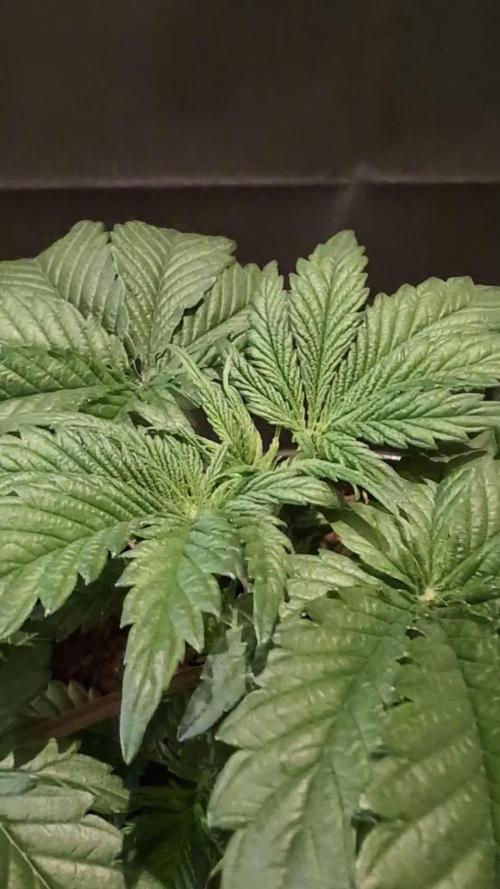
She is now putting on weight - and still going tall! She looks like she has a while to go before harvest but she is doing magnificently. Little to no deficiencies!

Likes
12
Share


Likes
6
Share

@GoodTimesOrganics
Follow
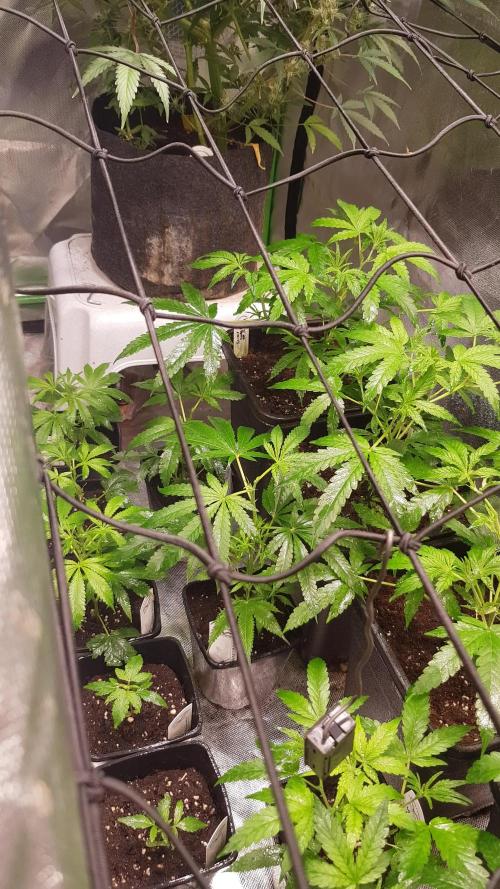
Hi liebe Community and Welcome Back! 🌿💚
Die kleinen Äffchen wachsen prächtig! 🌄🐒
Die Jungpflanzen machen sich sehr gut und es ist zu beobachten, dass nun dass Wachstum richtig startet.
Die Seitentriebe bilden sich immer weiter aus. Die Blattform ist schön Breit und Buschig.
Die Umgebungsgegebenheiten sind aktuell gut:
—————
🌞 Temp: 24
🌚 Temp: 18°C bis 19°C
💨 RH: 58%
VPD: 0,91 kPa
💡ppfd: 330 mpm
—————
Viele Grüße 👋
Likes
8
Share

@Organic_G
Follow
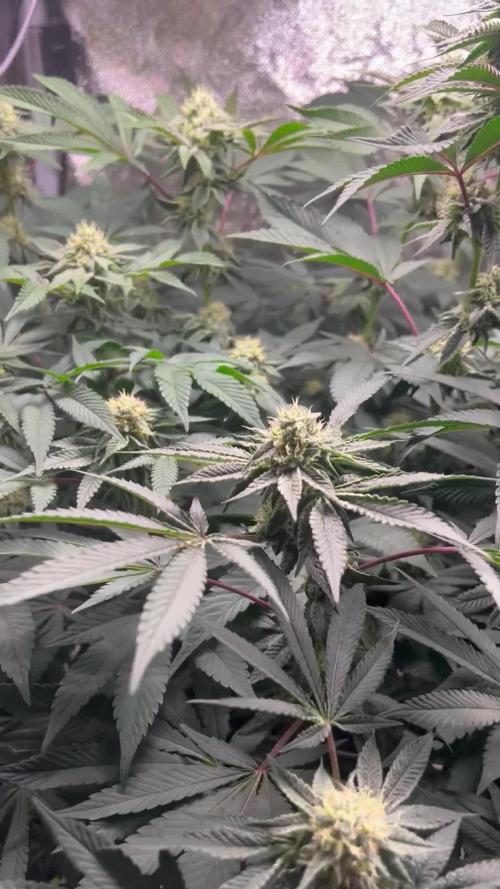
Wirklich sehr nice wenn man einfach gar nichts machen muss, ich öffne das Zelt teilweise nicht einmal mehr…
Beste Leben wenn alles automatisiert wurde und man nur den Wasser Tank mal alle 1-2 Wochen füllen muss…
Selbst das Osmose Wasser ist perfekt da dolomitkalk in der Erde angereichert ist und die Pflanzen laufen nicht auf Mangel an Mineralien… einfach super einmal mit super spoil aus einander gesetzt, jetzt gar nichts mehr machen 😆
Und stecken trotzdem top mit super Harz Besatz, UVB und Top Light scheint auch nicht zu verbrennen, es soll ich sagen bin durch und durch zufrieden

Likes
10
Share


@iLoveGoodWeed
Follow
She has stretch 17 cm this week, nice stretch. Is is getting tall. Next week she should get more bushy after this week defoliation.

Likes
12
Share


@DBQush
Follow
Dear diary,
Week 9 marks the last week of veg as it ends with us finally transitioning into the flowering phase. As we embark onto flowing, I continue to fine-tune the environmental conditions and adjust nutrient levels to support optimal development.
🍀🍀🍀🍀🍀🍀🍀🍀🍀🍀
⏰ Day 60:
I administered a feeding with a nutrient strength of 1.66ms and adjusted the pH to 5.8. Additionally, I increased the light intensity from 20 to 25 dli (daily light integral).
To maintain the desired humidity levels, I turned on the air conditioner to dehumidify the space, successfully bringing it back down to 58% as it started slipping up to the 70s again. However, this adjustment caused a slight drop in temperatures to 24.5 degrees Celsius.
⏰ Day 61:
During the evening feeding session at 18:00, the plants received a feeding with a nutrient strength of 1.66ms and a pH level of 5.8. Furthermore, I elevated the light intensity from 25 to 28 dli, positioning the lights 50cm above the canopy.
The night temperatures have also stabilized at 22.5 degrees Celsius after the AC change.
⏰ Day 62:
I provided a feeding with a nutrient strength of 1.67ms and a pH level of 5.6.
I also conducted some light low-stress training and removed any growth on the horizontal stems, as each stem already possesses its intended 16 tops. These adjustments will help maintain an even canopy and ensure optimal light penetration.
⏰ Day 63:
During the evening feeding session, I administered a feeding with a nutrient solution at a strength of 1.67ms and adjusted the pH to 5.7.
To enhance light exposure, I increased the light intensity to 32 dli/500ppfd and positioning the lights 48cm above the canopy.
⏰ Day 64:
At 11:55, just before lights off, I applied pesticides to address any potential pest issues.
During the evening feeding session, I provided a feeding with a nutrient strength of 1.67ms and a pH level of 5.7.
Additionally, I removed some excess growth and increased the light intensity to 37 dli/580ppfd, getting to the optimal levels before flowering starts.
⏰ Day 65 (Day 1 Flower):
I initiated the flowering phase by switching the lights to a 12/12 cycle and provided a feeding with a nutrient strength of 1.85ms and a pH level of 6.1.
As the plants enter the flowering stage, I have adjusted the nutrient composition.
The calmag has been reduced to 1.5ml/l, Bud Candy has been added at 1ml/l, and the A+B mix has been increased to 3ml/l.
The plants water consumption has also increased, now reaching approximately 2 liters per day, which aligns well with the timing of the light cycle change.
The temperatures have stabilized around 25 degrees Celsius during the day, and the relative humidity ranges between 55-60%. I have also set up the scrog net in preparation for the upcoming stretch phase.
⏰ Day 66:
During the evening feeding session, I administered a feeding with a nutrient strength of 1.85ms and adjusted the pH to 6.0.

Likes
101
Share


@Ferenc
Follow
Day 80, 2nd of December 2020:
Hi there! Ladies are cool everything is alright. In one week buds strated doubeling and the developement is dope haha.
The 2 Zamnesia ladies are pretty Gelato is so nice bushy and the smell is great as well.
Kalini Asia will be a green pheno I think and she my be hermied a bit on me.... I am still waiting to see I see some strange develepement lets say.
Sweet Seeds girls are dope unfortunately Red Mandarine and Tropicanns poison don't show any sign of colouting yet but it is okay even if they green phenos.... It may happen in the end of the flowering cycle let's see.
Basically that's all I wanted to share.
Oh yes... this one:
All good the lamp is now on 11 hours and off 13 hours. Every week 15 minutes was taken off and after 4 weeks here we go. Strated 12/12 and now 13/11 wanted try to imitate the nature as the light days are getting shorter.
Fertilization has changed no more epsom salt from this week and I will stop giving nitrogen as well from next week.
Great job Sweet Seeds and Zamnesia! Nice genetics :) Lovely plants!


Likes
5
Share

@Grow4ever
Follow
Ein paar Tage nicht da und dann solche Büsche im Zelt. Das hieß heute gehts ran ans defolieren und Scrognetz einspannen. Zudem haben Sie leider einen ganzschönen VPD Schock erlitten. Habe heute morgen also erstmal eine Ladung Wasser mit Cal/Mag und etwas algamic gegossen und die Lampe höher gehängt. Heute abend ging es dann direkt ans defolieren, da ich ehrlich gesagt, die Woche sonst wenig Zeit finden werde. Jetzt sollen Sie sich erholen und ins Scrog einfügen. Achja mein Sorgenkind, die Sfv Og Kush, hat immer noch deutliche Blattvervorfungen. Werde Sie in der Blüte, wohl um meine Paranoia zu beruhigen, täglich nach Hermaphroditmus untersuchen.

Likes
11
Share


@GrowShock
Follow
Очень липкие цветы, при дефолиации ножницы склеиваются после 5 листика, местами начала сочится гуттация. Запах на столько сильный что весь дом пропитан уже этим ароматом терпенов. Неделя промывки и Харвест как же долго я её жду, честно говоря уже устал

Likes
10
Share


@Colectivegrow
Follow
como ya habia mencionado anteriormente estoy esperando que esten listos los cogollos para poder hacer las pruebas de rigor.
pero es una cepa, rapida, fuerte y versatil. apta para cualquier cultivador.
Likes
2
Share

@Growfather2
Follow
Hello everyone,
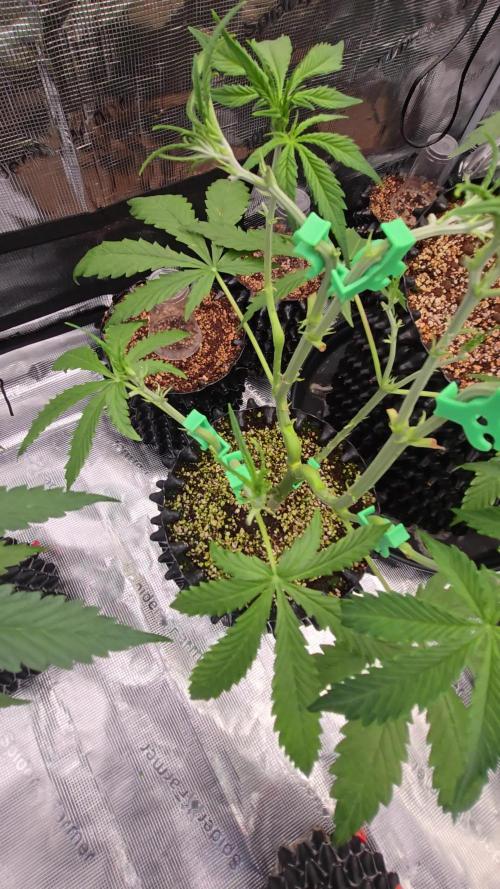
This week i going to transplant 2 Afghan skunk plants to a bigger airpot.
Everything is going to schedule and hope to put one plant in flower.
Thanks for stopping by and have a nice day.
Growfather

Likes
3
Share


@French__flair
Follow
N'hésitez pas à me contacter si vous avez des questions!
Pour préparer votre solution, dans votre réservoir ou arrosoir :
Mettre en premier la base (Iguana)
Ensuite Ancient Earth
Et enfin les bactéries
ASSUREZ-VOUS D'UTILISER UNE EAU DE BONNE QUALITE (EC < 0,2) POUR DE MEILLEURS RESULTATS.
J'utilise un substrat non enrichi pour permettre le meilleur départ à mes plantes.
Il s'agit du Promix de Plagron, il a une EC proche de 0, c'est pour cette raison que je commence les engrais assez fort dès le début. Les plantes sont très gourmande sous LED haute intensité et l'enracinement est rapide.
J'arrose tous les 3 jours environ avec 2 arrosages à l'engrais et 1 à l'eau par semaine. Je n'attend pas que le substrat sèche complétement sinon ça réduit l'efficacité de l'arrosage, ça détruit la faune et éventuellement facilite la cristallisation des minéraux.
Au niveau du volume d'arrosage, il faut prendre en compte 1/3 de la taille du pot. Pour un pot de 1L je vais donc arroser environ 300ml. Pour un Pot de 10L je vais arroser environ 3L.
Il est important d'arroser doucement pour éviter que l'eau ne coule tout de suite au fond.
Il est important d'avoir au moins 15% de drain pour s'assurer d'évacuer tous les nutriments non consommé et faire la place aux nouveaux.
IL EST PRIMORDIALE D'EVACUER L'EAU AU FOND DES COUPELLES, c'est une eau qui est chargée en nutriments non consommé et on ne veut pas qu'elle remonte dans les pots car cela risquerait de créer des blocages.
Au niveau de la technique de taille de formation, je réalise tout de suite une FIM que je reproduirai dès que l'apex aura repoussé. La première FIM est la plus longue mais les suivantes sont très rapide car la plante s'habitue à la technique et cela la stress beaucoup moins. En général il faut reproduire la FIM tous les 3 à 4 jours en fonction de la vigueur. C'est une technique très facile à mettre en œuvre et ne demande aucun matériel. C'est aussi la plus rapide pour obtenir des buissons.
N'hésitez pas à me contacter si vous avez des questions concernant la FIM!
Je retire également les feuilles supérieur (pas toute pour éviter de ralentir la plante) qui cache les secondaires pour augmenter l'efficacité de la FIM sur la croissance des secondaires.
Likes
18
Share


@Grower_Of_Persia
Follow
my dry and cure style is this:
4 days of hanging upside down to get water activity lower to around 0.6 in 50% humidity and 26 C temp (i know its a little high but we are in a hot summer right now and i cant get it lower even with air conditioner) and then after 4 days of drying i remove leaves and stalks, trim buds and move them to jar for the rest of their life :D . and in the first 4 days of curing i open the jar door and let hem get some fresh air in the jar for about 5 minutes and close the jar door again, after 4 days of curing like that buds are smokable but they will get better as they getting cured about 1 month.
buds are one of the hardest as fucking rocks type of buds! very dense , compact , sticky , smelly , amazing at every aspect
growing stage was 56 days and flowering stage was 75 days total (harvested tops at day 64th)
the total weight of dry buds was : (plant #1 & #3 top buds 56 G + lower buds 22 G ) 78 G + (plant #2 top buds 47 G + lower buds 18 G ) 55 G + (plant #4 top buds 120 G + lower buds 67 G ) 187 G = 367 G


Likes
6
Share


@Rabidreject
Follow
Thursday
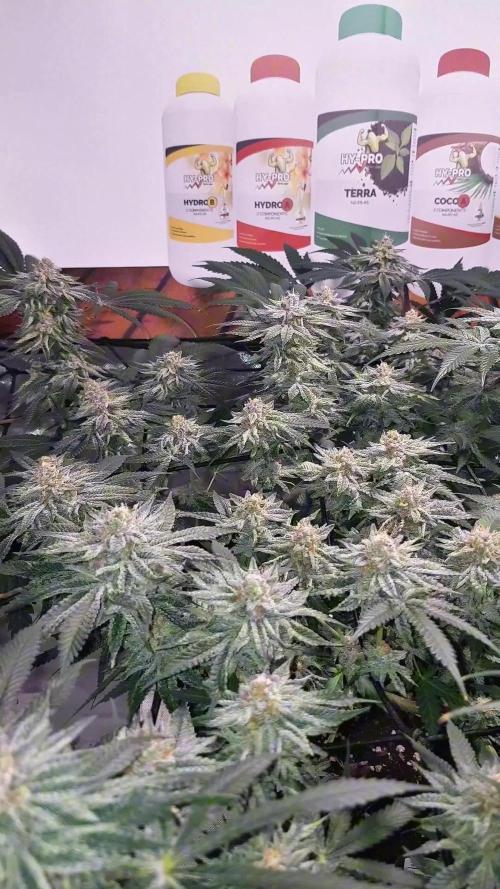
this week has been good so far, I pulled each plant out yesterday and tidied everything up. I got rid of all the tiny lateral branches that didn’t make the cut and I got Rid of everything that was below about half way down the plant. Obviously the lateral branches that grew to the same height as the canopy are staying it’s just all the non starter stuff below.
I annoyingly had my in take fan die on me. We’ll sort of, it just keeps tripping the fuse on my electric so I assume it’s from when I had my res flood onto the floor - I forgot it was there on the floor because it was hidden behind the res

Likes
2
Share


@Pot_Portraits
Follow
Another week and flower and all is good! happy vibes in the tent, plants transitioned well even with some technical errors like power cuts etc.
Looking forward to the late stage of flower, structure is beautiful !!

Likes
4
Share


@MichaelMan
Follow
Made hydroponics system myself. Very easy.
I should have fed them with voodoo juice if They were in plastic cups. It took the roots so long to grow in regular soil.
Likes
152
Share


@Roberts
Follow
Well 46.5 grams from a solo cup grow seems pretty good. It was my first attempt at doing this. Was a personal challenge, and glad I experienced it. I did move the cup around the room during grow. The herb is very fruity smelling and is a very pleasant aroma. Thank you again Amsterdam marijuana seeds. Was a excellent autoflower, and a beautiful solo cup grow. Thank you grow diaries community for the likes and follows. Special thanks to my YouTube channel subscribers. 💪🤜🤛🌱
DON'T DRINK AND DRIVE, SMOKE AND FLY
Www.amsterdammarijuanaseeds.com
Thank you grow diaries community for the 👇likes👇, follows, comments, and subscriptions on my YouTube channel👇. ❄️🌱🍻
Happy Growing 🌱🌱🌱
https://youtube.com/channel/UCAhN7yRzWLpcaRHhMIQ7X4g
Be safe out there👍
