


Likes
Comments
Share


@Luram
Follow
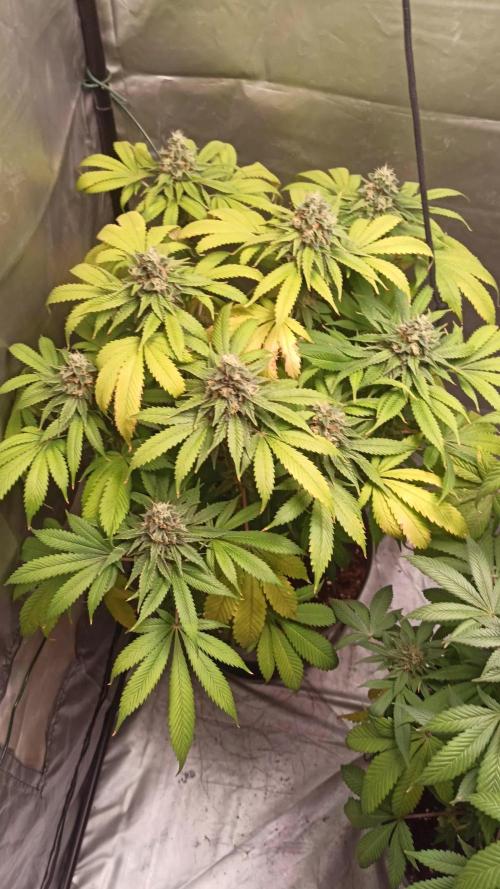
Starting week 6 , going full force with the nutrient dosages for the next 2 weeks and getting them ready after for their final flush week
Problems i had to deal with but i didnt was clearly the defoliation as i got a bit lazy start dealing with that twice, i ll just leave them as they are and see how their final development is

Likes
376
Share


@Metatronix
Follow
Good day to all my friends and visitors here on GD.
The finale grow week for the first Tropicanna XL is there (the one by the wall), she came out just lovely and the smell is mad. I could use it as perfume it's so rich and fruity, never had a plant with such outstanding fragrance.
This week we start of changing the reservoir water to which I decided to add nutrients.
Yes, this plant will not get a flush before harvest, it's the first time i'm not flushing a plant for the cut but you know only two of the four girls are ready to chop and it's not possible in my RDWC to seperate feed them.
So yes it's kind of an experiment for me...some time ago i heard that "man does not need to flush"... yeah I don't really believe what the white coats tell us but then we watched Dr Bruce Bugbee stating the same thing and he quoted experiments performed by his team... I believe him, and I don't really have much choice.
Something's not right with my fresh solution or the plants get root rot or something but the girls starting to show K deficiency...I ended up adding an insane amount of PK through the week...good that the plants are on the finish line :)
The SE7000 runs at 550 Watt and about 33cm from the canopy and is doing an astounding job.
For anyone who is interested in obtaining this efficient and affordable light fixture here's the link:
https://spider-farmer.com/products/spider-farmer-upgraded-se7000-730w-commercial-led-grow-light/
That's it friends, I hope to see y'all next week, bless.



Likes
36
Share


@OGTrauma
Follow
Everything went Green in this space homies! I'm just controlling the stretch with the net, not to emullate a full scrog, since the net Is from baggage not the scrog purpose to prevent light burn,. Feeding schema Is posted to maintain a small rooster of fertilizers, but barrier was not considered as fertilizer even when it surplus, in this ocassion it has the purpose to future plague prevention & expansion.
Elongation of each plant :
Eleven Roses : In this case they are being a bit low profile compared to other plants, expect that for a indica, that had LST .
Santa Bilbo: they do elongate but a bit more controlled with the top cut & lst combo. This was a tough lesson because i already know the strains , indeed of all as quoted as first week.
G13: But this one buddy still surprises me even being an almost indica legend, they are being one of the most forgiving plant i had know, but stretches way more than i remember !.
Cheers! ☺️


Likes
34
Share


@The_Bearded_Grower
Follow
Day 17 sorry for the late update today is Wednesday and as you can see she has come along quite nicely since the previous week leaves are fat which is a good sign and there's no sign of deficiency or any pests

Likes
137
Share


@MrJones
Follow
mrjones - Slurricane #7 S1
🌱Slurricane #7 S1
@inhousegenetics_official
👨🌾🏽GD Grower: MrJones
🔹🔹🔹🔹🔹🔹GOALS🔹🔹🔹🔹🔹🔹
🌞Environment - 75/80℉ and 60% Humidity Good Old Mother Nature
💧 Feeding - The Green Sunshine Company - Earth Dust All-Natural Plant Nutrients
⚗️Soil - 35% ProMix MP / 25% Ocean Forest / 20% Tupur Royal Gold / 10% lobster Compost / 10% Additional Perlite
🍃Training / So this girl was 60 Inches and spread out under a 5x5 Trellis
🕷️ IPM - Will be using Green Cleaner" 1 OZ per Gallon, and CannControl from Mammoth alternating between products each month
🔹🔹🔹🔹🔹🔹🔹🔹🔹🔹🔹🔹🔹🔹🔹
📜 Rambling - Week 27, and it's August now, the evenings are starting to be cooler, and the flowering is well underway, last week's defoliation is helping with the sunlight, let's see what happens now. I Applied Mammoth's CannControl, to my ladies last night, so 1 IPM treatment down,
🔹🔹🔹🔹🔹🔹🔹🔹🔹🔹🔹🔹🔹🔹🔹
▶️ Sunday - 08.08.21 / JJust watering daily with Dechlirnated H20 using the BOOGIE BLUE PLUS+ (High-Capacity Filter) to remove the Chlorine and Chloramine out of the water.
▶️ Monday - 08.09.21 / Just watering daily with Dechlirnated H20 using the BOOGIE BLUE PLUS+ (High-Capacity Filter) to remove the Chlorine and Chloramine out of the water.
▶️ Tuesday - 08.10.21 / Just watering daily with Dechlirnated H20 using the BOOGIE BLUE PLUS+ (High-Capacity Filter) to remove the Chlorine and Chloramine out of the water. IPM Treatment today.
▶️ Wednesday - 08.11.21/ Just watering daily with Dechlirnated H20 using the BOOGIE BLUE PLUS+ (High-Capacity Filter) to remove the Chlorine and Chloramine out of the water.
▶️ Thursday - 08.12.21 / Just watering daily with Dechlirnated H20 using the BOOGIE BLUE PLUS+ (High-Capacity Filter) to remove the Chlorine and Chloramine out of the water.
▶️ Friday - 08.13.21 / Just watering daily with Dechlirnated H20 using the BOOGIE BLUE PLUS+ (High-Capacity Filter) to remove the Chlorine and Chloramine out of the water.
▶️ Saturday - 08.14.21 / Just watering daily with Dechlirnated H20 using the BOOGIE BLUE PLUS+ (High-Capacity Filter) to remove the Chlorine and Chloramine out of the water.
🔹🔹🔹🔹🔹🔹🔹🔹🔹🔹🔹🔹🔹🔹🔹
Earth Dust - DESCRIPTION
🔹Earth Dust is our all-natural plant nutrient designed for indoor and outdoor flowering plant growers. You can grow easily by “just adding water” to your soil for the entire growth cycle. It creates a “living soil” so your plants thrive from seedling all the way through flower and harvest. Earth Dust represents an organic dry amendment method of gardening, it’s made of a natural powder of ingredients.
🔹Because you only need to water your soil with Earth Dust, you can concentrate on caring for your plants and getting a healthy crop “on autopilot”. Now you can grow without spending hours of your life mixing chemical nutrients, and you can do it naturally. What’s more, is you will enjoy the cleanest, most aromatic, and flavorful harvest you’ve ever experienced when a plant grows in a rich, organic web of living soil.
Product Highlights
🔹All-Natural Ingredients – Mostly plant-based – Safe around children and pets.
🔹Packaged in kraft paper bags that are recyclable and compostable.
🔹Easy to Use – Just mix the powder into the soil 3 separate times – then water only.
🔹Packed full of rich microbe food & contains billions of beneficial fungi and bacteria! Creates a resilient, living soil that defends against pests and diseases.
🔹Rich in trace minerals and nutrients for full plant expression. Sourced from rock dust, sea-farmed kelp, and land-grown crops.
🔹Soil Conditioners help balance pH and make nutrients more available in the soil. Achieved with ingredients like bat guano, worm castings, limestone, molasses, and humic acid.
🔹The correct balance of N-P-K nutrients for each stage of growth:
🔹Earth Dust Base (3-1-2) contains key nutrients for sustained vegetative growth. High nitrogen (N), Low Phosphorous (P), and Medium Potassium (K).
🔹Earth Dust Boost (2-3-6) contains accelerated-release nutrients for powerful flowering growth. Low nitrogen (N), Medium Phosphorous (P), and High
Potassium (K).
🔹Re-use soil harvest after harvest by simply adding more Earth Dust Base to begin again. Create your own living soil that gets better every time it’s used.
🔹Go organic, save time, and get predictable, healthy harvests.
🔹🔹🔹🔹🔹🔹🔹🔹🔹🔹🔹🔹🔹🔹🔹
Compost Tea for Vegetative Stage
Water 4 Gallons
3 Cups Composr (Your Favorite Worm)
4 TBL Molasses
4 TBL Seaweed Extract
4 TBL Fish Fertilizer
Use air Stone o the tea for 24/3 hours 70/75F, use at full strength for establishing plants and a half-strength for younger plants
Likes
26
Share


@DrRobeRt
Follow
Hello fellow Growers
Nancy had been droopy lately after her nute and light burn (Man she's had it tough) so I backed off on the nutes and she seems to be happier now - in fact, I think her buds are putting on weight now - slowly but surely.
Wendy, on the other hand, is Frikn bullet Proof! She's getting fatter and fatter by the day and I'm thinking that I will need to flush soon before the harvest.
Any tips at this point would be really appreciated - it's my first harvest and I wanna do it right ;-)
Peace oooot ;-)

Processing
Likes
47
Share


@FreddyGrows
Follow
No 2 much to say everything s consistent and going well.
Nice temperatures and air humidity all very stable.
They stay on the same diet as always nothin extra's until now.

Likes
156
Share


@StarLorr
Follow
Helloing👋🏻 friends and visitors.
Flip them Clones last Tuesday 12/12.
Did some defoliation.
Feeding:
Tue31st:2L each w/nutrients ph'd 6.25
Fri 3rd:2L each water only ph'd 6.5
Mon 6th:2L each w/nutrients ph'd 6.22
-----------------------------------
The game is on!! Let's see what i can get, out of them Black Candyland "indoor" Clones! 🤞🏻😂
This is it for this weekly update.
Thanks for stopping by!
Likes and comments are appreciated.
Keep on growin!
Keep on tokin!!!
😙💨💨💨💨💨

Processing
Likes
88
Share


@Fergie
Follow
Hey guys so here we are week two into flower and the tent is filling right up now got some awesome bud sights forming and my aim of 1kg dry out of the 2 plants is on course . Root structure is amazing and I have always had good results when I get the wrapped root over top as can see in pic . Anyway til next week guys


Likes
9
Share


@GYOweed
Follow
Flipping today 12 12 9/15.
Finally will be flowering at proper temps.
Did some defol and bending, took last cuts.
All these ladies good my diy immune boosters and triggers.
They also of course got natural growth stims i have researched seems to work making them huge.
Gonna hittem with more cytokinins aftern eylthylene foliar which will self prune it and control some stretch too.

Likes
107
Share


@Tropicannibis_Todd
Follow
ALRIGHTY THEN GROWMIES 😎
👉SHES PRETTY MUCH READY JUST WANT MORE AMBER👈
We just hit week 13 and all is well , have to admit she's just killing it super happy with how shes coming along 😃 ....... Just waiting on her to ripen up 👈
👉Had to bring out the Bamboo sticks a few week ago as she's putting on the weight 👈
And she's filling out the pot perfectly👌 Lots of tops 👈
👉NutriNPK NUTRIENTS USED FOR FEEDING 👈rain water to be used entire growth👈
👉www.nutrinpk.com right now get 10% off using SPRING2022 as the coupon code👈
Lights being readjusted and chart updated .........👍
I GOT MULTIPLE DIARIES ON THE GO 😱 please check them out 😎
👉THANKS FOR TAKING THE TIME TO GO OVER MY DIARIES 👈

Likes
14
Share


@HiGHLYDiGESTiBLE
Follow
Week 10 - 1/3 -1/10
1/4 - update - not sure what to do next. my feeding schedule only has 10 weeks of feed so i might flush with water for last 2 weeks until it is ready to go?
**i think the deficiencies are either Maganese or something im not sure .... i think i should add some cal mag to my feed but i didnt want to go "rambo" mode just yet with this being my first grow i wanted to stick to the gameplan. going forward i might cowboy up a little more because i didnt realize that the food chart was more of a guide and then depending on what the plant tells you - you adjust appropriately... but whatever live and learn .
PPMS havent really gone over 500 during the whole grow either so i think i got some room to work with.... people said they use 3ML of CalMag the entire flower stage. flower ppm should be 1000 and veg between 600 and 800 .... ill try that moving forward

Likes
2
Share

@GrowdadGage
Follow
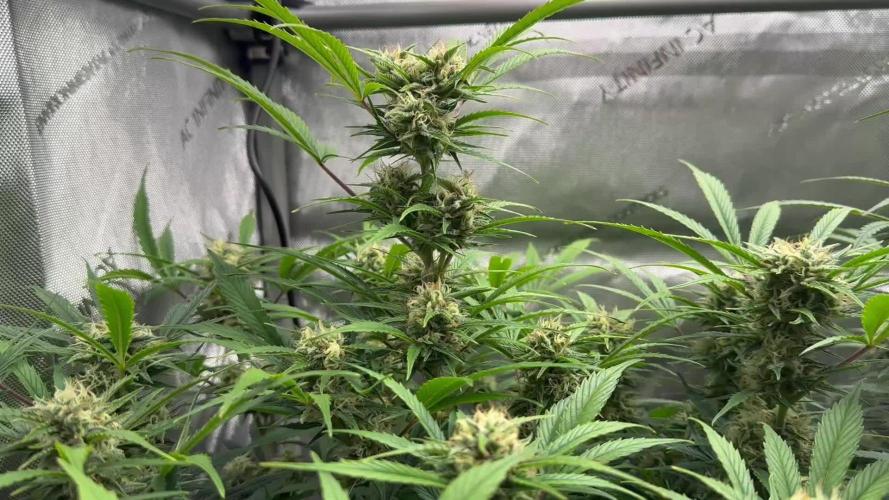
These girls are coming in nicely. I was impressed with how well the one plant I chose to top responded at first but now seeing the buds growing and coming in it’s lacking in comparison to the two plants that were just given low stress training.
Maybe it’ll catch up by the end but either way still very impressed with the Bruce Banner #3 Auto especially with the frost it’s starting to develop now 😁👌

Likes
132
Share


@rhodes68
Follow
Week 6 and still veg, they are knocking on Flowering's door but not there yet.
Happy with growth and between the Coco Tek and the weekly foliar (just for good measure) no problems. Water slowly rising but keeping nuets reasonable.
Increasing the bloom nuet ratio slightly as when it does go its gonna want lots of PK
Side note: Cant really drop the new FFT-7/5 seeds till these go into flower (never seen it go this long) and I can move them under the HPS so... good and bad.
12/21 New pics hope they are better
12/22 Beginning to transition into flower now, colas beginning to form, so half and half on the nuets.
Time for the last Kangaroots drench to get those roots as large as possible. 10ml with feeding at lights on tonight
Ripley went into the Flowering tent as they just need more room, think it will be ok as Ripley could use some stretch, Tara remains in veg tent until Stardawg final harvest.
12/23 pics
12/24 All is good but think I am going to continue reducing the nuets 10% and checking EC of runoff as still getting some small issues on leaf tips.
Maybe I am chasing ghosts we will see
12/25 White tip under control, tested runoff at 1450 adjusted out and 700 adjusted in, within limits
Last day in veg tent for Belle, she joins the Flowering tent after Stardawg harvest.
Water needs increasing steadily, up to almost 3 quarts/ feed for good runoff. Good sign the roots took to the Kangaroots drench well.

Likes
7
Share


@BiofuelEmpire
Follow
Everyhing is lookin fine they have been prayed up since before the top dress right at flip the front one has just been wanting to stay really squat but my favorite so far jus because of smell is the one to the left that doest quite fill the pot it actually got accidentally topped over there but the terps are like lemony and gassy
Likes
4
Share


@shwable
Follow
Hello and welcome to week 5, everything looks fine so far...
I almost topped the CP1 a second time by accident. When I tried to bend the stem a little more it just snapped clean and I applied tape and stabilized the branch. I hope it recovers and it's looking quite good ;)

Likes
1
Share


@AZTERPHUNTER
Follow
All these have been topped and trimmed just will stay in here for 2-3 weeks while others in flower room finish

Likes
Comments
Share


@BombBuds
Follow
Wachsen super unter den flex II 10
Alle sind gesund und schauen zufrieden aus!
In dieser Woche habe ich angefangen nach düngeschema zu düngen