




Likes
Comments
Share


@Geili_Seili_fireinfireout
Follow
Woche 4-5 ziemicher stillstand. Woche 6 beginnt sie zu explodieren
Likes
16
Share

@Shawneyboy85
Follow
This week has been good, no problems to say of. No changes to the light schedule or nutrients. I do have a Lemon Pie Auto doing something strange stuff it is @ 51 days old and is giving off some mutations in the fan leafs, and she stretched to double the height of the other 2 in the tent. Also has begun to develop a few small brown spots on a couple fans too but other than that all is well.


Likes
17
Share


@MasterKush714
Follow
Was a great experience hopefully my fruits of labor haven't gotten destroyed by bud rot so scary for real lol


Likes
28
Share


@Bongman
Follow
Hi All,
I think I must have missed a week, don't know how I did that but I switched on the 16th OCT and this should have been the fifth week of flowering.
Anyways I will change that over the weekend.
Weekly update:
*What's happening in the garden.
So starting the fifth week of flowering and the buds are starting to bulk up.
I still think the canopy is too dense but I am going to pretty much leave it and see how it plays out. Maybe I will thin out one large colla and see if that's going to grow a lot better but I don't know how meaningful this will be going forward.
*On-going problems
1. Top canopy leaves still showing red stems. (I am almost to a point where I think this might be genetics)
2. Sweating problem - I've tried to lower temps, thin out canopy and dimming light. So I've done all that with limited success UNTIL I moved two dehumidifier into the room and lowered the RH in tent from low 70's to low 60's and I directed the top fan directly at the canopy rather than blowing slightly above the canopy. That seemed to help the plant sweat without leaves pointing up and tacoing.
3. Brown goo in reservoir - I am seeing some brown goo started to grow again but less than before. So I am going to increase the cannazym, hydro guard and PH at 5.5.
*Neat trick to slightly increase your grow tent area.
Since this is a monster mother plant in a 2x4 tent. I've been having trouble keeping her in check especially on the perimeter of the canopy so I actually added a input fan to decrease humidity and increase air flow and also created a positive atmosphere in the tent so the tent basically increased 10- to 15% in volume especially in the middle of the tent where my canopy is at so this gives her more room to bulk up the buds.

Likes
2
Share


@Ninjabuds
Follow
Unrefined wild structure but super dank small buds with some cool colors and there super dense
Likes
20
Share

@Chubbs
Follow
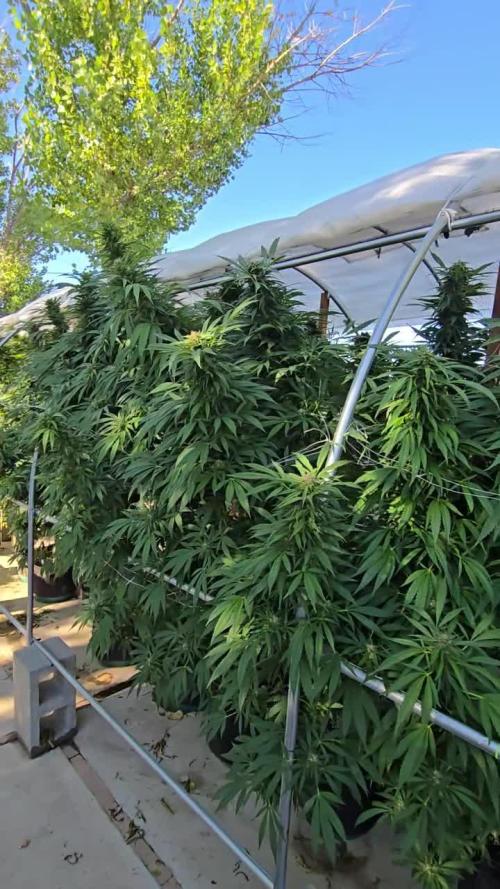
What up fam. Weekly update on these girls. During thus past week I found some dreadful catapillers in some of my flowers. It's never something you want to find but it's definitely part of the challenge growing outdoors. I started to harvest some for some fresh frozen so once I get them all done in the next couple weeks I'll know what my total is going to be. All in all Happy Growing.
Likes
4
Share

@DogDoctorOfficial
Follow
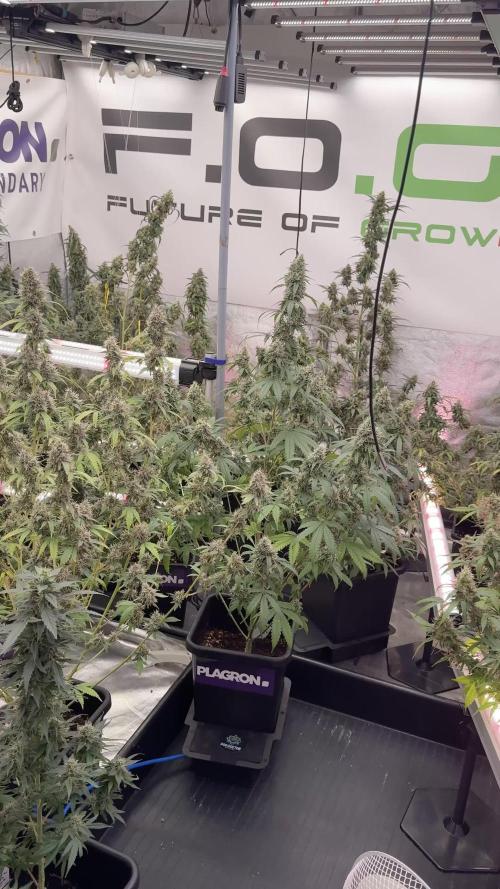
🥒 Project Blue Tent – Week 8
Pickle Lemon Haze F1 – Pheno B (Folder 14B)
Hello everyone, and welcome back to another chapter of Project Blue Tent! 💙🌱
If you're discovering this diary for the first time, welcome aboard!
Project Blue Tent follows four individual plants from seed all the way through harvest, with each phenotype receiving her own dedicated diary.
All four sisters share the same tent, lighting, irrigation, nutrition, environmental conditions and overall training strategy.
The idea is simple:
Keep the variables as consistent as possible and let the genetics tell the story.
And this week...
The story is getting very interesting.
Because all four girls have entered flowering with absolutely no intention of slowing down.
Today we're giving the spotlight to Pickle Lemon Haze F1 – Plant B.
And once again...
She's shining. 💙🌱
────────────────────────
🌸 Week Eight – Flower Has Arrived
The Blue Tent has officially entered the next chapter.
After seven full weeks of vegetation, we're now running 12/12, and the response from the plants has been immediate.
Plant B is now sitting around 81 cm, compared with approximately 60 cm when we finished the vegetative phase.
That's a serious amount of growth in a very short period.
And what's particularly impressive is that the plants aren't simply stretching upward.
They're developing everywhere.
The branches are extending.
New growth is appearing rapidly.
Flowering sites are becoming more obvious every day.
And the first real signs of bud development are now beautifully visible throughout Plant B's structure.
This is the point where all those weeks of preparation start becoming meaningful.
The SCROG gave us the structure.
The defoliation opened the canopy.
The training created the framework.
And now...
Flowering is filling that framework.
────────────────────────
🌿 Pickle Lemon Haze F1 – Plant B
Plant B continues to be one of those girls that makes me stop and look twice.
Her foliage is lush, vibrant and beautifully green, and the overall health of the plant is exactly where I want it to be.
The developing flowers are progressing quickly, with fresh pistils and new growth appearing throughout the canopy.
And despite the speed at which she's developing, she's still maintaining a remarkably even structure.
That's something I really appreciate about this phenotype.
She has always been a cooperative plant.
She responds well to training.
She builds strong lateral growth.
And even now, with flowering underway and the stretch accelerating, she's still giving us a canopy that is relatively easy to manage.
At least...
As easy as four extremely vigorous plants can be. 😂
────────────────────────
💥 Super Cropping – Keeping the Canopy Under Control
The biggest challenge right now isn't getting these girls to grow.
They've already made that part very clear.
The challenge is managing how quickly they're growing.
We're continuing to use super cropping on selected branches as another tool for managing the most vigorous vertical growth.
The idea is to reduce the dominance of certain shoots, redistribute growth and encourage stronger branching points as the plants continue developing.
And these girls are making me work for it.
I'll carefully work a branch down...
Come back later...
And somehow it's already standing back up again.
😂🌱
They're determined.
But that's actually what makes this stage so interesting.
We're not trying to stop their natural growth.
We're trying to work with it.
The canopy is already very even, and we're simply making small interventions where necessary to keep the most aggressive growth from getting too far ahead.
Whether we'll successfully keep everybody compact throughout the stretch?
Well...
Let's see.
They certainly haven't read that part of the plan.
────────────────────────
🌸 Bud Formation – Things Are Moving Quickly
One of the most exciting changes this week is the speed of flower development.
We're only at the beginning of flowering, yet Plant B is already showing beautiful formation throughout the canopy.
The sites we've spent weeks creating and positioning are now beginning to transform.
Pistils are appearing.
Clusters are becoming more defined.
And every day there's another little sign that tells me:
We're properly in flower now.
This is one of those moments where you can finally see the purpose behind all the earlier work.
The individual branches aren't just branches anymore.
They're becoming future flowers.
And Plant B has plenty of them.
────────────────────────
🌱 Seven Weeks of Vegetation – Was It Too Much?
Looking at Plant B now, I'm still wondering whether I gave these girls too much vegetative time.
Seven weeks of vegetation is considerably longer than I normally run.
Usually, I'd flip earlier.
But the extra time gave us something valuable:
A very established canopy.
Strong branches.
A developed root system.
And a structure capable of supporting a lot of flowering growth.
The downside is becoming very obvious now.
These plants have an incredible amount of momentum.
They grew from roughly 60 cm to around 81 cm incredibly quickly, and they're still moving.
So there is definitely a little bit of:
"What have I created?" 😂
happening in the grow room right now.
But worrying about it isn't going to make the plants grow slower.
We've prepared them.
We've trained them.
We've opened the canopy.
We're managing the stretch.
Now we watch.
And we see where these girls want to take us.
────────────────────────
💡 Strong Light From the Beginning
The transition into flowering also means we're starting with approximately 800 PPFD across the canopy.
I want these girls to have strong light available from the beginning of flower rather than slowly creeping toward higher intensity.
They're already extremely vigorous, so the idea is to give them the photons they need while closely observing how the canopy responds.
The challenge is balancing that strong light with the environmental conditions and the very significant stretch we're already seeing.
I'm particularly interested in seeing whether the combination of strong light and continued canopy management can help keep the plants from becoming excessively elongated.
Because if there's one thing Plant B has demonstrated this week...
It's that she has absolutely no shortage of energy.
────────────────────────
🌡️ Blue Tent Environment
The room continues to run with remarkably consistent conditions across all four sisters.
This week's recorded averages were:
• 🌡️ Day Temperature: 27°C
• 🌙 Night Temperature: 27°C
• 💧 Relative Humidity: 67%
• 🥥 Substrate Temperature: 24°C
• 💦 Nutrient Solution: 19.1°C
• ⚗️ pH: 5.81
• ⚡ EC: 2.09 mS/cm
• 💨 CO₂: approximately 666 ppm
• 💡 Light Schedule: 12/12
• 💧 Irrigation: approximately 1.4 L/plant/24h
• ? Pot Size: 8 L
• 📏 Plant Height: approximately 81 cm
One thing that continues to stand out is the relatively small difference between day and night temperatures.
We're sitting around 27°C for both.
That can contribute to continued stretching, and considering how quickly these girls are already growing, it's something I'm keeping firmly in mind.
But for now, Plant B is responding beautifully.
Healthy foliage.
Strong development.
Rapid flower formation.
And no obvious signs that she's unhappy with her environment.
────────────────────────
🥥 Feeding – Supporting the Transition
The flowering nutrition is now established.
Current feeding:
• Plagron Hydro A — 2 ml/L
• Plagron Hydro B — 2 ml/L
• Plagron Hydro Roots — 1 ml/L
• Plagron Power Buds — 1 ml/L
• pH Plus — 0.03 ml/L
• pH Min — 0.03 ml/L
Current EC:
2.09 mS/cm
pH:
5.81
The plants are consuming aggressively and developing extremely quickly, so the nutritional strategy is now supporting that transition without making unnecessary changes simply for the sake of changing something.
Plant B's colour is exactly what I want to see.
That beautiful, lush green foliage is telling me that she's handling the current program very well.
And when I look at the flowering sites developing throughout the canopy...
I'm certainly not seeing a plant asking me to interfere.
So for now:
We stay consistent.
Observe.
Measure.
Adjust only when necessary.
────────────────────────
💧 The Drip & Drainage System – One Continuous Loop
The automatic irrigation and drainage setup has become one of my favourite parts of this project.
Plant B is now receiving approximately 1.4 litres of nutrient solution every 24 hours through the drip irrigation system.
The process is beautifully simple.
The drippers deliver the nutrient solution directly to the coco.
The solution passes through the substrate and feeds the root zone.
The resulting runoff drains into the collection trays underneath the grow bags.
From there, the drainage pipe carries the water toward the pump.
The pump removes the collected runoff and returns it toward the reservoir, creating a recirculating irrigation and drainage loop.
Water goes in.
The plants use what they need.
Runoff is collected.
The pump moves it away.
And the system continues its cycle.
It's a remarkably elegant setup when everything is working properly.
And right now...
It is working wonderfully.
The plants are growing rapidly, their water demand is increasing, and the system is keeping irrigation consistent without requiring me to manually water four increasingly thirsty plants every day.
That consistency is especially valuable in a project where we're deliberately trying to keep the four sisters under comparable conditions.
It's another variable we can keep controlled while we watch the genetics express themselves.
────────────────────────
🕸️ Managing the Canopy During the Stretch
The SCROG has already done its main job.
Now we're using the structure we've created to manage flowering growth.
The canopy remains impressively even.
There are no huge dominant towers completely taking over the room.
Instead, the flowering sites are distributed across the surface we've spent weeks building.
But the stretch is happening quickly.
So we're continuing to watch the taller shoots and selectively using training and super cropping where necessary.
This isn't about constantly manipulating the plant.
It's about making small corrections before a branch becomes a major problem.
A little intervention now can be much easier than trying to fix an overly dominant branch later.
And Plant B has responded very well so far.
She's stretching...
But she's stretching into a structure.
That's exactly what I wanted.
────────────────────────
🌿 Plant B's Personality Is Still There
This is one of my favourite things about Project Blue Tent.
From above, the four sisters can look almost identical.
Same tent.
Same lights.
Same irrigation.
Same nutrients.
Same environment.
And yet...
Spend enough time with them and their personalities start becoming obvious.
Plant B remains one of the more naturally cooperative phenotypes.
She's vigorous, but her structure remains usable.
She's growing rapidly, but the canopy hasn't become chaotic.
She's producing flowering sites quickly, while maintaining that beautiful green foliage we've been watching since vegetation.
And now she's showing another characteristic:
She doesn't seem particularly interested in slowing down.
😂🌱
Which, honestly, is a pretty good problem to have.
────────────────────────
🌸 From Canopy to Flowers
There is something incredibly satisfying about looking at Plant B now and remembering what she looked like only a few weeks ago.
Back then, we were talking about:
Topping.
SCROG.
Empty squares.
Branch positioning.
Defoliation.
Canopy management.
Now we're talking about:
Flowering sites.
Pistils.
Stretch.
Bud formation.
And eventually...
Bulk.
That's the transition we've been working toward.
The plant has moved from building the machine to using the machine.
The canopy is the foundation.
Now the flowers get to take over the story.
────────────────────────
👀 Looking Ahead
The next couple of weeks should be fascinating.
All four sisters are moving incredibly quickly, and Plant B is right there with them.
We'll continue managing the canopy as needed.
We'll keep an eye on the stretch.
Super cropping will remain one of the tools available when individual branches get too ambitious.
The irrigation system will continue providing its consistent cycle.
The flowering nutrition will continue supporting development.
And the environmental conditions will remain under close observation.
Most importantly...
We don't need to panic about the speed.
Yes, they're growing fast.
Yes, I may have kept them in vegetation longer than usual.
Yes, the warm nights aren't exactly helping us keep the stretch compact.
But the plants are healthy.
The canopy is remarkably even.
The flowers are forming beautifully.
And Plant B is looking absolutely fantastic.
So...
Let's see where this goes.
🌸💙
────────────────────────
💙 Thank You
A huge thank you to Zamnesia for making Project Blue Tent possible and for giving us the opportunity to explore these Pickle Lemon Haze F1 genetics phenotype by phenotype.
A heartfelt thank you to Plagron for the Premium Growbags and Hydro nutrient line supporting these girls throughout their journey and now through the beginning of flowering.
A special thank you to Zamnesia for the Phytonaut LED lighting helping us create such a strong, even canopy and now providing the intensity we're using during the transition into flower.
And a massive thank you to Mars Hydro for the automatic drip irrigation and drainage system.
Watching the drippers, coco, runoff collection, drainage lines, pump and reservoir work together has been incredibly satisfying.
The system has become an important part of keeping the entire room consistent.
Thank you as well to GrowDiaries for providing a place where growers from around the world can document their journeys, exchange experiences and learn together.
And finally...
Thank you to everyone following Project Blue Tent. 💙
Plant B has officially entered flowering.
She's stretching.
She's building flowers.
She's producing lush, beautiful growth.
And she's making it very clear that seven weeks of vegetation gave her plenty of momentum.
😂🌱
For now, the canopy remains beautifully even.
The flowers are developing quickly.
The super cropping is helping us manage the most ambitious branches.
The irrigation system is doing its job.
The nutrition is supporting the transition.
And Plant B...
Well...
She's simply shining.
Four sisters.
One environment.
One experiment.
And four plants that somehow manage to make every week more interesting.
Let's see what the next chapter brings.
Until next week...
Growers Love, happy growing, and take care everyone! 🌱💙


Likes
10
Share


@Elguacho420
Follow
Buenas a tod@s... 3ra semana de floración de estás lemon cookie kush, de momento van bien, algunas hojas oxidadas a esta altura pero creo q es normal, eh podido regular bien la comida( a mí creer) y eh visto mejoras en las variedades, no las noto como antes q estaban como decaídas y se las veia agobiadas, las veo bien y en esta tercera semana se ve claramente la diferencia... Los nutrientes utilizados se ve q son la bomba... 🙌🏻👌🏻 La semana q viene más y mejor, se están poniendo hermosas...❤️ Muchas gracias y buenos humos para todos... 💨💨🇦🇷🤝🏻🇪🇦 🏻♂️

Likes
75
Share


@GODSGIFT_2005_JM
Follow
🍼Greenhouse Feeding BioGrow, Bio Enhancer & BioBloom
⛺️MARSHYDRO
The ⛺️ has a small door 🚪 on the sides which is useful for mid section groom room work. 🤩
☀️ MARSHYDRO FC 3000 LED 300W
☀️Also special thanks to VIPERSPECTRA P2000 (200W) & XS2000(240w) LED growlights
🌱GANJA FARMERS


Likes
4
Share


@jojopfoh
Follow
The fade has begun as this strain is 60-70 days. The buds are vey dense, frosty and sticky. many ot he leaves have now faded and some havr fallen off. It has a very sweet smell

Likes
13
Share


@Magical_Surgeon
Follow
My second girl is really having a rough time coping with hot temperatures. Summer is really hot where I'm from. It's about 40 outside.. and it's gonna get worse with heatwaves soon.I had been turning on my AC lately but ones I turn it off temp goes up in 10 minutes.. I tried putting ice buckets next to the opening vents in my tent.. but it didn't seem too make a big difference. I added another small fan inside the tent and big fan outside in the room for more cool air circulation. I just hope I can make my girl survive till the end. The buds are still getting bigger and the smell increases with days. Leafs started to die off tho and some started lose colour or get crispy. There's so much leafs that I can't even defoliatiate them all and don't want to touch the buds a lot to ruin them.LOOK AT HER THO SHE IS A BEAST! 🖤🖤👽
I've heard that with heat your pH goes down even if you gave her the correct one. So I think I've got that problem because I calibrate my pH meter every time I use it to avoid problems with pH. Will see in the future...she've got another 2 weeks I'm assuming. Gonna check trichomes in a few days, last time I checked they just started to get milky. I hate summer and heat 😭 it was doing all well before it got soo hot 👿👿🙏💪💪👀👀 oh well Cya next week with an update.

Likes
10
Share


@Salokin
Follow
**Week 8 | Jealousy Marker | Flowering**
She's fully committed to flower now and the canopy tells the whole story — at 78cm she's built a proper structure, with buds stacking up the main cola and side branches all pushing hard in the same direction. Trichome production is already visible on the developing calyxes, which is a good sign this early in the stretch.
Nutrient stack has switched over to bloom accordingly: CANNA Aqua Flores A+B at 3 ml/l each, CalMag Agent at 0.9 ml/l, Aptus Regulator at 0.1 ml/l, and Plagron Green Sensation introduced at 0.5 ml/l to support the transition and start building towards peak flower. pH 6.2, EC 1.2 mS/cm. Watering stepped up to 2L per plant per 24h — she's drinking more now. Natural light sitting at 16 hours, 25°C days, 18°C nights, humidity 60%.
Considering she's in a 5L bottomless airpot, the root development into the native soil below is clearly doing its job. No complaints from this one.
Updates every Sunday. Stay tuned.


Likes
35
Share


@DjDaveAtHome
Follow
Blueberry Headband (2) and a Amhest Sour Diesel (1)from Humboldt Seeds.
* Even though the ASD seedling is much different than the other ASD that I've grown, HSO says there's not a chance seeds got mixed, so I'm assuming that this pheno is more on the Amherst Super Skunk side of the lineage as was a seedling last grow. Love the pheno! Much different than the others.
https://www.dinafem.org/en/blueberry-headband/
https://www.dinafem.org/en/amherst-sour-diesel/
Lighting
https://www.horticulturelightinggroup.ca/products/260w-qb-v2-led-kit
Soil Amendments for Blueberry Headband Soil
https://www.gaiagreen.com/product-page/all-purpose-4-4-4
https://www.gaiagreen.com/product-page/glacial-rock-dust
https://www.gaiagreen.com/product-page/mineralized-phosphate
http://www.seasoil.com/
Worm castings
Sunshine Mix #4
Epsom Salts
Molasses
Teas made from Gaia as well as in the soil and top dressing.
May use General Organics BioThrive 4.3.3
https://generalhydroponics.com/biothrive
and Alaskan MorBloom 0.10.10
https://www.planetnatural.com/product/alaska-morbloom/
DWC Nutients
https://generalhydroponics.com/floraseries
FloraGro
FloraBloom
FloraMicro
Diamond Nectar
https://generalhydroponics.com/diamond-nectar
Cal Mag
https://generalhydroponics.com/calimagic
Epsom salts

Likes
Comments
Share


@LokalGrenz
Follow
The bottom watering worked for the week I think as away happy with results think I might just bottom water regularly and feed the tea from top every other changing
2/8
I did a good clean up and some pining Monday 2/10 I will filp to flower I also added power bloom today 2/8
Likes
Comments
Share


@Casa_das_Arvores
Follow
Final da 4° semana de floração
Planta aparentemente saudável
