


Likes
Comments
Share


@Hashy
Follow
********************************************
Week 13 Late flower (week 7 flower)
********************************************
Light cycle=12/12
Light Power=150w 63%
Extractor controller settings (during lights on).
High temp= 25c
Temp step=0c
High Rh= 50%
Rh step=0%
Speed max=10
Speed min=3
Extractor controller settings (during lights off).
High temp= 21c
Temp step=0c
High Rh= 55%
Rh step=0%
Speed max=10
Speed min=3
Smart controller settings (during lights on).
Lights on=9.00am
Radiator on= -22.c
Radiator off=+22.5c
Top fan on=
Smart controller settings (during lights off).
Lights off=9.00pm
Radiator on=-19.0c
Radiator off=+19.5c
Top fan on
VPD aim=1.0-1.4
DLI aim=35-40
EC aim=1.0-1.6
PH aim=6.0-6.5
💧💧💧💧💧💧💧💧💧💧💧💧💧💧💧💧
NPK= 8-17-26
Method= Automatic
Feed=Flower nutes
Neutralise=0.1ml/L
Plagron bloom=4ml/L
Plagron Power buds=1ml/L
Green Sensation=1ml/L
Easy Ph down=0ml/L
(1ml=24 drops, 1 drop=0.04ml)
Easy Ph Up=0.02ml/L
(1ml=24 drops, each drop is 0.04ml)
Ec=1.55 PH=6.2/6.1
Runs=18
Run times=4mins (0.3L each)
Gap times=16 mins
Total runtime=72mins(5.5L each)
Total flowrate= ml/min(ml/min each)
Auto start time=10.00am
Auto stop time=15.44pm
💧💧💧💧💧💧💧💧💧💧💧💧💧💧💧💧
********************************************
********************************************
📅29/12/24 Sunday (Day 85)(flower day 45)
📋Light power now 150w 63%
H=81cm D=32cm Dli=35.4 ppfd=818
💧
Automatic Water (Neutralise)
Easy Ph down= 0.01ml/L ( 3 drop total)
Ec=0.15 PH=6.3/6.2
Volume=13L
Volume left=2L
Volume used=11L(152ml/min)
Volume each=5.5L(76ml/min)
Runoff.
Total runoff=2.4L
Ec=3.5 PH=/6.2
💧
📅30/12/24 Monday (Day 86)(flower day 46)
📋
📅31/12/24 Tuesday (Day 87)(flower day 47)
📋New year's eve.
📅1/1/25 Wednesday (Day 88)(flower day 48)
📋New year's day.
Removed 3 leaves.
📅2/1/25 Thursday (Day 89)(flower day 49)
📋
💧
Automatic late bloom nutes
Ph up=0.24ml, 6 drops
Ec=1.55 PH=6.2/6.0
Volume=12L
Volume left=1L
Volume used=11L(152ml/min)
Volume each=5.5L(76ml/min)
Runoff.
Total runoff=1.1L
Ec=3.3 PH=/6.2
💧
📅3/1/25 Friday (Day 90)(flower day 50)
📋 Started snowing
📅4/1/25 Saturday (Day 91)(flower day 51)
📋H=81cm D=32cm Dli=35.4 ppfd=818
********************************************
Weekly roundup.
📋 She's maturing quite fast, I may expose some lower leaves next week.
Radiator is still doing a fair amount of work using 28.77Kw £7.19
Back soon.
Take it easy.
********************************************

Processing
Likes
14
Share


Likes
21
Share


@Ultraviolet
Follow
Heyókȟa
I desire to study nature, and to know better the mind of God, the creator, Holy art thou, O Father.
12x12=144, A dodecahedron is a polyhedron with 12 faces, and in coordination chemistry, it refers to a geometry where ligands surround a central metal atom (in this case, Magnesium) in a specific, 8-coordinate arrangement. Dodecahedrane is a hydrocarbon, meaning it's composed solely of carbon and hydrogen atoms. The carbon atoms are arranged at the corners of a dodecahedron, a 3D shape with 12 pentagonal faces. The water molecules in the dodecahedron form hydrogen bonds that are individually slightly weaker than in either the dimer or the tetramer. However, because three-quarters of the O -H groups in the dodecahedron form hydrogen bonds, it has a more negative energy per molecule than has either the dimer or the tetramer. Magnesium (Mg2+) is the essential, central metal ion in the chlorophyll molecule, crucial for photosynthesis by enabling light absorption and energy transfer. It is chelated by four nitrogen atoms within the porphyrin (or chlorin) ring structure. Chlorophyll appears green because it reflects light in the green region of the visible spectrum, specifically between 490 and 570 nm. The main resonance electronic frequency of a neutral Magnesium (Mg) atom corresponds to the transition from the ground state to the first excited state. Resonance Line Wavelength of Mg2+: 285.1nm (UVB light). The central atom of the chlorophyll molecule is Magnesium (Mg2+), which is coordinated within a porphyrin ring. The electronic "resonance frequency" of this central atom—meaning the frequency at which its electrons absorb energy—is primarily driven by the electronic transitions (ETR) of the surrounding conjugated chlorin ring structure, rather than a discrete atomic transition of the Magnesium atom itself. The resonant electronic frequencies of the chlorophyll porphyrin (technically, a chlorin) ring are determined by the energy required to promote π-electrons within its conjugated system, primarily appearing in the blue and red regions of the visible spectrum.
In standard physics, Chloryphyll b has peak absorption at 460nm (Blue). If we take the peak wavelength 460nm and a UV-B, UVR8 peak absorption wavelength 285nm Tryptophan-285 (W285) Sensing protein. 460/285=1.618 Φ, "natural harmony" and the "structure of light". The cryptochrome photoreceptor (CRY) is a UV-A/blue light receptor that shares this dual sensitivity with several other biological structures and functions, including significant sequence similarity and a common evolutionary ancestor with DNA photolyase enzymes. These are light-activated enzymes that use blue/UV-A light to repair DNA damage caused by UV-B radiation in plants.
Dodecahedrane (C20H20) is a hydrocarbon with a cage-like structure where carbon atoms form 12 pentagonal faces (a regular dodecahedron). It is highly symmetric (icosahedral), contains no delocalized electrons (no aromaticity), and has minimal angle strain, but significant torsional strain. Water Dodecahedron (H2O) forms hydrogen-bonded cages. While individual hydrogen bonds in this structure are weaker than in the linear dimer or tetramer, it has a more negative total energy per molecule. This is because three-quarters (75%) of the groups are involved in hydrogen bonding, creating a very stable, closed-shell configuration. a 3D carbon hydrocarbon (C20H20) to stable water clusters in hydrate, while the Magnesium ion acts as the central activator within a conjugated ring in biological systems, with its electronic absorption dominated by the ring, not the atom itself.
Effective quantum efficiency of photosystem II, often denoted as ΦPSII
In horticultural lighting, adding 730 nm (far-red) LEDs alongside standard red/blue lights has been shown to increase canopy photosynthesis by 20–30% in several crops by acting synergistically with shorter wavelengths. However, the limitation is that excessive, pure IR/Far-red light (without accompanying red light) can trigger the "shade avoidance response," causing plants to grow tall, weak, and spindly rather than robust. Knowing is half the battle however, engineering or utilizing infrared light (specifically the 700-750 nm far-red range) is a viable method to boost photosynthetic efficiency. It acts as a bridge to allow PSII to utilize a broader spectrum of light, breaking the traditional 700 nm barrier.
Extend, then multiply.
UVR8-mediated signaling (often in conjunction with CRY proteins) triggers protective mechanisms that maintain the stability of the photosynthetic apparatus (including LHCII and reaction center proteins), thus ensuring that the efficiency of Photosystem II remains higher in UV-B-exposed plants compared to plants lacking this receptor. ΦPSII indictates the rate of electron transfer from water to plastoquinone, which drives the production of ATP and NADPH. There is a close link between ΦPSII and the true rate of CO2 fixation (Φ*co2), particularly in C4 plants.
Effective quantum efficiency of photosystem II, often denoted as ΦPSII, represents the proportion of light absorbed by Photosystem II (ΦPSII) that is actually used in photosynthetic electron transport. It is a key indicator of how efficiently a plant is using light for photosynthesis, as opposed to losing it as heat or fluorescence. ΦPSII (effective quantum yield of photosystem II) functions primarily as a "multiplier" (a coefficient of efficiency) rather than an additive factor when estimating the overall photosynthetic electron transport rate (ETR). Multipliers are considered far more beneficial than additions because they generate exponential growth, leverage existing resources to their full potential, and create sustainable, self-multiplying capacity, rather than just incremental, linear increases.
Humans, and most other mammals, rely on other mechanisms, such as nucleotide excision repair, to manage and repair UV-induced DNA damage. As such, humans do not have the direct, light-driven repair mechanism that photolyase offers in plants.

Likes
15
Share


@VanHealzing
Follow
This week I didn't do much besides feedings.
Started noticing burnt tips, so time to lower my EC

Likes
2
Share

@hassehujasse
Follow
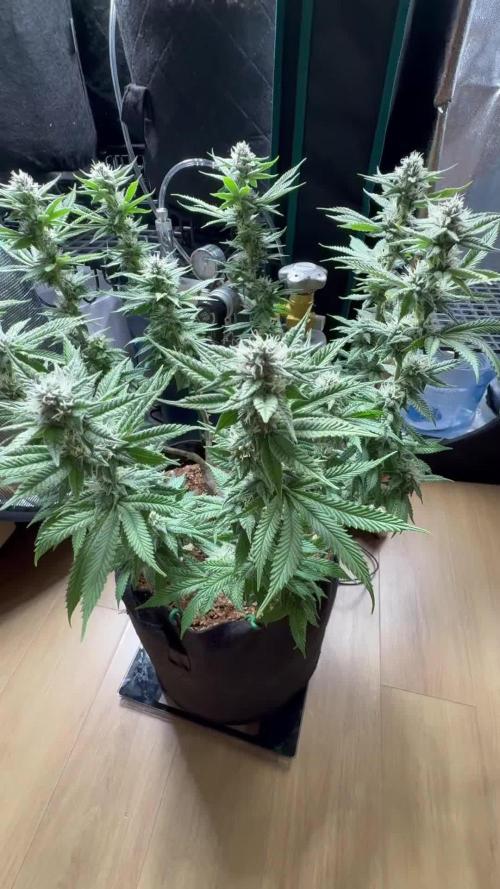
Se acaba otra semana de floracion. Espero ver mas de la GG4 en la proximaLlama al Doctor! Me estoy creciendo de maravilla. Buenos noches para GG4
Empesamos bien otra semana con co2 elevado hasta 1200 i ppfd hasta 1500
Likes
83
Share

@Schnabeldino
Follow
📅 Week 13 | Days 92–98 📅 🌼🌸🌺 Flowering Phase 🌼🌸🌺
Day 98 🌞 – Oreoz
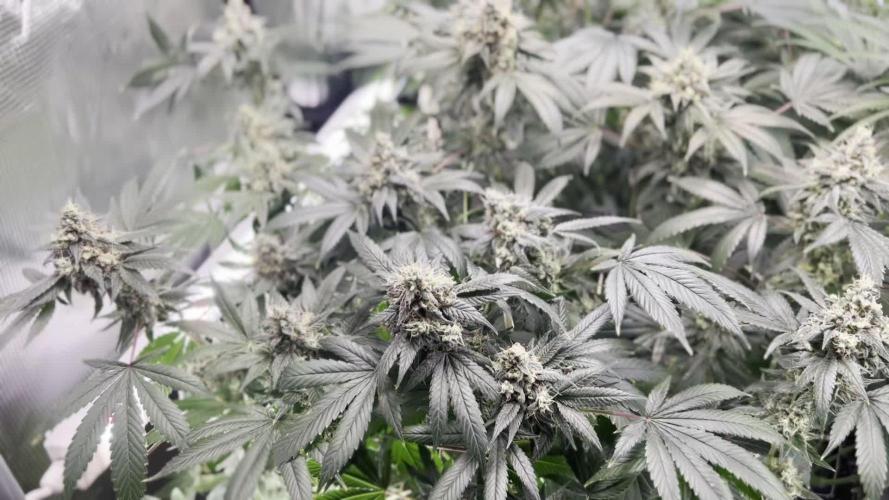
🔸 Oreoz is looking like an absolute showstopper this week. The buds are incredibly dense and completely frosted with thick, glistening trichomes – it almost looks like they’ve been dusted with snow. Resin production is off the charts, especially on the top colas. Trichomes: Mostly milky with some still clear – no ambers yet. She's not quite ready, but getting close.
🔸 Climate control has improved. Humidity started the week at 63%, but with the dehumidifier now running and all clip fans at full power, it's being maintained steadily between 50–60%. That little climate shift is definitely helping – the buds are chunking up without any signs of stress. The slight 2–3°C increase in tent temperature is worth it.
🔸 Nutrients: 1 week of Overdrive (Advanced Nutrients) before the flush phase. Water intake has already slowed down noticeably – another good sign that the end is near.
📈 Current Conditions
🌡️🔆 = 27°C
🌡️🌜 = 20°C
💨 VPD Target = 1.4 - 1.6
💨 Humidity = 63% → Target: below 60%
🔦 PPFD = 900 µmol (12/12)
🔦⌚ DLI = ~38
🛠️ Setup (unchanged)
💡 Lights: 2 x Sanlight Evo 4-120 @ 90%
⛺ Tent: 120 x 120 x 180
🍯 Pot Size: 18 liters
🌱 Medium: Bio-Bizz Light Mix
💊 Nutrients: Advanced Nutrients
💧 Water: Tap water (EC 0.5)

Likes
25
Share


@pifflestikkz
Follow
Day 106
14/10/24 Monday
Her colours are really coming through now 🤩
Nearing her end now, possibly another week after this ✌️💚
Picture and video update 📸💚
Day 108
16/10/24 Wednesday
Light watering, she isn't drinking anything, trichomes only just starting to turn amber. I'll leave her now till I chop
Day 109
17/10/24 Thursday
She is starting to dry from 1" now.
Putting her in 24hrs dark 🌑 now.
Will harvest Tomorrow

Likes
4
Share

@Black_Widow
Follow
Привет садоводы и огородники !
началась новая неделя
и началась она с Harvest
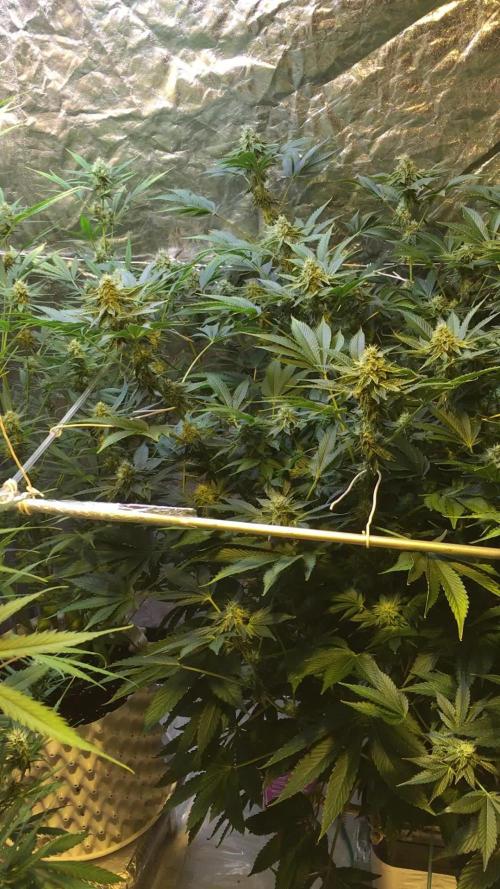
Strawberry Chemdawg OG , который рос в земле уже поспел ,так как он зацвел раньше на 2-3 недели в отличае от ее сестры гидропоники
симпатичный получился цветок

Likes
5
Share


@Wenz004
Follow
Experiment explanation see week1
This week the two living soil pots got one big shot compost tea...otherwise only water
No1 plagron experiment (gelato auto...other diary) got each two days some plagron plus one from aptus nutrients mixture...same as last week but added alga bloom....thow grow of this plant is the best from my trio so far.
End of this week ppfd increased to 550-580

Likes
1
Share

@BlackBear833
Follow
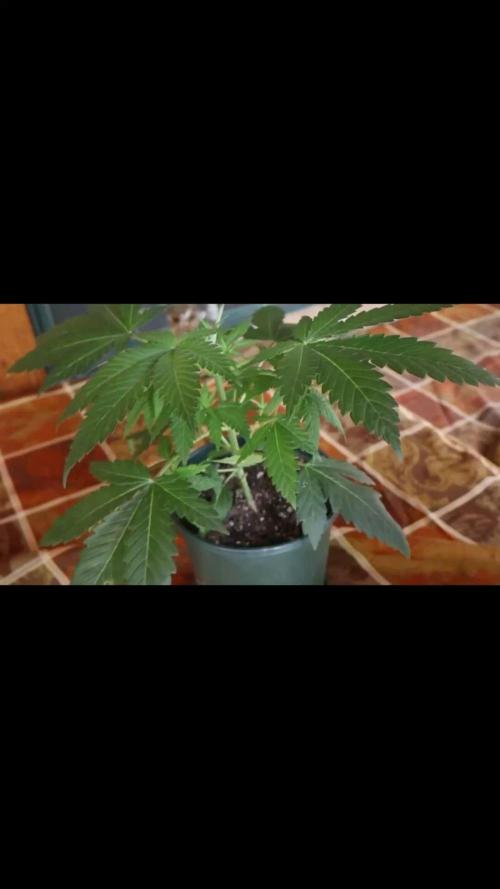
This week I trimmed each plant still struggling with one of my plants still holding off on culling it but the other one is doing well nice green growth so no real complaints yet


Likes
5
Share


@Weedseed
Follow
Estoy muy contento, con estas geneticas de fastbuds, e tenido que lavar las raices ya y esperar a que se seque la arena, aun que me hubiera gustado dejarlas mas tiempo, para que engorden las flores, pero me mudo de casa.. Lo proximo que vereis es cuando las valla a cortar
Likes
6
Share


@DeepRootsGrowTrees
Follow
Week #10 Gnomo Auto By Kannabia
Week#10 Dec.30th-Jan.6th
Gnomo Auto had stayed true to the indica genetics she has she's a shorter plant that's stocky with tight dense buds that are covered in trichomes. She's been a easy grow due to her genetics No real issues. I highly recommend if you like to grow indica or have limited space!
Likes
Comments
Share

@Lynx_361
Follow
07.07.2025
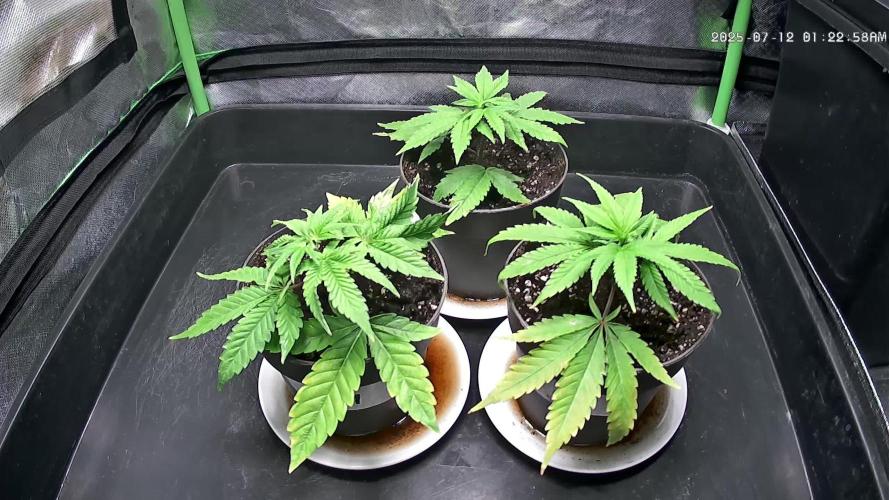
Flowering day 9 and rooting day 9. Both, flowers and roots show up now.
08.07.2025, 09.07.2025 | Flowering day 10 and 11
Did some lollypoping

Likes
23
Share


@Spliffi
Follow
Germination 27 September 2023
Heya 🤙👍🤙🌱🌱🌱
In the heart of a humble garden, a miraculous journey is about to unfold. Beneath the soil's dark, nurturing embrace, a seed lies dormant, awaiting the precise moment to burst forth into life. It is a marvel of nature, a tiny capsule of potential, encoded with the blueprints of the plant it aspires to become.
As the heavens open, raindrops penetrate the earth, quenching the thirst of the soil and signaling to the seed that its time has come. The seed absorbs this life-giving moisture, swelling as it takes in water. It's as if the seed is awakening from a long slumber, stretching its embryonic limbs for the very first time.
Within this subterranean realm, the seed's outer coat softens, and a tiny rootlet begins to emerge. This is the radicle, the seed's first root, and it instinctively knows to journey downward, anchoring itself into the soil. It is the plant's lifeline, seeking out water and nutrients essential for growth.
Simultaneously, a delicate shoot, known as the plumule, makes its way upwards, drawn by an invisible force towards the sky. It is a daring expedition, fraught with obstacles, as it navigates through the soil. Yet, guided by an innate sense of direction, it perseveres.
Finally, breaking through the soil's surface, the shoot unfurls its first leaves, miniature versions of what they will one day become. These are the cotyledons, a pair of leaves that have been stored within the seed, packed with nutrients to sustain the young plant in its earliest days.
As the sun's rays touch these fledgling leaves, photosynthesis begins. It's a momentous occasion, the plant's first breath, as it converts sunlight into energy. The seedling, still fragile yet full of promise, has successfully embarked on the first chapter of its life. From here, it will face countless challenges and opportunities, but for now, it stands as a testament to the remarkable resilience and complexity of nature.
Thanks for reading🤙👍🤙🌱

Likes
9
Share


@TheGreenGroomer
Follow
Hey everyone,
I’m thrilled to update you on my grow! Today marks day 57 in the flowering stage, and I began my flush on day 55 cutting out nutrients and feeding only plain water (not ph'd) If everything goes as planned, I should be harvesting around day 63-65, giving my plants a solid 8-10 days of flushing.
Oh boy, are they looking good! The buds have indeed gotten larger and denser. Some of the colas are even starting to fall over from the weight, but thankfully the trellis is supporting them well, so I’m not too worried about any snaps.
The smell is absolutely amazing, and the trichome production is off the charts. She’s super sticky too—now I really understand where the name Gorilla Glue comes from! 😂
Overall, I’m pretty happy with how this grow has gone. The plants have shown vigorous growth with no deficiencies, toxicities, or pest infestations. There’s a bit of larf below that I thought I had defoliated, but it seems like it grew back. Lesson learned for next time!
Happy growing, everyone! 🌱✨

Likes
13
Share

@HerrnBubatz88
Follow
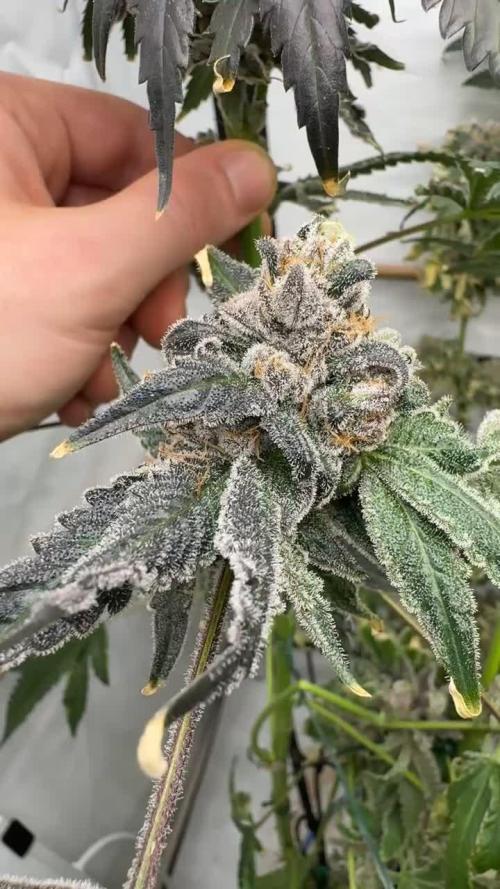
Stay tuned.. Full Review in about 10-14 days.
Chopped on:
Lob #1 : 22.12
Lob #2 : 20.12


Likes
8
Share


@CrizzlePope
Follow
Finally getting all caught up here. Sorry not more details, but the dates on photos are accurate from iPhone timestamp. Skipped a few nutrient feedings due to still fighting what I thought was a ph issue, so we’ll see how she reacts to being fed on 11/19.
Likes
14
Share


@LokalGrenz
Follow
Did defoliation on all three never done it before not sure did k over do it but they needed the trim I had a lot of fan leaves blocking bud sights
Jan23 started to use the self watering pots from acinfinity gallon in each pot with fish shit


Likes
6
Share


@CanarianGrow92
Follow
Amazing Kush strain with nice sweet fruity terpenes, it almost remind of winegums but with a hard kush punsh in the face.
We loved to grow this banana kush from super sativa seeds club. Nice yellowish coloured buds which gets hard as rocks, she loves some good toppings and LST, we had her in a bushy shape but dont forget the extra support as the buds get heavier and might fall around.
Likes
12
Share


@DaddyLauterbach
Follow
So i hatvested them on day 80, they got 24h of light before harvest.
I removed all fan leafes with no to verry little trichomes visible.
Both plants are now drying by ca. 21°C and 57% humidity.
This time i will dry them with lights on to be more efficient with my growing cycles. ( i think they will get at least 2-4 days darkness before the new seedlings move in the box )