







Likes
28
Share


@PrairieFrostGrow
Follow
*
************** Week 7 - May 23 to 29, 2020 - Days 43 to 49 from germination ****************
*
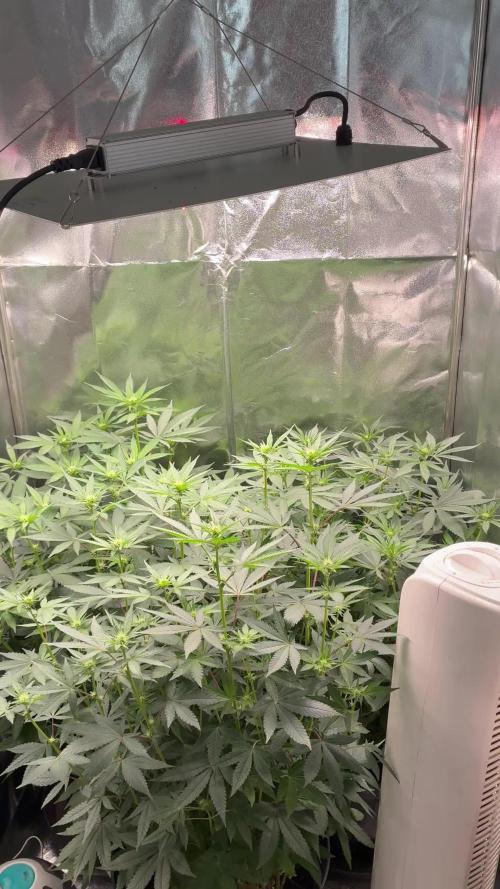
This week she started to take more shape and came out of her ball form and standing up now. Side branches are still growing strong and reaching for the top of the canopy. Increased light intensity also as she is getting bigger and bushy with leaves now. She has increased her feed amounts this week and eating more now. She is happiest when her pot is dry and her leaves are up and praying.
Heavy leaf strip and removed some lower nodes mid week. Letting her focus on growing the top nodes by removing lower points. Opened up the middle nice now and she is looking like a cannabis plant😀 Keep an eye on nitrogen though as she is green. She was getting choked out on the lower growth so removing some and letting the light in, the rest of the of sites should help her fatten up.
Little more detail.......
May 23/20, Day 43
- 3L feed - VeloKelp & Rezin & L.Wt & Sensyzime @ 1.5ml = 150ppm and 6.1pH
- she is setting her buds but her leaves still look dark.
- keeping ppm lower at 150.
- main top reaching up more today.
- Flower light switch turned on and raised the lights to increase intensity now.
May 24/20 - Day 44
- Dry out day
- Only two girls in the tent today so she should react well.
- (GSC plants not flipping and moved to veg tent so made room in flower tent.)
May 25/20 - Day 45
- fed twice today
- 7:30am feed: 2L Sensyzime, Piranha, Rhino Skin, Rezin @ 1.5ml/L = 335ppm and 5.9 pH.
- 8:30pm feed: Vitathrive & Velokelp @ 1.5ml/L = 350ppm and 5.8pH
- heavy leaf strip today.
May 26/20 - Day 46
- dry out day.
- keep an eye on the girl because the last time the girl dried out she reacted well
- noticed the inner growth is slightly brown around the edges. Buds/pistols are not very tall. Light should help with this.
- still only two girls in the tent.
May 27/20 - Day 47
- 3L feed: Mass&Terp @ 3ml/L, Rezin&LWt&Vita @ 1.5ml/L, CalMag&Rhino&Piran&D.F. @ 1ml/L = 1250ppm & 6.0pH
- added more water to reduce ppm to 1080.........1250 a little high right now.
- she was ready to be fed.....eating a little more now.
- Her hairs are getting longer and reaching out more now......light helps😀
May 28/20 - Day 48
- 2L feed: Mass @ 4ml/L, Vita & Sensyzime @ 2ml/L, Dual Fuel @ 1.5ml/L = 1350ppm
- little high so added water reduce ppm 1100
- She is taller and today and really looking nice.
- She definitely likes it when her pot dries out.
May 29/20 - Day 49
- dry out day
- letting her be....she is happy😀
That wraps up another week. It has been great because she is really taking shape now and looking like the little girl I had in my mind👌

Likes
21
Share


@Rollex420
Follow
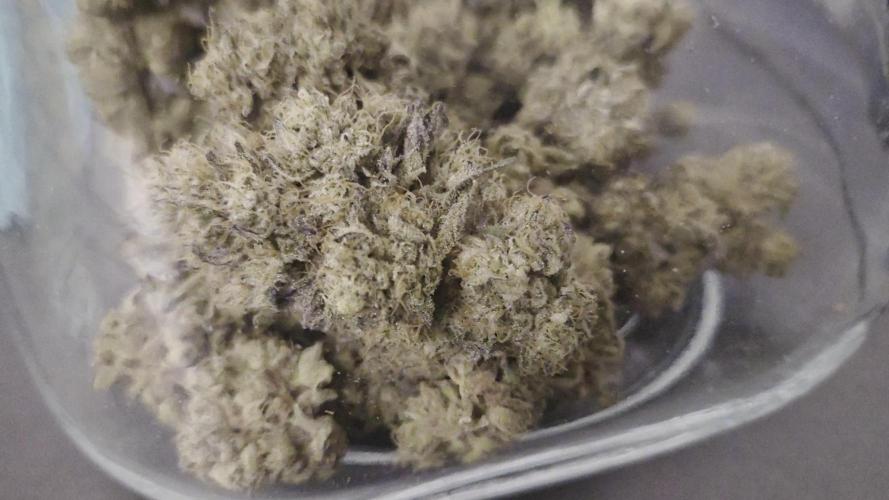
Dos Si Dos # 33 ready for drying in the jar, honest weight (53,5g) seeing the structure which was very small I would have expected something less..
but I am very satisfied. the quality of this weed is absolutely at the top, the taste is very well defined.. when smoked it makes your nose tingle,flavor it is mainly pure lemon with a hint of mint in it. even the strong smell induces an entire room in a few seconds without even smoking it yet.
I also collected a 0.4g of scissor hash which turned out very well.
it is my favorite in this crop because it surprised me in everything both for its unique terpene profile and for its yield that I never expected given its size compared to wedding cakes.
the total weight therefore of all three plants is (135.5g) and a total trim of (44.9g)
that according to the calculations even of these crops I reached (1g/watt) precisely. (And im not a pro)
I am certainly satisfied with that. 🙌🏻💚

Likes
14
Share


@RealPuffDaddy
Follow
Nothing much to report. She’s settled in and working on full flower. Cleaned a couple low hanging leaves, no more snipping past week 3. Up to every other day watering, roughly a liter. She’s been a breeze so far. Till next week.
Likes
2
Share

@hassehujasse
Follow
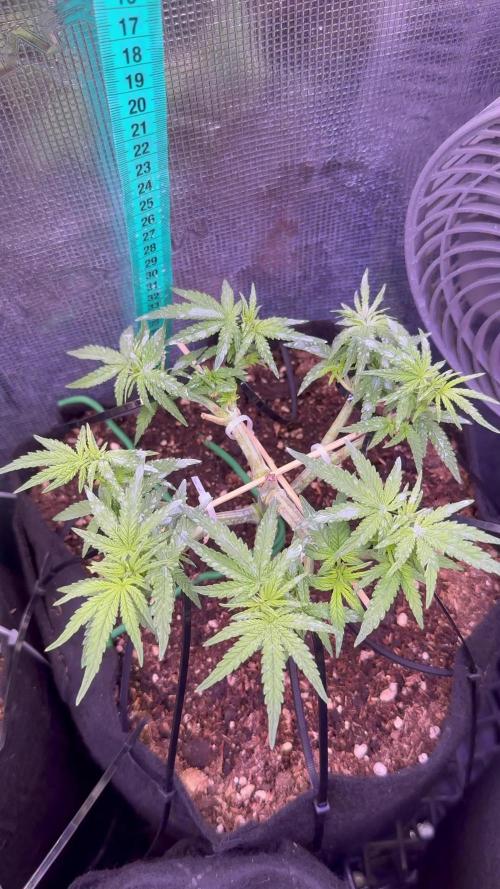
Have you ever been exceptional? 24/7/52/365/48??!!
With every new plant in my box bringing something new in my techniques
Likes
12
Share


@CeezarMoolawn
Follow
Seeds are in a Container/ Dome , Sitting between 80-90 Percent humidity , Using 600w Air cooled vent with fans to keep temperature around 75-80 .
Day 3 , all seeds show signs of sprouting, The wifi X zombie kush is moving along well!
The 1 purple punch x animal cookies is having a hard time coming out of the cube! but should push up Tonight/tomorrow morning!
Once i see some roots on the bottom of the cubes i will be transfering into my pots and starting the ebb n flow.



Likes
32
Share

@Salokin
Follow
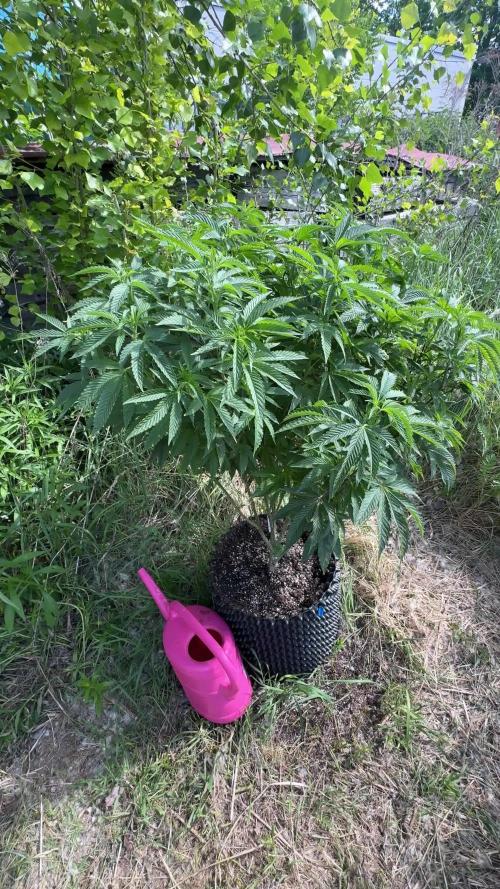
GMO × Triangle Mints BX – Week 13 Veg | Recovery, Defoliation, Pushing On
She’s bounced back well. The CalMag correction from last week has done its job — foliage is looking dark green and healthy across the canopy, no progression of the deficiency symptoms. Good to see the recovery was as quick as the diagnosis.
Did a defoliation this week to open up airflow and light penetration through the increasingly dense canopy. At 115cm and still in veg she’s building a serious frame — the LST continues to keep the tops even and spread wide.
Feed schedule unchanged: two feeds with CANNA Aqua Vega 4ml/l, CalMag Agent 1.1ml/l and Aptus Regulator 0.1ml/l, one feed plain water. pH locked at 6.2, EC at 1.5 mS/cm, 3L per feed.
The coming week looks warm but unsettled — temperatures staying around 24–25°C with a chance of showers and possibly some thunderstorm activity later in the week. The warmth is welcome, the shelter of her spot will do its job if things get rough.
Updates every Sunday. Stay tuned. 🌿
Likes
43
Share


@Regenwurm
Follow
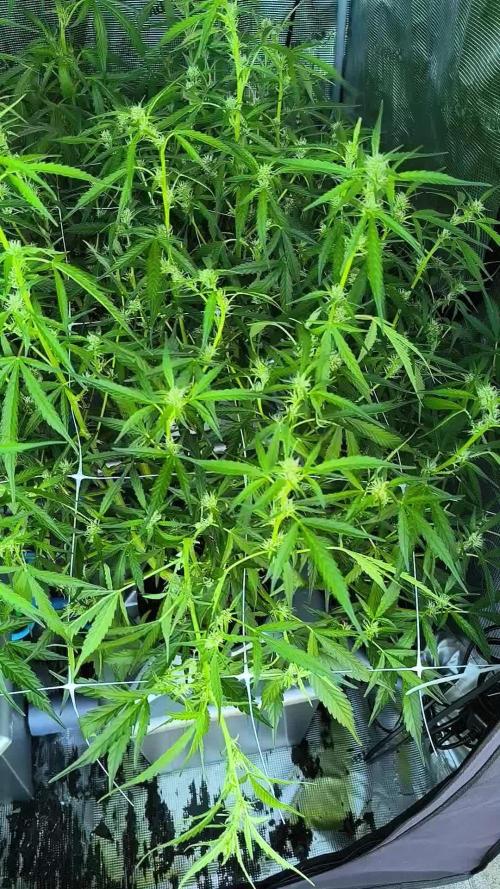
Den Ladies geht es ganz gut. Sie werden immer hungriger. Das Wachstum läuft gut, ich hoffe das geht so noch in diesem Tempo 1-2 Wochen weiter. Interessant ist, dass die Blackberry und Purple Lemonade eher aussehen wie eine Sativa, und der Hybrid Orange Sherbert bei dem am meisten Sativa drin ist, aussieht wie eine Indica ! Wir werden sehen…. Die Blackberry und Purple Lemonade sind von der Entwicklung ca. 1,5 Wochen voraus. Das Klima ist nach wie vor optimal, sie mögen das Blütelicht wie gesagt sehr gerne. Die aktive Zuluft läuft Konstant während der Beleuchtung. Da die Pflanzen sehr gesund aussehen, werde ich die Düngemenge minimal bis gar nicht korrigieren. Gießintervalle ca. 2,5-3 Tage mit jeweils 2 Liter. LST nur noch vereinzelt, Sie sollen jetzt wachsen, minimal entlaubt



Likes
15
Share


@DudeGrowsWeed
Follow
November 6, 2021
The Quick Critical is taking off!!! I started feeding some nutrients this week and she really seemed to like it. I could flip her to flower now, but I'm going to wait another 1-2 weeks so the other two ladies can veg longer (and to give the autos a chance to finish).
Critical Sour looks like she is ready to start rocking, I expect to see significant growth this upcoming week.
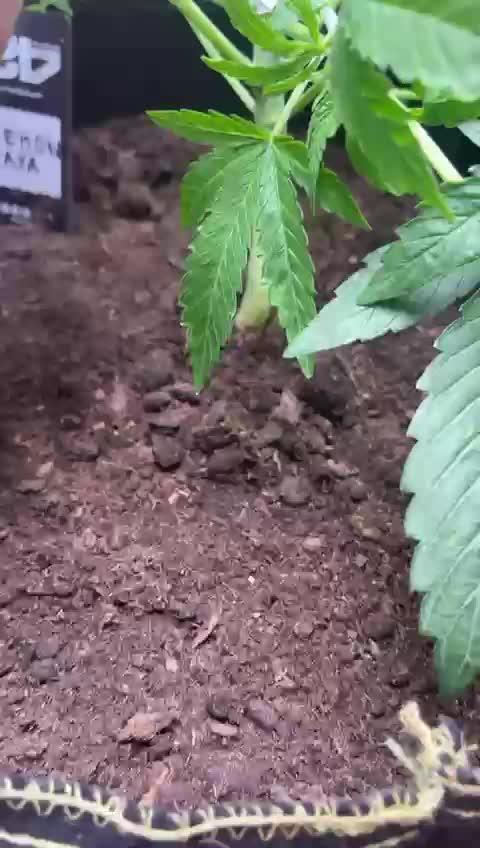
CBD Medi Kush is finally starting to look like a cannabis plant! I have no idea what caused the delayed growth in the initial couple of weeks, but she's seems on track now. Lots of good growth in the past couple of days. This morning when looking at her closely I noticed she is growing two stems. This is going to be fun to watch how she develops. I just hope she doesn't herm out later.
Neither of the two Dr Bruce Banner seeds nor the one CBD Lemon Aid seed I tried planting ever popped. This is now a 3 plant diary.


Likes
21
Share


@growops123
Follow
Lots of growth this week had to switch nutrients since I ran out of sensi grow anb

Likes
16
Share


@Foggedaboudit
Follow
Trichomes, density, looks it’s all there but the smell which is late to the party. They still got a few weeks to go though so I’m not too worried.
Likes
18
Share


@Stonyways
Follow
12 on 12 off, missing my girls... I spent about 35 mins tops with them during the week, and then I love giving them the attention they deserve on the weekends, what else is there to do when the worlds gone mad?
2nd grow on the "smart plug cycle" and the cost is so low..I am extremely happy with the SPIDER FARMER SF2000, but there's times I just want to plug in the 1000w to penetrate deep into the plants but the reasons for the LEDs is to grow some heady herbs for less. LEDs can get expensive but its just start up costs, after that you don't have to change bulbs and you don't notice the pull on the electric bill. WIN WIN
the ladies have been busy this week and producing which means i'll need to go in tomorrow and do a clean up.
happy growing!
...GOOD VIBES here!!!
HAPPY GROWING!!!!!
1/26/21 had to switch up watering today due to demands from the plants. This is where it gets tricky, 2 weeks left of feeding before flush and all I am trying to do is keep as many leaves possible to feed all those buds. I am usually just a big bud person but I recently purchased a hash machine and I know a couple old heads that still love bubble soooo...
THE SEED PHARM.... I will be going back very soon for more of this nice plant and something different.
THERE IS NEVER ENOUGH ROOM!!!
Likes
5
Share


@Pechu420
Follow
Beginning of the fifth week of flowering.
One organic and one fertilized!
Both sativas!
Likes
7
Share

@Ninjabuds
Follow
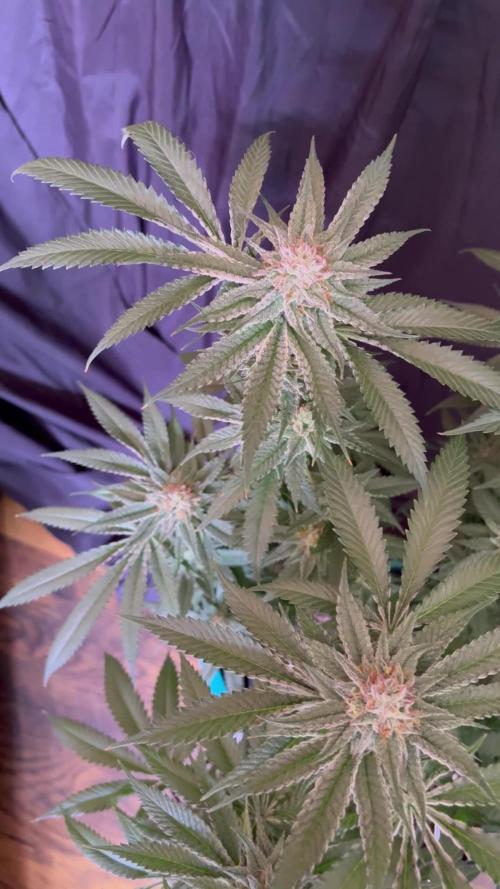
A pretty small plant with huge potential if I had a bunch of the same plant I could have moved the light closer this was the shortest plant in the tent and was kinda far from the light. When I was wet trimming the buds I realized the are really dense still and super dank they have some huge tricomb heads. Definitely a plant you could have some really good hash with just the trim. The plant smells good some fruit gunk and a little gas smell but a strong pungent smell for sure
Likes
19
Share


@sneakymexican712
Follow
This was an amazing firat grow and I’m not done yet love mainlining. Depending on how these dry and the yields come out I may just do lst and get about the same amount of yield out of the grow but I still have another week or so till I chop the others


Likes
28
Share


@TheHighentist
Follow
Welcome to week 7! Maybe the last week before harvest, i will keep an eye out for the trichomes in the end of the week
👽👉 21/11 Water day*
They got the same dose as last week, and flush might come soon.
👽👉 22/11 Lower humidity 40-45
👽👉 23/11 I got a cheap Scrog net to support the heavy tops and correct the canopy spread.
👽👉 24/11 Water day* Start of flush
Moved the light a little bit closer
👽👉 25/11 The Frost, The Smell and The Trichomes are telling me, we are getting close to harvest
👽👉 26/11 Changed the humidity to be extra low the last days of their cycle.
👽👉 27/11 Water day* Flushing
Likes
4
Share


@Hodo420
Follow
The plants are exploding in growth. Especially the gorilla cookies. I need to start doing a better job of watering my girls. I means its hard having to mix up all these nutrients at one time so I water my plants 2 at a time. I water 2 one day then the other 2 the next day. Im trying this method out cause it makes watering not so intense during dlower.