


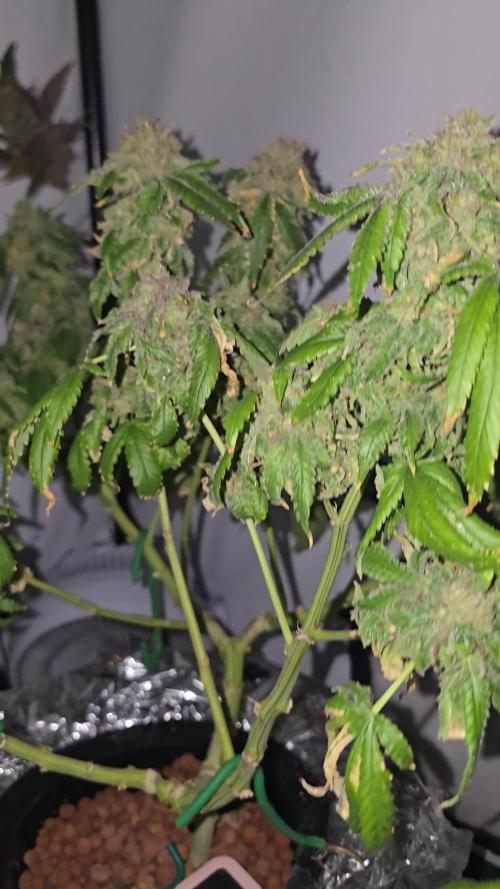


Likes
4
Share


@AustinRon
Follow
LJ 2Q24 BOLT II - Week 3
Start of Week:
- [Sun Jul 7, 2024, LJ 2Q24 8:B:2:1]
- Plant Heights: [ 7, in]
End of Week:
- [Sat Jul 13, 2024 LJ 2Q24 14:B:2:7]
- Plant Heights: [ TBD, in]
IrrigationRatePerPlantPerDay: [ 500, ml]
__
Sun Jul 7, 2024
LJ 2Q24 8:B2:2:1
- [x] LightIntensity: [ 683, µMol/m2/s]
- [x] LightDistance: [ 19.5, in]
EC: 1.7

__
Mon Jul 8, 2024
LJ 2Q24 9:B2:2:2
Product N P2O5 K2O Ca Mg S Si Carbon PPM w/out Carbon PPM w/ Carbon Product mS
Total FULL FW 3 198 153 404 182 37 36 42 877 1053 1930 2.11 mS
Total Hydro FW 3 207 113 405 169 38 45 75 339 1052 1391 2.10 mS
Hydro Add/Subtract 9 -40 0 -13 1 9 33 -538 -1 -539 0.00
Here we’re comparing the Rooted Leaf ‘Medium Feed Chart’ and “Hydro Feed Charts’ for Week 3 of flower.
Key differences of FULL Line, is 40% More Phosphorous, 30% MORE Carbon, 10% more Calcium; with LESS Sulphur & Silica than HYDRO CHART
- [x] LightIntensity: [ 693, µMol/m2/s]
- LightDistance: [ 19.5, in]
Fertigation:
- EC: [ 1.8, mS]
- RLA Medium Flower Week 2
__
Tue Jul 9, 2024
LJ 2Q24 10:B2:2:3
- [x] LightIntensity: [ 729, µMol/m2/s]
EC: 1.8
Note: Solution w/ ZERO EC Humidifier Water. (More RLA, Less background CaMg)
__
Wed Jul 10, 2024
LJ 2Q24 11:B2:2:4
Using the HEAVY Chart (Loads Silica & CaMag) for Nutrient Element Ratio (NER)
- [x] LightIntensity: [ 763, µMol/m2/s] # DLI: [ 33, Mol/day]
EC: 1.9
__
Thu Jul 11, 2024
LJ 2Q24 12:B2:2:5
- [x] EC: 2.0
(RLA Medium NER)
- [x] LightIntensity: [ 738, µMol/m2/s]
__
Fri Jul 12, 2024
LJ 2Q24 13:B2:2:6
EC: 2.2 (RLA Heavy NER)

- [x] LightIntensity: [ 780, µMol/m2/s]
__
Sat Jul 13, 2024
LJ 2Q24 14:B2:2:7
EC: 2.3 (RLA Heavy NER)

Friday’s Foliar Today
- [x] RLA Solar Rain: [ 2.5, ml, pt]
- [x] RLA Peak Bloom: [ 0.625, ml, pt]

Likes
5
Share


@Bingbings_garden
Follow
Hello growers
-May 30-
Canapee development going as planned. Using wire to keep new growth even.
Watering 0.3L every 72hours. No added nutrients plan seems to be doing ok so far.
Likes
2
Share


@Saintvicious
Follow
Looks like this might be the last week for this girl. Was hoping to see more change in tricomes but not sure if worth the wait. Give it a few more days and see what the loop says.
Likes
35
Share


@hornato420
Follow
Week 12 looks girl #1 is coming to a end. I haven’t over fed or over watered and she’s starting to get yellow leaves. I feed her one more time at the end of this week. Starting week 13 I’m going to start to flush her.
Her smell has gotten more intense this week also. She smells like sweet tropical citrus. Also she looks to be filling in more and her buds are starting to get a little dense. She definitely exceeded my expectations. I couldn’t have predicted from veg she would be this size.
Girl#2 unfortunately never started flower and she’s going get 12-12 after I harvest girl #1. I’ll start another diary for girl #2 when that time comes. I knew she would be long winded but this is just extreme 😂.
I know you experienced growers know this story very well, but for a rookie like me 😆 I’m pulling my hair out and punching the air with frustration 👊🤬🤯😁. This for me is a learning experience and I love the duality of this grow. I’ll know better next time I run into this time of issue.
Thank you for viewing my diary. I will be looking to possibly harvesting this girl in the next few weeks or sooner,
Likes
17
Share


@Elmobud
Follow
So there's been a few heat issues this week as the weather has been really nice so the temps have gone to nearly 30 degrees 🙈 so that's been fun to deal with, this strain is definitely not an 8 week flower more like 10 weeks flower but still looking good lots of crystals 😍 and the smell is 😋😋😋 Happy Times Happy Growing 😁 🌿
Keep Safe 😁


Processing
Likes
23
Share


@Alchapocanna
Follow
Harvest time for the gorilla glue. Very nice solid buds. sMellsnstrong but only when you smell the bud... tryed wet trimming half and drying and trimming the next half to see results
Gorilla bombs doing well tris are still mostly clear. Couple Amber and few cloudy. She smells so strong. She super sticky. Put the cool tube in today to get her closer to the light. Can switch the ballast up to 600 in cooler days .
Will doing a auto run next. Probably under 2 400
. Thinking about ;
3 or 4 Blks. Auto chemdawg
3 feminised seed auto blue treacle
1 fast buds stardawg
2 sensi seeds auto early skunk
Never had any merging good come from fast buds. I find there buds are very airy and foxtail like structure but iv only grown a hand full but maybe the stardawg will be different
Thinking about starting the flush got the g bomb in a round 3-4 days. Let her go another 2-3 weeks.
I have heard a few times that MH lights in the last week of flower increases trihcome production?
Had anybody had any experience with this?


Likes
16
Share


Likes
12
Share


@Huntablunt
Follow
Hello.........Ladies are going into the final weeks!! It is absolutely awesome to see and smell this every day!!! Did not water them for one day, and they were really thirtsty today.
I will give them 2 weeks minimum, at the end of the week I will decide when to cut nutrition. I hope they keep on inflating like last week. Buds are really quite frosty and I was checking weather report and I seem to have perfect timing for harvest, which is absolutely great. This strain will have such an interesting aroma.....
I dont know if it is clearly visible from the photos, but the buds will show some nice different colours. So if they finish on time it will be absolutely high grade in every aspect. Looks, smell and taste/turn. Still I will have to be quiet patient until testing, but this is going to be the most anticipated weed since I dont know when.


Likes
16
Share

@Z420Organics
Follow
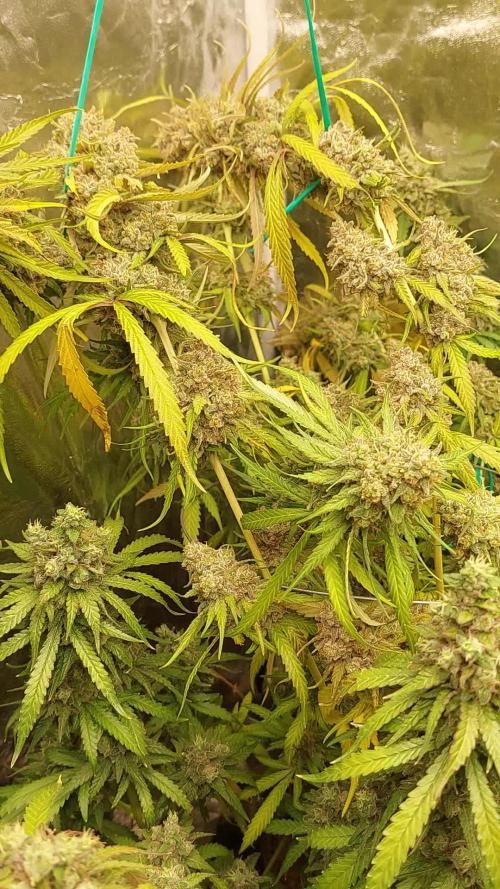
🔥 Kannabia Grow Update 🔥
The plants are starting to show their beautiful colors! 🌈
They’re ripening perfectly — trichomes are now mostly milky, sparkling under the light ✨
We’re officially in the final stretch! ⏳
Can’t wait to see how these beauties finish — it’s harvest season vibes! 🌿💚

Likes
1
Share


@Simon_Says_Smoke
Follow
17 January 2021
The seed has germinated and the plant has risen.
19 January 2021
The seedling had struggle with germination because the seed’s shell was stuck on the sapling causing the first pair of leaves to grow stuck in the seed shell and had to remove the shell by hand.
This has put a minor delay on the plant’s growth.
Likes
17
Share


@Fitzwell
Follow
First off I need to thanks crop kings seeds for sending me such great seeds.
I'm so close I can taste it. The Buds are getting nice and fat, and really stinky. Doing my flush tomorrow and running 15 gallons of RO water through it.
I'm done feeding it and water only the next week then CHOP CHOP


Likes
14
Share

@Growbody
Follow
Herzlich Willkommen zu meinem Growbericht der geheimnisvollen Guava Sundae F1 Hybrid Feminisierte Autoflower von 2Fast4Buds. Elternpflanzen der Guava Sundae Auto sind Guava Auto RF3 und Sundae Thumper F4, ergibt einen Hybriden Canabisstrain, der nach tropischer Guave und cremigem Gelato schmeckt. FastBuds macht keine Angaben zur Größe, Wachstumszeit oder THC-Gehalt. Die Guava Auto RF3, Teil der Genetik der Guava Sundae Auto, hatte ich beim letzten Indoorgrow dabei. Sie ist schön gewachsen, hat mir gut geschmeckt und hatte eine schönes High. Für mich ein guter Grund, die Guava Sundae Automatik zu testen.
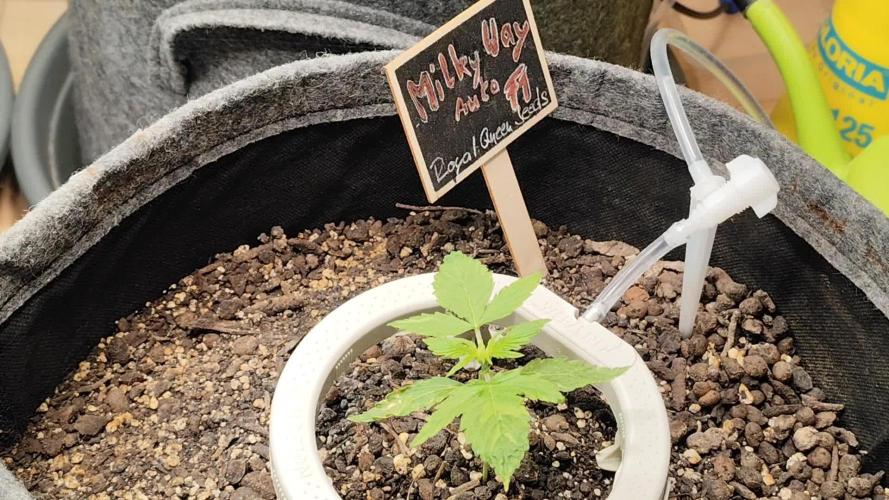
Tag 14: Die Guava Sundae F1 Auto von FastBuds entwickelt sich gut. Das zweite Blattpaar entwickelt sich kräftig. Die automatische Bewässerung läuft inzwischen gut. Die Schöne bekommt so 2x am Tag Brunnenwasser mit 26°C.
Tag 15: Ich muss einmal etwas aggresieves an meinen Händen gehabt haben, mit denen ich sie berührte. Das eine Blattende hat fahle Stellen.
Tag 16: Das 3. Blattpaar ist schon zu sehen.
Tag 19: Ratzfatz sind sie schon da.
Tag 29: Eine Minute tropfenweise Wasser, 2x am Tag.
Es freut mich, dass du dir meinen Grow ansiehst. Schau wieder rein und bleib Mitmenschlich 👋😎
Likes
9
Share


@Growing_Spartan
Follow
Today’s date is June 11th, it has been 6 days since my last update.
So far the Dolomite lime seemed to have helped with the yellowing of my fan leaves and the only “yellow” ones left look like they have a fade to them but I’m not sure if it’s due to proximity of the harvest or from the magnesium deficiency I had earlier. Either way I have to be more on top of my nutrients and my macros too.
They chunked up a decent size and the branches are even toppling over from their density! Trellis was definitely needed for this one.
Nothing special but watering when needed, temps have been as high as 84 and as low as 67, I’m really trying to master the environment but due to my location it’s getting harder to do so without hoping I don’t blow a fuse with all my equipment running, haha.
Overall I’m happy so far and hopefully next run I’ll dial in more perfectly, if you have any tips for me please share!


