Likes
Comments
Share
@Oldwied
Follow
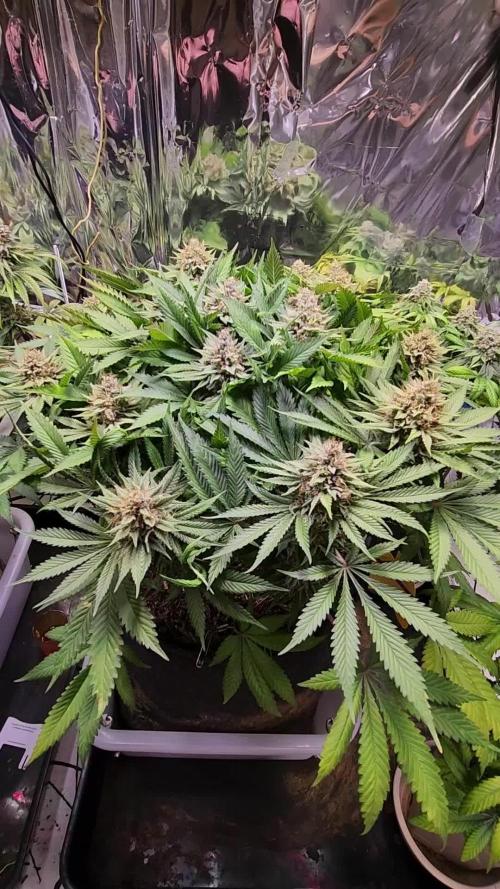
Last one or two weeks before harvest. Trichomes are mostly milky and a few heads turn to amper. Light Power: 100% Day 102 Flower day 55 Photoshooting
Likes
51
Share
@BlaKX
Follow
Hi Growmies es vergingen noch 7 Tage bis ich Ernten konnte ich ließ die Pflanze komplett austrocknen nachdem ich sie ein letztes Mal gegossen habe mit klaren Wasser. Leider ging es mir gesundheitlich nicht gut weshalb ich kaum Bilder gemacht habe und nicht richtig trimming. Werde noch Bilder den Blüten und Rauch bericht machen. Der nächste Grow ist schon safe welche Sorten ich anbauen werde: Guava Runtz Auto, Mendo Frost Auto und Purple Lemonade RF3! Danke Fast Buds für die Möglichkeit die neuen Sorten zu testen!
Likes
37
Share
@Reyden
Follow
Waow! C’è da dire Waow! Queste Fast Flowering sono super vigorose e crescono senza paura e senza timore alcuno, sono sorpreso di vedere come in così poco tempo sono già pronte per andare in fioritura perché sennò 5 piante in questo box ( 80x80 ) avranno spazio appena sufficiente…Ah e ho aggiunto circa 18/19g di Top Dress di Dogma Organics attorno alle piante e ho mischiato i primi centimetri…domani diamo solo acqua! 💦
Likes
8
Share
Of the 5 seeds i harvested 44grams avg. Keep in mind the pest condition and some ripped by snails. In all a satesfying grow.
Likes
54
Share
Hey guys :-) The lady developed beautifully this week :-) . She's starting to grow a lot. Next week I will repot them in 8 liter cloth pots. Watering was done twice this week with 0.5 l each. Since I partially washed the earth beforehand so that there are hardly any nutrients, I have a small layer of vomit Added Green House Powder Feeding. So she has a few nutrients until repotting :-) . Otherwise everything was cleaned. I wish you a lot of fun with the update and stay healthy 💚🙏🏻 👇🏼👇🏼👇🏼👇🏼👇🏼👇🏼👇🏼👇🏼👇🏼👇🏼👇🏼👇🏼 ‘Powered by GreenHouse Feeding’ Copy the link for 10% off all Nutrients 👇🏼 https://shop.greenhousefeeding.com/affiliate/MadeInGermany_PassionGrower 👇🏼👇🏼👇🏼👇🏼👇🏼👇🏼👇🏼👇🏼👇🏼👇🏼👇🏼👇🏼 You can buy this strain at : https://www.amsterdamgenetics.com/product/choco-cheesecake/ 👇🏼👇🏼👇🏼 Use the coupon code: madeingermany for 10% on all Amsterdam Genetics seeds Water 💧 💧💧 Osmosis water mixed with Cal/Mag (24 hours stale that the chlorine evaporates) to 290 ppm and Ph with Ph- to 5.8 - 6.4 MadeInGermany
Likes
10
Share
@hexhex
Follow
Love seeing them grow! Tried giving them a little more EC, I've been precision stressing via a low nutrient environment the whole grow. It's going to be interesting to see how distance to lamp will affect bud growth. I keep DLI @ 50 at the highest top.
Likes
8
Share
Welcome to Flower Week 1 of Divine Seeds Auto Black Opium I'm excited to share my grow journey with you all as part of the Divine Seeds Autoflowering Competition 2025. It's going to be an incredible ride, full of learning, growing, and connecting with fellow growers from all around the world! For this competition, I’ve chosen the Feminized Automatic strain: Auto Black Opium Here’s what I’m working with: • 🌱 Tent: 120x60x80 • 🧑‍🌾 Breeder Company: Divine Seeds • 💧 Humidity Range: 50 • ⏳ Flowering Time: 60-63 Days • Strain Info: 25%THC • 🌡️ Temperature: 26 • 🍵 Pot Size: 0.5l • Nutrient Brand: Narcos • ⚡ Lights : 200W x 2 A huge thank you to Divine Seeds for allowing me to be a part of this amazing competition and Sponsoring the Strains. Big thanks for supporting the grower community worldwide! Your genetics and passion speak for themselves! I would truly appreciate every bit of feedback, help, questions, or discussions – and of course, your likes and interactions mean the world to me as I try to stand out in this exciting competition! Let’s grow together – and don’t forget to stop by again to see the latest updates! Happy growing! Stay lifted and stay curious! Peace & Buds!
Likes
3
Share
@CalGonJim
Follow
8/3 3:32AM THE GATES OF HELL OPENED UP....aaaaand I forgot my wallet...couldn't get in, didnt expect to be carded... oh well, next time.....so bummed. 8/4 3AM FULL RETARD MODE ACTIVATED 8/6 12:18PM noon. Dawn AGAIN... Stupid goblins cant do ANYTHING right!
Likes
35
Share
Bueno, pues actualizamos el último diario de esta semana, estás red hot cookies de sweet seeds van muy bien, están increíbles bajo un ts3000 de la marca mars hydro, solo hay que verlas. . Se han trasplantado a final de semana a su depósito real 11L . La humedad anda entre 60/70% la temperatura está entre 23/26 grados, el led es increíble , y como siempre el ph , ya que es de lo más importante,está en 5,8/6,0. . AgroBeta: 0,8 ml x L Growth black line , vía radicular. 0,2 ml x L Tucán , vía radicular. 0,15 ml x L Flash Root , vía radicular. 0,05 ml x L Gold Joker, vía radicular. . Ahora si, esto es todo, está semana hubo bastante trabajo entre pedir montar preparar sala etc , pero ya esta, el último tiron es montar la extracción, pronto os enseñaré, buenos humos familia 💨💨💨.
Likes
3
Share
Next go around I will veg longer and do more training.
Likes
126
Share
@FoTwenny
Follow
Fo' Twenny Back with another update on this awesome little Northern Light Blue Auto from Delicious Seeds! I have been giving plain tap water run through 2 KDF filters as of 9/5 and I moved her into the bloom room under quantum boards set on 12/12 to make room for the next run and maybe help her finish faster. 9/9 - She seems to be bulking up a bit in her last few days, but I waited a day too long to water and got she started to wilt/droop a bit. So, there are a few dead/brown leaves I've been having to pick out of her and thus begins pre-harvest defoliation. 9/13 - More defoliation and put her in a loosely sealed box to give 48-72 hours darkness. Harvest, coming soon. 9/15 - Checked her today and she could still use another day to dry out. I have never tried the darkness before harvest thing, but a lot of growers swear by it. So, I figure, why not? I will let her go until she is a bit drier and then give her the chop! Thanks for checking out my diary. If you liked this diary, check out my other diaries and give me a follow! Until next time... Peace ☮️, Love 💚, And Frosty Nugs ❄️🌲! -Fo'Twenny
Likes
8
Share
Fast Buds - Wedding Glue Day 19 Closing in on start of week 3 Light - ViparSpectra XS2000 Watering every other day to every 2 days Slow growth in seedling stage but I am hopeful she will explode in vegetative stage! See you all next week!
Processing
Likes
15
Share
I just dropped it in water and rootjuice for 2hrs and then direct in peat pellet and after about 50hrs she was saying hello ✋ I'm very exited to start this experience whit exotic seed can't wait to grow this strains 😵
Likes
2
Share
Remember that, however you are played, or by whom, your soul is in your keeping alone. Even though those who presume to play you be kings or men of power, when you stand before God, you cannot say, 'But I was told by others to do thus,' or that virtue was not convenient at the time. This will not suffice. Remember that. Day:18 84°F and 65% RH (VPD) for the vegetative stage. Approximately 1.15kPa(assuming leaf temperature is about 2°F cooler than the air), which falls right into the ideal vegetative sweet spot (0.8kPa to 1.2kPa). At 1.15kPa, plants can draw water and nutrients efficiently without risking stress or wilting. It keeps the leaf pores (stomata) open, allowing for ideal carbon dioxide intake and maximizing vegetative growth. VPD is determined by the leaf's temperature, not just the ambient air. Because leaves usually run 1° to 3°F cooler than room air under bright grow lights, my actual VPD will be slightly lower, closer to the 1.0kPa mark. As she transitions from vegetative growth to flowering, one can gradually lower the humidity (to around 45–60%) and drop temperatures slightly to prevent disease from settling inside dense buds when they appear. Night:6 At 70°F and 60% relative humidity, Vapor Pressure Deficit (VPD) is 0.86 kPa. This is right on the cusp of whats optimal for the vegetative stage. During the nighttime, plants generally close their stomata and undergo cellular respiration rather than photosynthesis. Transpiration slows to a near stop, making VPD less critical at night than during the day. However, maintaining a nighttime VPD between 0.8 and 1.0 kPa is highly beneficial in that it ensures the air is dry enough to prevent powdery mildew or bud rot, but moist enough to keep the plant from undergoing unnecessary stress. This range keeps the environment comfortable for cellular processes and prevents large atmospheric swings. Keeping it all flowing. (Not pushing them yet, these are photoperiods) The optimal soil (root zone) temperature for cellular root respiration and nutrient uptake in cannabis is between 68F & 72F This narrow range balances biological energy production (cellular respiration) with the dissolved oxygen levels in the soil, maximizing plant growth and health. Warmer soils hold significantly less dissolved oxygen. When soil temperature exceeds 74F oxygen depletion occurs, inhibiting cellular respiration almost entirely, At 68-72F root cells generate optimal adenosine triphosphate (ATP) via respiration to power root-tip elongation and the active transport of water and nutrients. Too Hot (Above 78F) Root respiration increases, demanding more oxygen, while the water's oxygen-carrying capacity drops. This creates a prime environment for anaerobic pathogens and Pythium (root rot). Too Cold (Below 60F) Root metabolism and cellular respiration slow to a crawl. This severely impairs nutrient and water absorption, leading to yellowing, wilting, and phosphorus deficiencies. A lot depends on whether it's automatic or photoperiod; with photoperiod, there is not as much of a need to push "hard" as the real countdown only begins once the flower is initiated. Automatics, on the other hand, the chronological "clock" begins ticking the moment the seed germinates. It is of critical importance that the seedling growth gets off to the races, understanding that early growth is like compound interest, which will pay off come harvest. This reality is why getting autoflowers "off to the races" early on yields such exponential benefits. The "compound interest" is directly related to the surface area of the leaves. Larger, faster-growing seedlings process more light and build bigger root networks early on, which translates into an explosion of vertical and lateral growth during their short vegetative window. The margins for error are so thin with autoflowers; this early-stage momentum depends on several critical practices. Seedlings exposed to increased atmospheric CO2 levels early in life will develop at an increased rate. To effectively "extend" or optimize the capacity of Photosystem II (PSII) for increased photosynthetic efficiency. In standard oxygenic photosynthesis, Photosystem II (PSII) is naturally limited to the red-light spectrum, peaking at 680nm. Extending its light-harvesting capacity past 700nm into the far-red region requires bypassing the natural limits of standard chlorophyll a. Adding 730 nm (far-red) LEDs alongside standard red/blue lights has been shown to increase canopy photosynthesis by 20–30% in several crops by acting synergistically with shorter wavelengths. However, the limitation is that excessive, pure IR/Far-red light (without accompanying red light) can trigger the "shade avoidance response," causing plants to grow tall, weak, and spindly rather than robust. Utilizing infrared light (specifically the 700-750 nm far-red range) is a viable method to boost photosynthetic efficiency. It acts as a bridge to allow PSII to utilize a broader spectrum of light, breaking the traditional 700 nm barrier. UVR8-mediated signaling (often in conjunction with CRY proteins) triggers protective mechanisms that maintain the stability of the photosynthetic apparatus (including LHCII and reaction center proteins), thus ensuring that the efficiency of Photosystem II remains higher in UV-B-exposed plants compared to plants lacking this receptor. ΦPSII indictates the rate of electron transfer from water to plastoquinone, which drives the production of ATP and NADPH. There is a close link between ΦPSII and the true rate of CO2 fixation (Φ*co2). ETR stands for Electron Transport Rate. It measures the speed at which electrons are moved through the thylakoid membranes in a plant's chloroplasts during the light-dependent reactions of photosynthesis. Infrared light (particularly Near-Infrared or NIR) improves cellular energy by interacting directly with the electron transport chain (ETC) in mitochondria. This process boosts adenosine triphosphate production, which acts as a metabolic coefficient multiplier by accelerating enzyme activity dramatically. Extend then multiply. Far-Red photons interact with plant photoreceptors to accelerate the plant’s biological "clock" or trigger a shade-avoidance response. Autoflowers don't use the plant's biological clock, although the IR will initiate a shade avoidance and make them stretchy. You can just add equal measures of 660nm-680nm to negate the shade avoidance effect. Replacing nights' "darkness" with a combination of IR+ and 660nm. Because autoflowers don't require a dark period to flower, many growers just blast them with light. 18/6 24/0. However, this ignores the plant's metabolic rhythms, where daytime photosynthesis (light reactions) must be perfectly balanced with nighttime carbon fixation and assimilation (Calvin cycle) to avoid bottlenecking plant development. Cellular respiration is a 24/7 process, but it can only function while the plant has the free oxidative capacity to do so. A 100% photosynthetically active leaf cannot perform cellular respiration. The viral trend of defoliation of every leaf that isn't "getting enough light" is of great detriment overall, putting 100% of the cellular respiratory "workload" and responsibility on the 0/4/6 hours of darkness in sub-optimal conditions for enzymatic activity. Photosynthesis captures nearly 100% of the initial energy as carbon, while cellular respiration is the process that unlocks 90% of that captured energy into usable ATP so the plant can use it. Respiration is considered only roughly 30% to 40% efficient. It captures enough of the potential energy in glucose to synthesize around 30 to 38 ATP molecules per glucose molecule. The remaining 60% to 70% of the energy in the sugar is not captured in ATP; instead, it naturally escapes into the environment as heat, which helps regulate plant temperature. In plants, the primary enzymes of the Electron Transport Chain (ETC) and the ATP synthase complexes are typically adapted to function optimally in warmer temperatures (roughly 77°F to 95°F, depending on the specific plant strain). As temperatures rise within this physiological range, molecular collisions increase, speeding up respiration and ATP production. The cannabis plant has a branched respiratory pathway. During heat or cold stress, plants activate Alternative Oxidase (AOX). AOX burns sugars to dissipate energy as heat rather than coupling it to ATP production. This pathway actually functions optimally at elevated temperatures to help protect the cell from the damaging build-up of Reactive Oxygen Species (ROS) during heat stress. Enzyme activity generally scales with heat; there is a strict biological limit. If canopy temperatures in a grow room exceed 104°F, the enzymes and their supporting lipid membranes lose stability. Not saying you need to go crazy, just optimize nights the same as we optimize days. Phosphorus is the driving force behind early seedling development. It acts as the "energy hub" of the plant, directly driving cell division, robust root growth, and the creation of DNA. Without an adequate, easily accessible supply early on, the plant's overall growth potential and final yield can suffer permanently.
Likes
89
Share
2020-07-24 (Day 129) This girl and her Bruce Banner sister have cow manure mixed in and this is the first week I’ve added nutes. Leaves weren’t yellowing but I felt that overall the plants were pale throughout, especially compared to her clone. From here on out I’m more or less letting her do her thing. I’ll likely have to add supports once she starts bulking up with flowers. I’ll also have to move her and her BB3 sister in my yard once flowering initiates as the sun will be blocked more by my hedges come that time. I’ve added a picture of her beside her untrained clone in a two gallon pot. This clone leads me to believe that left untrained this thing would grow into a massive tree! It’s been sunny and warm with little rain, so far knock on wood an amazing summer for growing outdoor. Stay tuned, flowering is just around the corner!
Likes
35
Share
Y cómo no aquí va la sexta semana de vida de las red hot cookies(sweetseeds) ,hace una semana que cambie el fotoperiodo a 12/12 con lo cual empieza la floración, es una variedad la cual salió al mercado este año 2020, con lo cual es bastante nueva la variedad en si. . La humedad la tengo al 50% la temperatura está entre 21/24 grados , y el ph está en 5,8/6,0. . AgroBeta: 0,5 ml x L Flowering black line , vía radicular. 0,3 ml x L Tucán , vía radicular. 0,8 ml x L Génesis, vía radicular. 0,1 ml x L Betazyme, vía radicular. 0,2 ml x L Flash Root , vía radicular. 0,05 ml x L Gold Joker, vía radicular. 0,2 ml x L Silver, vía radicular. . Hasta aquí es todo amigos, buenos humos fumetillas💨💨💨.
Likes
23
Share
Gracias al equipo de Sweet Seeds, XpertNutrients y Marshydro sin ellos esto no seria posible. 💐🍁 Red Hot Cookies: Excelente genética resultado del cruce entre un clon seleccionado de una variedad “Super Strong” americana de la familia Cookies, la Tropicanna Cookies (Girl Scout Cookies x Tangie), y un clon seleccionado de una potente variedad también americana de excelente aroma a mandarinas, la Tangie. Para el cruce se han elegido exóticos parentales con fenotipo de flor roja. El color rojo en las flores se presenta en un 60% de la descendencia y suele aparecer en las últimas semanas del periodo de floración, comenzando desde las ramas y flores inferiores hacia las superiores. Variedad de marihuana “Super Strong”, muy productiva y resinosa, que alcanza niveles de THC de hasta el 25%. Excelente aroma y sabor, dulce, profundo y denso, con marcados tonos de mandarina y mango, y pinceladas de frutos del bosque. 🚀 Consigue aqui tus semillas: https://sweetseeds.com/es/the-red-family/3066-red-hot-cookies.html 💡FC6500: Eficiencia líder en el mercado: la lámpara de cultivo LED FC-E6500, que ostenta un estatus líder en el mercado, es una solución rentable con un PPE de 2,8 µmol/J y un rendimiento máximo de 2,5 g/vatio. Ofrece un PPF alto de 2026 umol/S y es adecuada para una cobertura de vegetación de 1,50 m x 1,50 m y una cobertura de flores de 1,20 m x 1,20 m. Iluminación versátil y uniforme. https://marshydro.eu/products/mars-hydro-fc-e-6500-730w-commercial-led-grow-light/?gad_source=1&gclid=Cj0KCQjw1qO0BhDwARIsANfnkv9IIrYSbmJqz8PqpJOIyWwJfp5bc3SGJgUV68USLQ4tjmXDYwoBuAsaAue3EALw_wcB 🚥 MarsHydro ADLITE UV/IR/RED: Para lograr un crecimiento óptimo de las plantas y maximizar los rendimientos es un arte simple que depende en gran medida de las condiciones ambientales adecuadas. Reconociendo las limitaciones de la iluminación natural y las soluciones de iluminación tradicionales para satisfacer estas necesidades únicas, lanzamos ADLITE. Estas luces especiales UV, IR y roja están diseñadas para llenar áreas del espectro, proporcionando las altas longitudes de onda que las plantas necesitan para un crecimiento y desarrollo óptimos. 🚀 Consigue aqui tu Adlite: https://marshydro.eu/collections/adlite-supplemental-lights/ 🏠 : Marshydro 1.50 x 1.50 x 1.80, carpa 100% estanca con ventanas laterales para llegar a todos los lugares durante el grow https://marshydro.eu/products/diy-150x150x200cm-grow-tent-kit 🌬️💨 Marshydro 6inch + filtro carbon para evitar olores indeseables. https://marshydro.eu/products/ifresh-smart-6inch-filter-kits/ 🍣🍦🌴 Xpert Nutrients es una empresa especializada en la producción y comercialización de fertilizantes líquidos y tierras, que garantizan excelentes cosechas y un crecimiento activo para sus plantas durante todas las fases de cultivo. Consigue aqui tus Nutrientes: https://xpertnutrients.com/es/shop/ 📆 Semana 11: Última semana para uno de los ejemplares, la otra se va a quedar una semana mas todavía. Los tonos rojos en las flores son muy notables. Estoy muy contento con esta variedad.
Likes
28
Share
@HaanfSolo
Follow
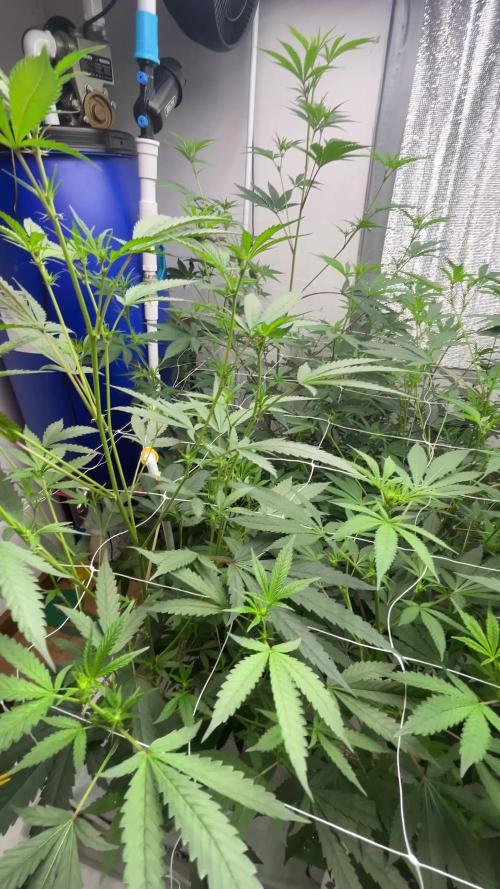
continues LST some defoliation, mainly lower leaves Don’t mind the ones in the back, they haven’t been touched.
Likes
21
Share
2024-05-09 Directly after the Photoshoot, i topped them. they had a super progress and you can watch them growing big steps every day. All will started Indoors under SANlight Flex 25, and move Outdoors. Only one Plant stays indoors, to see the performance under best Conditions because my Outdoor Garden is hard^^ So i started with letting them soak, and then the seeds will move under a humid Kitchensponge unil i see a sweet Taproot. then they will go into the Final Pot, filled with lovely TerraPreta mj mix the grow will be supported with Biotabs fertiliser Breeder Information Fatso GMO F1 Auto is a feminised hybrid strain that is the result of crossing two autoflowering strains, viz. Fatso Auto and Cotton Candy Auto. This Cali-derived, slightly sativa-leaning, easy to cultivate strain will please growers with its big yield, solid THC content and its sweet, candy and fuel palate. Fatso GMO F1 Auto will grow well both indoors and outdoors. It has an above-average resistance to mould but will still benefit from good ventilation, especially where humidity levels are quite high. Resistance to plant pests and other pathogens is excellent. While plants will remain quite short at around 100cm or less indoors, they can grow a little taller, reaching a height of 130cm, outdoors in open ground. The entire cycle is completed in a maximum of 75 days from germination through to harvest and although yields are said to be average this is still pretty impressive for an autoflowering strain. The combination of high resin production and high terpene levels make Fatso GMO F1 Auto a very good strain from which to make cannabis extracts. The terpene profile is sweet and funky with savoury scents of Skunk with pine and floral notes. The taste is like sweet candy with hints of fuel. THC production is high, reaching 24% while CBD is low. The effect is uplifting and well-balanced.