Likes
Comments
Share
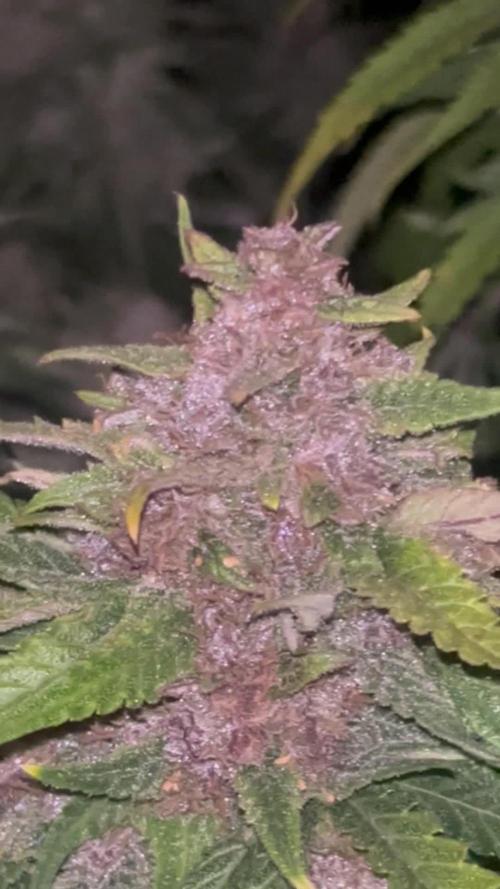
Well down to 1. Had to harvest miss mullberry, on day 79 she was mostly cloudy and right amt of amber for me ill get back with dry weight...the compton qoolaid yeilded 3.39 oz, but this blutane girl i am impressed with the most still feeding every other water at a 1/3 dose and she eating every cola is huge and super dense and smells amazing. The video is blutane and trimmed is CQ.
Likes
52
Share
@DevilsBud
Follow
New week for the purple berry Kush There doing great like every bean coming from @spliffseeds 👌🏻 Will be updating Tru the week
Likes
100
Share
Giorno 21 fioritura Le piante stranamente stanno tutte in forma e se loro sono in forma anche io sono in forma ☺️ Non sono bravissimo con il riconoscere gli odori ma le due Rainbow Belts sanno solo di frutta. Una sembra una sa di lime l'altra è più sui frutti di bosco. Le due Zombie la più grande (#1 fenotipo haze) ancora non profuma di nulla mentre la più piccola (#2 fenotipo Bubba Kush) mi sta impregnando la stanza di gasolio 😂 La Milk Monkey è molto lenta. Al 21 esimo giorno di fioritura ha appena messo i primi peletti bianchi Ci vediamo settimana prossima sperando tutto vada per il verso giusto. Grazie dei like 😊 ❤️
Likes
26
Share
Gracias al equipo de Seedsman y XpertNutrients sin ellos esto no sería posible. 💐🍁 Bubba Cheescake: Bubba Cheesecake es un cruce de Bubba Kush anterior al 98 con Cheese Cake (Wedding Cake x Exodus Cheese). Se trata de un híbrido 70% índica con muy buenos rendimientos, alto en THC y bajo en CBD. Bubba Cheesecake prospera en interiores y exteriores. En interior se aconseja un corto periodo de crecimiento vegetativo debido a la cantidad de estiramiento que presentan las plantas. Las plantas pueden crecer hasta una altura de 250 a 350 cm. cuando se deja crecer naturalmente al aire libre. En interior, la floración dura entre 60 y 65 días, con rendimientos entre buenos y altos, de 400 a 550 gr/m2. Las plantas de exterior son capaces de producir entre 700 - 800 gr. peso seco. En las latitudes norteñas, en exterior, los productores pueden esperar cosechar a principios de octubre. Los cogollos son grandes y duros como piedras. Las plantas maduras muestran atractivos colores púrpuras y azules y brillan con una resina pegajosa que cubrirá las manos del cultivador si no tiene cuidado. El componente Wedding Cake agrega dulzura al sabor del regaliz y el aroma es terroso y musgoso. La producción de THC es muy alta con un nivel bajo de CBD. El efecto es intensamente narcótico, fuerte y duradero. 🌻🚀 Consigue aqui tus semillas: 🍣🍦🌴 Xpert Nutrients es una empresa especializada en la producción y comercialización de fertilizantes líquidos y tierras, que garantizan excelentes cosechas y un crecimiento activo para sus plantas durante todas las fases de cultivo. Consigue aqui tus Nutrientes: https://xpertnutrients.com/es/shop/ 📆 Semana 12: Continua el buen tiempo y ella sigue creciendo de forma considerable, continúo con las dosis de nutrientes recomendada por el fabricante.
Likes
2
Share
@Dico29
Follow
Looking good pistils coming in but probably won’t touch it too much and prune
Processing
Likes
5
Share
@Mrg7667
Follow
Finally have some tricombs coming in!! Buds are just starting to have a great smell! Looks like the bud sites are actually starting to get bigger, no more growth this week! Fires are mostly cleared up, stilla. Little red in the morning and night Also had to start using general organics Calmag because my store didnt have roots organics
Likes
80
Share
@Hawkbo
Follow
They're settling in to the pots nicely and the flower tent is about to be cleared out. Need to do some work around the tent before I can move them should be a week or 2.
Processing
Likes
2
Share
@DIRTYKEG
Follow
63 days from start and 3rd day flower and started adding flower fuel bloom booster to the water... 67 days 7 days flowering with second half of pics and 2 videos
Likes
5
Share
This plant seems to have grown much denser and better than my first plant. I just got the ac infinity ventilation setup with controller 69 for my 2x2, still trying to learn, hopefully grow #3 goes even better. Stay tuned
Likes
13
Share
Strong growth she stopped for a day my cat dug in the pot then boomed taller then the rest (thus lst clip test ) lights are up to 36 inches I wanna get them like 3 or 5 more inches trying for compact plants but not to compact lol the purple punch buds were unearthly dense using my normal nites and set up trying to replicate here fast buds sponser me with beans lol u wont regret it
Likes
1
Share
Turned off IR @ nights Red wigglers (Eisenia fetida) are highly beneficial. They are considered an ideal choice for "no-till" or container-based organic growing because they live in the upper layers of soil, feeding on organic mulch rather than the plant's root system. Red wigglers accelerate the breakdown of organic amendments and produce high-quality, nutrient-dense worm castings directly in the root zone. Clover is another exceptional component of an organic rhizosphere, offering a sustainable, self-sustaining alternative to synthetic nitrogen fertilizers produced via the energy-intensive Haber-Bosch process. By forming a symbiotic relationship with Rhizobia bacteria, clover converts atmospheric nitrogen N2 into ammonium NH4, providing a steady, slow-release nutrient source that enhances soil health and reduces environmental impacts. Red clover offers superior nitrogen fixation and biomass production compared to white or yellow clover, making it the premier choice for maximum soil vitality, particularly for improving soil structure and providing a high-volume nitrogen credit for subsequent crops. If it is fully functional and efficient soil, the rhizophagy cycle is far superior long-term than any synthetic delivery when it comes to preventing deficiencies, not because it's "better," per se. The medium will require a very high CEC to make it to harvest without re-fertilization. The rhizosphere acts as a dynamic, interactive exchange where plants and soil microbes trade resources based on immediate needs. When a plant lacks a specific nutrient, it changes its physiology and releases specialized chemical cocktails—root exudates—into the surrounding soil. These exudates, which include sugars, amino acids, and organic acids, serve as a "shopping list" to attract specific microorganisms, which in turn return higher levels of desired nutrients. There is nothing in comparison to synthetic delivery, which causes plants to stop producing exudates, effectively "starving" the beneficial soil life, over time turning the soil barren and void of microbial life. Responsible use, applying the right amount at the right time, can minimize these negative effects. Relying solely on synthetic fertilizers without replenishing organic matter is what typically leads to exhausted soil. The use of synthetic fertilizers can utilize the Cation Exchange Capacity (CEC) of the soil, but without a robust rhizosphere and active microorganisms, the efficiency of this process is significantly reduced. This makes synthetic growing more difficult to prevent deficiencies overall compared to an efficient organic living soil with a robust rhizophagy cycle, as there is no "one size, fits all" when it comes to different nutrient profiles of strains/genetics, making it trickier to "guess" and prevent creeping deficiencies. CEC does not contribute towards EC. Add more CEC using biochar, problem solved. If you keep pH between 6.3 and 6.7, hydrogen is exudated to cycle the medium's CEC for its needs. Keeping the pH between 6.3 and 6.7 creates an environment where plants release H+ to displace positively charged nutrients (like Ca2+, Mg2+, K+ held on soil particles or within artificial media this cycle through nutrients via the medium's Cation Exchange Capacity (CEC) Microorganisms generate a stable potential of approximately 0.5 V EC. The rhizosphere creates its own food, similarly to chelation, using 1000's of varying combinations to create its own food. Start to finish, just add water. Eventually, more materials will need to be added at the beginning of each new grow, but very attainable to go from seed to harvest without ever fertilizing, regenerative cultivation. ATP is king above all else when it comes to biomass accumulation. Cellular root respiration and cellular respiration are essentially the same biological process, the breakdown of glucose to create usable energy (ATP) in the presence of oxygen, just taking place in different parts of the plant. Synthetic (salt-based) grows have significantly lower levels of total rhizosphere respiration, often referred to as root-zone activity, compared to organic living soil grows. While the plant roots themselves may respire in both systems, the surrounding soil ecosystem in a living soil setup is vastly more active, teeming with bacteria, fungi, and beneficial microorganisms. 2 pools of ATP, it won't double in growth buuuut, but improving root respiration by ensuring high oxygen in the soil is crucial. Good aeration ensures roots can fully utilize glucose to generate the ATP necessary for nutrient uptake, leading to healthier and more productive plants, even if growth isn't exactly doubled. The ATP created using root respiration is dedicated to rootzone growth; the ATP created using regular cellular respiration in a synthetic system would have to dedicate a lot of ATP to the roots when there is little or no root respiration. It's true that there is less of an initial ATP cost in breakdown when nutrients are already in their final form (synthetic), but you lose a solid chunk of ATP when the entire plant is reliant on cellular respiration alone; a large portion of ATP is dedicated to root zones for "forced" (active) nutrient uptake. Making it overall less efficient, even if the initial cost of breakdown is higher. If that makes sense. Oxygen is of critical importance when growing in living soil compared to synthetic methods because it supports the metabolic needs of the microbial, fungal, and insect ecosystem, rather than just the root respiration required by the plant itself. While synthetic grows can survive in lower-oxygen environments with precise mineral feeding, living soil systems rely on aerobic microbes to decompose organic matter (microbial mineralization) to create plant-available nutrients, which is an oxygen-intensive process. While a specific fair percentage is difficult to guess, my experience points to a massive, compound difference between the two methods and the amount of oxygen required. All the ATP spared is used on more biomass, not only that, but the extra root respiration can achieve a much higher CO2 compensation point naturally than you could with synthetic and atmospheric CO2 alone. As a plant grows faster and increases in size, its demand for nutrients to support that growth increases, requiring a higher rate of nutrient uptake. As plants enter phases of rapid vegetative/floral growth, their metabolic demand for nutrients increases exponentially. Without a robust buffer zone—whether in the soil (cation exchange capacity) or in a hydroponic reservoir—deficiencies will occur rapidly because the instantaneous demand for specific nutrients can quickly exceed the rate of supply. A growing body of evidence suggests that organic living soil provides superior long-term soil health and environmental benefits compared to synthetic fertilizers, which are often criticized for promoting a cycle of dependency and degradation. While synthetic fertilizers offer short-term convenience and high yields, they often come at the expense of long-term soil health, sustainability, and increased corporate control over growers/ farmers. Organic living soil, while slower and requiring more care to establish, creates a sustainable, resilient, and, ultimately, more fertile environment. We don't grow; we facilitate energy conversions. Once all water is removed, approximately 95% to 97% of a plant’s dry matter consists of carbon, oxygen, and hydrogen. These three elements form the structural backbone of all plants. Corporate interest sells you the other 3-5% NPK & all the rest in RATIOS! Why not throw the 3-5% in a pot, and focus your energy on the other 95-97%? Indigenous Amazonians created, or at least significantly enhanced, the fertile, dark soil known as Terra Preta de Índio (Portuguese for "Indian Black Earth") by incorporating biochar and other organic materials into the soil. This anthropogenic (human-made) soil technique, which dates back roughly 2,500 to 8,000 years, allowed ancient civilizations to flourish in regions with naturally poor, acidic, and nutrient-poor tropical soils.
Likes
2
Share
Looks like a lot of top sights. Afraid stretching too much. Hopefully it fills in.
Likes
5
Share
Starting to get the tent more dialed in, got a Govee heater off Amazon and I got it connected to my WiFi and set parameters on it and it works great! Considering getting the humidifier to link up to the same app to fine tune the tent even further! Some small gnats from the fox farm ocean soil but nothing bad whatsoever, put some sticky traps out (and there’s some dirt stuck on the trap that’s not all bugs) And spayed some crop control on the soil around the seedlings to help prevent bugs
Likes
31
Share
Likes
14
Share
Ultima das Extraterrestral. Vega indoor 1 mês. Flora outdoor 3 meses. Clone do clone do clone. Jah Bless Rádio Ganjah on youtube!
Likes
Comments
Share
OK, so I’ll begin dialing back in my grow focusing after I gave her a top dress feeding I watered her in well with 2 gallons of water unpHd maybe two or three days later I noticed that her topsoil was starting to dry so I gave her another gallon of water just because although I believe in allowing the plant to have the dry back. Between watering I also keep hearing you know that with organic soil, you have to keep it moist in order for you know the nutrient to break down and I definitely want those top nutrients I gave her to become readily available . Also, in terms of dialing it back in the plant has been at a very abbreviated or dimmed level like since recovering from when I basically almost killed it and with that being said with the light being out at a dim level of about 40 to 50%, it was also brought up to a very High height in order to decrease stress so that they can regrow so I lower the light from 26 inches 28“ to 14 inches above the canopy. I put back in my floor fan for the lower canopy although I found out that it no longer circulate so I’m having to replace it. Its replacement is on the way in the mail. I added it back in the humidifier for the plants mainly because I was doing the cuttings in the clones since I needed to trim the lower canopy and begin training the plant down more for the trellis. This is my first run using a trellis. This is my first time trying to make one plant so massive, but I’m just a small time grower trying to get the most bang for my book since I’m trying to grow plants to supply myself anyways rather than maintaining so many different plants, I just thought I’d give it a go at making one plant massive I’ve gotten fairly decent and establishing good structure implants as far as like the number of branches or branches so I really wanna like push the threshold of my quantity that I can that I can deliver, but this are all the while. I’m still really working hard to get the quality that I know I like to smoke. I’m happy you know I’m learning but wow I’m still very far from the goal so the light is still at 50% but it lowered to 14 inches. There’s an additional lower canopy fan that’s not currently circulating but one on the way that will circulate the air down there and the humidifier in the tent now oh I also reprogram my humid controller because ever since I’ve called the other three plants that were occupying this tent when I began this this project I tried to switch it over for new settings for this plan considering you know it was set for the flower setting for my last three ladies but when I did that I messed it up and I was just too lazy to go in there and fix it so we have been running with BPD issues this entire time you know and that’s that’s part of the stunning growth as well you know the darn near 30 inch light height, being hungry and meet me during the watering but just in discriminated amounts because I’m not TDS and or PPM any of this stuff I’m really just eyeballing it not paging this stuff circulation and low light intensity. I mean, I can see why it’s taking her a little while to start moving like got like I remember her moving but since I’m back posting I’m I’m I’m working a dollar and I was even considering buying a new light at first but then I realized one I do have a really good light too. I really haven’t got that many runs off of this light less than 10 three is because I doubt her back so much in order to like decrease the stress and I can. I can push this plant with this light. I just need to dial my equipment back in and for you know, I had him back in the extra circulation and the humidifier to get the environment dialed in. I mean, you thought you get that BPD setting right and she used to transpired but now she’s hungry and if I keep that so more so that those nuts can break down she’s gonna get to looking for those nutrients so if not now like I think it’s supposed to take a week no more than a week gonna have to before those nutrients become you know bi available tour so I’m doing I’m doing my part now to give her the attention that she needs into dollar back in so that we can we can get the show on the road. This is entirely too long, but that’s just because I haven’t. I’ve been. I’ve been hands off. I mean, I found that I like the hands off approach to growing much more than the hands-on because then I’m too impatient and I’m oh man then it becomes a chore and has to go take care of her. You know as opposed to a pleasure or like a getaway, I enjoy when I take care of my plan. I like it to be at my activity you know not something that I’m just ready to get over with. I like to spend time with my plans I like to not mind going in there and then defoliating every couple of days. Listen, I need a strain that has an excellent of matter fact a low leaf to blood ratio I need far more bud and weight less leaves. I strain that I pick out a pure interest, but at this point, I’m almost ready to pick strains based off of leaf to blood ratio. I would enjoy just a good simple girl like I just have a couple of leaf Plug every couple of weeks. Let’s see when I’m mean to her with food top dressed because she’s in a 6 gallon hot, I gave her 1 tablespoon of the guy green broke and 3 tablespoons of organic worm castings per 6 gallons so that was a total of 6 tablespoons of the guy green grow nutrient maybe even seven for good measure and then 18 tablespoons cause I don’t know how many you know a4 cups 1/3 cup for cups that is but I actually wanna find out so I can stop doing these tablespoon measurements but 18 tablespoons of worm castings and I just I did my best to work. I didn’t really well to the top so and then I watered that in really slowly to try to avoid runoff the best I could. I did end up getting about a quarter inch runoff when I usually get about an inch and a half a runoff so I did good. I just even know that stuff eventually sucks back up in the pot. I didn’t want all that stuff to like rush to the bottom and then only get sucked back up at the bottom cause I don’t know what the root looks like at the bottom. I kinda have to assume that it is nice and strong, and maybe even root bound need to be upside to a bigger pot before I flipper the flower but if it’s not like I don’t want the concentration of nutrients and salts to be at the very bottom, especially when it comes time later for flushing, like I want that stuff to be you know closer to the to the top in the middle of the other of the soul structure, where I know the majority of the roots are and eventually work as way down to the evening rate, but not have a concentration at the bottom and I’m adding stuff in at the top. I really wanna flush this plant. Well, my lash flush it was semi decent. This flush it could be between my flesh, my dry and my cure which is crippling anybody I mean the girl I got far better man you should’ve seen my first couple girls terrible but now I’m gonna achieve quality in good structure. I just need to get I mean I can see quality you know structure of plants and blood structure but I gotta get the quality smoke. The sticks the smells taste the dense buds at the right moisture level if you’re enjoying it so far, give us a like. FINAL UPDATE OF THIS WEEK: 16DAYS SINCE DRY AMENDING SOIL . . PLANT STILL SHOWS NUTRIENT DEFICIENCY. I had hoped to be back on Water Onlu by now bc I’m afraid I’m going t burn her with these nutrient waters this long since my dry ammenduand what’s worse is that if I follow my 3 week amendment rule I’ll be adding 6 more tbl spoons of nutrient alongside worm castings ALL WHILE THE LAST NUTRIENTS I FED STILL HAVENT BECOME AVAILABLE YET. I DONT LIKE THIS