


Processing
Likes
Comments
Share


@Ogbangbang2981
Follow
week 9 was a good week I watch my pollen sacks grow into beautiful pods cant wait to use it plant doing pretty good health and strong

Likes
10
Share

@LandraceCBDLover
Follow
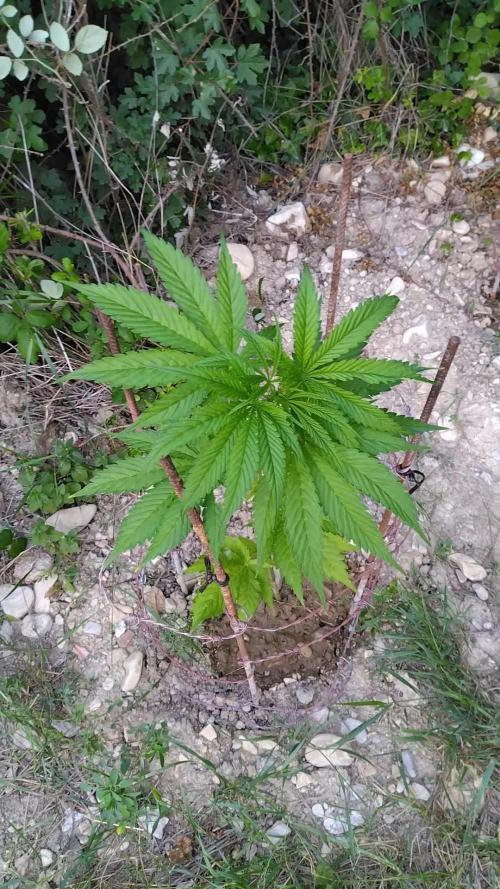
La croissance continue du côté des sativa Nigérianes. Elles mesurent maintenant dans les 70 cm !
Les Frosty's Freak entament leurs floraisons. 🧟♀️🌸
En prévention, j'ai pulvérisé le fameux mélange eau + savon noir + huile de Neem (pucerons et autres insectes) + bacillus thuringe (chenille, pyralle...).
Je renouvelle l'application toutes les 3 semaines à 1 mois.

Likes
19
Share


@EmeraldLakeCannabis
Follow
Decent week. I had a branch start drooping massively on UKBS 2 and decided to amputate, the last thing it currently needs is to have one branch being nursed back to health while it tries to recover from the stem wasting that's taken place already. I've not yet resolved myself to it, but I'm fully prepared for the worst case scenario of total plant death and having to take clones. (which I certainly will be doing if total death occurs, this has been an incredibly fast and strong growing pheno)
Inside the tent, both of the plants are kicking into flower mode; it's approximately halfway through week 2 of flower as the diary weeks aren't synced with the flowering cycle unfortunately. Carl 1 is a very stretchy plant, almost 12 inches above the net once I flipped to flower. Carl is starting to put a strong stank on, not as much like skunky weed but more of a piney and lemony scent. UKBS 1 is starting to flower as well but is much smaller so has a less noticeable odour. Both of the indoor plants will be receiving a defoliation at F21 ish to clean up any lower bullshit that I don't want developing into larf.
updates as the week goes on, the usual.
Likes
26
Share


@SmokeableHobby
Follow
1/5 - Day 51 / Day 23 flower - Feeding Day
Pots were mostly dry on this day, last time they were fed was a little over a week ago on day 43 (12/28). I've done two small waterings since last feed, about a half gallon of water for each of my 5 gallons and about 8oz of water for my bonsais. My plants are drying out within about 48 hours of each small watering.
For today's feeding I went to full strength on my nutes. My solution consisted of:
- 1 gallon distilled water
- 3ml CalMag
- 3 tsp of FF Big Bloom (full dose))
- 2 tsp of FF Tiger Bloom (full dose)
- pH: 6.9
- TDS: 342ppm
- EC: .7
I gave each of my 5 gallons about a half gallon of the fertigated water each which wasn't enough to produce runoff. I gave them each about another 1/4 gallon distilled water to generate enough runoff to test. I tested the runoff of my Z52 which gave me readings of:
- pH: 6.3
-TDS: 1600ppm
-EC: 3.2
I gave about 12oz of fertigated water to each of my bonsais. My ZB2 runoff posted readings of:
- pH: 7.2
- TDS: 594ppm
- EC: 1.2
My TDS readings are definitely low compared to the FF Soil Feeding Schedule. The suggested readings for week 7 are an EC of 2.8 - 3.0 and 1960-2100ppm. Not stressing too much over the reading as the girls are looking healthy and happy. Will add another feeding in between waterings if I start to see any nutrient deficiencies but I don't see any cause to do so at the moment.
As you can see from the picture on 1/3, the super cropping I did on 1/2 didn't hurt my girls one bit. By the following day, the tops were already bending back toward the lights. This was a big relief.
****************************************************
1/7 - Day 53 / Day 25 Flower
Light watering in the morning today using pH'd dechlorinated tap water w/ 4ml of cal mag. Gave about about a 1/4 gallon to each for my 5 gallons and another 8oz each for my bonsais.
****************************************************
1/8 - Day 54 / Day 26 Flower
Noticing signs of nutrient issue on the Z51. Surprisingly, no signs of nutrient issues on the Z52 despite using the same solution and roughly the same amount of water during the feeding day on 1/5. Decided to do a heavier watering tonight, using about 3/4 gallon of pH'd dechlorinated tap water. Hoping that dilutes the soil a little bit and pushes the salts toward the bottom.
****************************************************
1/9 - Day 55 / Day 27 Flower
Nutrient issues did not appear to get any worse overnight so that is encouraging. Did some minor defoliation on my 5 gallons this morning to remove any of the smaller branches on the lower 3rd of the plant. Haven't completely removed any branches that are below the trellis. Will start pruning more regularly every other day so I don't shock the plants too much.

Likes
18
Share


@VI_Cannabis
Follow
July 5 - The girls are still doing awesome. temps are between 21-26. Humidity is 40-50. Still feeding every 24-36 hours with 3L per plant.
July 6 - They are doing good. Showing lots of flower sites now. Unfortunately I did not get any pictures today.
July 7 - Tons of progress since last week. I don't see any signs of any problems, and still no pests! The smell is getting A lot stronger as it starts to flower more
July 8 - Still doing there thing, no problems, temps and humidity is fine. Have been feeding every 24 hours now as they seem to be really thirsty
July 9 - Super happy with how they are doing. No issues yet. Smell is heavier, and tons of bud sites showing up. Only issue is they are growing pretty uneven.
July 10 - Time to get a even canopy! First time doing some HST. I also did some defoliation. One of the stems split open a bit but it seems to be doing just fine. I did he HST and defoliation in the morning, i then took pictures of 12 hours later and everything seems just fine!
July 11 - Everything seems to be a lot more even and the broken stem doesn't seem to affect the growth.
Likes
55
Share

@Natrona
Follow
**Sponsored grow **Auto Wappa by @paradiseseeds Seeds
7/26-8/1 W4
Hello Friends,
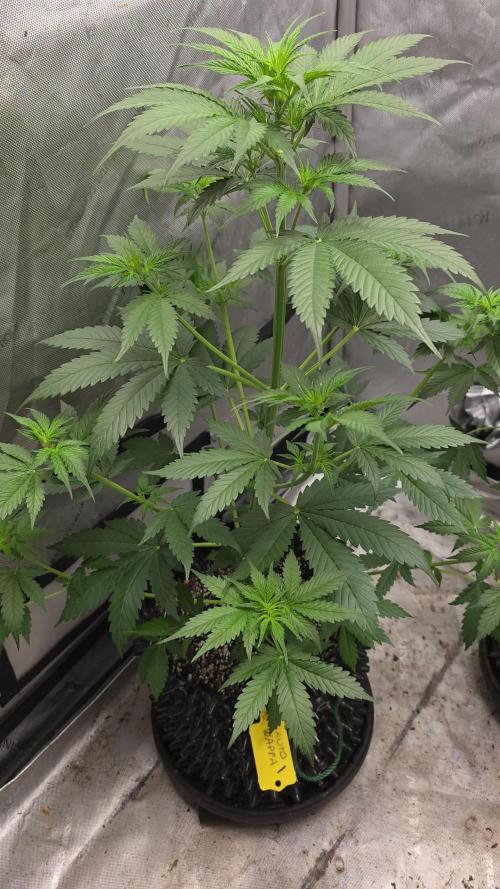
This week, the Wappa girls stretched like Jack’s bean stalk. All of them more than doubled in size this week. Wappa 1- 25”, # 2- 27”, # 3 -13 & #4- 18”. They showed the first signs of flowering. Thank goodness, I was afraid I had photo flowers. The stems are thick, the fan leaves are large indica leaning and all look fine. #3 has been with yellow crown since germination and still shows this yellow pattern so the yellow is in the phenotype. I am using TPS1, Silica Gold and Sensi Calmag. All 4 received 2 liters of fertilizer solution at Ph 6.55, PPM 485 74.8F.
Thanks for visiting.
Stay green, growers love 💚🌿
💫Natrona💫

Likes
120
Share

@Hologram
Follow
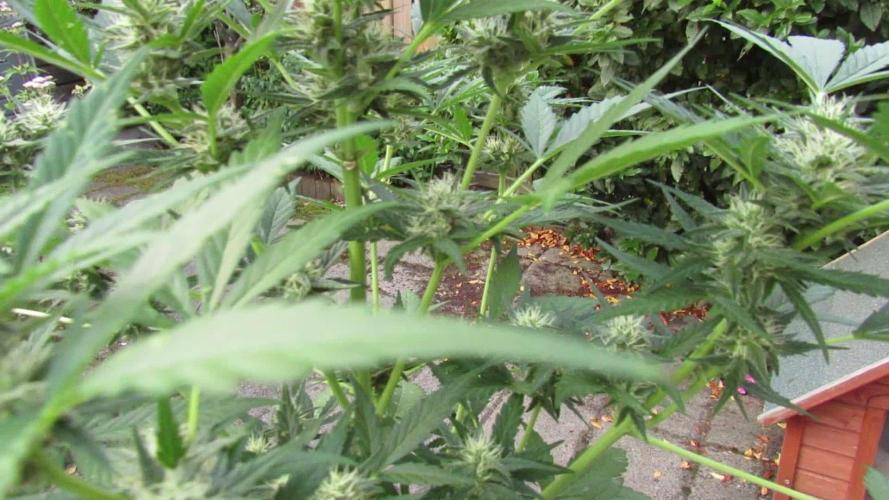
OK, im doing an update now becouse my breakup cake is going tranny!!(hermie)
I already have noiticed she was not growing as strong .. but u can blame that on anything , especially when growing outdoor..
but this morning i saw that she was g(r)oing 'bananas'!😢
I have put her aside from the rest (in the back of garden) but think gonna have to terminate her asap!..(and i will, right after this post👍)
The weed she will give will be filled with seeds and those seeds will be hermies too, so wothless..
and if i dont throw her away quick she can infect the rest.
So goodbye breakup cake..😢
who wants to eat a cake when they are breaking up anyway..😒 (just hiding my pain with lame humour 😳)
happy growing for all ✊

Likes
17
Share

@Kirsten
Follow
7.5.25:
I retied down the branches on RQS Northern Lights auto.
I had to clean the tent, so the opportunity had to be taken, I hope not to have to move them again. I ended up snapping a small branch off another plant 😖
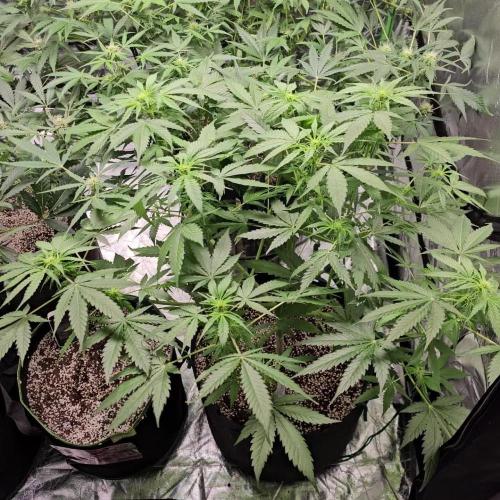
She is looking so big out of the tent, and even bigger than I thought! Now, having readjustmed, the fabric ties, and she is looking even larger still. This really is an absolute giant of a plant! 😱
I really am struggling to get them all in, I think the 8 gallon pots were a definite factor in that. They certainly are great for getting big plants, but be prepared if you have a small space.
She's still stretching and not really focusing on her bud development in these mid flowering weeks. I think we will be in for a long haul with this lady. I hope she doesn't get too much bigger.
I watered some bloom nutes after I top dressed, with Mega Crop Part A by Greenleaf Nutrients. I watered 3.2 litres
PPM:745
PH:6.0.
This time, I'm going to keep the top dressing moist. So as not to kill all the beneficial microbes. Other than that, I will wait until the pots are light again.
Overall, she is doing great, I wish she had stretched a little more evenly to catch up in height. I just can't even out the canopy anymore.
I'll leave it and hope she'll sort herself out 😅
I'm very excited to see what happens next! This is going to be crazy whatever happens! 😍😋
8.4.25:
Northern lights had dried out significantly, so I watered with 2 litres of dechlorinated water PH'd to 6.4.
Containing per litre:
♡ 1/4 tsp of Greenleaf nutrients Sea K(elp).
PPM: 800
PH: 6.4
I don't want the top dress to dry out too much, and the plants are starting to drink much more.
9.5.25:
It's a necessity to keep the soil moist. That means I need to water more often now.
Today I watered with 1.5 litres of dechlorinated water PH'd to 6.4 which contained:
♡ 1/5 tsp of Sea K(elp). By Greenleaf nutrients
♡ 1/4 tsp Ecothrive Biosys.
PPM: 564
PH: 6.4
12.5.25:
Northern Lights has been srayed with the foliar spray and all symptoms have resolved.
Due to having a few leaves burnt with that, I've decided to use the Ecothrive Trace in the water instead.
It left some orange spots of damaged leaves.
Thanks for checking out my diary and hanging out 😊💚🙌🍃✌️

Likes
6
Share


@ChewiestEndZa
Follow
This week saw an influx of flower sites all over the plant, cannot believe how many flower sites this girl started yielding!
Did some HST previous week and had wrangled the stems to create knuckles by breaking cell walls and forcing them to become thicker.
Pics of recovery and knuckle forming.


Likes
11
Share


@GermGrowFox
Follow
18. Mai
Pflanze wächst sehr schnell. Untere Triebe plus Blätter großzügig entfernt
20. Mai
4l Wasser, davon 1l mit 1ml Bio grow
Pflanze zeigt erste Blüteanzeichen
Processing
Likes
1
Share


@Teddy01500
Follow
Hello everyone here are new photos with a new video this is the second week of flowering for my babies. Thanks.


Likes
2
Share

@Crazy_Luxembourg
Follow
🌱 Dognabis Cup 2025 – Jalousy Diesel Auto · Octo Genetica
After preparation comes life. 💚
Before the seeds sowed, I carefully prepared my 100% coco substrate with the Aptus Super Soil Organic program – the foundation for an active, vibrant medium that provides everything a young plant needs right from the start.
Since coco naturally contains no nutrients, I deliberately chose a slightly stronger mix to create a stable and biologically active base:
Likes
7
Share


@Green_fingers
Follow
Just starting to take off full nutrients feeds it’s getting see how it goes from here

Likes
22
Share


@SecretTreasures
Follow
Lollipopped in the middle of the third week.
Added 500ml water plus 10ml Bio PK 5/8 and 2.5ml/l Orgatrex ONCE per plant.
Watering every two days around 2l water. Sometimes more, sometimes less and sometimes also the next day again a bit- just how it seems to me.
Two small fans blow air backwards below the leaf line and slightly upwards. Above the lamp, also at the front, there is a swivel fan in the corner which blows air downwards.
The Fat Freddy's Cat are all between 88-97cm tall.
The Mimosa X Orange Punch are
between 83-90cm high
The London Pound Cake X Zoap is 33cm tall (but also 1.5 weeks younger and shorter in flower)
It has become much colder outside, at night a small additional heater has to run in the room (outside the tent).
One plant at the back got a too big stretch. I hope it's over, because the Tent is only 2m high and It don't have any more space to lift the LED. Also I wanted to set the light at 100%, from the 4.flowering week but the plant already shows light stress, I will consider, what I will do against it.


Likes
6
Share


@Moss420
Follow
Potted up from 5L fabric pots to 10L air pots. I got these air pots because they are tall and narrow which helps disperse the water laterally (I also use Yucca and Silica additives), it's important because I use the auto watering halos.

Likes
4
Share

@growian420
Follow
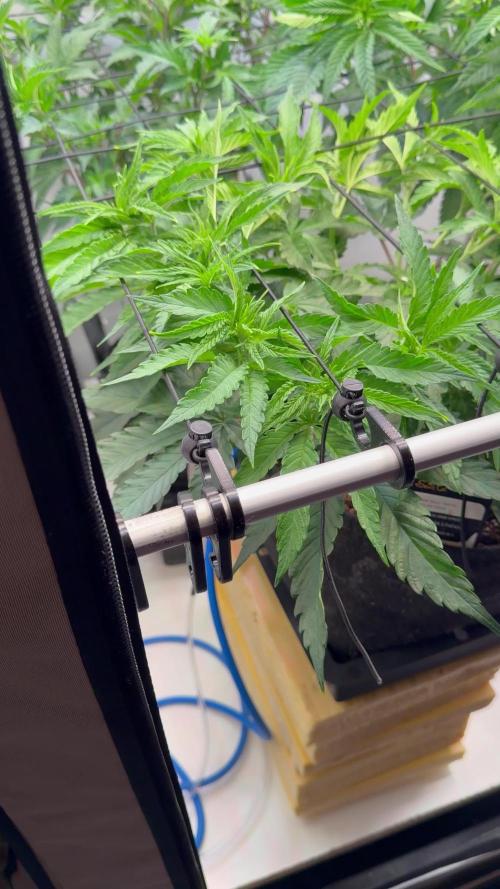
Wir schreiben den 29.9.2026, Tag 1 der Vegi Woche 6.
Am Samstag den 26.9.2026 gab’s wie üblich einen Liter mit FPE, Alfa Boost, Hesi Wurzelkomplex, und etwas SF-Nematoden da die Trauermücken Gang ihr Unwesen Treibt.
Zusätzlich habe ich wieder eine Viertel Tablette BTI im Lauwarmen Wasser gelöst und dem Wassertank beigemischt.
Außerdem hat die Gute noch einen halben Biotab spendiert bekommen.
Heute wurde das DIY SCROG Netz installiert.
Aktuelle Werte im Zelt:
DLI 33
Blatt VPD 1,4
Da ich die nächsten Tage beruflich außer Haus bin darf die Lady jetzt noch bis zum Wochenende ein bisschen Wachsen dann wird die Blüte eingeleitet.
Was soll ich sagen, bisher keine Probleme. Alles läuft wunderbar
Likes
24
Share


@Firepharmer
Follow
Flushed and Chopped everything in the last 7 days, very happy with both strains my best grow to date with the futur vert flora max 660watts led. Adding another futur vert Flora max 660watts for the next grow shit going to get crazy then .. the monkey berries with be trimmed Friday more pics to come them


Likes
3
Share

@MrBurnone19
Follow
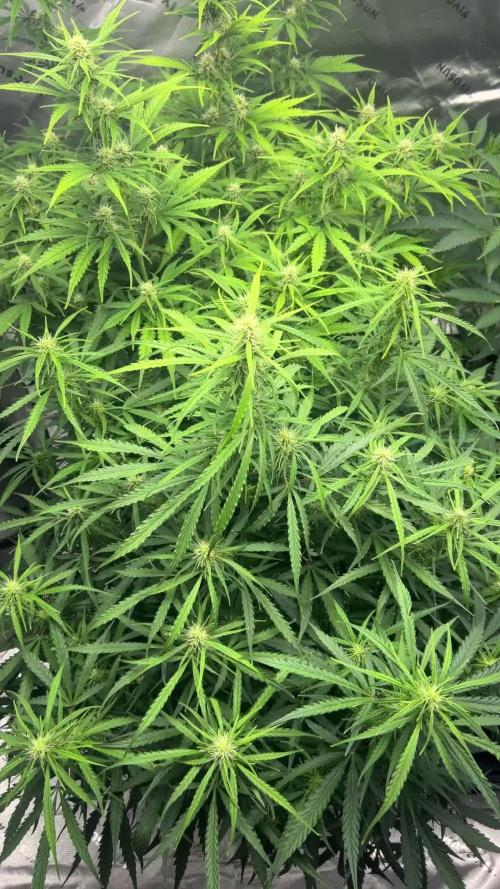
Both of them giving off two distinct olds one is given off for citrus fresh peeled orange smell. The other is given off a cookie dough, sweet sugar, cookie dough.
Likes
9
Share


