


Likes
Comments
Share



Likes
56
Share


@Prilyfe13
Follow
May 3, 2024 Day 78
This week is what seems to be the last week before flushing and a light intensity drop. Both ladies look really nice and coming along swimmingly. More orange pistils, more amber trichomes. Not enough of either, but they are getting there. Probably the next week of nutrients and a week of flush.
Speaking of nutrients, I decided to cut the whole regimen in half. There's clearly nutrient burn and I can't seem to get rid of it. I also believe the plants aren't taking in as much water as they were before. The containers are holding more water and that tells me it has nowhere to go besides in the soil and the ants aren't keeping up. Nutrient lockout? Age of plants? They are an 8 week strain while we are starting week 11 today. I'm sure I'll find out. So I'm guessing about a week and a half left before harvest. I'm not sure if it will be 2 weeks or not, but I've been saying 2 weeks for over a week now. We are definitely close to comfortably call 2 weeks or earlier. Hopefully earlier.
Banana Purple Punch A is getting heavy. Branches are starting to lean and buds are covering buds from the weight. Apparently these branches aren't as strong as Banana Purple Punch B whose branches are stiff as boards. Very healthy though. Although, she did take a hit from the nutrient burn. Not much and definitely not as bad as the Tropicana Cookies did.
Banana Purple Punch B is a thing of beauty. She is small and compact, but her buds are fat and she smells amazing. Tons of trichomes and lots of bud throughout the plant. She'll definitely need a trimming before I harvest. I think I've decided to do a mostly wet trim and leaves just the sugar leaves on the plant. Anything with a stem I can reach will be cut off. Same with Banana Purple Punch A, but her buds to leaf ration is fantastic. I won't have to do much trimming on her. Banana Purple Punch B, on the other hand, will need a whole lot of trimming.
I've got this week's first set of trichome pics. One for each plant. Looks pretty good. A bunch of cloudy, a bunch of clear and some amber. Definitely not ready.
No watering today as I topped off the reservoirs with a half gallon of plain water. PHed at 6.2 which took a bit of PH down. Apparently my water is really low in acid.
The lighting will be staying the same for most of the week. As these ladies have only a couple of weeks left, I'll try to time the light intensity drop accordingly.
The environment is still messed up. SMH. The temp is still fine, but the humidity is still high. Now only 55%, but still too high. I'd prefer 40% now, but I'll take 50% somehow. It stopped raining and the weather is really nice, so I don't see why the humidity is still high. Last night the temp was averaging out at 67.9° with a low of 65° with the humidity still being high at 55.8%. At least it's staying the same.
Grow System Environment:
Temp: 73.2°
RH: 55.0%
VPD: 1.23 kPa
May 4, 2024
May the 4th be with you! Star Wars all the way!
Not a lot going on today. Both ladies got a full gallon of half dose nutrients. I think it's time. They have about a week and a half left to go. Maybe less. Hopefully less.
Banana Purple Punch A was rotated today. Her branches are so top heavy now that the whole plant jiggled when I moved it. Honestly, kinda funny to see. Her reservoir was almost empty. She's definitely still thirsty. With the half dose of nutes, I expect to start to see a fade.
At the end of the week I'll start the real flush with Flawless Finish. Only for the first watering though. Also, I don't top flush. All of the nutrient buildup on the top soil will just poison the plants. So I continue to run the reservoir. Afterall, that is the place where the nutrients get absorbed.
So Flawless Finish blocks some sort of beta things that prevent the plant from taking in nutrients. I've used it for the last 3 runs and I have no idea if it works or not. I very rarely get a good fade. Too many nutrients at the end? Maybe.
Banana Purple Punch B hasn't changed position at all. She fits perfectly in the tent where she is. She had a little bit more water than her sister, but still low enough to fill the reservoir with a whole gallon and not overdo it.
She also has about a week and a half left. Her buds are huge now. The very tops are the huge ones, but the lower buds are all dense. Should be decent popcorn for pressing.
Her leaves are a deep color of green. Not so deep to be a concern for toxicity. However, FastBuds says the leaves should turn light green at the end. We shall see. Also, I'm not seeing purple at all. Hence the half dose and flush next week.
The lighting of course is going to be dropped to 70% power in a few days. Then down to 60% at the start of next week and will be brought down to 50% for the final few days.
The environment is bad today. The humidity is back to 60%. I can still control the temp though. I think I need to drop it to 74° for the day and try to keep it at 65° at night. A tall order, but I think I can pull it off. I just wish I could get rid of this damned humidity. Not that I think anything will get ruined. I have 3 clip fans running at half power each, so airflow is fantastic. These also quite a bit of open space for Banana Purple Punch A. Not so much with Banana Purple Punch B. But she still has a decent amount of open space. Definitely enough to not get any issues. At least that's the theory.
Grow System Environment:
Temp: 74.0°
RH: 57.9%
VPD: 1.19 kPa
May 5, 2024
Trichome day!
I got a couple of decent trichome pics from each plant. They aren't perfect, but they are pretty good for what I can do.
No watering today obviously. That won't be for another day or 2.
Banana Purple Punch A looks great! Her colas are getting heavier and slightly fatter. I'd say I'm on point with when she will be done. I say another 10 days. Flush will start at the end of this week. That should leave me a good 5 to 6 days of flushing before harvest. She's also getting more and more orange pistils and some amber trichomes. I still see mostly clear and a good amount of cloudy. Definitely not ready yet.
Banana Purple Punch B also looks great! Her buds are just as fat as her sister plant. They aren't nearly as far along though. I'd give this one 2 weeks. But maybe the same 10 more days. They are different phenomes afterall.
Her branches are like SUPER stiff. No leaning, no anything except the jiggle when moved. Such a strong little one.
Neither plant is showing signs of fade yet. I expect it will start to show up in the next week. The buds are also still quite green. I'll also be expecting purple in the next week. We shall see.
Light power will be dropped at the end of the week I think. I was going to drop it tomorrow, but I think these two need a bit more time.
The environment is still messed up. It's mid spring now and it's just getting humid. I can expect to have a lot of humidity for the next 3 weeks. I will just have to do my best to fight it.
Currently, the temp is at 76° and the humidity is still at 60%. It just refuses to drop down. I had the humidity in my room all the way back down to 50% and it did absolutely nothing. I'll have to periodically open the tent until this humidity levels back out. No big deal, I'm always home.
I also keep trying to get the temp down at night. I can't seem to get it below 67°. I'd really like it at 65° and the day temp at 74°, but it doesn't seem to be working. The problem is I can't get the humidity down without cranking the heat. But if I crank the heat, the temp goes above 77° and gets dangerously close to messing up the trichomes.
Grow System Environment:
Temp: 73.1°
RH: 59.7%
VPD: 1.10 kPa
May 6, 2024
Not much going on today. No trichome pics, no watering, no light changes. The only thing I have to mess with is the humidity still. It should go down today. I have my room at 47%.
Banana Purple Punch A looks great! Super heavy colas and dense... Very dense buds. Solid. She has a few more orange pistils, but that's a good thing. She should be finishing up in about a week now.
Banana Purple Punch B is stunning. For a small plant, her structure is wonderful, bud are huge and solid. She is pretty bushy, so I will be very happy when I can trim all the foliage off before harvest. She should need about another 10 to 12 days.
The aroma coming off of these has changed since that last time I said something about it.
It's more pungent now and smells of sweet fruit and something heavy. I'm not getting much or any banana smell, but I'm a smoker, so my sniffer is a bit off. It's still strong enough for me to smell the essence of this strain. Unfortunately, I don't know anyone who doesn't smoke and will be willing to smell my weed. Lol
And the one person I know who would smell it smokes more than I do.
As before, the lights will stay the same for the rest of this week. Then I'll drop them down to a DLI of 36 mol/m²/d.
The environment is still kind of wonky with the temp being around 75° and the humidity being still high at 58%. But as I said earlier, I have my room back down to 48% humidity, so I should be able to get the tent down to 50% sometime this afternoon, and hopefully it will stay that way for at least another week.
Grow System Environment:
Temp: 73.8°
RH: 62.3%
VPD: 1.06 kPa
May 7, 2024
Watering day. Both ladies got a full gallon today. Other than that I took some pictures. I'm not bothering with trichomes for the next few days with these 2. They clearly aren't ready, so no point in checking clear trichomes. When I see more orange pistils, I'll start checking them.
Both ladies have super heavy buds. They are making the tops sway a bit when moved. So big, so dense, so heavy. I look forward to harvest.
The lighting is the same as always. It'll be dropped by the end of this week I think. I'm planning on dropping it down to 36 mol/m²/d for the last week of flower. It should work to bring out purple and to help tighten the buds up.
I'm also considering cutting the nutrients off at the end of this week and go for plain water. It's just about time for flushing as it is, so in 2 days, I'll do one last nutrient dose and that's it.
The environment is starting to readjust to a normal level, it's just taking a long time. Currently the temp is at 76° and the humidity is at 54%. Still high humidity, but better than 60%. My room has 42% humidity, so the humidity should eventually drop below 50%. I'll try to drop the temp as well. I'd like to see 74° for the rest of the grow.
I'm still having issues with night temp. I cannot get it to go down enough. It sat at 68° and 55% humidity.
Grow System Environment:
Temp: 73.6°
RH: 54.6%
VPD: 1.25 kPa
May 8, 2024
So I have been doing a bit of image research and have found that these two should start showing purple anyway now. At least that's what it looks like. These ones have super green buds. Nowhere near ready for harvest. Still another week and a half or so.
No water needed today. I will note that the reservoirs are still nearly full. Interesting.
Banana Purple Punch A looks great. Her buds are super fat and smell great. They are dense and when they are ready will be hard as rocks.
Her leaf to bud ratio is perfect. Not too many but no bare. I was more worried about her getting super bushy. Nothing of the sort. Very nice. I'll be trimming her down before harvest, but I'm not bothering with the sugar leaves until after drying. They will help give more of an even dry.
Banana Purple Punch B has caught up in bud size with her sister plant. Although, she has more leaves. Trimming will be a nightmare with this one. I plan to do it in 2 sessions. Once before harvest to clean out all of the stemmed leaves. Anything I can reach at the base of a leaf is gone. After drying, I'll complete the trimming session with basically a manicure and that's it.
The lights are staying as they are for a bit longer. I can't really tell if these two are actually done yet or not. I'll do a trichome check tomorrow and post pics.
The environment is a nightmare. It's still 60% humidity with the temp being a bit high at 77°. I'd rather it be at 74°, but the humidity gets higher that way. I'll just have to keep opening the tent as I have been for what seems to be the last week. Either way, I will not get mold. Not if I can help it. Now drying in such high humidity is a concern. Very little airflow. Hopefully I can keep the temp in the low 60's in there. I highly doubt it.
Grow System Environment:
Temp: 74.0°
RH: 57.6%
VPD: 1.19 kPa
May 9, 2024
Some noticable things today. First off, neither plant is taking in as much water as they were. A sign of either nutrient lockout or they don't need as much water because they are finishing up. Finishing up makes the most sense.
Banana Purple Punch A was rotated again today to keep the plant from growing mold and keep the lights hitting all the buds from every angle. She's definitely closer to being done than her sister plant is. I'd say about 5 days difference? Maybe slightly less. This is kind of a blessing and kind of a curse. I have 4 other plants in 3 gallon containers that need to go in the tent asap. If I can clear at least 2 of the 4 plants currently in the tent, including this one, I could fit all 4 plants in the tent with the last 2 plants. Then I can harvest those two separately kind of.
Banana Purple Punch B has huge buds now. Some are a little bigger than her sister. They seem to have the same amount of bud, just structured differently. This plant has the super compact structure with buds all up and down, but it's only like 19" where the other one is closer to 23" and has more space between buds.
But it's a larger plant, so there is the roughly the same amount of bud. At least that's what it looks like. I'm seeing no signs of fading yet. I'm guessing this is one of those strains that waits for the last week or so before showing color.
Although, other diaries I've seen show different. The weird thing is that the majority of the other plants I've seen all have purple buds. Mine are still bright green. But they are definitely not ready. So I'm guessing another week and a half.
Frankly, I have a lot of trouble timing harvests. I don't know what the plants do or are doing, for example, I've never had a plant finish up based on breeder specs. I've even had an autoflower go well over 15 weeks. Granted it was HUGE (understatement), but it still took over 15 weeks. But then I have strains that finish up in 12 weeks. But I couldn't tell if they were done or not. Disadvantages of not having the proper equipment. This time around I have a microscope, so I can get a really good idea of when to harvest.
As for trichome check, I was supposed to do it yesterday. Then I thought maybe today. But then I realized tomorrow is a new week, so I'll take my trichome pics tomorrow. Plus, they clearly aren't ready, so no point in checking yet.
The lighting as I said will stay the same for now. These 2 are showing no signs of needing it and are definitely not ready for it to drop. Not for another few days to a week anyway.
The environment is kind of calming down. I can keep the day temp down to 74°, but the humidity is still high at 55%. I'll be spending the day opening it up periodically... again. I did manage to get the average night temp down to 66°, so that's something. It messed up my Sour Diesel seedlings in my 2x2 though. The temp in there went all the way down to 62°. I really need to get them in this tent.
Grow System Environment:
Temp: 72.6°
RH: 58.7%
VPD: 1.11 kPa

Likes
69
Share


@Mimi420
Follow
Hi guys!
The girls streched out I think.The tallest is Blue Kush with 95 cm,and the shortest is Mataro Blue with 85cm.Some leafs on the botom are yellowing,becouse of bad air floow,need to upgrade ventilation for next grow!They started to produce nice buds.I started to feed them with green sensation.The smel is geting strong.Cookies Kush have such a amazing sweet smel.They on FD 26.I'am falling in love with them 😍


Likes
24
Share


@Mastr
Follow
This strain my favourite I love her orange smell and lots resin on sugar leaves lots off them
I let her grow atleast another week or more and still feed her with nutrient maybe start flush next week will update every other day new pic or videos thanks everyone
Update I think she is bruce banner coz she slow flowering and take over 11 week to grow witch is and also smell and bud shape
Today I seen most steam bend down and they need support so I try my best
I will feed her till day 84 then I give her just ph water for week and hopefully around day 90 she is ready
Day 83 top leaves start getting yellow 💛 so it's good thing plant go to last week off flowering
Likes
65
Share


@Dendegrow
Follow
So the net is installed, lets wait until it is full covered and then going into bloom. I make this time a trial only to feed the Organe sherbet with Melass yeast buddermilk and sugar in vegetation. The yeast will produce the whole grow enough co2 to keep it up about 800 ppm only thing you have to do is to put some sugar in the feeding solution.

Likes
10
Share

@RatmanJR
Follow
September 27th. 104 days in flower.
Clones:
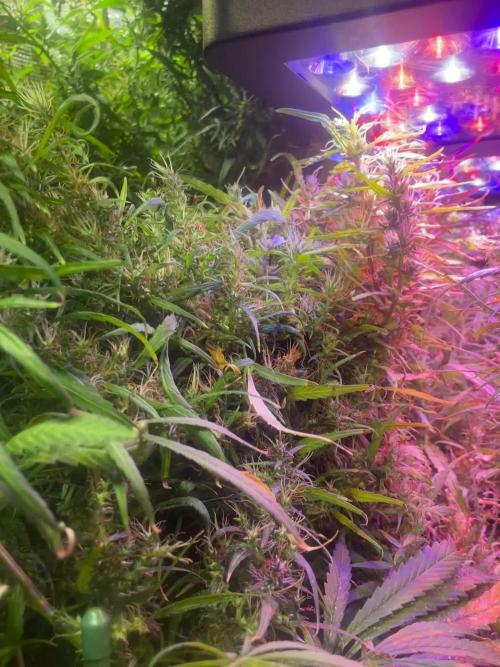
Buds are noticeably more filled out than they were last week. Still developing new stacks though, crazy how the structure is so different from modern hybrids and indicas. At 104 days my official estimate is 3-4 weeks remaining before chop. I lowered the light another 15 minutes per day so we are down to a 11:13 cycle.
At this point providing nothing but water as the massive amount of dry amendments I gave it a month ago should really be kicking in now. They go through about a half gallon of water each a day or 1.5 gallons for all 3 a day
Not going to give a plant by plant update this week as no noticeably or differential developments between the phenos. I will say #2 has not developed any more bud rot so I am very happy about that. So far I am still liking #4 the best.
Parents:
Defoliated the parents a week ago. They have since recovered for the most part with even more bud shoots than before. I will be giving these guys nothing but water for about a month and likely won’t defoliate for a few more weeks
God bless and thank you guys for following!

Likes
25
Share


@Luna91
Follow
Hello guys!
This week was amazing for my girls & Me! :D
4 of them are showing a great sign of flowering! After I defoliated all and tried main Lining for the first time! I didn’t expect such a great results! They are already healing and I should say: I’m falling in love with growing!!
It’s like my thing! After hours and hours reading and searching! When i see them happy like this, feels like all of my efforts are paying off.
I just wish they weren’t autos!
A newbe grower totally can handle an original femmenized seed! I don’t know why everyone said go for autos for tour firat grow!!
I’m practicing most of the trainings suitable for autos till i get real stuff!! Soon!
I also got that powerful AC, i was hesitating to buy!! it’s pretty amazing! Now I can grow my pineapple Express at thr best temp 25 degrees with 2200w!
I just hope i dont get too suprise when i see the Bill😅
Likes
11
Share

@Philhsy
Follow
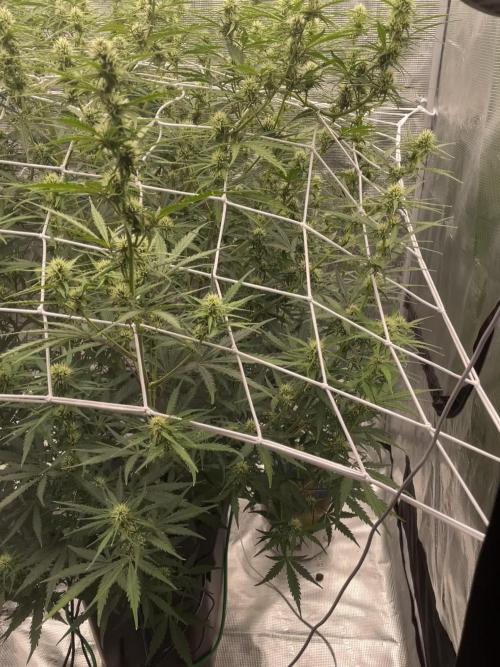
Using the scrogg net was a good idea, wluld have overgrown orherwize, its eating alot, trying to keep up, some minor spots showing on random older leafs, but nothing except that maybe a bit tiny leafs.
But the budsites omg, one plant and all this, doesnt account for all the buds below the net you cant see, its föowers all the way down and they seem to get enough light, truly a monster plan.t. Changed bath added calmag, and it ate .3 ec over night, dunno if thats good or bad, my humidofier broke so laying wet towels lol..
Hoping this auro will finish, dont think in. 8 weeks tho because shes huge, from edge to edge in my 120. Alotnof maintnence


Likes
48
Share


@MG2009
Follow
Still on water only. Captains Cake going to mom and clone tent. Alongside sour dream. For future diary's. Switching to Budswell 0-7-0 for flowering next week.😁

Likes
Comments
Share


@gr3g4l
Follow
Semana tranquila, lo de siempre en estas últimas semanas , ir atando apicales como buenamente se puede para que no toquen el techo del invernadero.
el resto son fotos de lo que le fui añadiendo al invernadero para favorecer la ventilación y la renovación del aire. De esta forma me puedo permitir cerrar la puerta hasta abajo y que quede todo más protegido.

Likes
25
Share


@Ultraviolet
Follow
ANTHOCYANIN production is primarily controlled by the Cryptochrome (CR1) Photoreceptor ( !! UV and Blue Spectrums are primary drivers in the production of the pigment that replaces chlorophyll, isn't that awesome!
1. Diverse photoreceptors in plants
Many civilizations, including the sun god of ancient Egypt, thought that the blessings of sunlight were the source of life. In fact, the survival of all life, including humans, is supported by the photosynthesis of plants that capture solar energy. Plants that perform photosynthesis have no means of transportation except for some algae. Therefore, it is necessary to monitor various changes in the external environment and respond appropriately to the place to survive. Among various environmental information, light is especially important information for plants that perform photosynthesis.
In the process of evolution, plants acquired phytochrome, which mainly receives light in the red light region, and multiple blue light receptors, including his hytropin and phototropin, in order to sense the light environment. .. In addition to these, an ultraviolet light receptor named UVR8 was recently discovered. The latest image of the molecular structure and function of these various plant photoreceptors (Fig. 1), focusing on phytochrome and phototropin.
Figure 1
Ultraviolet-visible absorption spectra of phytochrome, cryptochrome, phototropin, and UVR8. The dashed line represents each bioactive absorption spectrum.
2. Phytochrome; red-far red photoreversible molecular switch
What is phytochrome?
Phytochrome is a photochromic photoreceptor, and has two absorption types, a red light absorption type Pr (absorption maximum wavelength of about 665 nm) and a far-red light absorption type Pfr (730 nm). Reversible light conversion between the two by red light and far-red light, respectively(Fig. 1A, solid line and broken line). In general, Pfr is the active form that causes a physiological response. With some exceptions, phytochrome can be said to function as a photoreversible molecular switch. The background of the discovery is as follows. There are some types of plants that require light for germination (light seed germination). From that study, it was found that germination was induced by red light, the effect was inhibited by subsequent far-red light irradiation, and this could be repeated, and the existence of photoreceptors that reversibly photoconvert was predicted. In 1959, its existence was confirmed by the absorption spectrum measurement of the yellow sprout tissue, and it was named phytochrome. Why does the plant have a sensor to distinguish between such red light and far-red light? There is no big difference between the red and far-red light regions in the open-field spectrum of sunlight, but the proportion of red light is greatly reduced due to the absorption of chloroplasts in the shade of plants. Similar changes in light quality occur in the evening sunlight. Plants perceive this difference in light quality as the ratio of Pr and Pfr, recognize the light environment, and respond to it.
Subsequent studies have revealed that it is responsible for various photomorphogenic reactions such as photoperiodic flowering induction, shade repellent, and deyellowing (greening). Furthermore, with the introduction of the model plant Arabidopsis thaliana (At) and the development of molecular biological analysis methods, research has progressed dramatically, and his five types of phytochromes (phyA-E) are present in Arabidopsis thaliana. all right. With the progress of the genome project, Fi’s tochrome-like photoreceptors were found in cyanobacteria, a photosynthetic prokaryotes other than plants. Furthermore, in non-photosynthetic bacteria, a homologue molecule called bacteriophytochrome photoreceptor (BphP) was found in Pseudomonas aeruginosa (Pa) and radiation-resistant bacteria (Deinococcus radiodurans, Dr).
Domain structure of phytochrome molecule
Phytochrome molecule can be roughly divided into N-terminal side and C-terminal side region. PAS (Per / Arndt / Sim: blue), GAF (cGMP phosphodiesterase / adenylyl cyclase / FhlA: green), PHY (phyto-chrome: purple) 3 in the N-terminal region of plant phytochrome (Fig. 2A) There are two domains and an N-terminal extension region (NTE: dark blue), and phytochromobilin (PΦB), which is one of the ring-opening tetrapyrroles, is thioether-bonded to the system stored in GAF as a chromophore. ing. PAS is a domain involved in the interaction between signal transduction-related proteins, and PHY is a phytochrome-specific domain. There are two PASs and her histidine kinase-related (HKR) domain (red) in the C-terminal region, but the histidine essential for kinase activity is not conserved.
3. Phototropin; photosynthetic efficiency optimized blue light receptor
What is phototropin?
Charles Darwin, who is famous for his theory of evolution, wrote in his book “The power of move-ment in plants” published in 1882 that plants bend toward blue light. Approximately 100 years later, the protein nph1 (nonphoto-tropic hypocotyl 1) encoded by one of the causative genes of Arabidopsis mutants causing phototropic abnormalities was identified as a blue photoreceptor. Later, another isotype npl1 was found and renamed phototropin 1 (phot1) and 2 (phot2), respectively. In addition to phototropism, phototropin is damaged by chloroplast photolocalization (chloroplasts move through the epidermal cells of the leaves and gather on the cell surface under appropriate light intensity for photosynthesis. As a photoreceptor for reactions such as escaping to the side of cells under dangerous strong light) and stomata (reactions that open stomata to optimize the uptake of carbon dioxide, which is the rate-determining process of photosynthetic reactions). It became clear that it worked. In this way, phototropin can be said to be a blue light receptor responsible for optimizing photosynthetic efficiency.
Domain structure and LOV photoreaction of phototropin molecule
Phototropin molecule has two photoreceptive domains (LOV1 and LOV2) called LOV (Light-Oxygen-Voltage sensing) on the N-terminal side, and serine / on the C-terminal side. It is a protein kinase that forms threonine kinase (STK) (Fig. 4Aa) and whose activity is regulated by light. LOV is one molecule as a chromophore, he binds FMN (flavin mononucleotide) non-covalently. The LOV forms an α/βfold, and the FMN is located on a β-sheet consisting of five antiparallel β-strands (Fig. 4B). The FMN in the ground state LOV shows the absorption spectrum of a typical oxidized flavin protein with a triplet oscillation structure and an absorption maximum wavelength of 450 nm, and is called D450 (Fig. 1C and Fig. 4E). After being excited to the singlet excited state by blue light, the FMN shifts to the triplet excited state (L660t *) due to intersystem crossing, and then the C4 (Fig. 4C) of the isoaroxazine ring of the FMN is conserved in the vicinity. It forms a transient accretionary prism with the tain (red part in Fig. 4B Eα) (S390I). When this cysteine is replaced with alanine (C / A substitution), the addition reaction does not occur. The effect of adduct formation propagates to the protein moiety, causing kinase activation (S390II). After that, the formed cysteine-flavin adduct spontaneously dissociates and returns to the original D450 (Fig. 4E, dark regression reaction).
Phototropin kinase activity control mechanism by LOV2
Why does phototropin have two LOVs? Atphot1 was found as a protein that is rapidly autophosphorylated when irradiated with blue light.
The effect of the above C / A substitution on this self-phosphorylation reaction and phototropism was investigated, and LOV2 is the main photomolecular switch in both self-phosphorylation and phototropism. It turns out that it functions as. After that, from experiments using artificial substrates, STK has a constitutive activity, LOV2 functions as an inhibitory domain of this activity, and the inhibition is eliminated by photoreaction, while LOV1 is kinase light. It was shown to modify the photosensitivity of the activation reaction. In addition to this, LOV1 was found to act as a dimerization site from the crystal structure and his SAXS. What kind of molecular mechanism does LOV2 use to photoregulate kinase activity? The following two modules play important roles in this intramolecular signal transduction.
Figure 4
(A) Domain structure of LOV photoreceptors. a: Phototropin b: Neochrome c: FKF1 family protein d: Aureochrome (B) Crystal structure of auto barley phot1 LOV2. (C) Structure of FMN isoaroxazine ring. (D) Schematic diagram of the functional domain and module of Arabidopsis thaliana phot1. L, A’α, and Jα represent linker, A’α helix, and Jα helix, respectively. (E) LOV photoreaction. (F) Molecular structure model (mesh) of the LOV2-STK sample (black line) containing A’α of phot2 obtained based on SAXS under dark (top) and under bright (bottom). The yellow, red, and green space-filled models represent the crystal structures of LOV2-Jα, protein kinase A N-lobe, and C-robe, respectively, and black represents FMN. See the text for details.
1) Jα. LOV2 C of oat phot1-to α immediately after the terminus
Rix (Jα) is present (Fig. 4D), which interacts with the β-sheet (Fig. 4B) that forms the FMN-bound scaffold of LOV2 in the dark, but unfolds and dissociates from the β-sheet with photoreaction. It was shown by NMR that it does. According to the crystal structure of LOV2-Jα, this Jα is located on the back surface of the β sheet and mainly has a hydrophobic interaction. The formation of S390II causes twisting of the isoaroxazine ring and protonation of N5 (Fig. 4C).
As a result, the glutamine side chain present on his Iβ strand (Fig. 4B) in the β-sheet rotates to form a hydrogen bond with this protonated N5. Jα interacts with this his Iβ strand, and these changes are thought to cause the unfold-ing of Jα and dissociation from the β-sheet described above. Experiments such as amino acid substitution of Iβ strands revealed that kinases exhibit constitutive activity when this interaction is eliminated, and that Jα plays an important role in photoactivation of kinases.
2) A’α / Aβ gap.
Recently, several results have been reported showing the involvement of amino acids near the A’α helix (Fig. 4D) located upstream of the N-terminal of LOV2 in kinase photoactivation. Therefore, he investigated the role of this A’α and its neighboring amino acids in kinase photoactivation, photoreaction, and Jα structural change for Atphot1. The LOV2-STK polypeptide (Fig. 4D, underlined in black) was used as a photocontrollable kinase for kinase activity analysis. As a result, it was found that the photoactivation of the kinase was abolished when amino acid substitution was introduced into the A’α / Aβ gap between A’α and Aβ of the LOV2 core. Interestingly, he had no effect on the structural changes in Jα examined on the peptide map due to the photoreaction of LOV2 or trypsin degradation. Therefore, the A’α / Aβ gap is considered to play an important role in intramolecular signal transduction after Jα.
Structural changes detected by SAXS
Structural changes of Jα have been detected by various biophysical methods other than NMR, but structural information on samples including up to STK is reported only by his results to his SAXS. Not. The SAXS measurement of the Atphot2 LOV2-STK polypeptide showed that the radius of inertia increased from 32.4 Å to 34.8 Å, and the molecular model (Fig. 4F) obtained by the ab initio modeling software GASBOR is that of LOV2 and STK. It was shown that the N lobes and C lobes lined up in tandem, and the relative position of LOV2 with respect to STK shifted by about 13 Å under light irradiation. The difference in the molecular model between the two is considered to reflect the structural changes that occur in the Jα and A’α / Aβ gaps mentioned above.
Two phototropins with different photosensitivity
In the phototropic reaction of Arabidopsis Arabidopsis, Arabidopsis responds to a very wide range of light intensities from 10–4 to 102 μmol photon / sec / m2. At that time, phot1 functions as an optical sensor in a wide range from low light to strong light, while phot2 reacts with light stronger than 1 μmol photon / sec / m2. What is the origin of these differences? As is well known, animal photoreceptors have a high photosensitivity due to the abundance of rhodopsin and the presence of biochemical amplification mechanisms. The exact abundance of phot1 and phot2 in vivo is unknown, but interesting results have been obtained in terms of amplification.
The light intensity dependence of the photoactivation of the LOV2-STK polypeptide used in the above kinase analysis was investigated.
It was found that phot1 was about 10 times more photosensitive than phot2. On the other hand, when the photochemical reactions of both were examined, it was found that the rate of the dark return reaction of phot1 was about 10 times slower than that of phot2. This result indicates that the longer the lifetime of S390II, which is in the kinase-activated state, the higher the photosensitivity of kinase activation. This correlation was further confirmed by extending the lifespan of her S390II with amino acid substitutions. This alone cannot explain the widespread differences in photosensitivity between phot1 and phot2, but it may explain some of them. Furthermore, it is necessary to investigate in detail protein modifications such as phosphorylation and the effects of phot interacting factors on photosensitivity.
Other LOV photoreceptors Among fern plants and green algae, phytochrome ɾphotosensory module (PSM) on the N-terminal side and chimera photoreceptor with full-length phototropin on the C-terminal side, neochrome (Fig. There are types with 4Ab). It has been reported that some neochromes play a role in chloroplast photolocalization as a red light receiver. It is considered that fern plants have such a chimera photoreceptor in order to survive in a habitat such as undergrowth in a jungle where only red light reaches.
In addition to this, plants have only one LOV domain, and three proteins involved in the degradation of photomorphogenesis-related proteins, FKF1 (Flavin-binding, Kelch repeat, F-box 1, ZTL (ZEITLUPE)), LKP2 ( There are LOV Kelch Protein2) (Fig. 4Ac) and aureochrome (Fig. 4Ad), which has a bZip domain on the N-terminal side of LOV and functions as a gene transcription factor.
4. Cryptochrome and UVR8
Cryptochrome is one of the blue photoreceptors and forms a superfamily with the DNA photoreceptor photolyase. It has FAD (flavin adenine dinucle-otide) as a chromophore and tetrahydrofolic acid, which is a condensing pigment. The ground state of FAD is considered to be the oxidized type, and the radical type (broken line in Fig. 1B) generated by blue light irradiation is considered to be the signaling state. The radical type also absorbs in the green to orange light region, and may widen the wavelength region of the plant morphogenesis reaction spectrum. Cryptochrome uses blue light to control physiological functions similar to phytochrome.
It was identified as a photoreceptor from one of the causative genes of UVR8 Arabidopsis thaliana, and the chromophore is absorbed in the UVB region by a Trp triad consisting of three tryptophans (Fig. 1D). It is involved in the biosynthesis of flavonoids and anthocyanins that function as UV scavengers in plants.
Conclusion
It is thought that plants have acquired various photoreceptors necessary for their survival during a long evolutionary process. The photoreceptors that cover the existing far-red light to UVB mentioned here are considered to be some of them. More and more diverse photoreceptor genes are conserved in cyanobacteria and marine plankton. By examining these, it is thought that the understanding of plant photoreceptors will be further deepened.

Likes
16
Share


@grow_nerd420
Follow
Girls looks very happy 💪🔥😍
Second Week Of Flowering 🔥 pistols start shooting😂so we officially into Flower stage😂🔥😁✌️✌️✌️

Likes
54
Share


@Hou_Stone
Follow
It's too hot, I had to switch my hps to 400w
--------------------------------------------------------
Grow Room: trafika urban hydroponics 100x100x200 cm
Lamp: kit trafika urban hydroponics ballast & lampe HPS : 250-600w
Extractor & carbon filter : Mars hydro 6 inch 402 CFM ( power 3/10 )
Soil : 20% perlite, 20% vermiculite, 60% universal soil
Average daily temperature & humidity : 24-30°C 40-60%
Average nigth temperature & humidity : 14-22°C & 50-70 %

Likes
32
Share


@Compassionate_Gardener
Follow
The plants continue to develop more and more flower clusters all over the main and side branches, its FANTASTIC to see. 😍 The Shiva Skunk is still a little bit taller (47 cm) than the Serious Kush (42 cm), but the Kush plants have denser flower clusters. Trichome production is now in full swing under the Q6W-Gen.2 LED-lamps, which are still dimmed to 100% (=3 green lights on the dimmer). The plants SMELL DELICIOUS and have a STRONG AROMA now! The Shiva Skunk has a very musky and sweet aroma now with hints of citrus in it, while the Serious Kush smells 'dank', it has an extraordinary strong and gassy smell which is intoxicating!


Likes
65
Share


@nonick123
Follow
Día 92 (14/04) Riego con 500 ml H2O EC 0,45
Ha bajado algo la temperatura promedio
Día 93 (15/04) Riego con 500 ml H2O EC 0,45
Reviso los tricomas y aún le faltan unos días...
Día 94 (16/04) Riego con 500 ml H2O EC 0,45
Día 95 (17/04) Riego con 750 ml H2O EC 0,45
Tiene mucha sed! El tiempo está loco por aquí! Picos de 27 ºC en abril... 😵💫
Día 96 (18/04) Riego con 1.000 ml H2O EC 0,45
Día 97 (19/04) Riego con 500 ml H2O EC 0,45
Día 98 (20/04) Fiesta de la Cosecha!
Reviso los tricomas y están un 10% ambar, 85% nublados y 5% transparentes
Perfecta!
Likes
252
Share


@Tropicannibis_Todd
Follow
💩Alrighty then Growmies We Are Back At it 💩
Well folks we just finished up the last run and so we are back to do it all over again 😁
So what do you say we have some fun 👈And what we got here folks is a Strawberry Blast 🍓 🍓 🍓 🍓
Strawberry 🍓 Gorilla , Strawberry 🍓 Banana 🍌 and there new release 🍓 Ztrawberriez 🍓 from FastBuds
And we also got Strawberry 🍓 Cola from Exotic Seeds
👉 I had realized I had quiet a few Strawberry Strains in my inventory , and I just finished doing the Strawberry Pie , and I liked it so much I figured do them all 😮
Seed soaked for 24 then placed in a tub with paper towels , once it cracked and rooted , placed into its main pot 👌
FC4800 from MarsHydro Lights being readjusted and chart updated .........👍
www.marshydro.ca
👉I used NutriNPK for nutrients for my grows and welcome anyone to give them a try .👈
👉 www.nutrinpk.com 👈
NutriNPK Cal MAG 14-0-14
NutriNPK Grow 28-14-14
NutriNPK Bloom 8-20-30
NutriNPK Bloom Booster 0-52-34
I GOT MULTIPLE DIARIES ON THE GO 😱 please check them out 😎
👉THANKS FOR TAKING THE TIME TO GO OVER MY DIARIES 👈

Likes
27
Share
@GrowBro1981
Follow
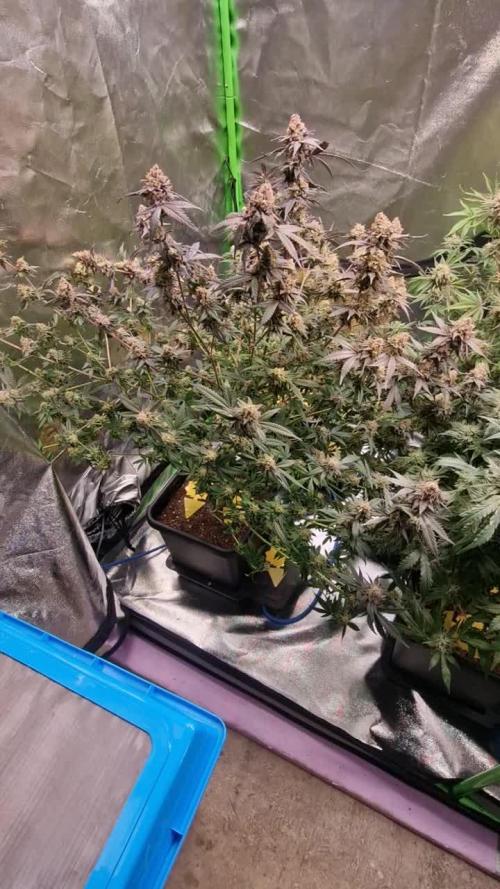
Jaaa, was soll ich da noch sagen... 😅😅 Hat Spaß gemacht und das Ergebnis ist Top!!
Folgt mir auf Facebook für mehr Infos, Bilder und Videos 🤗 🤗 🤗


Likes
17
Share

@Mastr
Follow
Hi all grower auto orange bud week 13 she had long veg pase due transplant shock but now she get very big and bushy u feed her 1ml bio grow 4ml bloom 2ml big bud
Half ml cal mag with 5 litre water ph every other day
The bud top leaf start getting purple so beautiful plant definitely grow her again


