


Likes
Comments
Share


@DogDoctorOfficial
Follow
Animal Mints — Legends of the Frozen North
Week 8 from Seed | Week 4 Flower
Another chapter unfolds in the frozen north.
For anyone joining this diary now, here is a quick recap of how we arrived here.
This run explores Animal Mints grown primarily under a 12/12 cycle from seed, allowing the plants to naturally express their structure while moving efficiently into flowering. Most of the plants followed this path from the beginning, with one small exception in the room — a plant that spent about two weeks in vegetative light before joining the 12/12 cycle.
Interestingly, that plant ended up being the smallest of the group, showing how genetics and environmental response can sometimes surprise us.
But despite those differences, the room now feels unified. The canopy is alive, vibrant, and moving together into the deeper stages of flowering.
This week has been a big one.
With more than 300 photos captured, the goal was to document every angle of development — structure, branching, flower sites, and canopy behavior — as the plants continue their journey through bloom.
⸻
Environmental Snapshot
The room is currently running with fairly aggressive parameters, but supported by strong airflow and active air exchange.
Current conditions
• Canopy temperature: ~28°C (gradually tapering toward 26°C)
• Relative humidity: ~70% (slowly reducing toward ~60%)
• CO₂: 1000+ ppm through passive enrichment
• PPFD: 800 → 1300 µmol across the canopy
These values are slightly on the upper edge of traditional recommendations, but with strong airflow and healthy transpiration, the plants are responding very well.
Air movement remains one of the most important elements in this environment.
The goal over the next weeks will be to gradually tighten the climate window as flowers develop further.
⸻
Light Strategy
The lighting across the canopy currently ranges between:
800 and 1300 PPFD
This allows the plants to maintain strong metabolic activity without excessive stress during early flower development.
Additionally, we run a 15-minute red light pulse after lights off.
This small far-red window helps accelerate the phytochrome transition between light cycles, effectively signaling nightfall to the plants and assisting the flowering rhythm.
It is a subtle adjustment, but one that helps maintain consistent flowering signals.
⸻
Under-Canopy Lighting
One of the key elements of this room is the use of under-canopy lighting.
As plants grow bushier and develop dense foliage, the lower zones of the plant often receive very little light.
Under-canopy lighting helps:
• increase light penetration to lower bud sites
• reduce excessive shading
• maintain photosynthetic activity deeper into the plant
• improve overall bud development throughout the structure
Combined with careful defoliation and strong airflow, this approach helps keep the entire plant active rather than only the top canopy.
⸻
Airflow — The Invisible Engine
Airflow is one of the most underestimated tools in indoor cultivation.
In this room we rely heavily on constant air circulation and active air exchange.
This helps:
• regulate leaf temperature
• support transpiration
• prevent humidity pockets inside the canopy
• strengthen plant structure
• reduce risk of fungal pressure
Plants are living organisms interacting with their environment, and air movement is part of that conversation.
⸻
Feeding Strategy
The plants are currently feeding very actively.
Feed EC: ~2.4
Soil EC: ~0.9
This indicates that the plants are absorbing nutrients efficiently from the medium.
As long as the plants continue eating and the runoff remains stable, the feeding program stays consistent.
If nutrient uptake slows or runoff EC begins climbing, adjustments will be made accordingly.
For now, the system remains balanced and responsive.
⸻
Nutrient Recipe
Current weekly top feed includes:
• CalMag Pro
• Terra Bloom (base nutrient)
• Power Buds
• Green Sensation
• Pure Zym
• Sugar Royal
• Vita Race (foliar where applicable)
At this stage of flowering, foliar applications are used sparingly. Once flowers begin forming, keeping the canopy dry becomes increasingly important.
⸻
Why Add Power Buds + Green Sensation
As plants transition fully into the flowering stage, the goal shifts from structural growth toward flower formation and metabolic support.
Power Buds helps stimulate the plant’s flowering response and encourages the development of early bud sites.
Green Sensation acts as a metabolic enhancer, supporting:
• bud density
• terpene production
• nutrient transport
• overall plant energy during bloom
Together, these additives help guide the plant’s resources toward productive flower development.
⸻
Mixing Order — Why It Matters
One of the small details that can make a big difference in nutrient stability is the order of mixing.
Our mixing process always follows the same structure:
1. CalMag Pro first
2. Base nutrient (Terra Bloom)
3. Additives
CalMag is added first until the base EC reaches around 0.7.
This creates a stable mineral foundation for the rest of the solution.
After that the base nutrient and additives are introduced gradually.
Proper mixing order helps prevent nutrient precipitation and instability, keeping the solution balanced and available for the plants.
In simple terms:
Chemistry matters.
⸻
Defoliation Update
This week also included selective defoliation.
Some plants had not yet received any canopy thinning, and their structure had become quite dense.
Those plants were defoliated more deeply than the others to restore:
• airflow inside the canopy
• light penetration
• structural balance
Despite the heavier pruning, the plants responded beautifully.
Leaves remain vibrant, growth continues strong, and the canopy quickly reorganizes itself.
⸻
Structural Observations
Across the room, the Animal Mints plants show distinct structural expressions.
Some lean toward tighter node spacing and compact branching, while others stretch slightly more.
These differences highlight the diversity within the genetic expression of the cultivar.
Yet despite those differences, all plants are developing healthy flower sites and strong green foliage.
⸻
What To Expect Next
Over the next weeks we expect:
• vertical stretch slowing down
• bud stacking intensifying
• resin development beginning
• stronger aroma expression
Environmental parameters will gradually shift toward slightly cooler temperatures and lower humidity as flowers continue forming.
The focus will remain on airflow, canopy balance, and metabolic stability.
⸻
Gratitude
Before closing this update, a moment of appreciation.
To the long-time followers, the OG readers, the new growers discovering this diary, the skeptics, the critics, the silent observers, and everyone who spends time following these plants.
Thank you.
Gratitude as well to:
• the platform hosting these diaries
• the sponsors supporting the work
• the genetics that make these explorations possible
• and everyone contributing to the community.
If you are here reading, learning, questioning, or simply watching quietly…
You are part of this journey.
⸻
The legends of the frozen north continue.
🌿❄️
📡 Please stay tuned they can try and take us down but we never quit https://www.youtube.com/@DOGDOGTHEDOCTOR NEW
🙏 Thank you for your patience and continued support.
FOR DISCOUNT CODES AND MORE JUST FOLLOW THE LINK https://website.beacons.ai/dogdoctorofficial
📲 Don’t forget to Subscribe and follow me on Instagram and YouTube @DogDoctorOfficial for exclusive content, real-time updates, and behind-the-scenes magic. We’ve got so much more coming, including transplanting and all the amazing techniques that go along with it. You won’t want to miss it.
GrowDiaries Journal: https://growdiaries.com/grower/dogdoctorofficial
Instagram: https://www.instagram.com/dogdoctorofficial/
YouTube: https://www.youtube.com/@dogdoctorofficial Deleted by Youtube
Vimeo : https://vimeo.com/dogdoctorofficial Under construction stay tuned ⸻
Explore the Gear that Powers My Grow
If you’re curious about the tech I’m using, check out these links:
🔆 Lighting & Environmental Control
• Future of Grow — Advanced LED lighting technology
https://www.futureofgrow.com/
DISCOUNT CODE: DOG20
• Lumiflora — Under-canopy LED lighting
https://lumiflorade.com/
• TrollMaster — Environmental controllers and automation gear (past collaboration)
⸻
Genetics
• Zamnesia Seeds — Genetics used in this project
https://www.zamnesia.com/
⸻
🌱 Soil, Substrates, Boosters & Root Support
• Plagron — Substrates, bio mixes, and supportive products
https://plagron.com/en/
⸻
🎒 Storage, Curing & Preservation
• Grove Bags — Curing and storage solutions
https://grovebags.com/
⸻
📸 Photography Equipment & Tools
(Not sponsors, but part of my creative toolkit)
• Sony A6700
• Sony full-frame macro lens + few more
• Stacking photography workflow - learning
• iPhone (for behind-the-scenes shots)
We’ve got much more coming as we move through the grow cycles. Trust me, you won’t want to miss the next steps, let’s push the boundaries of indoor horticulture together!
As always, this is shared for educational purposes, aiming to spread understanding and appreciation for this plant. Let’s celebrate it responsibly and continue to learn and grow together.
With true love comes happiness. Always believe in yourself, and always do things expecting nothing and with an open heart. Be a giver, and the universe will give back in ways you could never imagine.
💚 Growers love to all 💚
📸 P.S. – The Eye Behind the Lens
All photos in this diary (for now — except for the ones showing the camera, which I took with an iPhone) are taken with a Sony A6700 paired with a Sony full-frame macro lens and a few more.
Photography is part of the story — it’s how we share the fine textures, the glow, and the quiet details that words can’t always capture.
I’ve also started experimenting with photo stacking — a technique where multiple images, each taken at a slightly different focus point, are layered together to create one perfectly sharp image from front to back.
It’s not digital enhancement or AI; it’s pure photography — a way to reveal the plant’s beauty in microscopic depth, from trichome to petal.
You’ll even see a few shots of "ghost me" capturing the shots — camera, lens, setup — because every grow deserves not just to be cultivated, but documented like art.
FOR DISCOUNT CODES AND MORE JUST FOLLOW THE LINK https://website.beacons.ai/dogdoctorofficial
NEW DISCORD - Official Server Invite Link : https://discord.gg/ksjAkA5T74
P.S.2- not all filer were uploaded but i think enough to get the idea wore, i will try and upload them o next week update if not over crowded with files also

Likes
57
Share


@Krisis
Follow
So i apparently lost a buncha the pictures from this. :/
Fatso is probably my favorite plant so far. Very pretty and also very forgiving.
Probably the most pictures I’ve ever taken of a plant before.. which makes it extra sucky that I’ve lost most of the ending pictures.
She made nice buds even though she was starving to death for a couple weeks from lockout. It took me that losing to get it sorted. Her buds would have probably been even bigger than they were.. jeez.
Anyhow, after drying and curing a little bit - good goood smoke and high. If you’re not a heavy/long time smoker.. I’d suggest not doing anything that needs real focus. Definitely a make you miss your exit weed.. not that anyone should be driving high lol.
Sorry bout the lack of pictures.

Likes
3
Share

@Nebuloso420
Follow
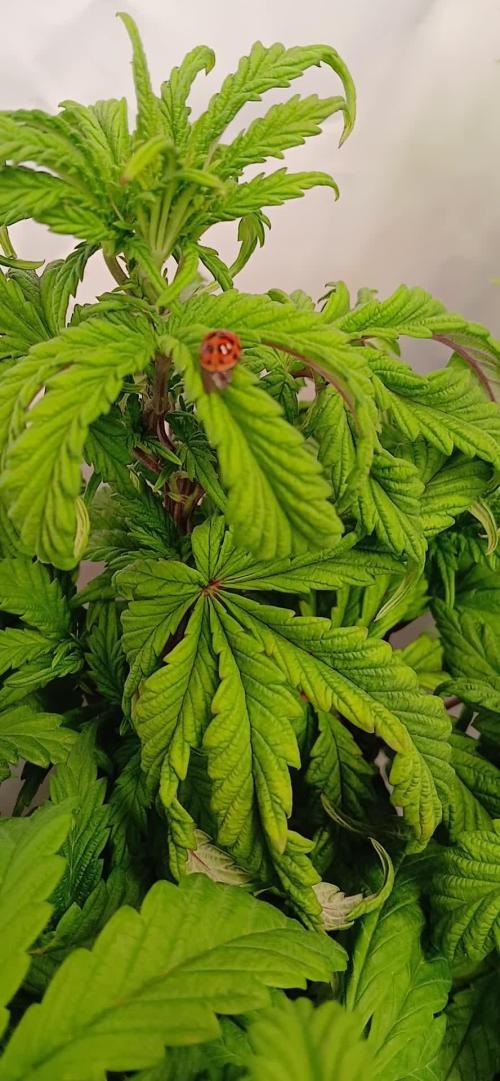
Dear Diary This week was uneventful nothing to write, same treatment as the week before, exept I added some Advanced nutrients " BigBud" to the mix. It contains phosphorus andpotassium and is used during week 2 through 4 of the bloom phase.
EC still around 1.3-1.4.

Likes
2
Share


@CannaIGrow
Follow
I did not top this girl, yet. Her top lowers started catching up to the top so I didn’t want to stop her yet lol. But all in all she’s looking healthy.


Likes
15
Share


@Brickie74
Follow
Very good week for the Jelly Rancher plant. The JR plant went from 3 inches to 6-1/2 inches. So 3.5 inches of growth this week...not too bad. No issues so far 😬. I pruned the plant just a little this week, took of the first, second and third set of leaves off. Not any branches just the leaves. The second and third set of leaves just get in the way...get covered in soil as they grow and not really all that useful so I just get them out of the way. Onto week 4 😁.

Likes
22
Share


@BruWeed
Follow
La planta por suerte pudo crecer bien sin ningun problema grave, lo unico que me sucedió fue que en cierta etapa me excedí con los fertilizantes y las hojas se pusieron un poco amarillas pero se pudo solucionar.
En sus tres etapas, enraizamiento, crecimiento y floración estuvo muy bien su desarrolló.
Los cogollos a la hora de podarla se ven muy bien, estan bastantes pegajosos y tiene muy buen olor, parecido a frutal.
En unas semanas cuando ya se pueda probar subire mas imagenes de su etapa final.



Likes
60
Share


@Natrona
Follow
Sour Jealousy Auto FastBuds 2025 Outside Grow
Week 6 May 11-17 Veg
Sour Jealousy remains in veg at 6 weeks with no hairs or buds in sight. She is a sativa hybrid, and they say sativas take longer to go into flower. She is 12 inches tall now. This week’s weather has been rainy and will continue thru the weekend. May started out in the 90s but has steadily fallen over the past two weeks. Maintaining temperatures in the upper 60s and low 70’s
These temperatures are below our average upper 70s-to 80s.
I noticed some spots on a leaf but the other outside girls don’t show any spots.
Side note: outside growing isn't easy. I found cabbage worms on my Brussels sprouts. Hope my outside girls get stinky to protect my vegetables.
Your likes and comments are appreciated. Thanks for stopping by.
Growers love 💚🌿
💫Natrona💫

Likes
7
Share


@Sea_canna_blubb
Follow
Zu letzter Woche hat sich nicht viel geändert außer dass sie noch doller riechen und ihre Buds immer dicker werden 🌿😋🍇
Die Trichome einer Pflanze sind schon sehr bernstein farbend 🍯
Likes
15
Share

@Brujha77
Follow
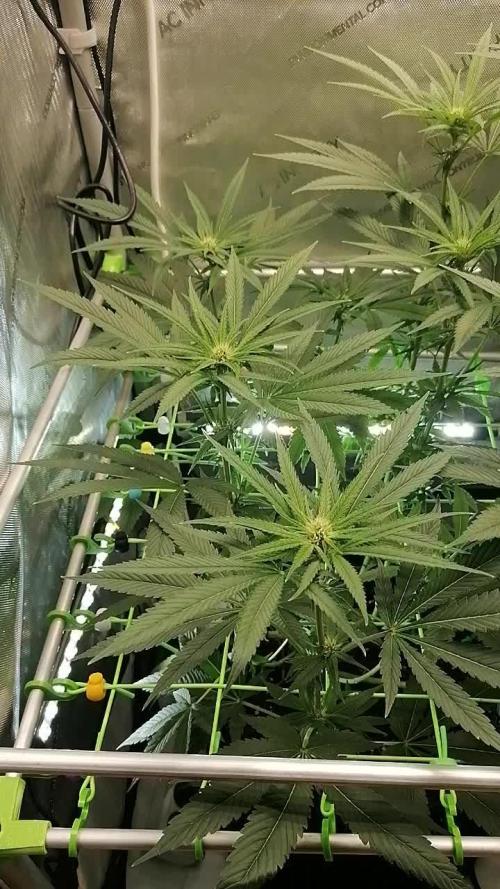
Beginn 4. Blütewoche
Was soll ich sagen.
Die beiden entwickeln sich richtig schön, gerade die rechte.
Schöne stabile Seitentriebe bei beiden.
Sie werden diese Woche noch nen Compost Tee bekommen, ansonsten wird nichts an den Pflanzen getan.
Hoffe nur die rechte ist nun mit dem größten Teil des Strech durch, die Topps haben noch knapp 40cm bis zur Lampe🙏
Tag 25 Blüte
Die beiden bekamen heute jeweils 1l Composttee (15g/l Biotabs PK Booster mit 10g/l Kelp Meal und Melasse).
Zudem gab's noch ein Topdress mit 15g Crustacean Meal.


Likes
3
Share

@NEPA-Cultivations
Follow
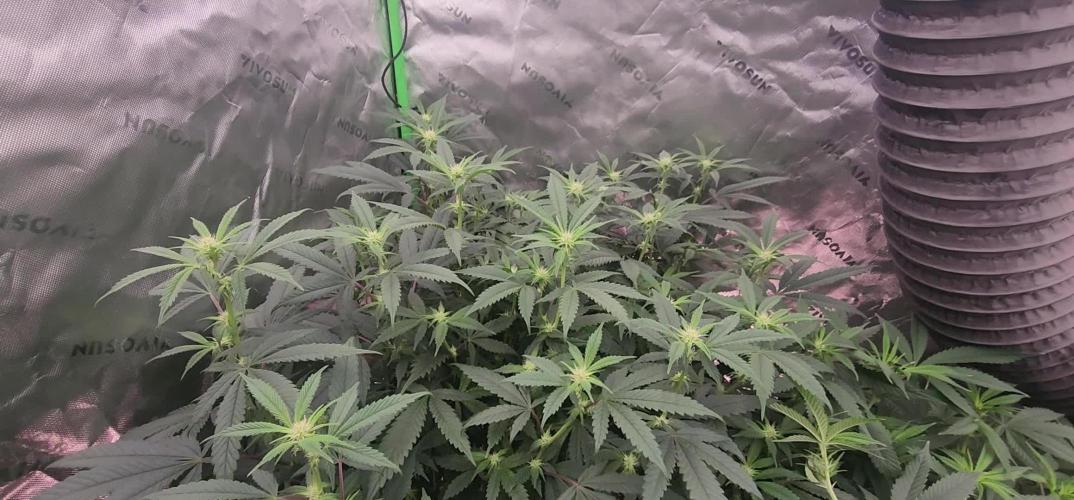
Another good week removed leaves covering bud sites the stretch is over!
Likes
12
Share


@Medgrow93
Follow
Just waiting for them to finish.
8 Apr - 2.2L each + B.A.C Final Solution (last watering before harvest)
I'll probably harvest them early because I need to paint the room. Will give them one more week until the substrate dries out.
10 Apr - just waiting for the substrate to dry out before chopping down. Trichome productions is crazy. I hope they taste as good as they look.

Processing
Likes
12
Share


@Studabaker
Follow
Can anyone help me out. Why does it have this color. It’s only a week old.

Likes
8
Share


@Rinna
Follow
Big chunky buds, and both pheno’s smells exactly what I was hoping for: sweet creamy vanilla with some gas. This is deffo my favorite terp profile, I do love to mix it up with some fruity/candy gas, that why I got the blueberries too. Both plants are in top shape with beautiful dark green leaves, and super dense and thicc buds. they’re starting to show a nice purple fade too despite the summer temps. I’ve been lowering the ppm from 1100 at the high point to 850 now. This is the last update for two weeks as I’m going on holiday, all girls should be ready to harvest once I’m back 🤩 My roommate will take care of the flush, I filled a 30 liter tank with feeding water, after that he’ll refill it with just water and some ph-min!
Likes
17
Share


@Fat_Olsh_Farms
Follow
Day 7. Mutant 3 leaf plant. Looks healthy tho. We'll see how she does.
Day 13. Never had a plant like this before. Pretty cool.
Likes
4
Share


@Endemic
Follow
Месяц не был на поляне - растения слегка забило камышом, в связи с чем к ним был ограничен доступ света. Навел порядок, прорвал камыш, покормил органикой - теперь всё будет хорошо))
Likes
7
Share

@Matteliquo
Follow
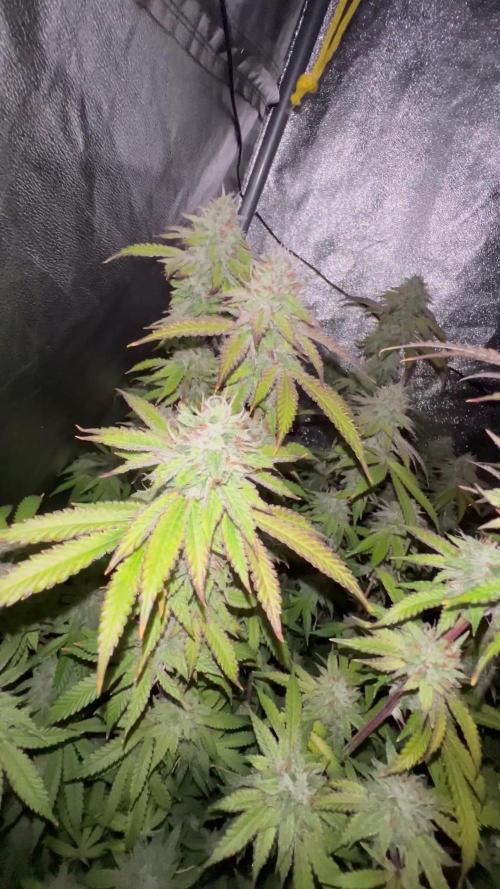
Here we are at the end of the sixth week, friends. I'm starting to feel pessimistic about the challenge of gaining a pound. The buds haven't gained much weight, but we'll see what happens. The indications are 8/9 weeks, so there's still a bit of time.🤞

Processing
Likes
4
Share


Processing
Likes
3
Share


@mr_smooke
Follow
It's coming to the end at a rapid rate, she shows some violet shade, trichomes are milky and about 10% brown. So I will harvest this doctor, tomorrow. I have made splitting 3 days ago
Here is day 56 of flowering
