




@Gorillagrower
Follow
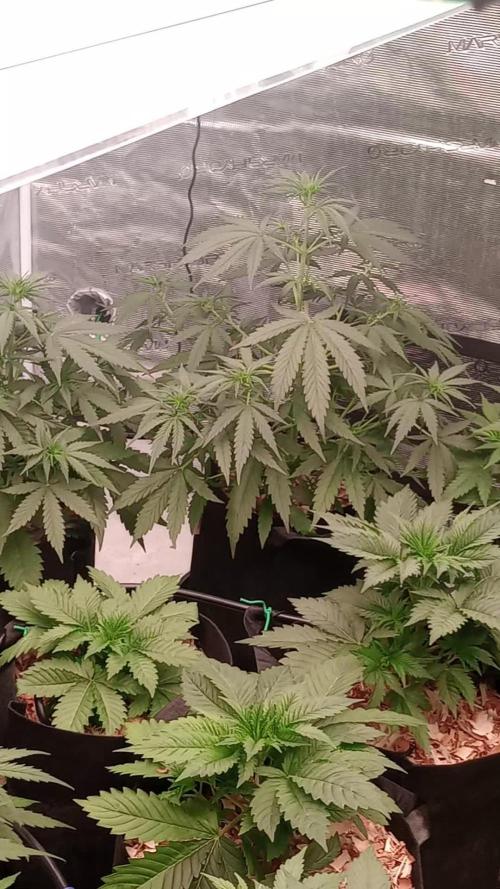
A shout out to my brother's at Spliff Seeds! Without the good genetics you don't have shit! Lol 😂 Dutch Blue Automatic is a very aggressive growing strain.



@HOME_GROWBOOK
Follow
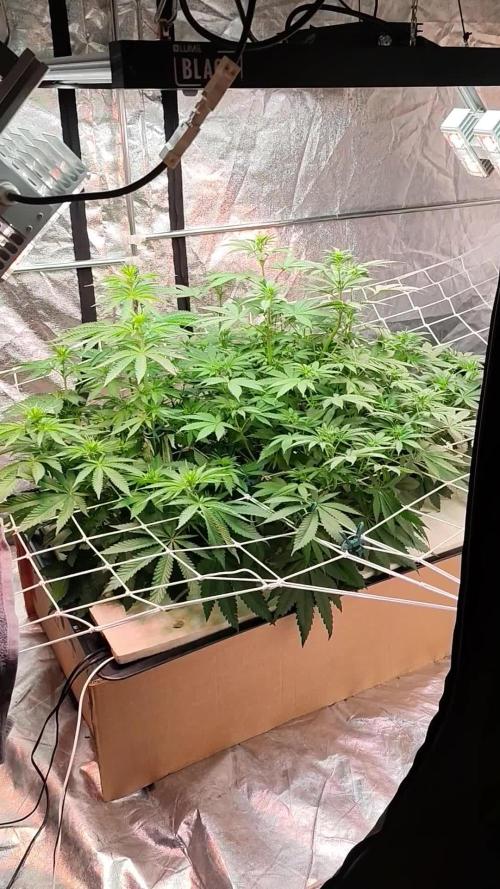
Die Pflanzen befinden sich nun in Blütewoche 4 und zeigen eine starke Entwicklung. Die Stretch-Phase ist endgültig abgeschlossen, und die Energie fließt nun vollständig in die Ausbildung dichter, gleichmäßiger Buds. Die Blütenstände nehmen sichtbar an Volumen zu, erste Harzschichten beginnen sich zu bilden, und der Duft wird langsam intensiver.
Das semi-hydroponische System läuft inzwischen konstant und zuverlässig. Durch die integrierte Pumpe bleibt die Nährlösung in Bewegung, was die Sauerstoffversorgung im Wurzelbereich deutlich verbessert. Das zeigt sich an einem kräftigen, hellen Wurzelbild und einer insgesamt hohen Aufnahmefähigkeit. Die Pflanzen wirken vital, standfest und reagieren hervorragend auf das System.
Die aktuelle Düngung mit 6 ml/l Canna Coco A + B wird optimal vertragen. Kein Hinweis auf Überdüngung oder Mangelerscheinungen – das Blattwerk bleibt gesund, tiefgrün und leicht glänzend. Der Wasserstand und pH-Wert werden regelmäßig kontrolliert, wodurch das Gleichgewicht stabil bleibt.
Die Struktur ist offen und gut belüftet, die Blütenstände sind gleichmäßig über das gesamte Netz verteilt. Die Pflanzen präsentieren sich kompakt und kräftig, bereit, in den kommenden Wochen an Dichte und Harzproduktion zuzulegen.
Insgesamt ein sehr stabiler und produktiver Verlauf: das unfreiwillig entstandene Semi-Hydro-System hat sich zu einem echten Vorteil entwickelt – konstante Feuchtigkeit, gute Durchlüftung und sichtbar schnellere Entwicklung im Vergleich zu reinem Coco-Betrieb. Alles deutet auf eine starke mittlere Blütephase hin.


@Mastr
Follow
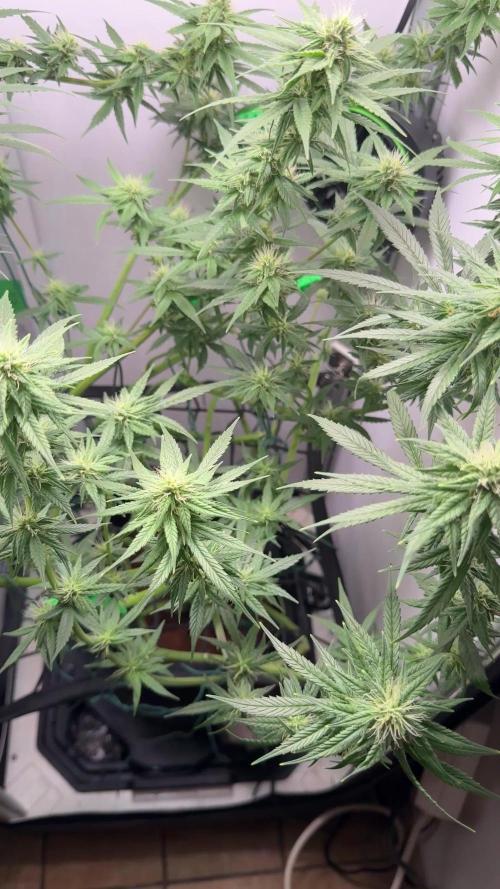
She is alot different than last week shi is so bushy and she is indica for sure
Day 49 I find her even more bigger I upload video too
she is way wider than door 🚪 and she grow in 6L I'm shock she is too big


@Anditsch
Follow
Die Gelato ist jetzt ca in der 13. Woche (eigentlich Automatic).
Sie wächst sehr gesund und stark, hat ca 20 Seitentriebe welche zum Teil runtergebunden worden sind.
Sie ist jetzt seit ca 1 1/2 Wochen in Vorblüte und ich hoffe das an diesem heißen Wochenende jetzt der Sprung in
die volle Blüte gelingt.
Ist eine durstige Dame ca 1,5 -2 Liter pro Tag an Wasser.
Jeden 2 oder 3 Tag wird gedüngt je nach Bedarf.
Die Pflanze steht auf einer Dachterrasse - absolute Hitze manchmal in der Sonne bis zu 49°C.
Nachts ist es teilweise auf 15°C abgefallen.
Sie bekomm von 7,45Uhr bis 20.00uhr Sonne, vollgas Sonne.
Die Pflanze steht in einem 5 Gal Stofftopf von Spiderfarmer.
Die meisten Sonnensegel wurden bereits entfernt, diese waren riesig.





@Ultraviolet_
Follow
Turned off IR @ nights
Red wigglers (Eisenia fetida) are highly beneficial. They are considered an ideal choice for "no-till" or container-based organic growing because they live in the upper layers of soil, feeding on organic mulch rather than the plant's root system. Red wigglers accelerate the breakdown of organic amendments and produce high-quality, nutrient-dense worm castings directly in the root zone. Clover is another exceptional component of an organic rhizosphere, offering a sustainable, self-sustaining alternative to synthetic nitrogen fertilizers produced via the energy-intensive Haber-Bosch process. By forming a symbiotic relationship with Rhizobia bacteria, clover converts atmospheric nitrogen N2 into ammonium NH4, providing a steady, slow-release nutrient source that enhances soil health and reduces environmental impacts. Red clover offers superior nitrogen fixation and biomass production compared to white or yellow clover, making it the premier choice for maximum soil vitality, particularly for improving soil structure and providing a high-volume nitrogen credit for subsequent crops.
If it is fully functional and efficient soil, the rhizophagy cycle is far superior long-term than any synthetic delivery when it comes to preventing deficiencies, not because it's "better," per se. The medium will require a very high CEC to make it to harvest without re-fertilization. The rhizosphere acts as a dynamic, interactive exchange where plants and soil microbes trade resources based on immediate needs. When a plant lacks a specific nutrient, it changes its physiology and releases specialized chemical cocktails—root exudates—into the surrounding soil. These exudates, which include sugars, amino acids, and organic acids, serve as a "shopping list" to attract specific microorganisms, which in turn return higher levels of desired nutrients. There is nothing in comparison to synthetic delivery, which causes plants to stop producing exudates, effectively "starving" the beneficial soil life, over time turning the soil barren and void of microbial life. Responsible use, applying the right amount at the right time, can minimize these negative effects. Relying solely on synthetic fertilizers without replenishing organic matter is what typically leads to exhausted soil. The use of synthetic fertilizers can utilize the Cation Exchange Capacity (CEC) of the soil, but without a robust rhizosphere and active microorganisms, the efficiency of this process is significantly reduced. This makes synthetic growing more difficult to prevent deficiencies overall compared to an efficient organic living soil with a robust rhizophagy cycle, as there is no "one size, fits all" when it comes to different nutrient profiles of strains/genetics, making it trickier to "guess" and prevent creeping deficiencies.
CEC does not contribute towards EC. Add more CEC using biochar, problem solved. If you keep pH between 6.3 and 6.7, hydrogen is exudated to cycle the medium's CEC for its needs. Keeping the pH between 6.3 and 6.7 creates an environment where plants release H+ to displace positively charged nutrients (like Ca2+, Mg2+, K+ held on soil particles or within artificial media this cycle through nutrients via the medium's Cation Exchange Capacity (CEC)
Microorganisms generate a stable potential of approximately 0.5 V EC. The rhizosphere creates its own food, similarly to chelation, using 1000's of varying combinations to create its own food.
Start to finish, just add water. Eventually, more materials will need to be added at the beginning of each new grow, but very attainable to go from seed to harvest without ever fertilizing, regenerative cultivation.
ATP is king above all else when it comes to biomass accumulation. Cellular root respiration and cellular respiration are essentially the same biological process, the breakdown of glucose to create usable energy (ATP) in the presence of oxygen, just taking place in different parts of the plant. Synthetic (salt-based) grows have significantly lower levels of total rhizosphere respiration, often referred to as root-zone activity, compared to organic living soil grows. While the plant roots themselves may respire in both systems, the surrounding soil ecosystem in a living soil setup is vastly more active, teeming with bacteria, fungi, and beneficial microorganisms.
2 pools of ATP, it won't double in growth buuuut, but improving root respiration by ensuring high oxygen in the soil is crucial. Good aeration ensures roots can fully utilize glucose to generate the ATP necessary for nutrient uptake, leading to healthier and more productive plants, even if growth isn't exactly doubled. The ATP created using root respiration is dedicated to rootzone growth; the ATP created using regular cellular respiration in a synthetic system would have to dedicate a lot of ATP to the roots when there is little or no root respiration. It's true that there is less of an initial ATP cost in breakdown when nutrients are already in their final form (synthetic), but you lose a solid chunk of ATP when the entire plant is reliant on cellular respiration alone; a large portion of ATP is dedicated to root zones for "forced" (active) nutrient uptake. Making it overall less efficient, even if the initial cost of breakdown is higher. If that makes sense. Oxygen is of critical importance when growing in living soil compared to synthetic methods because it supports the metabolic needs of the microbial, fungal, and insect ecosystem, rather than just the root respiration required by the plant itself. While synthetic grows can survive in lower-oxygen environments with precise mineral feeding, living soil systems rely on aerobic microbes to decompose organic matter (microbial mineralization) to create plant-available nutrients, which is an oxygen-intensive process. While a specific fair percentage is difficult to guess, my experience points to a massive, compound difference between the two methods and the amount of oxygen required. All the ATP spared is used on more biomass, not only that, but the extra root respiration can achieve a much higher CO2 compensation point naturally than you could with synthetic and atmospheric CO2 alone.
As a plant grows faster and increases in size, its demand for nutrients to support that growth increases, requiring a higher rate of nutrient uptake. As plants enter phases of rapid vegetative/floral growth, their metabolic demand for nutrients increases exponentially. Without a robust buffer zone—whether in the soil (cation exchange capacity) or in a hydroponic reservoir—deficiencies will occur rapidly because the instantaneous demand for specific nutrients can quickly exceed the rate of supply.
A growing body of evidence suggests that organic living soil provides superior long-term soil health and environmental benefits compared to synthetic fertilizers, which are often criticized for promoting a cycle of dependency and degradation. While synthetic fertilizers offer short-term convenience and high yields, they often come at the expense of long-term soil health, sustainability, and increased corporate control over growers/ farmers. Organic living soil, while slower and requiring more care to establish, creates a sustainable, resilient, and, ultimately, more fertile environment.
We don't grow; we facilitate energy conversions.
Once all water is removed, approximately 95% to 97% of a plant’s dry matter consists of carbon, oxygen, and hydrogen. These three elements form the structural backbone of all plants. Corporate interest sells you the other 3-5% NPK & all the rest in RATIOS! Why not throw the 3-5% in a pot, and focus your energy on the other 95-97%?
Indigenous Amazonians created, or at least significantly enhanced, the fertile, dark soil known as Terra Preta de Índio (Portuguese for "Indian Black Earth") by incorporating biochar and other organic materials into the soil. This anthropogenic (human-made) soil technique, which dates back roughly 2,500 to 8,000 years, allowed ancient civilizations to flourish in regions with naturally poor, acidic, and nutrient-poor tropical soils.




shorts_status_processing


@victor_lion
Follow
I miss, the first leaves were born with something similar to white hairs on the tips of the leaves!



@CampaCavallo
Follow
4ª Settimana di Fioritura 💐💐💐💐
Ecco una ripresa della giovane Mimosa Shot 🌼🎇 appena calata la notte alla fattoria 🚜 CampaCavallo.
Domiamo la sua esuberante crescita sotto la rete👍🏻





@SugarandTerps
Follow
Bloom W2 Fastbuds Mendofrost ❄️❄️
12.6
Nährlösung 3L PH-WERT 6,5 mit Plagron Silic Rock, Power Roots, Power Buds und Sugar Royal, Alfa Boost All in one
15.6
Nährlösung 3L PH-WERT 6,5 mit Plagron Silic Rock, Power Roots, Power Buds, Sugar Royal und Green Sensation, Alfa Boost All in one
17.6
Morgen soll das Wetter sehr warm werden.
Es werden noch mal 3L Nährlösung angemischt. PH-WERT 6,5 mit Plagron Silic Rock, Power Roots, Power Buds, Sugar Royal und Green Sensation, Alfa Boost All in one.
Stretch scheint sich dem Ende zu neigen und die Buds werden immer dicker😎💚


@Hyperbunny
Follow
das sind die bilder der letzten ca. 2 wochen… ab jetzt gibts passende infos zu den bildern ;)


@Ferenc
Follow
Day 80, 2nd of December 2020:
Hi there! Ladies are cool everything is alright. In one week buds strated doubeling and the developement is dope haha.
The 2 Zamnesia ladies are pretty Gelato is so nice bushy and the smell is great as well.
Kalini Asia will be a green pheno I think and she my be hermied a bit on me.... I am still waiting to see I see some strange develepement lets say.
Sweet Seeds girls are dope unfortunately Red Mandarine and Tropicanns poison don't show any sign of colouting yet but it is okay even if they green phenos.... It may happen in the end of the flowering cycle let's see.
Basically that's all I wanted to share.
Oh yes... this one:
All good the lamp is now on 11 hours and off 13 hours. Every week 15 minutes was taken off and after 4 weeks here we go. Strated 12/12 and now 13/11 wanted try to imitate the nature as the light days are getting shorter.
Fertilization has changed no more epsom salt from this week and I will stop giving nitrogen as well from next week.
Great job Sweet Seeds and Zamnesia! Nice genetics :) Lovely plants!



@phenohunterx
Follow
11 BT
Nährlösungswechsel und leichte Erhöhung Cal/Mg
Stickstoff weniger dafür mehr Phosphor und Kalium im groben die Empfehlung des Herstellers nur 1 und 3 leicht reduziert da genug N vorhanden und zusätzlich wird ab 3 Blütewoche dann noch PK 13 /14 ins Spiel kommen jedoch immer nur als kleine Beigabe um max P und K Verfügbarkeit zu gewährleisten


@Centollo
Follow
Acabo de hacer el lavado de raíces. Ya queda poco, y estoy deseando ver el resultado. No tengo ninguna favorita, porque todas tienen una pinta tremenda!! La Oreoz es preciosa, la vanilla frosting tiene unos cogollos increíbles, la Og kush es mega resinosa ( eso si, una se ha quedado pequeña y con cogollos más flojos), la Blue sunset sherbert huele increíblemente afrutado, y la Rainbow mints es super productora y suculenta. Feliz semana amig@s!


shorts_status_processing


@Chronicbastard
Follow
They are really starting to take off now.im hopeing they do get about a foot taller.not sure though.


@ElRojo
Follow
First Time grower, growing in a DIY growbox made from cardboard and taped mylar on the walls, some PC fans and an arraged carbon filter, a cheap led light bought on Amazon.
I'm curious to see what i can harvest.
Planning to do some lst on week 3 and start feeding 8-6-6 npk on week 2



@RicoGrow
Follow
Hello,
On Monday evening, I watered with a supplement of 1 gram of Trichoderma and 1/2 teaspoon of dolomite lime to boost calcium and magnesium levels.
Today, I defoliated, keeping only the top 2 or 3 sets of flowers to concentrate energy on the top buds, knowing they haven't finished growing. Incidentally, I found 5 male flowers on the lower part of the plants, but they're still closed, phew!
I slightly re-trained my plants.
From today onward, my watering schedule will be. I'm really moving into the flowering phase and I'm adding Green Sensation to my nutrient solution.
Once a week, in addition to Plagron nutrients:
Power Bud 1ml/L once a week. (Why only once a week with POWER BUD? Plagron confirms that they have achieved better results in hydroponics, so for me, who works with soil, there is no need to use more.)
This means that according to Plagron, POWER BUD is more effective or requires different usage in hydroponic systems, while for soil cultivation, a lower or less frequent dose is sufficient.
Also,
Cane sugar molasses 2ml/L once a week. I don't use royal icing. Cann’Candy is the black cane molasses from the organic fertiliser manufacturer Guano-Diffusion.
Black molasses is a by-product of sugar refining, resulting in this thick black liquid with miraculous properties for microbial life.
Cann'Candy provides carbohydrates that are useful during the fruiting period, for tastier and more flavourful fruits and vegetables.
It is used to increase and optimise the sugar content of the fruits and vegetables in your harvests.
Black cane molasses is rich in minerals, trace elements, and vitamins that supply the carbohydrate source necessary for beneficial microorganisms living in your substrates.
You can use Cann'Candy molasses with all ranges of organic fertilisation to optimise your living soil and keep it healthy.
I'm using
Biobizz Bio Up and Bio Down to correct my pH, which I'm now raising to 6.6. My EC is 1.2 today.
I wish you all a successful cannabis grow.
DIAPOGRAMME
MUSIC SOUNDCLOUD
EL MUNDO & ZAZOU
LIKE FOREVER
[HMWL061]
Bonjour,
Lundi soir, j'ai effectué un arrosage avec un complément 1 gramme Trichoderma et 1/2 cuillère à café de chaux dolomite pour renforcer en calcium et en magnésium.
Aujourd'hui, j'ai effectué une défoliation en gardant que les 3 ou 2 étages de fleurs au sommet afin de concentrer l'énergie pour les fleurs au sommet, sachant qu'elles n'ont pas fini de grandir. À savoir, j'ai trouvé 5 FLEURS MALES sur le bas des pieds, mais encore fermer OOUUUFFF.
J'ai remis légèrement mon palissage. Je passe vraiment dans la phase Floraison et j' ajoute
green sensation à ma solution nutritive.
À partir de ce jour, mes arrosages seront :
1 fois par semaine en complément des nutritions Plagron
Power Bud 1ml/l 1/Semaines. ( Pourquoi 1 fois par semaines seulement et bien POWER BUD . PLAGRON CONFIRME qu' ils ont eu de meilleurs résultat en hydroponie donc pour moi qui travail en terre il n ' y a pas besoin d en mettre plus .)
De même
Mélasse de sucre cannes 2 ml/l 1/Semaines. Je ne met pas de sugar royal. Cann’Candy est la mélasse noir de canne à sucre du fabriquant d’engrais organiques Guano-Diffusion.
La mélasse noire est issue du raffinement du sucre, ce qui donne cet épais liquide noire aux vertus miraculeuses pour la vie microbienne.
Cann'candy apporte des hydrates de carbones utiles en période de fructification, pour des fruits et légumes plus savoureux et gouteux.
Il s'utilisera pour augmenter et optimiser le taux de sucres des fruits et légumes de vos récoltes.
La mélasse noir de canne est riche en minéraux, oligo-éléments et vitamines qui vont apporter la source de glucides nécessaire aux micro-organismes bénéfiques vivants dans vos substrats.
Vous pouvez utiliser la mélasse Cann'Candy avec toutes les gammes de fertilisation organique pour optimiser votre sol vivant et le maintenir en bonne santé.
J' utilise biobizz Bio Up Bio Down pour corriger mon PH que je monte maintenant à 6.6
EC 1.2 ce jour
Je vous souhaite une bonne cannabiculture.
POUR LE DIAPOGRAMME
MUSIC SOUNDCLOUD
EL MUNDO & ZAZOU
LIKE FOREVER
[HMWL061]


@OwlGang_Uk
Follow
Gorilla Glue #1 - Harvest Comment - I Am Very Satisfied With What I Got, I got 3 ounce 7 grams - I Uses Advance Nutrients PH perfect In veg then I switch to the iguana juice organic juice for the flowering stage. I notice a much more slower growth when I switch to organic nutrients.00


@Growing2Give
Follow
Took this plant down the next day after the Sex Melon, so there was no change in anything worth noting.


@KingCatfish
Follow
End of week 8 and mid way through week 9. Already put nutrients in and already finished first flush. Will be flushing from now on, trying to get 6.5 everytime. Room is 24 degrees at 55 percent Rh sometime 45 or 65. Smell starting Ng coming from no where, good bud smell coming from them.

