


Likes
Comments
Share

@pandrticka
Follow
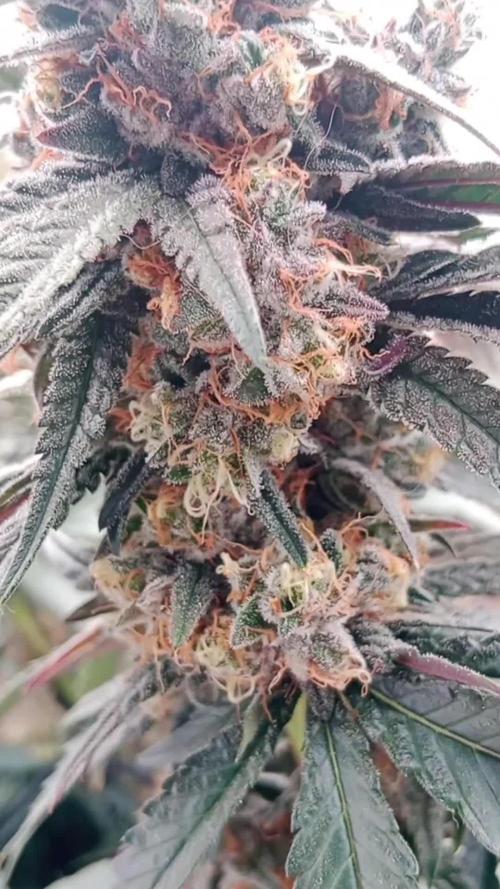
Let's go to the finale. The eighth and final week of flowering. The flowers are hard as a rock. The trichomes are milky and sometimes an amber hue appears.

Likes
46
Share


@Juschiln420
Follow
5/28 added 1.3L banana,3.3L cookies, 2.3L runtz
Resivor is 3 gal now on all
New nutrients
Raised light
Wrapped cookies bucket in foam insulation
Moved Humidifiers and sanitized them
Lollipoped cookies
Defoliation all
Lst all
Closed bottom vents and put two 6" tubes to wrap around tent to block light
6/1 ph
6/2
Light turned up to 100% left at 28"
added nutrients
2ml gro
1.5 micro
1ml bloom
1ml big bud
1ml bud candy
1.5 cal mag
2ml hydroguard
6/3
Lowered light to 26"
nutrients added to make a full feeding
Runtz and cookies
Bloom-Full strength/ 3gal
Micro 0.75/L =8.5ml
Gro 1.0/L =8ml
Bloom 0.75/L=7.5ml
Cal mag 1/L = 10ml
Bud candy 0.5/L= 4.6ml
Big bud 0.5/L = 4.6ml
Hydroguard 2ml/gal=4ml
Banana
Bloom-Full strength/2.5gal
Micro 0.75/L=5.5ml
Gro 1.0/L=7.5ml
Bloom 0.75/L=6ml
Cal mag 1.0/L=8ml
Bud candy 0.5/L=4.65ml
Big bud 0.5/L=4.65ml
Records kept here
https://1drv.ms/x/s!AmTQ-7u9iyH6kDFcBT1QhRk7ttv4


Likes
10
Share


@Ktims420
Follow
Very happy with the grow so far , been doing next to nothing to these girls. I haven’t topped or trained at all they are pretty bushy and my space is limited for LST. All but one have started flowering. Any advice I’m all ears still a big amateur.
Likes
17
Share

@foxbberg
Follow
Day 22:
Drain EC 3 feet high and risin'😅( average 3.3 to be exact...)
dunno how much whatever-salt is building up in that pots, but it obviuosly doesn't bother the ladies.
Dark green colour, very few 'claws', no signs of tipp-burn, new foliage appears in a juicy green and turns dark in an instant, leafs point upwards.......
looks like they're happy😊.
Planns for this week:
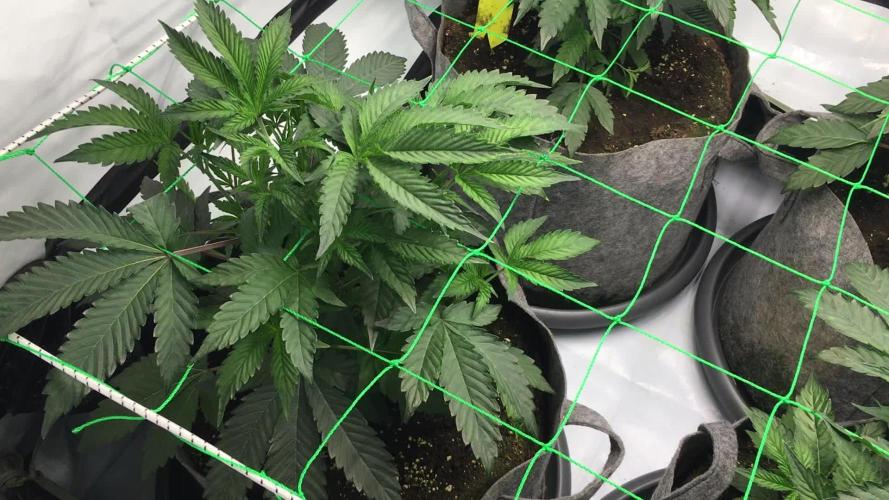
- Install the scrog-net
- Obsereve plants/soil ( when do i have to feed nutrients again?)
otherwise there will be no changes......
Thoughts:
These bushy babies will be kind of a challlenge to create this scrog the way i'm used to (basically bending the 4 main main colas to the corners of the tent, upper branches to the walls and spaces between the pants, lower branches to the very center).
Now these ladies make so many branches, so close togehter and so equal in length, underneath huge fanleafs..... i'd love to have them in a 100 square meter canna-crib....but in a tent...????? I really hate doin' things without having them planned - but in this case i guess i will have to install the net, start weaving and see what's happening😯
Day 23
Let's keep it positive...... indoor-climate of 64% rh is perfect for my health💪😁!!! ......but in my tent it's killing the vpd😖.
at a lousy 24 degrees C, i'm readin' about 60-64 % rh wich results in about 0.7 to 0.8 kPa.*
More figures? Here come the crazyones👻!:
pH 5.5; EC 4.2😨
but thats only drain from plant 3....... average was 6.1/3.6
The girls busy produce roots, shoots and leafs....... still very green, still not unhealthy.......few claws, no tipp-burn.
Basically a comfortable place to be: It's not bad yet - no work but watering - and it can only get better!!!😁
*VPD issue solved:
The sensor hung too close to a fanleaf - didn‘t expect this thing beeing so sensitive 😅.
Day 24
Climbed new hights this morning: Plant 1 had an EC of 3.8 - the others didn't climb any higher than yesterday.
So maybe we've reached the climax..... 😇
Visible growth now - so i installed the scrog-net and will start bending and weaving these days:-)
Thoughts:
Did beeing out of VPD-range for one day harm my plants? How exact can my sensor measure VPD?
after a bit of research i found out: Whatever you buy for less than 200 bucks is far from beeing exact! Even professional sensors have a margin of about +/- 1% in relative humidity. Thermometers at least +/- 0.5 degrees C. This could give some a good guess of the actual VPD BUT: Leaf-temperature-offset is absolute key! Many of our trusted homegrow-equippment isn't even able to measure it (some offer default temp-offset) ....don't wanna go further here - but there's no way to achieve something like a precise VPD-measurement in homegrowing.
So why caring for VPD?
Even with those less accurate instruments, you may be able to keep your plants in something like a comfort-zone. Way better than only guessing 👆!!!
In case i ran a much higher VPD than planned, yesterday (due to a missplaced sensor) , it will not harm or kill my plants. they might have had a bit of stress from dry air - but nothing to worry about!
Day 24:
Decreasing salt-levels in the drain - excepting plant 4, wich had an EC of 4.0 - so i guess i'm slowly draining exess-salts from top to bottom and might have collected some build-up.
The girls seem to be quite okay. Root-growth is vigorous (there are thick, white roots penetrating through the pots, everywhere), the stems are relatively thin.
removed the LST-lines.
the Sc.r.o.g:
only materiels needed, were a climbing-net for gardening (HDPE) cut to 90x90 for my 1x1 tent, 4 cable-ties and 2 meters of strong rubber-cord.
Pre-installed the net with the cable-ties, then weaved the cord around the outter cords of the net, led it aroud the posts and pulled tight.
Then brought the net into it's final position. Not as sturdy as with a wooden frame - but i had less than half the work and a bit of freedom to move things if necessary.
Any shoot will now be put to the next outter square (relative to the center of each plant) as soon as can be held by the net, without harming the top.
Once i moved all of the dominant colas to the next square, i'll have to take 10-15cm steps (vertical growth), to reach the next square.
As soon as i have about 70 of my 81 squares filled, i'm going to flip to 12/12. Since i'm plannin' to have them full of sugar when flippin', i don't expect too much of a stretch. This way i hopefully have the longest and strongest shoots framing the shorter ones in the center - so the canopy shapes like a bowl, in order to achieve the most even light distribution possible.
Day 25:
The main colas visibly reached out for the light - but yet i only moved 1 single shoot to the next square.
Girls look good, EC is dropping slowly, climate fine.
CU tomorrow👋
day 26:
on Track... nothing to worry about......
till day 28.......
Due to high EC levels in the soil, i couldn't do much more than pour out some water and prepare the scrog this week.
Next week i will have to do some weaving. If the nutrientlevels allow, i'll do some defoliation.
Likes
32
Share


@Sadhus
Follow
Bon le ph descend en flèche tout les jours, l' ec lui monte en flèche tout les jours, tout conseil est bien a prendre , quelque feuille brûlé sur les bords , et les pointes des feuilles qui se tortille


Processing
Likes
5
Share


@FrightNiteFreddy94
Follow
Everything's good buying a 600watt ZNet 4 to add more light!


Processing
Likes
5
Share


@Ensign420
Follow
Week 02 Introduction
This week has been a bit of a struggle. Had my first experience dealing with slime and brown algae. But I think adding enzymes and increasing the beneficial bacteria helped to fix the issue. Also experienced nutrient burn for the first time. My nutrient solution strength got as high as 671 PPMs. So backed it down to about 430 PPMs during the end-of-week reservoir change. Also cut Hydroguard (expired?), CaliMagic, and Superthrive from this grow. Now she's still stunted, but is starting to recover. Hopefully...
[START OF WEEK 02]
Day 01 - Monday - 08/10/20 - Total Days: 008
-----------------------------------
- [0830]: Still looks a bit yellow. But getting larger!
--- Solution strength was at 248 PPMs.
--- Just topped off with a bit of distilled water
--- PH went up to 6.1 so PH'd down to 5.8
--- Ran the top feed for a bit to wet the hydroton.
- [2130]: She's looking even more yellow now.
--- Even the new leaves are really yellow.
--- Decided to add more base nutes.
--- Added 4ml of Sensi A
--- Added 4ml of Sensi B
--- Now at about
--- Solution Strength went up to 304 PPM.
--- PH was at 6,
--- Also raised the water level a bit more.
--- I really hope it's a nutrient deficiency and not an over-watering issue.
--- Please live!
Day 02 - Tuesday - 08/11/20 - Total Days: 009
-----------------------------------
- [0830]: Looking less droopy. But still yellow.
--- Decided to do a reservoir change.
--- 4.5gal of distilled water
--- 8ml of Sensi Grow A
--- 8ml of Sensi Grow B
--- 8ml of Voodoo Juice
--- 4ml of B-52
--- 4ml of CaliMagic
--- 4ml of Hydroguard
--- 4 drops of Superthrive
--- PH'd down to 5.8
--- Solution strength: 302 PPM
--- Since I didn't want to risk over-watering the rockwool, I did not to do a top feed, may do one tonight after the sleep cycle (lights are still set to go off at 10am and back on at 4pm).
--- As I was doing a reservoir change, I noticed that the tubes and bucket were a bit slimy. Didn't really stink or anything. Is this normal? Maybe due to the Hydroguard and Voodoo Juice?
--- I hope she gets better soon!
- [2215]: Getting larger! But still yellow.
--- Also can see a root growing through the net pot! Tiny little thing but it's there! Will have to start dropping water once more appear.
--- After looking over a few DWC diaries using AN nutes, seems like my solution strength is still too low. Most around this stage average around 500 PPMs with about 4ml per gallon.
--- Top fed for a minute to wet the top of the hydroton.
--- Solution strength went down to 263 PPM.
--- Added 8ml more of Sensi A
--- Added 8ml more of Sensi B
--- Now base nutes are at 16ml for 4.5 gal of water.
--- PPMs went up to 411.
--- Still lower than 500 PPMs, but that's okay.
--- PH was at 6. Not sure if I should adjust PH using AN nutes. So going to not ajdust unless PH goes above 6.1.
Day 03 - Wednesday - 08/12/20 - Total Days: 010
-----------------------------------
- [0830]: Looks like more root growth!
--- She still looks yellow. But leaves are perky.
--- PH was at 6.2 so lowered down to 5.8.
--- Solution strength was at 394 PPMs
--- Since roots are still growing, I decide to lower the water level a bit. Now water level is a bit below the net pot.
- [2200]: Root is getting longer!
--- Slime is returning. Not sure why.
--- Solution strength: 357 PPMs
--- PH: 6.1
--- Decided to add an enzyme along with more beneficial bacteria to hopefully cure the slime.
--- Added 16ml of Sensizym
--- Added 5ml of Hydroguard
--- Added 8ml of Voodoo Juice
--- New solution strength: 430 PPMs
--- New PH: 6.1
--- Top fed for a minute.
--- This slimy residue is really freaking me out! I hope the added enzymes will help eliminate the slime.
--- Going to do a full reservoir sterilization/nutrient change over the weekend. Please survive until then girl!
Day 04 - Thursday - 08/13/20 - Total Days: 011
-----------------------------------
- [0930]: I think the enzymes worked! There is little to no slime now!
--- Although I think the root was also dissolved in the process. It's now just a little stub sticking just below the net pot. The enzyme is also suppose to dissolved dead roots too but guess that root was too weak? Not sure what happened there. But I think the slime is cured!
--- Solution strength went down to 395 PPMs. Decided to add more base nutrients.
--- Added 8ml of Sensi A
--- Added 8ml of Sensi B
--- Added 4ml of B-52
--- Solution strength went up to 598 PPMs.
--- PH was at 6.1
--- As long as the PH is between 5.5 and 6.3, I'm not going to use PH Up or Down. But still will monitor PH levels.
- [1715]: Checked up on her after her nap and shes looking alive but stunted. But no slime!
--- Decided to add some sugars to help maintain the enzymes and beneficial bacteria.
--- Solution strength was at 587 PPMs.
--- PH was at 6.2
--- Added 8ml of Bud Candy
--- Solution strength went up to 671 PPMs.
--- PH also went up to 6.3
--- Lowered water level a bit to hopefully promote more root growth.
--- Top fed for a minute.
--- She is getting bigger, but still looks yellow.
Day 05 - Friday - 08/14/20 - Total Days: 012
-----------------------------------
- [0915]: Leaves look a little burnt on the tips. Still no slime.
--- Going to back off on the PPMs to hopefully fix the nutrient toxicity.
--- Solution strength was at 632 PPMs
--- PH was at 6.3
--- Added/Removed water until PPMs were at 536.
--- PH was still at 6.3
--- Raised water up a bit, then top fed for a minute.
- [2200]: Looking better. Still yellow though.
--- Solution strength: 514 PPMs
--- PH: 6.5
--- Added PH down.
--- New solution strength: 518 PPMs
--- New PH: 5.2
--- PH was kind of high. So decided to PH down. Had to use quite a bit to bring it down. But eventually got it to drop down to 5.3. A little low, but so far, the PH has always gone up so wanted to start it really low.
--- Ran the top feed for a minute to re-saturate the top of the hydroton.
Day 06 - Saturday - 08/15/20 - Total Days: 013
-----------------------------------
- [0830]: She looks stunted. leaves are still yellow.
--- Solution strength: 514 PPMs
--- PH: 5.6
--- Top fed for a minute.
--- Not sure what to do at this point. Going to do another reservoir change soon. Hoping she lives until then.
- [2145]: Looking pretty much the same.
--- A bit of slime has returned. Since I've been diluting the nutrient solution, the enzyme ratio has dropped. So I guess this is expected.
--- Also noticed that slime build up was on the air-stones. Never really checked the stones so not sure how long that has been there. Looks brown too, which can't be good.
--- Going to do an H202 sterilization of the system (minus the net pot) tomorrow so did not add anything.
--- Lowered the water level to below the net pot.
--- Then top fed for a minute.
Day 07 - Sunday - 08/16/20 - Total Days: 014
-----------------------------------
- [0900]: STERILIZATION DAY!
--- Decided to skip today's night cycle for a deep clean.
--- I'm hoping that skipping a night cycle won't be too stressful.
--- Temporarily moved her to a new bucket.
--- Used about a half of gallon of straight distilled water to flush out the net pot.
--- Drained the system and wiped up all the brown sludge. Also removed the air stones and cleaned up all the goo.
--- Filled the system with 2 gallons of distilled water and at least 30ml of food grade hydrogen peroxide (35% strength).
--- Yea its a lot, but since I'm not going to sterilize the system overnight, I went with a really high doseage. Basically I kept adding until I started to see little bubbles start to form.
--- Then I ran the water pump.
- [0915]: Boiled the air stones in tap water for about 10 min. Then reconnected them to the airlines.
--- I let the air stones and hose soak in the sterilization solution for about 5 minutes so the peroxide can absorb into the stones. Then ran the air stone to help mix and agitate the solution.
--- Occasionally, I'd repeat the process of turning the air pump off for a few minutes to let the stones soak.
- [1000]: Covered the top two row of holes of the net pot with some aluminum tape. Hopefully this solves the light leaking in through the hydroton.
- [1200]: Used an old toothbrush and scrubbed the pump clean. Then drained the system.
--- Refilled with more distilled water and peroxide. Again added a lot.
--- Ran system again to sterilize even more.
- [1530]: Drained the system and refilled with distilled water to rinse.
--- Ran the system for a few minutes, then drained and rinsed again.
--- Did this a few more times over about an hour.
- [1630]: Added 4 gallons of fresh distilled water.
--- Added 15ml Sensi Grow A
--- Added 15ml Sensi Grow B
--- Added 12ml of B-52
--- Added 16ml of Voodoo Juice
--- Added 16ml Sensizym
--- Solution strength was at 430 PPMs
--- PH was at 5.6
--- I was going to add Hydroguard, but I think the bottle is expired. Since 2017 or 2018!? I think Hydroguard is good for up to 2 years from the date on the bottle or 6 months after opening. So not going to use from now on. I wonder if this could have contributed to the slime build up.
--- Also removed the CaliMagic and Superthrive too. Going to only use AN products to eliminate the chance of incompatible nutrients.
--- Placed her back in the bucket and top fed for a minute.
--- Here's hoping for the best. Going to let it ride until morning! Please feel better!
[END OF WEEK 02]

Likes
10
Share


@AUTOBUDDHA
Follow
These Blue dream matic Autos are gonna be some absolute monsters! Here we are at 37 days and were sitting at almost a week into flower, qnd the plants are over 17 inches tall.
Looking at a great yielding strain here! Starting to get a good amount of smell to them! Super healthy plants, and super heavy stalks.
First round of nutrients came at 35 days. They were moved to the hps at 32 days. General hydro, flora trio at 5ml each per gallon.
They EXPLODED overnight.
This week, i will begin some light lst and defoliation.
Also, this week I will be hanging my brand new HLG Diablo 650R. These 5 blue dreams will be moved from the hps to the Diablo.
Likes
21
Share


@OGTrauma
Follow
Hi there my beloved stoners who take all the pain about reading these text walls, i'm taking this week as nutrient schema week because, as i changed to a new substrate i have to deal with new shit as i'm trying to bond over with these new medium. Organic Life Light mix is a local product that can be found mostly in Chile and some parts of South America as well. There is no much review about it but most insights nevertheless if the brand can be considered on the u get what you pay acording to its price , is more than that as it's a bit more complex to grow on a peat moss & coco coir mix and noticed it as im having some nutrient issues (detailed below ) as well watering is different , dear readers i have experienced it as well ! .
I can make accountable the substrate on these ones 4 days evolved in a good and a bad way at the same time , as it's seems to be really light & airy gives the advantage of seeing some more faster growth , but at the same time has quite low nutritional value as older leaves already becoming yellow, yet discarding a nutrient block due excess because no edges are burnt , also considering the shit i used previous week is pretty organic and i stay on the lower doses. This gave me a bit more of dependency and record on the food i give to my babies, the reason that spams this post itself, if this CalMag helped to correct the issues depicted on photos as exampled. Hope this doesn't evolve to the worst hahahahahaha. (If anything shitty happens or something cryptic goes beyond my understanding i will post it , yet the update on 28/08 shows everything went better than expected! 😇).
I discard tap water quality as secondary cause on the issue (water from a faucet ) as if that shit were causing glitches, it could have happened on the start of my previous grow too! And the substrate was different too, on the bright side now i have to think that its easier to correct carencies more than excess as well.
On the space aspect also sorted the light bulbs to be closer to the plants now that are a bit more matured rather than seedlings, it's a 4000k & 6500k dominant mix according to what is better to vegging itself and changed it to 3 different modules to play with height if have some stretching differences between the killer kush f1 siblings.
BIG GAS LEAKS CRUSTY MOTHERFUCKERS AND XUPENLA MIANDO CTM !!!
Likes
10
Share


@CastilFarm420
Follow
Tuvimos unos días apurados por la aparición de unos pequeños bichos que solucionamos con una fumigacion con tierra de diatomeas y con la potente abamectina, subimos un poco más las nemesis y ahí van estupendamente
Likes
121
Share


@NuggetPawn
Follow
So she was chopped (wet trimmed) yesterday (F74) and is now hanging up to dry at 55% RH and temps between 15 and 18ºc.
I made fresh frozen dry ice hash today using a 160 micron bubble bag, a flat surface, 8kg of dry ice and a couple 5 gal buckets. I already have the weights for that, which far exceeded my expectations. Those figures I will post once she is dried and in 1 quart screw top glass jars.
People suppose dry ice hash is inferior quality vs bubble hash. I am not experienced enough to comment on that but must say it is extremely easy to make hash with dry ice, it took 40 mins to process 995g of trim which included sugar leaves, some stems and popcorn buds. I then pressed it into 3.5g briquettes for storage using a pollen press. As you can see from videos, this stuff is all blonde - and after already trying some today with some friends, it knocked our boots off!
Will be back in 5-7 days with harvest figures, smoke analysis and other details!
Happy growing all!
P.s I ticked defoliation this week - the only week I intentionally cut any leaves off for the entire grow 😉
Likes
56
Share


@KingSalomonsWeed
Follow
Das war ein aufregender Lauf. Problemlos, aber aufregend sexy.
So ab Blüte fühlte es sich an wie das Video. Aufregend, Anziehend.
Das ist total geiles Weed!
9 Punkte
Sehr Empfehlenswert für Feinschmecker, die wenig Zeit haben.
Und trotzdem ne starke Brise um die Ohren gehauen bekommen wollen.
03. Februar
Oh Jungs?
Knallt gut!
Schmeckt gut!
SWEET SEEDS, SUPERSORTE!
06. Februar
Munchies und ein tiefer zufriedener Schlaf inklusive. " GEIL "
Likes
10
Share


@Big_Dennis_Budz
Follow
Tweaking the feed every watering, increasing the big bud and dropping the voodoo slowly




Likes
38
Share


@Magnetous_tryko
Follow
Here we are, last week of feeding! She has been showing the first ambers begining of the week so I don't want to wait too long before harvest. Week 11 will be flush week.
I really love this pheno; how it looks, smells and I hope tastes!
The buds have nicely grown in size this last two week and trimming should be quite easy on this one! 😘
I realize I did't take global pics this week so next week before harvest I'll make plenty of them.
But, I made a video attempt trying to film in macro and I already feel sorry for those of you that will get sick watching it... 😨 With this level of zoom it is so difficult to have a smooth travelling and no shaking, especially when you have to manually live focus. I will improve my skills for the harvest video!
Likes
18
Share


@FatCobra
Follow
Great week!!! What a resilient plant, a few different times now I’ve come up with issues, I attempt to diagnose and compensate with my limited growing knowledge and the thing just keeps coming back better and healthier and stronger then before.
So far, I am very happy with this strain, Dresden Green Diamond from the Garden of Green seed company because it’s been so easy for a beginner like me and it’s going so well. Looks like they are either sold out or they discontinued the strain possibly I got them as freebies with my order on Seedsman but yea super happy with it.
So on to the meat and potatoes of this week. I realized the biggest issue that I have now is going to be controlling the heigh of the plant. It’s only a 4 foot tent. The pot takes at least a foot of height space away, the light is currently as high as the pulley system allows and is still hanging down a foot from the top. (I may have to end up just juryrigging a new attachment system for it to get more space. Also the plant is now about a foot tall and the light is 10 inches away. I’ve heard that they can double or more in height during flowering which would be a problem.
So what to do? I topped it this week for the first time. Hoping that will redirect some of the plants energy into developing the lower branches, of which I have a healthy number. So I’m hoping they will catch up with the top of the plant and I just have a bunch of top sites. There are also 2 new top branches starting to grow from the top site. As soon as they are big enough I will bend them at a 90 degree angle to try and prevent it from going any taller than this point. I haven’t got around to it yet but I will begin LST this week as well to spread the branches out a bit and have them more horizontal to fill up more of my space.
Overall, things are going great.

Likes
20
Share


@4F1M6
Follow
So she really stretched super hard when she geared up for bloom. Over night she hit me with 6 inches of growth. Leaving my grow light far to close for the fragile new growth that was coming in. It was a lot worse mid grow week last week. I re adjusted my lighting SMH. Her tips slightly recovered but They will never fully recover.
Other than that... shes stack amazing. Super bushy and LOTS of budsites. Bunch of donkey dock cola candidates. If I can stop beating em up with light intensity. She spans the full 2x2 like a beast. What an autoflower.
I preventative treated her again with Dr zhymes. Shes due for another shower mid week. Got her on a solid balanced feed. I will adjust levels as needed from here. Until next update. Happy growing and stay lit fam.

Likes
72
Share


@BodyByVio
Follow
After 14 days drying, 7 days hanging and another 7 days on cardboard boxes 📦 at a temp between 61 and 65 degrees F and a humidity between 52-55 % I trimmed all the buds and jar them with Boveda 62. After 2 days in jars ( 16 days from cutting the plant down) I weighed in everything. I got 434g of grade A buds and 685g of Grade B ( perfectly smokable ) buds plus a lot of trim that I didn’t weight.
I’m very pleased with everything and I enjoyed every single step along the way. Probably next time I will lollipop/defoliate more aggressively so I can get more top bud and less grade b bud.