Likes
Comments
Share
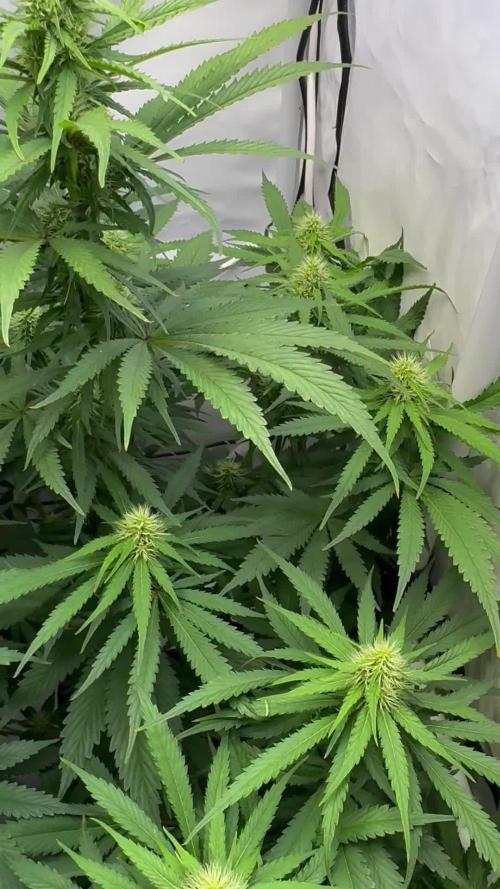
Heyho Leute, wie man sieht geht eine der Ladys durch die Decke 😝 Naja, mal sehen. Wir haben Tag 22 in der Blüte. Habe grob „unnerum" frei gemacht und habs Licht derzeit auf 70 %. Da es drei unterschiedliche Sorten sind, sieht man echt gut wie unterschiedlich sie auf den Dünger reagieren. Ein bisschen angesengte Spitzen haben die beiden großen. Die Banner interessiert es irgendwie gefühlt nicht 😃 Die gushers hat leider nur noch 20 cm bis zur Lampe und wenn sie weiter wächst, komme ich ohne Supercropping nicht hin. Andernfalls toaste ich den headbud.😄Ajo, ist dann halt so. Ich probiere grade von Bionova ein alternativen Silikat düngen aus. Der verschmoddert einem nicht so das Autopot System wie der von TA. Grüße 🖖🏼
Likes
44
Share
@Belverde
Follow
Hello everyone Welcome 🙂 We are now at the end of week 15 from seed with this delicious , GREEN GELATO 🌲🍦 74° days of bloom.. Another few days and then ✂️ After the cut I will dry it properly , for 5 to 10 days , it dipends , in temperature around 20/23°C and ur 50/60% , the entire plant.. After that , when the branches are dry but before the crack sound , I will do a nice manicuring and then I put the flowers in a browbag for one or two days , it depends.. Then , when I will think the moinsture of the buds can be good , I will put the flowers in to the jar.. Not all full but just for 3/4.. And then I will start the curing process.. Usually after the first time I have put the buds in to the jar , I leave it closed for 24 h.. After this full day closed , I will start to open up the jar four times a day every six hours for the first week.. And then I will doing it for about three to four weeks , and every week I will open the jar one time less.. Sometimes I change the metod , but the final product it's always be the same 👌🔥 But when I will finish this process I show you in a video how the ash it's and especyally how it's will burn , nice and slowly without still continue to light up.. That's all.. See you in a few weeks , maybe one month and half , for the Harwest report and for see in the end how the flowers will looks like and if they burn in the right way.. Slow , clean , tasty and smooth.. Thanks guys for stopping by here and support all this weeks or just now for the first time👍👍 Hope you was enjoy 😎 Ciao✌️ 🇮🇹 BONUS If you like too see , for almost her entire life cycle , she share the space with other girls that you can find in the links here below 👇👇👇 https://growdiaries.com/diaries/46286-barney-039-s-farm-dos-si-dos-33-grow-journal-by-fun-clouds This.. https://growdiaries.com/diaries/46282-barney-039-s-farm-blue-gelato-41-grow-journal-by-fun-clouds And another one.. https://growdiaries.com/diaries/48209-barney-039-s-farm-dos-si-dos-33-grow-journal-by-funclouds 😉🌱
Processing
Likes
4
Share
Noticed some slight yellowing and the white blemishes on a couple of the older plant's leaves were getting bigger. I believed the white blemishes were do to a cal-mag deficiency and added that to my feed. Also was using 1/4 nute strength and now bumped up to full to counter the yellowing. Started LST this week too.
Likes
3
Share
Likes
47
Share
🌱Welcome to my 2 x 4 ft autoflower tent. Who else is stoned as fuck? Here we have Fast Buds tester 2210. We just finished the 3rd week of flower and holy shit she's getting tall. Last week we saw her shoot up 7 inches. This week was 6 inches. That's almost an inch per day! she is now the tallest in the tent and taking on more of a sativa hybrid structure. She is looking like she's about to put on some huge flowers 😌💨 💧She has been receiving water every other day about 1 L of pH adjusted to 6.5. ✂️ TRAINING: N/A. 💡⚡Check Mars Hydro out on Instagram! @marshydro_aliexpress2 💡⚡
Likes
119
Share
Hello, my green journey companions! What a thrilling odyssey it has been, and here we are, standing on the cusp of the harvest. The time has come for the Last Report Before the Harvest for our beloved Jealousy in the Power Buds competition. Jealousy, in all her botanical magnificence, has gracefully faded out to black, and the emergence of those stunning black leaves is a sight to behold. It's like the grand finale of a cosmic ballet, where every leaf dons a cloak of darkness, contributing to the dramatic allure of our green empress. Now, let's talk trichomes—the celestial jewels of the cannabis world. As they shimmer like stars in the night sky, the majority have taken on a cloudy appearance, which is precisely where we want them. The cloudiness signals that the THC is at its peak, providing the perfect balance between potency and flavor. This is the sweet spot, where the magic of cannabinoids and terpenes converges to deliver an optimal sensory experience. The abundance of trichomes, akin to stars in the sky, is a testament to the genetic prowess and care that Jealousy has received. Each tiny crystal is like a botanical gem, contributing to the overall potency and character of the harvest. The trichomes are the storytellers of this journey, capturing the essence of the plant's journey from seed to bud. And now, let's talk about the olfactory symphony that fills the room. The mix of strawberry bubble gum and candy is nothing short of aromatic alchemy. I'm glad you have a good carbon filter; otherwise, my neighbors might start wondering if Willy Wonka decided to open a strawberry-themed factory next door! lol The joke aside, it's a testament to the incredible terpene profile Jealousy possesses, creating an olfactory experience that is both enchanting and mouthwatering. As Jealousy rests in the dark for 36 hours before harvest, it's like the calm before the storm—a botanical meditation where the plant consolidates its energy for the final act. The decision to harvest at day 63 is a culmination of careful observation, from the germination report to the present moment. Reflecting on this journey, it's been a rollercoaster of green emotions. From the excitement of germination to the strategic moves during the vegetative and flowering phases, every decision has shaped the destiny of our botanical queen. It's like watching a masterpiece unfold, stroke by stroke, leaf by leaf. And now, the traditional shout-outs. A grand salute to Zamnesia for providing the seeds that set this journey in motion, to Plagron for the nutrients that fueled the growth, to Grow Diaries for being the platform on which we share our horticultural tale, and to the incredible community for sharing in the collective knowledge that enriched our green adventure. To my fellow contestants and growers, may your own green odysseys be filled with as much joy, learning, and success as mine has been. Here's to a harvest that exceeds expectations, to the culmination of our shared green dreams, and to the anticipation of what lies beyond. Stay green, stay inspired, and keep cultivating those dreams! With true love comes happiness. Always believe in yourself and always do things expecting nothing in return, with an open heart. Be a giver, and the universe will respond in ways you can’t even dream of . Friendly reminder: all you see here is pure research and for educational purposes only. Genetics - Jelousy @Zamnesia Nutrients @Plagron Light - @viparspectra P2000 Room size - 3x3 - 0,9x0,9
Likes
4
Share
Absolutely gorgeous strain 😍, the all 3 phenos of Runtz muffin have big size, fat big leafs and they look like they can't wait to get very big and produce many fat sticky colas! This is gonna be a great strain to grow here in spain outdoors, I really hope to find a new favorite flavor here!!
Likes
9
Share
@Ryno1990
Follow
Today starts my flush week for this beautiful wedding glue from fastbuds the gelato is budding really nice an should only have another week or two before flush time
Likes
14
Share
@BatGuano
Follow
This is the final week right before the harvest. I am very pleased with the results. I am also glad that Spider Mite problems ceased once and for all with the harvest :)
Processing
Likes
20
Share
Likes
92
Share
@GMSgrows
Follow
The Cheese trees are doing great. Buds getting nice, tight, and large. GanjaFarmerSeeds has some real great genetics going on there. The scent from the cheese is very strong, overpowering my extraction fan as the lights go out. Fills my entire house with her smell. Very pleasing to me, but not so much for the wife. A few more weeks left for these ladies. The trim is going to be a breeze. Not much leaf in these flowers. Love trimming the indoor weed. Thanks for the looks, likes, and comments my friends🙏
Processing
Likes
14
Share
@Datiko
Follow
I Topped 3 days ago, she got a little bit stress, she could be stressfull if i top earlyer, so i hadnot other way. I think she will give me 50-60 g dry buds... but i am scaryed with this. she is still not flowering. explain me why. almos every GSC auto starts flowering at 5 week
Likes
16
Share
Seedling managing 93F 30%RH, around 20 DLI. Vpd is in the 3's. No I don't recommend. Signum Magnum. "A great sign appeared in the sky a woman clothed with the sun with the moon under her feet and on her head a crown of twelve stars. Sing ye to the Lord a new canticle: because He has done wonderful things. Glory to the Father, and to the Son, and to the Holy Spirit As it was in the beginning, and now, and ever shall be, world without end." The plant nutrient nitrogen exists in forms with both positive and negative charges. Ammonium (NH4+)(immobile in soil)(Cation) has a positive charge, while nitrate (NO3-) (highly mobile in soil)(Anion)has a negative charge. Nitrogen is unique among plant nutrients in that it can exist in both positively charged (ammonium, NH₄⁺) and negatively charged (nitrate, NO₃⁻) forms in the soil. This makes it a special nutrient. In that it is responsible for providing balance for reactionary trade offs when it comes to ph. Because ph itself in the medium will always slowly drift towards acidicity, such is nature. 80% of nitrogen should be nitrate and no more than 20% ammoniacal nitrogen. Ca, mg, and K are the big 3 cations related to soil composition, pH & base saturation. When nitrogen is in the form of ammonium, it can compete with calcium, magnesium, and potassium for absorption sites in the plant root. This competition can lead to a reduction in the uptake of these other essential nutrients. Nitrogen, particularly in its nitrate form (NO3-), can increase soil acidity, which can also affect the availability of calcium, magnesium, and potassium. The form of nitrogen applied (ammonium vs. nitrate) can influence its interactions with other nutrients. Ammonium nitrogen can have a more pronounced negative effect on the uptake of calcium, magnesium, and potassium compared to nitrate nitrogen. Common forms of ammonium nitrogen include ammonium ion (NH4+), urea, and ammonium compounds like ammonium nitrate, ammonium sulfate, and ammonium phosphate. Common forms of nitrate nitrogen include potassium nitrate (KNO3), sodium nitrate (NaNO3), calcium nitrate (Ca(NO3)2), and ammonium nitrate (NH4NO3). Phosphorus is an essential plant nutrient, and its availability in the soil is strongly linked to the presence of oxygen. Plants primarily absorb phosphorus as phosphate (PO4), and oxygen is a key component of this molecule. Furthermore, the availability of phosphorus in the soil can be impacted by factors like soil aeration and temperature, which in turn affect the oxygen supply to the roots. Phosphorus uptake in plants is most critical during the early stages of growth, particularly within the first few weeks of plant development. Young plants actively growing tissues have a high demand for phosphorus. They may absorb up to 75% of their total phosphorus requirements within the first few weeks of vegetative growth, with up to 51% of uptake happening overnight, primarily in the first few hours or early nightfall. ⑨Anaerobic root respiration, or respiration without oxygen, is detrimental to plants because it's less efficient and produces toxic byproducts, leading to reduced energy production, nutrient uptake issues, and ultimately, root damage and plant stress. ⑨Anaerobic respiration, unlike aerobic respiration, doesn't utilize oxygen as the final electron acceptor in the electron transport chain. This results in a significant drop in the amount of energy (ATP) produced, which is necessary for various plant functions, including growth, nutrient uptake, and maintenance of cellular processes. ⑨In the absence of oxygen, plants produce byproducts like ethanol and lactic acid during anaerobic fermentation. These byproducts can be toxic to the roots and inhibit their function, ⑨When oxygen is depleted in a medium, the pH tends to decrease (become more acidic) due to the production of metabolic byproducts. This is particularly relevant in biological systems where aerobic respiration relies on oxygen as the final electron acceptor. ⑨When oxygen is scarce, plants may switch to anaerobic respiration. This process produces carbon dioxide (CO2) as a byproduct. ⑨CO2 dissolves in water to form carbonic acid (H2CO3). This acid lowers the pH of the medium, making it more acidic. ⑨Anaerobic conditions can impair a plant's ability to regulate its internal pH, leading to a drop in cytoplasmic pH and potentially cellular acidosis. ⑨The change in pH can also affect the availability of certain nutrients to the plant, as pH influences the solubility of micronutrients like iron, manganese, zinc, copper, and boron. ⑨The lack of oxygen in the plant medium leads to a decrease in pH due to the production of carbon dioxide during anaerobic respiration and impaired pH regulation within the plant. In plant cells, cellular acidosis, a drop in the internal pH of the cytosol, is a significant stress response, particularly during conditions like flooding or hypoxia. This acidification can be triggered by a decrease in oxygen levels, leading to the production of metabolic byproducts like lactic acid and CO2. The plant's ability to tolerate and recover from these conditions depends on its cellular mechanisms to regulate pH and mitigate the effects of acidosis. When plants are subjected to low oxygen environments, such as those experienced during flooding, anaerobic metabolism, which produces lactic acid and ethanol, becomes the primary source of energy. This can lead to a build-up of these acidic metabolites in the cytosol, causing a drop in pH. OXYGEN Atomic oxygen (single oxygen atom, O) is the lightest form of oxygen, as it has the lowest mass of the oxygen molecules. Oxygen also exists as a diatomic molecule (O2) and an allotrope called ozone (O3), which have higher masses due to the number of oxygen atoms combined. Atomic Oxygen (O): This refers to a single oxygen atom, which is the most fundamental form of oxygen. Molecular Oxygen (O2): This is the common form of oxygen we breathe, consisting of two oxygen atoms bonded together. Ozone (O3): This is an allotrope of oxygen, meaning it's a different form of the same element, consisting of three oxygen atoms bonded together. Since atomic oxygen has the fewest oxygen atoms, it naturally has the lowest mass compared to O2 or O3. Ozone (O3) Lifespan: Ozone has a relatively long lifespan in the stratosphere, particularly at lower altitudes. For example, at 32 km in the middle latitudes during spring, ozone has a lifetime of about 2 months. Oxygen (O) Lifespan: Atomic oxygen, on the other hand, has a much shorter lifespan. At the same altitude, its lifetime is about 4/100ths of a second. Ozone-Oxygen Cycle: The ozone-oxygen cycle involves the rapid exchange between atomic oxygen (O) and ozone (O3). UV radiation can split molecular oxygen (O2) into atomic oxygen (O), which then reacts with O2 to form ozone (O3). Ozone can also be photolyzed by UV radiation, creating atomic oxygen again, which can then react with O3 to reform O2. Dominant Form: The partitioning of odd oxygen (Ox) between ozone and atomic oxygen favors ozone in the lower stratosphere. This means that a much larger proportion of odd oxygen exists as ozone than as atomic oxygen, especially in the lower stratosphere. Recombination: Atomic oxygen has a high energy and reactivity. When it encounters another oxygen atom, they can combine to form O2. This process releases energy, contributing to the heating of the atmosphere. Ozone Formation: Atomic oxygen can also react with molecular oxygen (O2) to form ozone (O3). Ozone plays a significant role in absorbing harmful UV radiation. Other Reactions: Atomic oxygen can react with various other molecules in the atmosphere, like nitrogen (N2), water (H2O), and carbon dioxide (CO2), forming different compounds. UV light below 240nm (peak 185nm) creates ozone (O₃) through a process called photolysis, where UV light breaks down dioxygen molecules (O₂) into single atomic oxygen atoms (O). These single oxygen atoms then react with other oxygen molecules to form ozone (O₃). Specifically, UV-C light with wavelengths shorter than 240 nm can cause this photolysis. UV light with wavelengths between 240-280 nm, (peak 254 nm) breaks down ozone (O₃) into dioxygen molecules (O₂) and atomic oxygen atoms (O). 280nm does not have the energy potential to break apart the stable bond of (O₂) into enough (O) to make (O₃) At ground level, atomic oxygen (single oxygen atoms) has a very short lifespan. This is because it's highly reactive and quickly combines with other molecules to form stable diatomic oxygen (O2) or other compounds. While the exact timeframe varies depending on the specific circumstances, its lifespan is typically measured in nanoseconds or picoseconds.
Likes
4
Share
Likes
20
Share
@BudXs
Follow
Plants are getting big enough to train through the fence. Im thinking a vertical scrog, but its gonna be a bitch to harvest . We will see, still dunno if they are even female
Likes
20
Share
@SkunkyDog
Follow
Hallo zusammen 🤙. Sie wächst sehr schön und macht keine Probleme.
Likes
12
Share
Aug 10: small but fast this Chemdawg is going to be ready pretty soon. I’ll resist the urge to harvest for a couple more weeks. Using the UV lights for a few hours at mid-day. Early in using it, but I think it helps. Aug 11: another perfect cannabis weather day with all day sun and five hours of UV lights. Ideally I’d have another set of four lights so to get full coverage I’m rotating the plant 90 degrees every 1.5 h or so for five hours total coverage. With the uniform manifold this isn’t a problem as the overall light coverage is quite even. Anyway, she’s getting some good strong light so some trichome production should kick in here soon. Looks good.
Likes
126
Share
Harvest Time of Fast Version B Strain and Welcome to : -Designers Club - Special Thanks to John for hopping through my Messages to Join The SSSC/DP Photo The Project was Supported by Narcos Seeds to give the Strain the Perfect lifespan it could Deserve . Light used for The Contest Grow : Tenty Pro x4 200w in a space of 60x60 Homebox Ambiente Tent. Preparation Before Harvest : 5 Days without Feeding / 2 Days of them Complete in the Dark . Enough Talk from me , just Enjoy youre Seats and be a part of The Designers Club . Good Luck to Everybody and Keep up Growing !
Processing
Likes
28
Share
Goodbye week one and hello week two of flower! No real concerns at this point, she seems to be moving along just fine and starting to stretch a little more every day. Had to raise fan, temp minder and humidity controller censor. Can hardly tell her leaves were stripped last week but won’t pull anymore till she done her stretch. Environment has been exceptionally stable throughout the grow thanks to my new LEDs and humidity controller. Just have to focus on watering 💦 Cheers 🍻 Day 14 flower - They perked right up after that watering. Still running humidity at 60-65%. Can’t wait for another week to go by so I can give it it’s final defoliation. Cheers 🍻