


Likes
Comments
Share

@MmaJunkie420
Follow
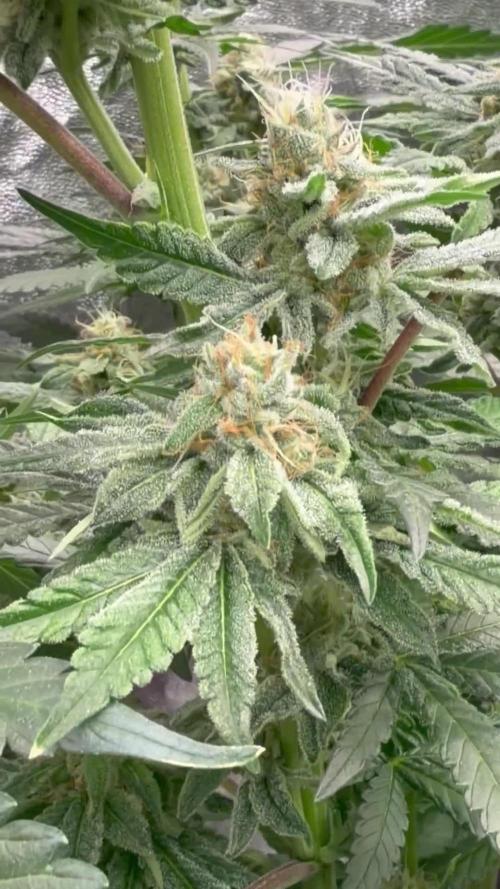
Week6 F start. A lot can happen in a week frozen biscotti #1 Hermied and had to get culled midweek luckily I have FB #2 & #3 and they looking fire smelling like straight vanilla cookies. plucked a few nanners from the zkittlez spread the remaining ladies into centre of the canopy and all looks good to finish. Papaya will be off first in roughly 3 weeks then the FB and Z last in around 4 weeks. Will be stopping pk dead mid week and upping a and b to reach target EC honestly losing 1 plant has been a blessing in disguise humidity is right on track lights are maxed out airflows better and the remaining plants have enjoyed the extra coverage starting to really bulk up now.



Likes
9
Share


@DaddyPrime2
Follow
9/22 topped them at 4th node. some of them are looking better for mainlining that others. some of them i may not mainline and others i left an extra node in case i want to keep clones around.
#1 is looking happy with the topping and looks really good.
#2 is the only one thats been praying and is the tallest and strongest looking all around.
#5 short and such tight internodal spacing that it makes it hard to see whats all there. just looks like a bunch of small leaves until they grow out. i may not mainline this one either be cause of it being so tightly packed it may make it
9/27/24
day 20 theyre growing quite well. #1 i ended up taking the bottom nodes. i was originally goi g to use them as clones later on but decided to just let her go with her 4 nodes. #5 is so tightly packed, she has like 8 mains all in such a small space, its hard to even make sense of it all.

Likes
9
Share


@eldruida_lamota
Follow
Vamos familia actualizamos la cosecha de las kritical.
La verdad que el secado muy bien 7 días en Malla y a los botes, 40% humedad y 24 grados es la temperatura ambiental que han tenido en el secado.
Por lo demás de miedo os la recomiendo.
Gracias a Agrobeta y Mars hydro , sin ellos este proyecto no sería igual 🙏.
Agrobeta:
https://www.agrobeta.com/agrobetatiendaonline/36-abonos-canamo
Mars hydro:
Code discount: EL420
https://www.mars-hydro.com/
Buenos humos.


Likes
82
Share


@PapaNugs
Follow
Big week here. Got the girls transplanted to their 7 gallon pots. First time with pots this big. Gonna really let them grow. Got a little water with BT and mycorrhiza.
Likes
14
Share


@Docteur_8
Follow
I finally topped them for main-lining. Will stay in vegetative cycle until they ready. ✌️🏼


Likes
11
Share


@TheMadHasher
Follow
Whats up everybody cheers to another week of growth for everyone!
This week the ladies buds started showing signs of progress. You can see them produce more and more resin every day thanks to the cold weather its really easy to keep a pretty dry environment. Can’t wait to do my final defo next week! Until then stay green!


Likes
3
Share


@Cultiv8or
Follow
I think there’s been some sort of salt build up / nutrient lock. The lower leaves have been turning a lighter green and some even yellow on SL plants. Most stems are red. Seems like it’s a pH problem. I flushed them with 4-5 litres of water to reduce the nutrient concentration in the roots.
Going to introduce molasses in next feeding! Organic Unsulphered
And also stop the Micro (nitrogen)


Likes
4
Share


@kens1
Follow
So this was the last days of their life, I love stressing the plants by the end of the life and the effect is insane, i give them some ice, 24Hours of darkness and it works perfectly!

Likes
7
Share


@Cogollo_eu
Follow
**Encontrarás la traducción a español al final de la descripción**
From/Desde: 29/03/19 || To/Hasta: 04/04/19
From day/Desde día: 36 || To day/Hasta día: 42
You can find the Gorillas Diary here:
** Podéis encontrar el diario de las Gorilla aquí:**
https://growdiaries.com/diaries/25675-makingmoney-with-gorilla-mm-vs-gorilla
-----IMAGES & VIDEOS-----
Video 1:
Exactly the same video as 2 but accelerated +206% to fix it to 1 minute for instagram.
Video 2:
7 days (36~42) TimeLapse, 1 image each 60 secs @ 30 fps (I think there's a missing day in the middle, GoPro things...)
Video 3:
Prune Cam, working on main money maker
Photo 4:
Nutrients Used this Week
-----WEEK SUMMARY-----
I must apologize myself for the lack of pictures this week.
I raised a bit the amount of water this week, anyway as you can see at the end of the timelapse video the babies are drinking much more now, and I'm not using enough water. Starting from the next week i will water in shorter periods alternating nutrients and additives.
I finally decided to switch to flowering the first day of the next week, i want to see what size of colas can they generate from this size of plant. I don't wan't to try to create monsters at time, and i think my pots are small for too big plants i think. With this growing i'm just introducing myself to growing techniques and to indoor photoperiod strains.
The day 1 i switched the lights to flowering mode, and as i said the day 5 (1rst 7th week day) i will switch to 12/12.
-----WATERING CALENDAR-----
29/03/19 - 1.000 ml with all week nutrients @ 0.9 E.C. PH5.8
02/04/19 - 500 ml. Just water @ PH6
*****ESPAÑOL*****
-----IMAGES & VIDEOS-----
Video 1:
TimeLapse, exactamente el mismo vídeo que el 2 pero acelerado al 206% para ajustarlo a 1 minuto para Instagram.
Video 2:
7 días (36~42) TimeLapse, 1 image each 60 secs @ 30 fps (Creo que falta un día entre medias, cosas de GoPro)
Video 3:
Cámara de podado, trabajando en la Gorila principal
Photo 4:
Nutrientes usados esta semana
-----WEEK SUMMARY-----
Tengo que disculparme por la falta de imágenes esta semana, y es que no siempre uno dispone de todo el tiempo que desearía.
A pesar de haber incrementado un pelín la cantidad de agua con respecto a la semana anterior, en el final del video timelapse se hace evidente como ya empiezan a beber bastante más agua y lo que les vengo echando ya no es suficiente, a partir de la semana que viene regaré cada menos días alternando nutrientes y aditivos.
He decidido que esta va a ser la última semana de crecimiento, quiero ver que tal se forman la colas con este tamaño de planta, hay que tener en cuenta que las tengo en tiestos pequeños/medios y tampoco es mi intención crear monstruos por el momento. Con este cultivo simplemente me estoy introduciendo a las técnicas de cultivo y al cultivo de fotodependienes en interior.
Con respecto a la luz, el día 1 he cambiado el modo de la luminaria a floración, y el día 5 (primer día de la semana 7) voy a hacer el cambio a 12/12.
-----CALENDARIO DE RIEGO-----
29/03/19 - 1.000 ml con todos los nutrientes semanales @ 0.9 E.C. PH5.8
02/04/19 - 500 ml. Sólo agua @ PH6

Likes
75
Share

@WhiteEdge
Follow
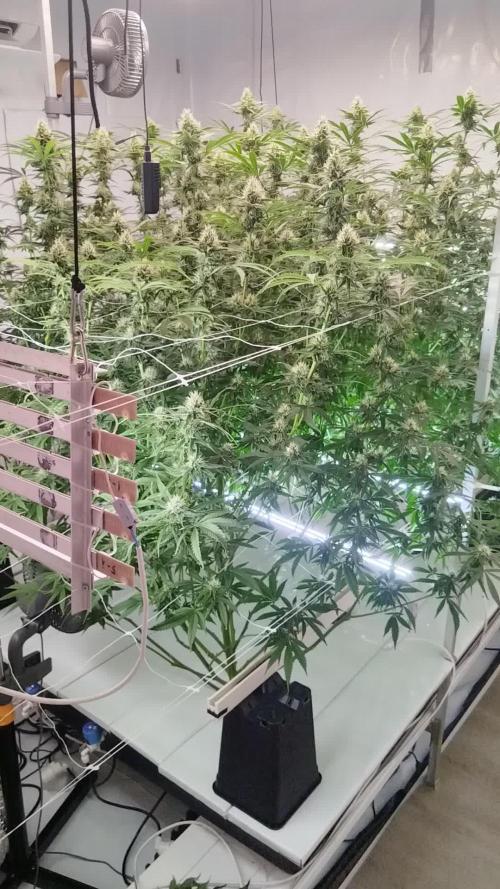
Flowering W5 D1
No Co2 in tank, last night Co2 levels drop to 250ppm
Outside temperatures freeze my window from extraction fan. Big problem. No Co2 , no ventilation😒
Light intensity HLG Diablo - 800-1000 PPFD , Light distance - 50/55cm, DLI - 42, Light Interval 12/12,
SCL @ 45% - DeepRed @ 100%, FarRed @ 30%, UCL-50%
Midea 25c5% day/night, TM 65/55%RH, AC Infinity AUTO - 4/3
Day RH - 65/70%, Night RH - 55/59%,
Day Temperature - 26/28c, Night Temperature - 21c/23c
Leaf temperature 25/26,
VPD Day - 1.1/1.2 , VPD Night 1.0/1.2
CO2 - less than 400ppm
Nutrient Tank - 2.20EC, PH-6.00, Temperature - 17/18c, ORP-600/800mV
Day Misting - 20sON/10minOFF + 1 x (8min) shot
Night Misting - 40sON/45min OFF
Runoff - 10.00h-r2400ec/6.02ph, 19.30h-2300ec
Flowering W5 D2
Light intensity HLG Diablo - 800-1000 PPFD , Light distance - 45/50cm, DLI - 42, Light Interval 12/12,
SCL @ 40% - DeepRed @ 100%, FarRed @ 30%, UCL-40%
Midea 25c5% day/night, TM 64/55%RH, AC Infinity AUTO - 4/3
Day RH - 65/70%, Night RH - 55/59%,
Day Temperature - 26/28c, Night Temperature - 20c/22c
Leaf temperature 25/26,
VPD Day - 1.1/1.2 , VPD Night 1.0/1.2
CO2 - 300-400ppm
Nutrient Tank - 2.20EC, PH-6.00, Temperature - 17/18c, ORP-600/800mV
Day Misting - 20sON/10minOFF + 1 x (8min) shot
Night Misting - 40sON/45min OFF
Runoff - 10.00h-r2410ec/6.12ph, 19.30h-2300ec
Flowering W5 D3
Light intensity HLG Diablo - 800-1000 PPFD , Light distance - 45/50cm, DLI - 42, Light Interval 12/12,
SCL @ 40% - DeepRed @ 100%, FarRed @ 30%, UCL-40%
Midea 25c5% day/night, TM 63/55%RH, AC Infinity AUTO - 4/3
Day RH - 65/70%, Night RH - 55/59%,
Day Temperature - 26/28c, Night Temperature - 21c/22c
Leaf temperature 25/26,
VPD Day - 1.1/1.2 , VPD Night 1.0/1.2
CO2 - 400+PPM
Nutrient Tank - 2.20EC, PH-6.00, Temperature - 17/18c, ORP-600/800mV
Day Misting - 25sON/15minOFF + 2 x (8min) shot
Night Misting - 40sON/45min OFF
Runoff - 10.00h-r2410ec/6.12ph,
Flowering W5 D5
PH calibration, 7.44,- 0.44 off, tank was at 5.56ph
Light intensity HLG Diablo - 800-1000 PPFD , Light distance - 45/50cm, DLI - 42, Light Interval 12/12,
SCL @ 40% - DeepRed @ 100%, FarRed @ 30%, UCL-40%
Midea 25c5% day/night, TM 63/55%RH, AC Infinity AUTO - 4/3
Day RH - 65/70%, Night RH - 55/59%,
Day Temperature - 26/28c, Night Temperature - 21c/22c
Leaf temperature 25/26,
VPD Day - 1.1/1.2 , VPD Night 1.0/1.2
CO2 - 400+PPM
Nutrient Tank - 2.20EC, PH-6.00, Temperature - 17/18c, ORP-600/800mV
Day Misting - 20sON/10minOFF + 1 x (8min) shot
Night Misting - 40sON/45min OFF
Runoff - 10.00h-r2430ec,
Flowering W5 D6
Again no irrigation for last 3 hour in day time and firs 3 hour in night times
Dilute tank to 1800ec, PH at 6.05 running for rest off the day with this solution
Light intensity HLG Diablo - 800-1000 PPFD , Light distance - 45/50cm, DLI - 42, Light Interval 12/12,
Smanjo diabla, bilo je i do 1380ppfd! Sada je na kanopji oko 950ppfd u vecem delu
SCL @ 40% - DeepRed @ 100%, FarRed @ 30%, UCL-40%
Midea 25c5% day/night, TM 60/53%RH, AC Infinity AUTO - 4/3
Day RH - 65/70%, Night RH - 55/59%,
Day Temperature - 26/28c, Night Temperature - 21c/22c
Leaf temperature 25/26,
VPD Day - 1.1/1.2 , VPD Night 1.0/1.2
CO2 - 400+PPM
Nutrient Tank - 2.20EC, PH-6.00, Temperature - 17/18c, ORP-600/800mV
Day Misting - 20sON/10minOFF + 2 x (6min) shot
Night Misting - 40sON/45min OFF
Likes
11
Share


@Bread_n_Buds
Follow
Here we are again ready to start again, always under the sign of Zamnesia, we make our fantastic plants and we show you what we are capable of. We have 5 autoflowering strains and 5 photoperiodic ones and now we present them to you.
The fifth and last autoflowering for now of this round that we present to you is another classic of the classics always in the Zamnesia version. We have already grown it once and we sincerely hope to find the purple phenotype, Mythical mythological herb really in music and in everything, WE ARE TALKING
To explain my germination method which is a combination of experiences acquired in the field and readings of right advisors, I have chosen to divide it into phases so whoever wants can follow them and understand better step by step.
- Preparatory Phase ---- Check the average temperature in the room, humidity status to understand well whether it is the case to start or wait, I decided for the end of August because the temperatures start to drop towards the 22-25 degrees recommended for germination.
Then another thing more or less credible depending on the sensitivity is the control of the lunar phases. I believe in it a lot, it is a method that ancient farmers used to understand when it was best to plant depending on the attraction of the moon. To make my life easier I use a simple app that advises you on the right time to plant, harvest and put in a jar (depending on the lunar phases).
- Phase 1 --- Soaking in water. There are many authoritative friends who advise against this method due to the risk of drowning, but I have always been fine and I follow the rule if it opens in water almost certainly the seed is healthy and will come out of the ground 90% normally.
- Phase 2 --- Opening of the seed in water. As soon as the seed opens and the root comes out a little you have to be very very careful not to leave the seed in water open for too long. This is why there is a risk of drowning. So as soon as the root has come out it must be planted. Do not wait for it to stretch out too much, in the absorbent paper you can wait a little longer in water no.
- Phase 3 --- While I soaked the seeds I prepared my pots: I use small biodegradable pots (choose the ones with holes underneath for drainage). A few hours before working with the opened seeds I moistened the soil with water adjusted to the right pH (5.8 - 6.2) and Plagron Power Roots. The small root is now open and we can make a little hole with a toothpick, widen it and insert the seed. Not too deep with the root facing downwards. From Serious Seeds we learned the dome technique: if you put a small dome of soil on the seed the water will settle on the sides avoiding overwatering problems.
- Phase 4 --- The plant emerges from the soil. Up to now I have not put the light on, now I turn it on at minimum after half a day of soil to give direction to the seedlings. The first week the light will be gradually brought from 40% to 60% to go to 70% - 75% in the remaining weeks of veg. During the first week maximum, I keep the cycle of 24 hours to avoid stretching. Be careful not to exceed the first week at least with photoperiodic.
- Germination % --- In water 20/20 seeds have opened for good luck I'm waiting to talk when they come out of the ground but it seems that we are going towards an excellent percentage of germination..."Not too bad"...
- Soil and Food --- The soil used is entirely organic in every part and is the Plagron Promix that will be used with the 100% organic pack supplied by Zamnesia complete with all the main fertilizers for your plant buy it at the link --
https://www.zamnesia.io/it/11457-plagron-easy-pack-natural.html
// Strain Description // Have you ever wondered what Jimi played in 1967? With Purple Haze Automatic, it has never been easier to experience the magic of Purple Haze firsthand. In just 65 days, this compact autoflowering will reward you with top-quality sativa buds that will take you on a long creative journey. -
- Get a seed of this fantastic strain --- https://www.zamnesia.io/
- Soil and Fertilizers entirely organic --- https://plagron.com/en
- Growbox --- https://www.secretjardin.com/
- Music and sound --- I made my girls listen to 432hz frequencies and music from www.radionula.com
- Z --- You can find these seeds, much more from the world of cannabis, mushrooms and an incredible series of accessories and gadgets on the reference site not only mine but of many growers ----
https://www.zamnesia.io


Likes
2
Share


@Bncgrower
Follow
Another week almost over, the girls are beautiful and smell great. Apparently everything is under control, I'm really looking forward to the results.
Happy growing! 🌱🌱🌱
Likes
6
Share

@Naujas
Follow
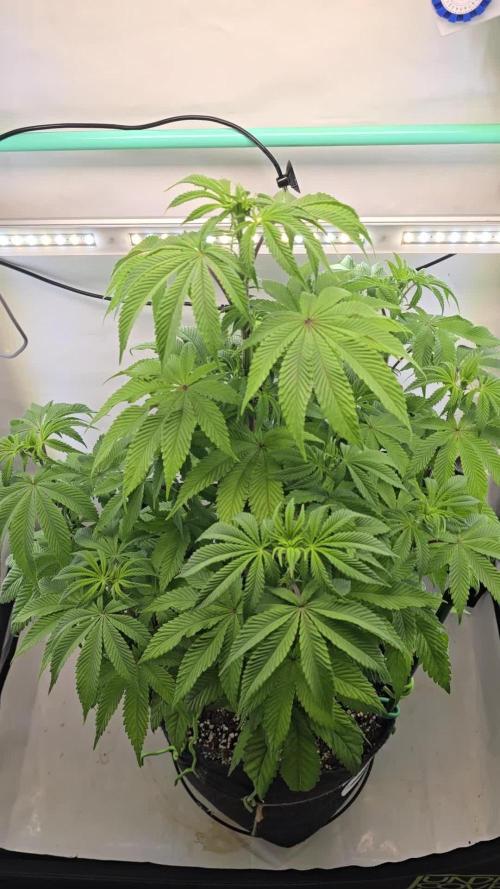
63 dienos!!! Mergaitės būklė tikrai pagerėjo :) šią savaitę įjungiau mergaitės papildomą šoninį apšvietimą, tai pirmas kartas su tokia įranga :) pamatysime, kas iš to gausis :) sėkmės visiems .

Likes
24
Share


@DeepRootsGrowTrees
Follow
SWISS DREAM ROSE 🌹 CBD AUTO
KANNABIA SEEDS
WEEK #8 Overall
Week #6 Flower
This week she's looking beautiful dense purple buds that have trichomes along with the white and orange colored hairs. Great Genetics 👍 from Kannabia Seeds of your looking to grow some CBD!! Stay Growing!!
Kannabia.com
SWISS DREAM ROSE 🌹 CBD AUTO


