Processing
Likes
Comments
Share
@
Follow
Likes
2
Share
Cada vez mais perto! Os buds estão a desenvolver bem (a meu ver)! Semana tranquila e sem nenhum contratempo. Questão: o que são aquelas manchas nas folhas? Nas pontas é excesso de nutrientes, mas e as maiores, o que poderá ser?
Likes
4
Share
Sep 8: surprise hailstorm last night did some damage. Heavy buds were causing the stems to topple so harvested first round. First round 270 g wet.
Likes
3
Share
Pues ya tenemos la quinta semana de la HellfireOG de Kannabiaseeds, está semana van creciendo muy bien las he abonado con agua con ph de 6,5 y tambien les he echado un fertilizante casero de crecimiento echo por mi
Processing
Likes
Comments
Share
@MG2009
Follow
06/01/2020 Time to make the seeds! First my Cookie Cake F1 plant is a 7 star cookies male (Top dawg seeds) X a female Captains cake clone (Captains connection) and will be growing TLO Style. 7 Stars Cookies Strain | Marijuana Strain Reviews 50% Sativa /50% Indica THC: 22% - 27% 7 Stars Cookies is an evenly balanced hybrid strain (50% indica/50% sativa) created through a potent cross of the classic F1 Durban X Girl Scout Cookies strains. This potent bud is infamous among cannabis users for its super high potency and long lasting effects that are perfect for any hybrid lover. The 7 Stars Cookies high starts with a rush of cerebral effects that rush though your mind, lifting your spirits and leaving you blissfully happy and unfocused. As your mind flies higher and higher, your body will begin to slip away into a state of deep relaxation that leaves you totally stoned and out of it. A sharp pang of hunger comes next, leaving you with a ravenous case of the munchies as your mind slips in and out of calming sedation. Thanks to these effects and its super high 22-28% THC level, 7 Star Cookies is often chosen to treat those suffering from conditions such as chronic pain, insomnia, stress, depression, and migraines or headaches. This bud has a sweet citrusy flavor with hints of spicy earthy grape upon exhale. The aroma follows the same profile although with a light pungency to it. 7 Star Cookies buds have fluffy dense popcorn-shaped olive green nugs with bright orange hairs and golden crystal trichomes. Captain's Cake Marijuana Strain Information About Captain's Cake Hailing from the beautiful land of Maine, Captain’s Cake is brought to us by The Captain’s Connection. This indica-dominant strain boasts two pretty incredible parents, Girl Scout Cookies and White Fire Alien OG, making her a bud that offers great effects for both recreational and medical patients. While Captain’s Cake typically acts as a true hybrid, user sensitivity may dictate that your experience comes with the roll of the dice. A fairly potent strain in her own right, Captain’s Cake averages around 21% THC. Rumor has it that CBD levels can vary dramatically, with some reports showing a range between 1% and 15%. While that data remains to be confirmed, you can instead relish in beautiful buds that are bright green, featuring orange pistils and lovely amber trichomes. Oddly enough, flavors and scents do vary a bit with this strain, and you’ll notice it smells much worse than it tastes. A sour and earthy fragrance that includes lemon, nuts, and berries will hit you right away while your mouth enjoys a nutty vanilla cookie experience that’s slightly citrus-like. Captain’s Cake is awesome for those times when you need a boost of energy to get through a particularly trying task. Whether you’re experiencing the three o’clock workday slump or you simply have to clean the house before it gets any worse, this strain is here to help. Users note a euphoric boost that helps you to focus on your tasks while having a huge smile on your face, but keep in mind that this joyful experience can only last so long. Soon the munchies will hit, and after you’ve had your fill of snacks, you’ll be ready to settle in during a sedating comedown. Even if Captain’s Cake doesn’t have an astounding amount of CBD, medical patients still note that she’s a strain that is practically magical. Users find that mental woes are easily dissolved after taking a few hits, making stress and depression a thing of the past. Bodily aches and pains are also treated with a slight feeling of physical sedation, and those who struggle with their appetite will likely turn to this bud time and time again. This plant is an ideal choice for new and experienced growers, and the ability to cultivate inside or out makes her pretty versatile. Said to be a quick flowering strain, you’ll be gifted with a nicely sized yield after 8 to 9 weeks. Plants tend to grow fairly large, so make sure you have enough space dedicated to your crop before you begin. Depending on how you handle marijuana, Captain’s Cake may knock you out for an amazing nap or in some cases may fire you up with tons of energy. Others will experience a nice set of hybrid effects, so it’s best to know yourself before lighting this one up. Red Sky is Description The (paternal P1) father is the legendary Cherry Hemmingway male. A hybrid of a landrace Bhutan, and Rez Dog’s Firecracker (Williams Wonder x NYC Diesel). The female KOS’s own Skyanchor (Bogglegum x PSI) a cross using a prime selected male of BOG’s Bogglegum. A bad ass old-school hybrid made using a Northern Lights #5 (real deal) crossed to a Bubblegum (real deal). The female used to make the Skyanchor was my clone only PSI (Purple Salem Indica) that I was given by my good friend Keith, in Salem, OR, USA. Some kind of crazy old Purple Kush variant; potency is not only severe with this baby, but supernaturally intense. The Cherry Hemmy is well known by me to relate large yields and incredible vigor along with increased resin production, and also usually relates cream soda, vanilla, or cherry-ish terpenes, making exotic and addictive combinations when used as part of any hybrid. So, the Red Sky yields well—very well. Some truly legendary strains involved in this Small Batch Seed run. Great genetics equals great end results. I put video of Red Sky #3's brothers #2, and #4.
Likes
7
Share
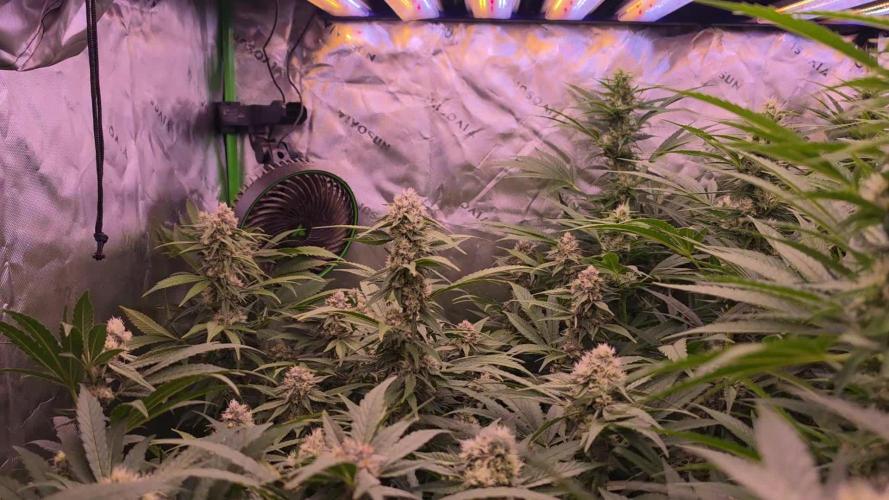
Ah nothing like a good stretch, Week 2 of flower after the massive transition feeding of 1800 ppm and no sign of nutrient burn so the media and nuites seem to be a winner. In the last feeding I doubled the watering, the second half was just water PH'ed to 6 for two reasons, dilute the 1800 ppm and to promote a deep watering for the roots. I let them dry out till the fan leaves started to wilt on one of the Strawberry Ice and after a deep watering of just water again this week they bounced back. I wanted to make sure the food from the last feeding is used up and also a mini flush before the next feeding for the flowering stage. I am going to go higher with the P & K % on top of recommended chart feeding. I want to play around with the numbers as a lot of growers have their own special sauce recipe. Based on these two strains they look pretty healthy, next week will be a lollipop on the bottom 1/3 to the canopy. as to promote air flow and stretch they are getting pretty thick and bushy still tucking the stems to fill out the scrog completely. The one BLUE DREAM HAZE is a different phenom by the look of it lets see how it turns out its a little shorter than her sisters, Please ;eave a comment good or bad I love to hear from you folks. TTFN
Likes
5
Share
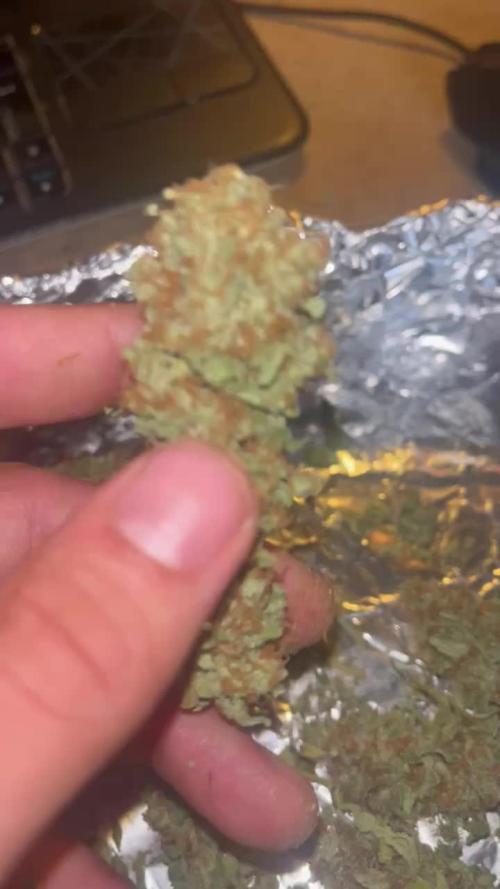
The smell coming from their Beaty is so dam sweet she smells just like a bowl of fresh cut pineapple ... Couldn't say that I've had a strain as fruity before very close but she takes the lead now.. the plant has put up with a lot of my mistake and with a better setup and more space she could be a real great producer ...can't wait to harvest this lady ..
Likes
75
Share
@Sider79
Follow
Starting to smell sweet again ,straight distilled H2O maybe there last drink. Purple Lemonade was a big girl with no sign of stopping she would had foxtailed another flush
Likes
18
Share
Green light is radiation with wavelengths between 520 and 560 nm and it affects photosynthesis, plant height, and flowering. Plants reflect green light and this is why they appear green to our eyes. As a result, some growers think that plants don’t use green wavelengths, but they actually do! In fact, only around 5 – 10% of green light is reflected from leaves and the rest (90 – 95 %) is absorbed or transmitted to lower leaves [1]. Green wavelengths get used in photosynthesis. Chlorophyll pigments absorb small amounts of green wavelengths. Light that doesn’t get absorbed is transmitted to leaves that are shaded out from direct light. This means that leaves at the bottom of the canopy get more green light than leaves at the top. A high proportion of green wavelengths compared to other colors tells lower leaves that they are being shaded out, so they are able to react accordingly. Lower leaves may react by opening or closing their stomata or growing longer stems that help the leaves reach brighter light [1, 2, 3]. When it comes to growing cannabis, many cultivators are interested in the quality of light used for the flowering stage. In many plants, flowering is regulated by two main photoreceptors: cryptochrome and phytochrome. Both photoreceptors primarily respond to blue light but can also respond to green, although to a lesser extent. Green can accelerate the start of flowering in several species (although cannabis has yet to be tested) [1, 4, 5]. However, once flowering has begun, it’s important to provide plants with a “full spectrum” light that has high amounts of blue and red light, and moderate amounts of green, in order for photosynthesis to be optimized. Green light mediates seed germination in some species. Seeds use green wavelengths to decide whether the environment is good for germination. Shade environments are enriched in green relative to red and blue light, so a plant can tell if it is shady or sunny. A seed that senses a shaded environment may stay dormant to avoid poor growing conditions [1]. Some examples of plant species where researchers have documented this response are: ryegrass (a grass that grows in tufts) and Chondrilla (a plant related to dandelion) [1, 6]. Although green wavelengths generally tell plants NOT to germinate, there are some exceptions! Surprisingly, green wavelengths can stimulate seed germination in some species like Aeschynomene, Tephrosia, Solidago, Cyrtopodium, and Atriplex [1, 6, 7]. Of course, light is not the only factor affecting seed germination – it’s a combination of many factors, such as soil moisture, soil type, temperature, photoperiod, and light quality. When combined with red and blue light, green can really enhance plant growth [1, 8]. However, too much green light (more than 50% of the total light) can actually reduce plant growth [8]. Based on the most current research, the ideal ratio of green, red, and blue light is thought to be around 1:2:1 for green:blue:red [9]. When choosing a horticultural light, choose one that has high amounts of blue and red light and moderate amounts of green and other colors of light. Not many studies can be found about the effect of green light on cannabis growth or metabolism. However, if one reads carefully, there are clues and data available even from the very early papers. Mahlberg and Hemphill (1983) used colored filters in their study to alter the sunlight spectrum and study green light among others. They concluded that the green filter, which makes the environment green by cutting other wavelengths out, reduced the THC concentration significantly compared to the daylight control treatment. It has been demonstrated that green color can reduce secondary metabolite activity with other species as well. For example, the addition of green to a light spectrum decreases anthocyanin concentration in lettuce (Zhang and Folta 2012). If green light only reverses the biosynthesis of some secondary metabolites, then why put green light into a growth spectrum at all? Well, there are a couple of good reasons. One is that green penetrates leaf layers effectively. Conversely red and blue light is almost completely absorbed by the first leaf layer. Green travels through the first, second, and even third layers effectively (Figure 2). Lower leaf layers can utilize green light in photosynthesis and therefore produce yields as well. Even though a green light-specific photoreceptor has not yet been found, it is known that green light has effects independent from the cryptochrome but then again, also cryptochrome-dependent ones, just like blue light. It is known that green light in low light intensity conditions can enhance far red stimulating secondary metabolite production in microgreens and then again, counteracts the production of these compounds in high-intensity light conditions (Kim et al. 2004). In many cases, green light promoted physiological changes in plants that are opposite to the actions of blue light. In the study by Kim et al. blue light-induced anthocyanin accumulation was inhibited by green light. In another study it has been found that blue light promotes stomatal opening whereas green light promotes stomatal closure (Frechilla et al. 2000). Blue light inhibits the early stem elongation in the seedling stage whereas green light promotes it (Folta 2004). Also, blue light results in flowering induction, and green light inhibits it (Banerjee et al., 2007). As you can see, green light works very closely with blue light, and therefore not only the amount of these two wavelengths separately is important but also the ratio (Blue: Green) between these two in the designed spectrum. Furthermore, green light has been found to affect the elongation of petioles and upward leaf reorientation with the model plant Arabidopsis thaliana both of which are a sign of shade avoidance symptoms (Zhang et al. 2011) and also gene expression in the same plant (Dhingra et al. 2006). As mentioned before, green light produces shade avoidance symptoms which are quite intuitive if you consider the natural conditions where the plants grow. Not all the green light is reflected from the highest canopy leaves in nature but a lot of it (50-90%) has been estimated to penetrate the upper leaves at the plant level ((Terashima et al., 2009; Nishio, 2000). For the plant growing in the understory of the forest green light is a signal for the plant of being in the shade of a bigger plant. Then again, the plants growing under unobstructed sunlight can take advantage of the green photons that can more easily penetrate the upper leaves than the red and blue photons. From the photosynthetic pigments in higher plants, chlorophyll is crucial for plant growth. Dissolved chlorophyll and absorb maximally in the red (λ600–700 nm) and blue (λ400–500 nm) regions of the spectrum and not as easily in the green (λ500–600 nm) regions. Up to 80% of all green light is thought to be transmitted through the chloroplast (Terashima et al., 2009) and this allows more green photons to pass deeper into the leaf mesophyll layer than red and blue photons. When the green light is scattered in the vertical leaf profile its journey is lengthened and therefore photons have a higher chance of hitting and being absorbed by chloroplasts on their passage through the leaf to the lower leaves of the plant. Photons of PPFD (photosynthetic photon flux density) are captured by chlorophyll causing an excitation of an electron to enter a higher energy state in which the energy is immediately passed on to the neighboring chlorophyll molecule by resonance transfer or released to the electron transport chain (PSII and PSI). Despite the low extinction coefficient of chlorophyll in the green 500–600 nm region it needs to be noted that the absorbance can be significant if the pigment (chlorophyll) concentration in the leaf is high enough. The research available clearly shows that plants use green wavelengths to promote higher biomass and yield (photosynthetic activity), and that it is a crucial signal for long-term developmental and short-term dynamic acclimation (Blue:Green ratio) to the environment. It should not be dismissed but studied more because it brings more opportunities to control plant gene expression and physiology in plant production. REFERENCES Banerjee R., Schleicher E., Meier S. Viana R. M., Pokorny R., Ahmad M., Bittl R., Batschauer. 2007. The signaling state of Arabidopsis cryptochrome 2 contains flavin semiquinone. The Journal of Biological Chemistry 282, 14916–14922. Dhingra, A., Bies, D. H., Lehner, K. R., and Folta, K. M. 2006. Green light adjusts the plastic transcriptome during early photomorphogenic development. Plant Physiol. 142, 1256-1266. Folta, K. M. 2004. Green light stimulates early stem elongation, antagonizing light-mediated growth inhibition. Plant Physiol. 135, 1407-1416. Frechilla, S., Talbott, L. D., Bogomolmi, R. A., and Zeiger, E. 2000. Reversal of blue light -stimulated stomatal opening by green light. Plant Cell Physiol. 41, 171-176. Kim, H.H., Goins, G. D., Wheeler, R. M., and Sager, J. C. 2004.Green-light supplementation for enhanced lettuce growth under red- and blue-light emitting diodes. HortScience 39, 1617-1622. Nishio, J.N. 2000. Why are higher plants green? Evolution of the higher plant photosynthetic pigment complement. Plant Cell and Environment 23, 539–548. Terashima I., Fujita T., Inoue T., Chow W.S., Oguchi R. 2009. Green light drives leaf photosynthesis more efficiently than red light in strong white light: revisiting the enigmatic question of why leaves are green. Plant & Cell Physiology 50, 684–697. Zhang, T., Maruhnich, S. A., and Folta, K. M. 2011. Green light induces shade avoidance symptoms. Plant Physiol. 157, 1528-156. Wang, Y. & Folta, K. M. Contributions of green light to plant growth and development. Am. J. Bot. 100, 70–78 (2013). Zhang, T. & Folta, K. M. Green light signaling and adaptive response. Plant Signal. Behav. 7, 75–78 (2012). Johkan, M. et al. Blue light-emitting diode light irradiation of seedlings improves seedling quality and growth after transplanting in red leaf lettuce. HortScience 45, 1809–1814 (2010). Kasajima, S., et al. Effect of Light Quality on Developmental Rate of Wheat under Continuous Light at a Constant Temperature. Plant Prod. Sci. 10, 286–291 (2007). Banerjee, R. et al. The signaling state of Arabidopsis cryptochrome 2 contains flavin semiquinone. J. Biol. Chem. 282, 14916–14922 (2007). Goggin, D. E. & Steadman, K. J. Blue and green are frequently seen: responses of seeds to short- and mid-wavelength light. Seed Sci. Res. 22, 27–35 (2012). Mandák, B. & Pyšek, P. The effects of light quality, nitrate concentration and presence of bracteoles on germination of different fruit types in the heterocarpous Atriplex sagittata. J. Ecol. 89, 149–158 (2001). Darko, E. et al. Photosynthesis under artificial light: the shift in primary and secondary metabolism. Philos. Trans. R. Soc. B Biol. Sci. 369 (2014). Lu, N. et al. Effects of Supplemental Lighting with Light-Emitting Diodes (LEDs) on Tomato Yield and Quality of Single-Truss Tomato Plants Grown at High Planting Density. Environ. Control Biol. 50, 63–74 (2012).
Likes
5
Share
9/11/25-9/21/25 I have been cleaning them out slowly. Probably took too long to really lollipop them all. They almost all have that nice look with tops everywhere. Clean out the insides and all water leaves to make sure light and air penetrate. At this point as you go through you really need to be separating your buds from the stems to help avoid mold build up, check for bugs or any older fallen leaf pieces that may be stuck to a bud. This step is pertinent for both inside and outside growers. Also you don't have to be overly gentile doing this. Obviously no need to be extra rough but plants can take being handled. I try to complete this process every couple days especially as we get closer and closer to the end game. Watering every day and using Bud Candy and Bembe x 2 weekly. Will move to the flush process by 9/28. Going to start flushing the Sunset Sherbet and Gorilla Skittlz this week. Weather has been great 85F and dry, 55-60f at night. Rain is expected to move in this week and I will be pulling a few plants soon as they are a little more dense. Any questions just ask, super ready for the end. May she always shine on your garden.
Processing
Likes
11
Share
Va a pasar a la tercera semana de vegetación el sábado 23 de mayo, la subsiguiente se hará el primer topping (apical). Las dos que tuvieron problemas en sus dos primer hojas reales, se han recuperado muy bien. 22/05 se rego con todo, un super cocktail. 27/05 las dos plantas mas grandes les hago Topping. La tercera le dare una semana mas. 28/05 las tres GDP son transplantadas a maceteros de 7L.
Likes
61
Share
Hey friends :-) . There is not much to tell this week. They smell stronger and stronger, but unfortunately I don't really like the bud production. It is going very slowly, and she just doesn't want to have many nutrients :-(. Just don't understand why. I know the genetic, because I have it as a mother, and there are 100% all parameters in the perfect area. I have prepared a completely new nutrient solution again, and I will watch you closely this week :-). Otherwise everything looks great. The new update is coming next week. Until then, I wish everyone a great start to the new week 🍀👍 Let it grow 😎🌱
Likes
1
Share
21.08 - First leaves appear and start consuming light. Watering - 0.2 ml per plant - pH 6.30 Lamp distance - 50cm Humidity - 75% - 95% Temperature - 23 - 27 C Light - 18/6h - Dim - 50% 22.08 Watering - 0.25 ml per plant - pH 6.50 Lamp distance - 50cm Humidity - 75% - 90% Temperature - 22 - 27 C Light - 20/4h - Dim - 50% 23.08 Watering - 0.50ml per plant - pH 6.30 Lamp distance - 50cm Humidity - 70% - 90% Temperature - 22 - 27 C Light - 18/6h - Dim - 50% 24.08 Watering - 0.80ml per plant + Root Juice + Acti Vera- pH 6.30 Total 250ml water with 1ml Root Juice and Acti Vera - 0.5ml Lamp distance - 50cm Humidity - 62% - 79% Temperature - 25 - 28 C Light - 20/4h - Dim - 50% 25.08 I skip watering, the soil is wet Lamp distance - 50cm Humidity - 70% - 85% Temperature - 22 - 27 C Light - 22/2h - Dim - 55% 26.08 I skip watering, the soil is wet Lamp distance - 50cm Humidity - 55% - 85% Temperature - 22 - 27 C Light - 22/2h - Dim - 55% 27.08 Skip watering Lamp distance - 50cm Humidity - 70% - 85% Temperature - 22 - 27 C Light - 22/2h - Dim - 55% 28.08 Watering - The big one get 450ml water - pH - 6.3 The other 2 get 250ml per plant - pH - 6.3 Total 1L water with 2ml Root Juice Sprayed leaves with Acti vera Lamp distance - 40cm Humidity - 70% - 85% Temperature - 22 - 27 C Light - 20/4h - Dim - 80% Also at the end of the day I gave to the biggest one cal mag biobizz 2,3 pippet drops with 200ml water. Until September 2nd, I use one lamp. From the 2nd there are already two
Likes
17
Share
@leliantu
Follow
Sexta semana de vegetación y las plantas crecen a buen ritmo, la California Orange se recupero de la poda y se ve mas vigorosa y firme, ambas plantas están comiendo mas y consumiendo mas agua. Ésta semana ambas plantas alcanzaron la malla.
Likes
99
Share
@DevilsBud
Follow
Hallo fellow Growmies Welcome to blackberry Moonrock by @Anesia_Seeds seeds Blue Moonrock x Blackberry Genetics: 80% Indica, 20% Sativa Yield: 550g/m² • up to 700g per plant Flowering time: 8-9 weeks Harvest outdoors: end of september suitable for indoors and outdoors Height: 110-130cm THC: 33% Aromas / flavors: blueberry, lavender 18/9/21 Putting them in soil and hope for the best banana Mac didn't make it 🤘🏻😎🤘🏻 🤘🏻🤩🤘🏻 🤘🏻🤘🏻 muchas gracias compañero por el gran paquete. Haré mi mejor esfuerzo visit www.marshydro.eu for your best gear and use the PROMO CODE: DEVILSBUD Fully marshydro supported Setup: Marshydro GT100X100X180 Marshydro Ts 1000 LED lamp soil :Plagron batmix Advanced Nutrients pH Perfect Bloom pH Perfect grow pH Perfect micro B-52 Voodoo Juice Rhino Skin Big bud Bud candy Overdrive flawless finish Sensizym
Likes
22
Share
We are 1 week in and the second set of true leaves are beginning to grow, both are doing great and moving full steam ahead. Still watering about 20-30 mL of 200ppm CalMag RO water once daily and misting a couple times throughout the light cycle seems to be working great.
Likes
25
Share
@Kakui
Follow
Flower4, día 4 desde que comenzó la floración, se regaron con 1.8 EC y pH 6.2, con los nutrientes puestos en la descripción, no me tienen muy convencido pero creo que van mejorando. Flower9, defoliación y riego, está vez se agregó al riego Bud Candy, el cual seguirá siendo usado en toda la fase de floración. Flower13, riego 2.0 EC y pH 6.2, se agregó Voodoo Juice, Tarantula y Piranha al agua de riego.
Processing
Likes
17
Share
Just starting , This is my soil mix! Only took two days to break soil pretty sweet!!