


Likes
Comments
Share

@RockoCalenberg
Follow
Rocko's Terp Test – Fruitbomb Punch
| Ernte an Blütetag 87 ✅✂️🌡️
Als letzte verbliebene Pflanze im Terp Test durfte die Fruitbomb Punch bis Blütetag 87 stehen. Nach den vorangegangenen Schimmelproblemen bei den anderen beiden Kandidaten war das schon fast ein kleiner Luxus. Mit 130 g Nassgewicht verabschiedete sie sich schließlich als Abschluss des Runs.
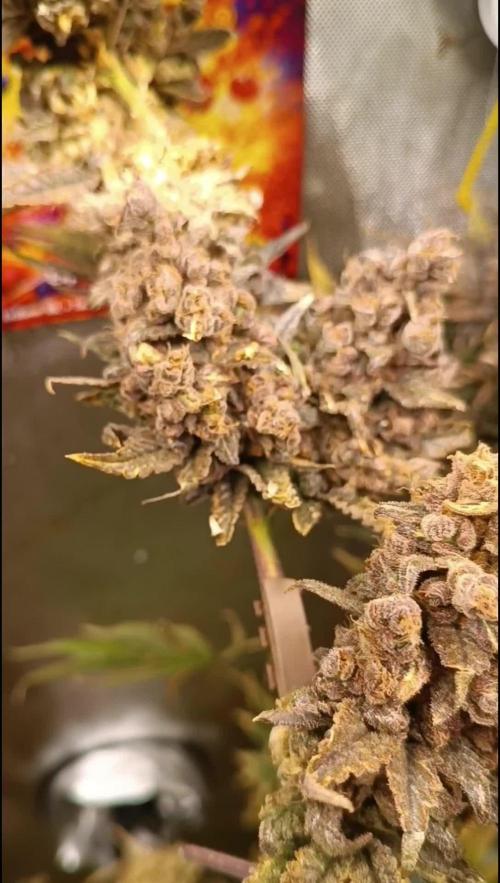
Genau wie während der gesamten Blüte blieb sie ihrer Linie treu. Die Buds wuchsen lang und eher speerförmig, oben schön kompakt und fest, während sie nach unten hin deutlich lockerer wurden. Kein klassischer "Steinbud"-Strain, sondern eine Sorte mit einer eher offenen Blütenstruktur.
Beim Trimmen zeigte sie sich dafür angenehm unkompliziert. Wenig Blattmasse, dadurch ging die Ernte vergleichsweise zügig über die Bühne.
Das Highlight ist aber ganz klar das Aroma. Zwar steckt der Name "Fruitbomb" nicht umsonst drin, aber es ist keine reine Erdbeer-Nummer. Vielmehr erinnert sie an einen Korb voll reifer Früchte – süß, tropisch und leicht überreif, fast schon in Richtung fermentierte Frucht. Ein sehr eigener, intensiver Terpen-Mix, der sich deutlich von Strawberry AK und Chicken & Wafflez absetzt.
Jetzt beginnt wie immer der spannendste Teil: die Zeit im Glas. Erst nach dem Curing wird sich zeigen, ob die Fruitbomb Punch ihr volles Potenzial auch beim Geschmack und der Wirkung ausspielen kann.
Am Ende entscheidet das Glas. ✌️🌱💚



Likes
12
Share


@2Stones1Bird
Follow
Checkout my Instagram @smallbudz to see the Small budget grow setup for indoor use, low watt, low heat, low noise, step by step.
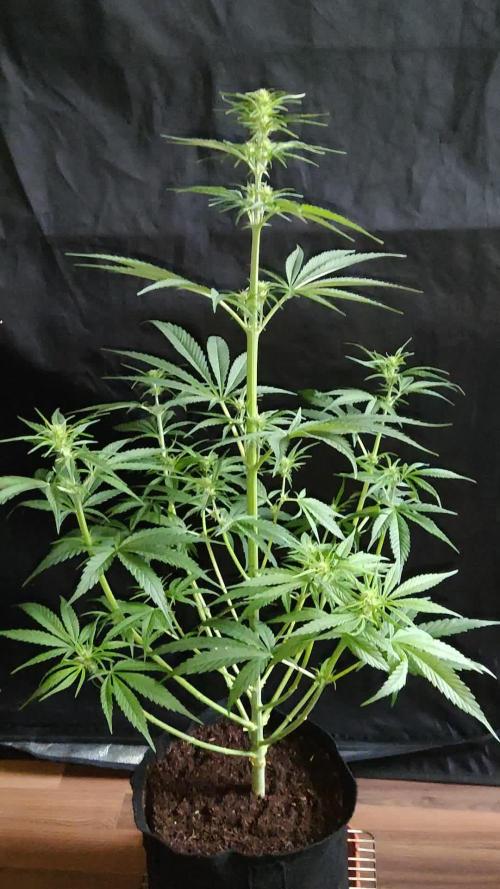
27/02/2020 - Gave her 1.5l of RO water.



Likes
18
Share


@berlinbeginner
Follow
High temperatures and nutrient burn. At this point i have no idea what i am doing. Every now and then SD2 and SD3 release typical weed smell but apart from that no other smell. The stems upon rubbing and touching smell like cinammon,cloves and orange zest.It reminds me of fanta drink.

Likes
19
Share


@Cannabingrowin
Follow
Almost to flower lighting. Doing a high frequency fertigation. Due to the properties of the growing medium. Made up of pretreated coco coir at about 70%, the rest is perlite. It seems to be difficult to overwater. I found the coco for cannabis website and have been following their recommendations for feeding twice a day. Trying to keep the run off water at 20-30% of what I add to the top of the pot. EC readings comparisons to input values have made watering twice a day with less total water each time. Is the only way to keep my ec measurements within 400 or .400 depending on the meter. Of the input. So I don't want the run off to read higher than 400 micro semens ec reading than the original solution fed to the plant. Going to stick with it. Purple stems are on all the plants. So magnesium is not being absorbed as well or I don't know. Not enough in the nutrients. I'm skeptical to use magnesium sulfate. Very alkaline.



Likes
6
Share


@sa2_gr
Follow
Hey guys
Everything going good, one Zake and one Shimo (in the front) have pretty much no stretch 😓
Beside that, everything going good, the ChemZu's are so Big 😍


Processing
Likes
50
Share


@BarrieGrower
Follow
The one plant that has always been under the cobbs is a couple of weeks ahead. They are all fattening up and the smell is great. Humidity in the tent has dropped, this is due to the outside weather changing and running a 6" fan 24/7.
I may start the flush on the one plant, will decide in a few days.
Cheers


Processing
Likes
21
Share


@SmithicusAlbertaCanada
Follow
So, Linda decided it was time to stretch, could it be that all four of these ladies are different phenos?
It's looking like strong growth, so far - fingers crossed!
Let me know what you think! Thanks, have a good one! 🙏
Likes
11
Share


@thevaporino
Follow
Entramos en la 9 semana y seguimos con heladas en el exterior , las mínimas con luces apagadas son de 15º y las máximas con luces encendidas


Likes
15
Share


@the_big_pink_place
Follow
01/03/22 Watered plants 2L of nutrient water each , assessed plants to determine what LST I'm doing, looks like these plants have potential to be monsters. Let's hope I don't fuck it up now. 01/01/22 Topped and defoliation was done, didn't water that day even though they needed it I wanted to give them a day or two from the stress they went through, watching to make sure they didn't wilt. Its paying of not listening to my ocd mind thinking I need to do something everyday, I didn't even want to top them, but they where looking very kushy type of plant. And I have trellis going in later two tiers. 01/08/22 Did a full water threw tested run off , it's sitting 800ppm above what I'm feeding, next watering straight 6.0ph water. Lights at 💯%

Likes
4
Share


@JoaKingAlfaro
Follow
Its 1/13/2023 10:30 pm and The White Og has been doing good this past week. She surfaced 4 days after being planted directly into soil and has stretched out quite a bit these past days. She stands a little above 3 inches at the moment. I have her under a 40 watt led light on the 18-6 schedule for her first two weeks as a seedling. Later on I will be moving her to her permanent home inside a grow box I created under the 400 w mh.
Likes
34
Share


@Bread_n_Buds
Follow
We have two very very pretty Rainbow Sherbet at different stages of flowering.
The smallest one left to grow straight is doing very well and is in its first week of flowering. It is a plant that grows fast and primes very well.
The plant worked with the main lining is really very beautiful.
On her I was very successful in bending the branches of the main mainfold creating a very interesting T.
The two ends of the main lining with their branches are the main ones and have shot up but there is good stuff everywhere halfway through the flowering phase let's say. Really excellent resin guys already from halfway through flowering
The shape is very very beautiful as is the structure of this plant for real.
We are still using soil, fertilizers and all the additives recommended by Plagron 100% organic.
We only noticed that the plant was becoming too dark and stopped the basic ALga Bloom fertilizer leaving intact additives and boosters to allow the flower to have the boost it deserves.
---- Decide on the right soil and calculate your fertilization program based on the soil on the official website.
-- www.plagron.com
Try a seed of this variety that drives us crazy..
---- https://www.zamnesia.io/en/11230-zamnesia-seeds-rainbow-sherbet-automatic.html
Zamnesia Description //A cross between Pink Guava, Sunset Sherbet and a hint of ruderalis, Rainbow Sherbet Auto offers a wide range of flavors, effects and more. This 70% indica-dominant strain reaches considerable THC levels (24%) and is suitable for both experienced growers and those taking their first steps in the world of cannabis cultivation.
All the best that mother nature has to offer is on ---- www.zamnesia.com
Likes
11
Share


@OleGrow
Follow
Monday May 10th: Didn't wake the plants up this morning with the light! Time for 36 hours of darkness and then harvest tomorrow morning😊
Processing
Likes
1
Share


@Guzgrown
Follow
Really hot week with some showers early in the week, but chucking along. Fed with bloom once and a compost tea. 1-1.5 gal of water daily. Smelling some wonderful tropical smells. Cant wait to smoke it and figure out what it is.
Likes
5
Share


@Localbudz
Follow
Week 1 of flower is finally here. Tons of growth! One more foliar application of Chitosal this Saturday. These plants need a thorough cleaning underneath at the two week point to allow flower initiation without stress. I will be watching closely for deficiencies in laughing Buddha and blueberry. With the size of the plants a heavy feed schedule might not satisfy requirements. I see a noticeable increase in the quality of plant growing directly under the Hortilux in comparison to the mars hydro supplemental lighting. I am debating adding flora nectar to my nutrient regiment to help in the flavour profiles. I have recently added terpinator from Rhizoflora to increase resin glands on bud structure. I can’t wait to see flowers develop, am hoping for a heavy yield from laughing Buddha and blueberry


Likes
25
Share


@BudHaks
Follow
I am now flushing her with plain Brita filtered water PH'd with lime juice to lower her PH.
I initially first flushed her with 42L of water and now I am flushing her once a day for 8 days and then I will put her in for darkness for 3 days and then I will harvest her and dry her for 9 days and then cure her for 28-48 days.
Likes
48
Share


@DudeGrowsWeed
Follow
Buds are fattening on the Tangie'Matic. She is looking and smelling very good. She's a bit shorter than the first Tangie'Matic I grew last fall/winter. Oh well.
