


Likes
Comments
Share


@TheCalyxLaboratory
Follow
🌿 C99 (Cinderella 99) – End of Week 2: Repotting Day & Into the Final Home!
Weekly Update:
The little C99 has been developing brilliantly over the past two weeks. However, the small starter cup (Red Solo Cup) reached its absolute limit—during repotting, a gorgeous, dense, and healthy white root system was revealed, having completely root-bound the cup. Time for the next big step! 🚀
Setup & Details:
Container: Upgraded from the small cup to an 8.5-liter final pot
Medium: Freshly mixed 50/50 Coco-Perlite mix (ideal for maximum aeration and drainage)
Special Feature: An Airdome is installed at the bottom to supply the root zone with extra oxygen.
Lighting (PPFD): Stable at 400 PPFD
Feeding / Watering: Thoroughly watered in right after repotting with an EC of 1.4 and a pH of 5.8.
Observations:
The plant shows strong vigor, though it was starting to show slightly lighter leaves in the old cup as the nutrients were running low. The fresh coco/perlite mix combined with the tuned EC of 1.4 and pH 5.8 gives her the exact fuel boost she needs. The roots look pristine, and thanks to the Airdome and the increased volume, she is ready to explode in growth.
Ready for Week 3! 🌿✨


Likes
16
Share


@simps
Follow
The bud development on this strain has been great rock hard buds I mean rock hard really nice quality bud heavy the resin production is super high it’s been cold at night for a week 48 as the low it has this girl oozing with resin very pungent smells of Fuel so dank smells like pine fuel citrus and a touch of skunk I’m very happy with the quality of this strain
Processing
Likes
12
Share


@Tazard
Follow
These are clones that I managed to take from my summer garden that became a disaster due to a heat wave that we had breaking 100 year records. I expect everything to be 48” in height at maturity.

Processing
Likes
17
Share

@Tazard
Follow
We are nearing the end and she looks beautiful. I will flush with plain RO water the next week or two while she ripens. I didn’t do any training to her. I have a clone from her and I cut a few leaves from the top of the meristem when she was vegging and she responded with 6-8 branches catching up with the top.

Likes
13
Share


@DutchBarnacle
Follow
Week 7!
Day 51: No water
She's in full bloom and thickening up! I reckon it's safe to say that she's surpassing the Sherbet Queen's final in bud size already, with a 10 day headstart.
I'm expecting to have to water her tomorrow and Saturday. Now that her nutrient lockout has been resolved, it's likely she'll pick up pace.
With nothing out of the ordinary expected to happen this week, I'll shift my focus towards photography.
Day 52: Still moist, no water
Perhaps the mulch is slowing down evaporation because the soil is still moist. Overall, I can see she's almost ready for a new watering, but she'll have to wait until tomorrow.
For the past few, weeks I've done some research regarding the presumed phosphorus toxicity. While I was under the impression that phosphorus is the main nutrient for fat buds, today I learned that actually pottasium is the desired one.
I'll keep using the PK13-14, but also found an organic alternative that might be more forgiving to dose and time. Moreover, it's the leftover water from boiling potatoes, or banana peels - kitchen scrap! I'll return to this idea in the future.
Day 53: 2L (PH 6.4)
Canopy PPFD ranges from 790 on the high shoots, to 600-400 range in the middle canopy, and around 300 on the lowest budsites of the canopy.
Day 54: 2L (PH 6.1)
When I watered her yesterday, I noticed the runoff was wicked up quite quickly. Since she's in full bloom - her buds seem noticeably thicker than yesterday - and the top of the soil was already feeling less moist compared to other watering days, I decided to give her a bonus round of water. The runoff wasn't as much and I expect that, too, to be wicked back up.
Day 56: Moist, no water
Her buds have gained substantial size. I set out a trap against fungus gnats and within ten minutes two of them were caught. Irregardless, there's nothing much going on besides that and some defoliation.
Likes
Comments
Share
@JamesRenato
Follow
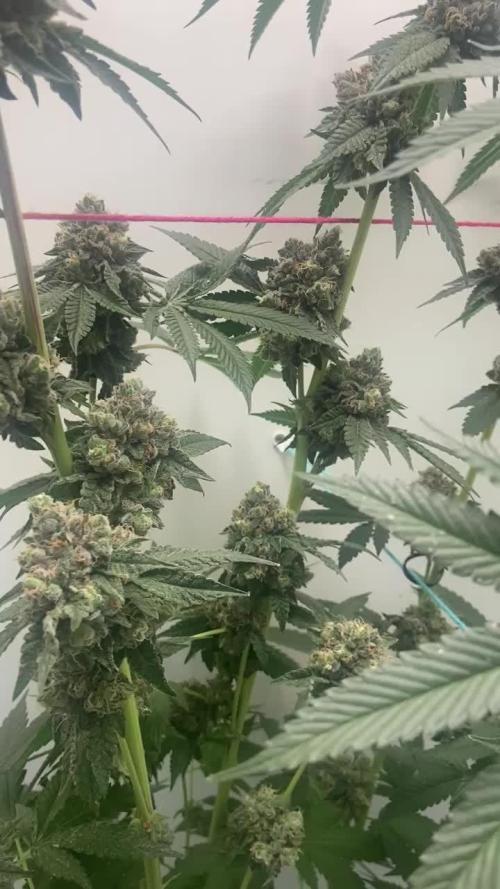
Já faz 11 dias desde a ultima atualização, tinha me programado para colher dias atras porem, mudei de ideia ao ver que os buds estão ganhando mais volume. Nos últimos dias falhei na rega e a ela acabou passando sede por um dia, logo senti a diminuição do cheiro, provavelmente esse estresse volatilizou alguns terpenos. Eu já estava regando no modo flush mas, por conta do ocorrido decidi retornar com alguns suplementos (Cal-Mag, Silica e alguns Carboidratos), com a intenção de estimular a produções de novos óleos. Estarei observando os tricomas e quando os primeiros estiverem mudando a coloração, ai sim vou colher.

Likes
4
Share


@zip420
Follow
1st Harvest: 45g
2nd Harvest: 6.29g
3rd Harvest: 62g
Total: 113.29g
It was a small grow, but I’m happy it yielded more than I expected.
Maybe the staggered harvest helped.
Right now, I’m curing in mason jars with Boveda packs.
I can’t wait until it’s ready to smoke!

Likes
11
Share


@goeser
Follow
More details and photos are coming when all buds are dried in about 6-7 days00


Likes
5
Share


@Hawkbo
Follow
On cruise control now, done some defoliation here and there but that's it, feeding every 2-3 days and they are swelling up very nicely. I took a nice slow video instead of photos of each plant individually below is the order they appear in the video.
1st is 31?
2nd is #29
3rd is #35
4th is Orange Sherbert
5th is #33
6th is Wedding Cheesecake
7th is Wedding Cheesecake #2
8th is #37
REMEMBER , IF YOUR SHOPPING FOR GEAR YOU CAN USE THE CODE “BANGDANG” FOR 10% OFF YOUR ENTIRE PURCHASE FROM ANY OF THE FOLLOWING COMPANIES.
@greenbuzzliquids
@rainscience_growbags
@gorilla_grow_tent
@growlightscience.led
NEW* @Rocbudinc Seeds on his website *
*****Gorilla grow tent discounts extend to all companies affiliated with grow strong industries which include..*****
@super.closet
Lotus Nutrients
Kind LED grow lights


Likes
29
Share


@DOOBS_N_BREWS
Follow
Day 71- Starting week 7 of flowering with these 2 GDPS nearing the end! I have 2 different phenos but they both formed really dense sticky buds so kudos to MSNL for that. GDP A is a snowy gdp with slight purps but GDP B really shows the purple pheno well and the leave progression is really pretty cool. I will continue to go light on waterings and sledgehammer it 2 more times this week. 💪
Day 73- Another big flush for these girls. Its crazy to see both these plants side by side. I did the same training on each one and changed no feedings up but one obviously was very open and grew HUGE while the other grew very tight and compact but still very vigorously in its own special way ;)

Likes
35
Share

@Hologram
Follow
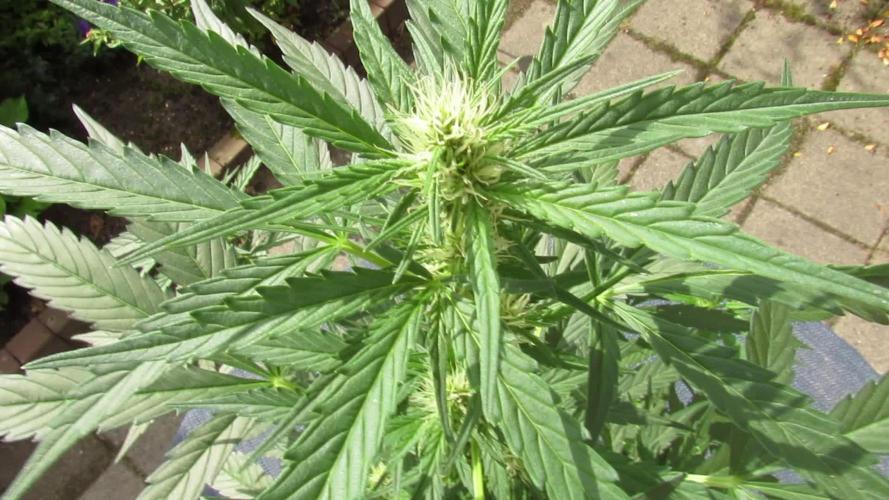
Black Opium is head- 'banging it' with her long hairs!
(I susppect its the CANNAZYM who is responsible for this.. 👍its great stuf it turnes the dead stuff*roots* in the soil into nutes!)
She is growing great, despite of the bad weather we were having last days..
Now sun has returned for a while.. (still a bit cloudy.. but i got HIGH hopes 👊)
..So the hedgehogs can get their hair permed and highlighted .. and really get the party started!😎👌
Happy growing 4 all✊
**KISS! growingtechnique: keepItSimple, Stupid!

Likes
Comments
Share


Likes
6
Share


@ThinkDankGenetics
Follow
Super easy grow bud is fire was a nice freebie if you got seeds run em

Likes
4
Share

@DogDoctorOfficial
Follow
🥒 Project Blue Tent – Week 7
Pickle Lemon Haze F1 – Pheno B (Folder 14B)
Hello everyone, and welcome back to another chapter of Project Blue Tent! 💙🌱
If you're discovering this diary for the first time, welcome aboard!
Project Blue Tent follows four individual plants, each documented in its own dedicated diary from seed all the way to harvest. Every plant shares the exact same environment, lighting, irrigation, nutrition and training strategy, allowing us to observe how each phenotype develops its own personality while keeping the growing conditions as consistent as possible.
Today we're checking in with Pickle Lemon Haze F1 – Plant B.
And this week marks another important milestone.
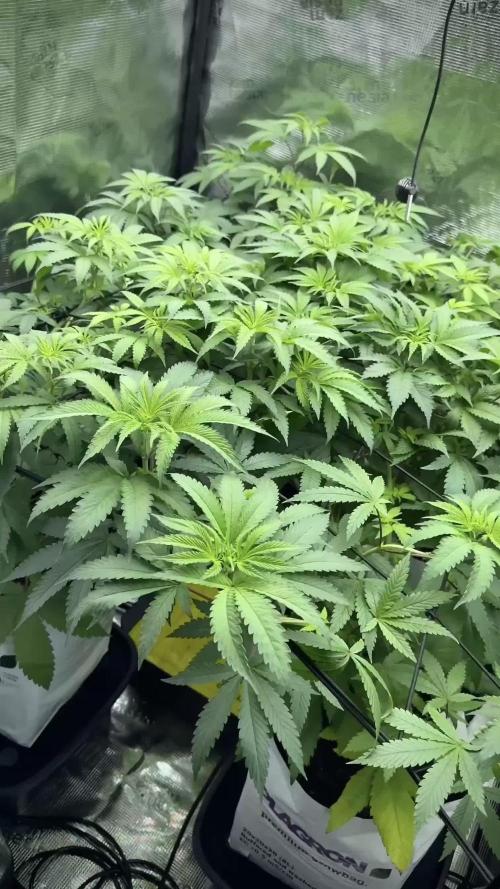
The canopy is full.
The structure is ready.
And we're preparing these beautiful ladies for their transition into flowering.
────────────────────────
🌱 Week Seven – The Canopy Is Complete
Looking across the Blue Tent this week, it's becoming increasingly difficult to distinguish the four plants from above.
The SCROG has done exactly what we wanted it to do.
Instead of four individual plants growing vertically, we now have one remarkably even canopy spreading across the available space.
Plant B has been particularly well suited to this process.
From the beginning, she's shown a natural tendency to grow outward rather than constantly trying to reach upward. Her compact structure, strong side branching and excellent response to training have allowed her to fill her section of the screen beautifully.
After lowering and tightening the SCROG net, all four plants are now sitting at approximately 60 cm.
At this point we're no longer trying to gain height.
We're managing the surface we've created.
Every branch has found its place.
Every available section of the screen has been used.
And now it's time to prepare that canopy for what comes next.
────────────────────────
🕸️ SCROG – From Training to Flowering
For anyone joining this diary without having followed the previous weeks, SCROG stands for Screen of Green.
The purpose of the screen is to guide branches horizontally instead of allowing a few dominant tops to grow significantly taller than everything around them.
As branches reach the screen, they're gently guided into neighbouring openings.
This spreads the future flowering sites across a wider area and creates a much more uniform canopy.
It's not about forcing the plant into an unnatural shape.
It's about taking the growth the plant is already producing and distributing it more efficiently across the available space.
And after several weeks of doing exactly that, the mission has essentially been completed.
The screen is full.
The canopy is even.
Now we move into the cleanup phase.
────────────────────────
✂️ Defoliation – Preparing the Plants for Flower
This week's biggest job is defoliation.
And because this technique is often misunderstood, it's worth explaining what we're actually doing.
Defoliation isn't about stripping a plant of every leaf.
Leaves are essential to the plant. They capture light and support photosynthesis, so removing healthy foliage without a reason isn't the objective.
Instead, we're performing a deliberate canopy cleanup.
After weeks of vigorous vegetative growth and SCROG training, the interior of the plants has become extremely dense.
Leaves overlap.
Branches cross through one another.
Some areas are heavily shaded.
And airflow through the middle of the canopy becomes increasingly important.
So we're selectively removing foliage from areas where the density has become excessive.
We're opening the interior.
Creating more space between branches.
Improving airflow.
Improving visibility.
And creating a cleaner structure for the flowering cycle.
The objective isn't:
"Remove as many leaves as possible."
It's:
"Remove what is no longer helping the structure we're trying to build."
That's a very important difference.
────────────────────────
🌬️ Why Defoliate Before the Flip?
Timing is everything.
A significant defoliation is a form of stress. Even when performed correctly, the plant needs some time to adjust to the loss of foliage and return to its normal growth rhythm.
That's why we're doing this before flowering, rather than waiting until we're already well into the bloom cycle.
Right now the plants are still running an 18/6 vegetative schedule.
They have time to recover.
We can perform the cleanup.
We can watch how they respond.
We can allow fresh growth to resume.
And then we can flip the lights once the plants have settled again.
I don't want to ask the plants to deal with a major cleanup at the same time they're dealing with the physiological transition into flowering.
Instead, we're following a simple sequence:
Build the canopy.
Fill the screen.
Clean the canopy.
Recover.
Flip.
The goal is to enter flowering with healthy plants and a well-organised structure.
────────────────────────
🌿 Pickle Lemon Haze F1 – Plant B
Plant B continues showing exactly the personality we've come to know throughout this project.
She's balanced.
She's compact.
She's incredibly branchy.
And she seems perfectly happy growing sideways.
While Plant A has always shown a little more vertical ambition, Plant B has naturally concentrated her energy into lateral growth and secondary branching.
That has made her particularly enjoyable to work with under the SCROG.
Her stems have continued thickening nicely, her internodal spacing remains compact, and her foliage has developed that rich green colour we've been looking for.
The recovery from topping is now nothing more than a memory.
She's completely moved on from that stage and has spent the last few weeks concentrating on building the framework that will eventually support her flowering sites.
Looking at her now, it's easy to see how much the plant has changed.
She's no longer simply a young vegetative plant.
She's become a properly structured little bush with a full section of the canopy to her name.
And now we're preparing her for the next chapter.
────────────────────────
🥥 Feeding – Staying With What Works
The nutrient recipe remains unchanged this week.
Current feeding:
• Plagron Hydro A — 1.9 ml/L
• Plagron Hydro B — 1.9 ml/L
• Plagron Hydro Roots — 1 ml/L
Current pH:
5.8
Current EC:
1.92 mS/cm
The plants continue showing excellent colour and vigorous growth, so I don't see a reason to change the recipe simply because we're approaching flowering.
Sometimes consistency is the better decision.
We'll see how the plants respond after defoliation, and depending on their recovery and appetite, we may increase the nutrient strength next week.
For now, however, they're telling me exactly what I want to hear.
Healthy colour.
Strong growth.
Good leaf posture.
And no obvious signs that they're asking for anything different.
So...
Nothing changes.
────────────────────────
💧 Drip Irrigation – Keeping the Roots Consistent
The Mars Hydro automatic drip irrigation and drainage system continues to perform beautifully.
Each plant is receiving approximately 1.2 litres of nutrient solution per 24 hours, delivered through the automated drip system.
The slow and consistent irrigation keeps the coco supplied with fresh nutrient solution while the automatic drainage system removes the resulting runoff.
This is particularly valuable in a project like this.
Four plants are sharing the same environment.
The same nutrient recipe.
The same lighting.
The same irrigation schedule.
That consistency helps us keep another major variable under control.
And as the plants become larger, the benefit becomes even more obvious.
The irrigation system simply keeps doing its job every day.
No rushing around with watering cans.
No trying to remember which plant received what.
Just consistent irrigation while I concentrate on observing the plants themselves.
It's one of those systems that doesn't necessarily demand attention when it's working properly.
And honestly...
That's exactly how I like it.
────────────────────────
🌡️ Blue Tent Environment
The environmental conditions have remained very stable as we approach the transition into flowering.
This week's average conditions were:
• 🌡️ Day Temperature: 28°C
• 🌙 Night Temperature: 25°C
• 💧 Relative Humidity: 65%
• 🥥 Substrate Temperature: 24°C
• 💦 Nutrient Solution Temperature: 18°C
• ⚗️ pH: 5.8
• ⚡ EC: 1.92 mS/cm
• 💨 CO₂: approximately 450 ppm
• 💡 Light Schedule: 18/6
• 💧 Irrigation: approximately 1.2 L/plant/24h
• ? Pot Size: 8 L
• 📏 Height: approximately 60 cm
At this stage, stability is more important than constantly changing numbers.
The plants are healthy.
The canopy is full.
The roots are receiving consistent irrigation.
And the current nutrient strength is producing beautiful growth.
So we're staying the course.
────────────────────────
🌿 A Full Canopy Means a Different Kind of Work
One of the interesting things about reaching this stage is that the work changes completely.
Earlier in the grow, the challenge was getting the plants to occupy the space.
Now the challenge is managing everything they've produced.
When the canopy was still developing, every new branch was welcome.
Now we have to start asking different questions.
Does this leaf contribute enough?
Is this area too crowded?
Can air move through here?
Is this branch getting enough light?
Is this part of the plant going to benefit from remaining in the canopy?
That's what good canopy management is really about.
It's not simply growing as much as possible.
It's deciding what growth deserves to remain part of the final structure.
And Plant B has given us plenty to work with.
────────────────────────
Recovery Before Flowering
Once the defoliation is complete, the most important thing we can do is give the plants time.
No unnecessary additional stress.
No rushing.
No immediately piling another major intervention on top of the first one.
The plants need time to rebalance after the cleanup.
We'll watch the new growth.
We'll monitor their posture and overall appearance.
We'll keep the environment stable.
And we'll let them recover.
Once they're settled again, we'll be ready to move forward.
This is why the timing of the defoliation matters so much.
We're not trying to make the plants do everything at once.
We're preparing them step by step.
────────────────────────
👀 Looking Ahead
The next few days should be particularly interesting.
The SCROG has been filled.
The canopy has been cleaned.
The plants now have room to breathe.
And we're approaching the moment we've been working toward for weeks.
The nutrient recipe will remain unchanged for now, although we may increase it once we see how the plants respond after defoliation.
The irrigation continues at approximately 1.2 litres per plant per day.
The environment remains stable.
And most importantly...
We're not rushing the flip.
We'll allow the plants to recover properly first.
Then, when they're ready...
We flower.
🌸
────────────────────────
💙 Thank You
A huge thank you to Zamnesia for making Project Blue Tent possible and for providing these outstanding Pickle Lemon Haze F1 genetics.
A heartfelt thank you to Plagron for the Premium Growbags and Hydro nutrient line that continue supporting this beautiful growth.
A special thank you to Phytonaut for the LED lighting helping us maintain such a consistent and beautifully structured canopy throughout the Blue Tent.
And a massive thank you to Mars Hydro for the automatic drip irrigation and drainage system that continues bringing consistency and simplicity to the daily routine.
Thank you to GrowDiaries for providing growers around the world with a place to document their journeys, exchange knowledge and inspire one another.
And finally...
Thank you to everyone following Project Blue Tent.
Whether you've been here since germination, recently discovered this diary, leave comments every week or simply enjoy watching these four sisters develop...
Your support genuinely means the world to me. 💙
Plant B has spent the last several weeks quietly building herself into one beautiful, compact and incredibly well-structured phenotype.
Now the canopy is ready.
The cleanup is complete.
All that's left is to give her time to recover...
And then see what she can do.
Until next time...
Growers Love, happy growing, and take care everyone! 🌱💙
Likes
3
Share


@AdirondackGreen
Follow
Some light defoliation this week to hopefully get more airflow and encourage upward growth before flowering sets in. (already well underway), might go heavier next week. Got some nasty visitor chewing my leaves, but not aphid or mites, possibly cricket or beetle... monitoring.

Likes
25
Share


@DC_MagicCheeseSocks
Follow
Going into week 9, seeing some frost on the leaves and the aroma is stronger and so nice. She looks great after the heavy defoliation last week, contrary to opinions from a few critics. Sometimes I like to find out for myself, I read many different viewpoints on defoliation and I decided to try. And it worked. Peace friends, happy growing! 🌱👍


