






Likes
9
Share


@Northerngarden85
Follow
Looking nice now taking a bit for feed now
The smell is definitely getting stronger now really looking forward the see these baby's in final stage also big shout out the @barnysfarm my seed have arrived today ready for launch. And new diaries tk come piece out growmies update few pictures when lights are off 🍋🍋

Likes
6
Share


@MisterFlavonoid
Follow
This one was Baked in Paris by PerfectTreeSeeds, grown with GreenPlanetNutrients only! Check the other weeks to see the ones with AptusPlantTech!
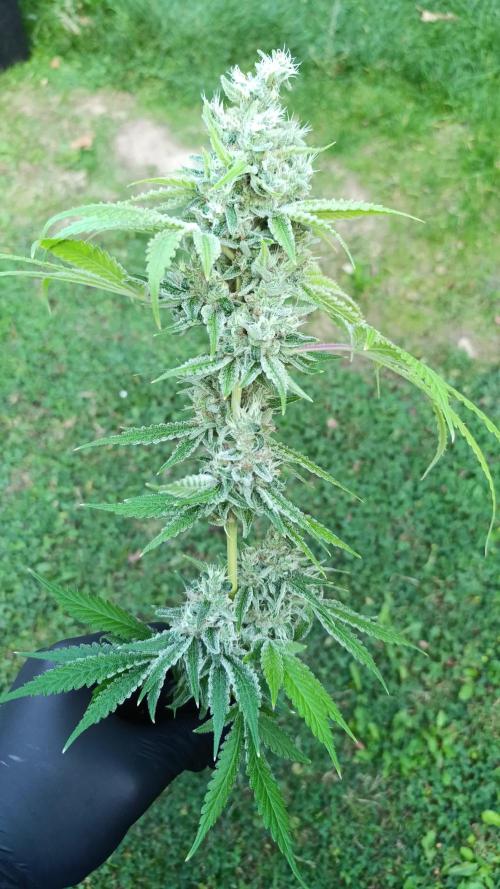
Great zkittles terpz, awesome structure, beautiful colours.
So, this is the one I liked the most since day one, love her colours, her structure and her smell, but precisely because of that I was too excited to harvest her that I forgot to take proper photos so I leave the ones of her last days .. Will try to update soon with some pictures of her on the drying screen ahah

Processing
Likes
9
Share


@Bakeryguy420
Follow
Gelato been really glowing these last few days. :) just bent her over today and stretched out the lower arms. I'll leave it like this for awhile eventually the arms will all go upwards towards the light along with the main cola to make and even canopy. Or atleast longer arms has worked many times in the past. Check out my blue dream by fast buds I'f you havent :)
Update on day 24/25 mid week she been blowing up lately nice size fan leaves going be a nice indica dom for sure :) bent over just like Colorado cookies:) again all ppms had be bumped up close to thousand bitches are hungry this round:)

Likes
16
Share


@Jays_Not_Here_Man
Follow
Week 4-(Day 29)
She has recovered from my transplant disaster. The combination of that, and the feeding I had given her was a lot of stress all at once, and it shows on some of her leaves that were damaged.
However, she has recovered quite nicely, and has grown into her light quite a bit this week. I haven’t done anything other than leaf tucking. I kept her damaged leaves on as once she corrected herself, no further spread is noticeable.
I’ve got a bigger 6x4x7 tent setup, and am gathering all the necessary components to keep a perpetual grow happening. Looking at the Smart -8 from Medic Grow, amazing value (still pricey) for the footprint it makes! Any ideas on how to convince my wife to let me buy a 1000 dollar💡? Lol 😆

Likes
2
Share


@Ultraviolet_
Follow
We become aware at such times of man's wonderful ability to bring seemingly unrelated elements into harmonic balance, and receive a glimpse into a world where everything exists in conscious sympathetic attunement to everything else. When we listen to a piece of music that seems to strike a beautiful chord somewhere inside us, or view a painting that simply glows with harmonic awareness well executed, we probably do not spare much time to contemplate the wonderfully intricate combination of vibrations that our sensors make it possible for us to perceive. We tend to appreciate the relationship between the parts of something by an awareness of the harmony or dissonance of the whole. This ability enables us to say "what a beautiful house!" instead of "analysis has proven that this collection of building materials exhibits certain elements of harmonic proportion." While this ability to instinctively appreciate the beauty of true harmony has an important role to play in evolution, a more analytical understanding of the laws involved can be most useful. This is especially so if we wish to create works of art where each part exists in true harmony, not only with the other part of that particular whole, but with the universe within which the creator and the created exist.
Everything vibrates. From the most dense matter to the most subtle cosmic rays, everything which our senses allow our thoughts to become aware of, can be specified in terms of wavelength or frequency of vibration. These two terms define the same thing, but from different points of view.
The following are the approximate wavelengths of various energy carriers:
Cosmic rays 0.000,000,001 mm
Gamma rays 0.000,000,1 mm
X rays 0.000,500 mm
Ultraviolet rays 0.003 mm
Visible light 0.006 mm
Infrared 0.01 mm
Sound waves 1 meter
Radio waves 300 meters
Violet light 400 nm to 450 nm
Blue light 450 nm to 500 nm
Green light 500 nm to 570 nm
Yellow light 570 nm to 590 nm
Orange light 590 nm to 610 nm
Red light 610 to 700 nm
1 nanometer (nm) = 0.000,000,1 cm = 1/10,000,000 cm
If a guitar string is plucked and we hear a sound, it is not too difficult for the human mind to associate this sound with the vibration of the guitar string. With color it is quite different. It is difficult for us to conceive that the color of a substance is not an inherent property of the substance itself, but an indication picked up by our senses of that substance's ability to absorb or reflect the light which happens to be shining on it at that moment. Neither the matter nor the light is colored. What happens is that the brain learns to differentiate between the frequencies reflected or transmitted by the substance the eyes are focused on. The same thing happens with sound. When we say "Oh! Listen, they're playing my favorite song," what we really mean is: "My brain has stored within it a particular pattern of frequencies. I have compared the new information being received with this stored pattern and have deduced the answer that the two patterns are similar within certain specified tolerances." The 'pleasure' involved could have something to do with our running the pre-recorded pattern at the same time, in 'sympathy' with the new pattern as it is received.
The word sympathy describes very well our ability to appreciate color and sound. It also describes the reason behind certain elements of harmony. For instance, if a substance vibrating at 100 cycles per second (tone 1) is in the proximity of another substance vibrating at 200 cycles per second (tone 2), we could perceive, if we had the right equipment, a certain sympathetic relationship between the two.
We will see from this that there is a uniform doubling of the first tone seen in the second. At various points along the waves, the two are the same in amplitude. At other points, they are at opposite poles to each other. This doubled frequency has more points of similarity to the original than any other frequency except the original itself. If the equipment we had available for measuring these two frequencies was a soundboard amplifier and a pair of ears, then we would hear what would sound to us like one tone. If we had the opportunity to hear one at a time, we would hear that although they sound the same, one is higher in pitch than the other. This characteristic of 'the same but different in pitch', musicians have called the octave. Any two tones produced where one has exactly doubled the frequency of the other is called an octave. Speaking in ratios, an octave would appear then as the ratio 2:1 or 1:2, depending on whether we are talking of an octave up or down.
A single note produced by almost any instrument will contain more than one wavelength or frequency. It will have a dominant frequency, the wavelength of which we would call the note's 'fundamental' or 1st harmonic. It will also have a varying number of upper harmonics, gradually fading in intensity into infinity or silence.
Natural harmonics always have the same pattern of intervals between them. The interval between the 1st and 2nd harmonic is a perfect octave; between the 2nd and 3rd a perfect fifth; between the 3rd and 4th a perfect 4th; and so on, the intervals becoming smaller and smaller until they lose any relationship with the western 12 tone scale as it exists at the moment. Just as an octave has certain elements of sympathy with its fundamental, so some intervals have been noted to be more perfectly in sympathy with the fundamental than others. The ratio of the 'perfect 5th' or interval of 7 semitones, as it occurs in the harmonic series, is 3:2 or 2:3, while that of the 'perfect fourth" is 4:3 or 3:4. All the tones in the western 12 tone scale can be expressed in terms of the ratio between the upper tone and its fundamental. This would seem to be an ideal way of generating a scale from any given fundamental and several attempts have been made to do this, the Pythagorean system being probably the most well known. Although when working with a single tone instrument playing on its own, the Pythagorean formula works wonderfully well, if we had several instruments tuned this way together and asked them to play almost any western music, we would find that at times they sounded quite out of tune to each other.
The lack of flexibility of the various scale systems based on the harmonic series has led to what is known as the 'tempered' scale. This uses as its primary unit of interval the ratio of the octave or 2:1. It then proceeds to divide the interval between any fundamental and its upper octave into 12 smaller intervals by applying the ratio: two to the one-twelfth power, to one (21/12:1). This equals 1.059463094, so by multiplying any frequency by this number, we will obtain the tempered semitone next up from our fundamental. We will also find that any tone twelve semitones up from any other tone, in a scale generated in this way, will have exactly double the frequency.
If we took the note middle C on a piano and halved the wavelength, we would have the note C one octave above. If we halved this, we would have the C above, and so on. However, within about 6 octaves, we would find that although a 'sound' was being produced, no human ear could perceive it. If we kept on going, halving and producing upper octaves of our fundamental C, we would proceed through the infrared band, into the visible light spectrum. If we happened to be outside during the day, we would, for one octave only, see the note C with our eyes. The next octave above would already be in the ultraviolet band, and outside the eye's sensitivity range. If we can think of color as being an indication of a substance's vibratory rate or wavelength, we may begin to see a relationship that could exist between the color and sound spectrums.
The logical extension of what has so far been said is that there exists a scale in the color spectrum that corresponds exactly to the scale in the sound spectrum, each color tone being an octave of the equivalent note in the sound range.
This is not the end of the story but only the beginning. If we can for the moment accept that any wavelength in one band has upper and lower octave stretching out to infinity, then the next question is 'fine, but what shall we use as our fundamental? A particular color? A particular sound frequency?' The musicians among us will probably say 'A 440'. This means that the note A should vibrate at 440 Hertz, or 440 times per second. They would tell us that this is standard pitch has been adopted by most orchestras around the world; pianos are tuned to it, instruments are constructed to formulas based on it, and so to them it would probably seem the most appropriate place to begin. Some of these musicians may know of the battle that is still raging with regards to this being the standard, but few would know why A = 440 Hz was chosen except that it worked when it was set to be a suitable compromise between the many different pitches in use at the time.
432 Hz is said to be mathematically consistent with the patterns of the universe. Studies reveal that 432 Hz tuning vibrates with the universe’s golden mean PHI and unifies the properties of light, time, space, matter, gravity, and magnetism with biology, the DNA code, and consciousness. When our atoms and DNA start to resonate in harmony with the spiraling pattern of nature, our sense of connection to nature is said to be magnified.
Another interesting factor to consider is that the A=432 Hz tuning correlates with the color spectrum, while the A=440 Hz is off. Audiophiles have also stated that A = 432 Hz music seems to be non-local and can fill an entire room, whereas A=440 Hz can be perceived as directional or linear in sound propagation.
Once you adopt the idea that sound (or vibration in general) can have an equalizing and harmonizing effect (as well as a disturbing effect), the science of harmony can be applied to bring greater harmony into one's life or tune to specific energies. There is a form of absolute and relative harmony. Absolute harmony can, for example, be determined by the tuning of an instrument. The ancients tuned their instruments at an A of 432 Hz instead of 440 Hz - and for a good reason. There are plenty of music examples on the internet that you can listen to in order to establish the difference for yourself.
Attuning the instrument to 432 Hz results in a more relaxing sound, while 440 Hz slightly tenses up the body. This is because 440 Hz is out of tune with both macro and micro cosmos. On the contrary, 432 Hz is in tune. To give an example of how this is manifested microcosmically: our breath (0,3 Hz) and our pulse (1,2 Hz) relate to the frequency of the lower octave of an A of 432 Hz (108 Hz) as 1:360 and 1:90.
It is interesting to note that 432 Hz was the standard pitch of many old instruments and that it was only recently (19th and 20th century) the standard pitch was increased. This was done in order to be able to play for bigger audiences. Bigger audiences (more bodies) absorb more of the lower frequencies, so the higher pitch was more likely to “cut through”. One of the oldest instruments of the world is the bell ensemble of Yi Zeng (dated 423 BC), tuned to a standard F4 of 345 Hz, which gives an A= 432 Hz. The frequency of 345 Hz is that of the platonic year! Similarly, many old organs are tuned in A=432 as well; for example, St. Peter’s Capella Gregoriana, St. Peter’s Capella Giulia, S. Maria Maggiore in Rome.
Maria Renold’s book “Intervals Scales Tones and the Concert Pitch C=128 Hz” claims conclusive evidence that 440 Hz and raising concert pitch above scientific “C” Prime=128 Hz (Concert A=432 Hz) disassociates the connection of consciousness to the body and creates anti-social conditions in humanity.
The difference between concert pitch A=440 Hz and Concert A=432 Hz is only 8 cycles per second, but it is a perceptible difference of awareness in the human consciousness experience of the dream we share called existence.





Likes
10
Share


@Tischi
Follow
Sieht aus als würden sie von Tag zu Tag anschwellen die Süßen.
Jetzt wo die Regenzeit mit hoher Luftfeuchtigkeit anfängt habe ich mir einen Luftentfeuchter zugelegt.
Weiß nicht ob es übervorsichtig ist, den schon anzumachen. Doch bei einigen Growmies gab es schon Schimmel in der Ernte.
Ich versuche die Luftfeuchte den Rest des Grows unter 50% zu halten
Likes
1
Share


@Russian_Scrog_King
Follow
hello everyone, I thought the plants were already big enough and switched them to flowering.
A shivaki (Three A Light) type of training was conducted for 27 days and after a day the plants recovered from stress and since this quarrel is going well, I thought that it was impossible to wait any longer.
I expect to harvest in 70 days
Likes
101
Share


@Ferenc
Follow
Day 73, 25th of November 2020:
Hi! Well they are getting nice maturing buds getting bigger and all good.
I love the red colour of the Red Hot Cookies. Unfortunately, Tropicanna Poison and Red Mandarnine does not show any signs of purple or red colour.
Kalini Asia neither albeit, the bonsai version gets purple.
Gelato is little beauty. So yes, basically not much to say.
Fertilization is still the same every second day with the ratio and mixture above stated.
The lamp is on 11.15 min and off 12.45 min.
Last week was 15 min longer light cycle....
So every week 15 min shorter light cycle until the 5th week. So far -45 min. It switches on at 6 am and off at 17.15 pm.


Likes
4
Share


@PapaTerps
Follow
RS11 x Banana OG - Barney's Farm x Doja
Day 105 - watered with 2L of RO tap water with nutrients listed above mixed in order, and ph'd to 6.3. I'm not too sure about this one, there were a few issues with her during veg and now that we're more than half way through her flowering cycle, I would have expected her buds to have bulked up a lot more - her pistils have started to show signs of maturity, so I don't expect her to bulk up much more... Maybe it's the genetics, maybe Im just unlucky here, but I have a feeling the yield will be extremely small with this one... Which is a shame, because it smells so good!!
She's close to harvest and there is enough room in the tent, so I'll finish her off, but under different circumstances, I would have removed her already and turned her into cannabutter... You win some, you lose some...
Likes
19
Share


@GUGU_choices
Follow
Peace growers! Another week of the flowering phase is behind us. We are in the best time of the entire plant cycle. The buds are gaining a lot of volume and the trichomes are filling up to a milky color. The plants are slowly starting to shed their lower leaves and are getting ready to ripen. Judging by the trichomes, it seems to me that they are faster at this stage than I expected. We will see what else they can do at the end of the entire cycle. Sometimes I think that these plants would be very well suited to a stronger wattage of light when I see what potential the girls have... But I like them the way they are and thank you for following them with me :)
-
Peace growers! Další týden květové fáze je za námi. Jsme v tom nejlepším čase celého cyklu rostlin. Palice vydatně nabírají na objemu a trichomy se plní do mléčné barvy. Rostliny začínají pomalu odhazovat spodní lístky a chystají se na dozrávání. Přijde mi podle trichomů, že jsou v této fázi rychlejší než jsem předpokládal. Uvidíme co ještě ze sebe dostanou v závěru celého cyklu. Někdy si říkám, že by těmto rostlinám vydatně slušela silnější watáž světla když vidím jaký mají holky potenciál... Ale líbí se mi takové jaké jsou a vám díky, že je sledujete se mnou :)

Processing
Likes
21
Share


@Daddylongleggz
Follow
Wow things have been looking good so far, Really no problems.. Slow but I'm seeing the fruit the joy pop out of my ladies. So i gave Trina a cut after feeding very heavy as you can see in the pic. Ran out of Ph up and Gina ran Ph of smfh 5.6, that's all I'm going to say.. Cross my fingers also my Rh really been up and down. I'm going to fix that tomorrow.
Likes
24
Share


@MrPott
Follow
Everyone is smelling GREAT! Nice dense buds and covered in trichomes. However, a bit disappointed with Piper as she didn't turn fully purple but that's because I live in a hot and humid country so I can't really get the temperature down to 15-18 celsius at night for her to change colors. Overall, gonna harvest a bit of her cause I'm running out of stock and we'll see how that goes


Likes
3
Share


@Black_Widow
Follow
Привет садоводы !
началась новая неделя и я пока решил не переводить растение на цветение и дать ему еще неделю
это будет и хорошо для авто цветущих
они к сожалению задержались в посылке на 2 недели и уже не успевают на вегетативный световой режим
хотя 1 цветок я уже убираю на ночь в режиме 12/12 и он уже почти зацвел
растения чувствуют себя хорошо а в новом боксе им стало просторнее

Likes
13
Share


@ChachoGreenCrown
Follow
Buena producción dió Rainbows pese a que el clima es algo complicado en esta zona de España en la que vivo. Las lluvias llegan rápido en Octubre! Aún así tenemos unos veranos magníficos para cultivar en outdoor.. con un clima en las que las horas de Sol no faltan. La planta se portó fenomenal al ponerla en tierra, asimilando con facilidad toda la comida que le dimos. Sin signos de excesos y con ganas de comer más!!!
Cogollos duros como piedras bailando al son de los chunguitos. Dale mariano que ya tenemos rainbows para rato.

Likes
4
Share


@AgroCultiveta
Follow
Holaa, cuarta semana de la Negra44.
Esta semana hubieron varios cambios. Primero hice el segundo y ultimo transplante a una maceta de 7 lt al hacer esto aplique Great white en contacto directo con las raíces.
Luego le hice LST y al día siguiente le realice una defoliación para dar mas espacio a las ramas que pretendo mantener.
Hago los riegos 1/1, uno solo con agua(EC: 0.4) y el otro con los fertilizantes.
En los riegos estoy utilizando Sensi cal-mag para llegar a una EC base de 0.4 y luego aplicar los fertilizantes.
Regulo el PH con los reguladores de BioBizz.
Decidí sacar la malla para Scrog por la poca homogeneidad de las plantas en la carpa. Pretendo hacer esta semana la primera aplicación de Delta9 (estimulante floral) la cual será de manera foliar, está se hace 10 días antes de cambiar el ciclo de luz a 12/12. Va quedando menos para la esperada floración.
Estos días está haciendo más frio por lo que la temperatura en mí carpa a bajado, no puedo hacer mucho frente a esto así que espero que no afecte tanto. La única solución seria alguna fuente de calor pero la cuenta de luz se me dispararía.
Por lo demás todo va bien, no presenta carencias ni ningún posible problema. Se a adaptado muy bien a los cambios de esta semana y ya esta creciendo con mas vigorosidad.
Cualquier recomendación sera bien recibida!!
*Great White se mide en gramos. (Dosis: 1gr/3lt)

Likes
41
Share


@eldruida_lamota
Follow
Vamos familia que se viene la cosecha de estas Papayton de Fastbuds, que ganas que tenia ya de darles machetazo.
Que locura de variedad, me encantó cultivarla , pero e de comentar que para mí es una variedad bastante complicada y hacía años que no me encontraba un reto así, al final salieron y bastante top.
Las flores aparte de piedras, se ven resinosas.
a sido una genética, dificil de cultivar y no es muy resistente pero si tienes paciencia fliparas con la calidad, 8/9 semanas de floración, los aromas son bastante intensos y hay que tener cuidado con los plátanos , si sale alguno a final de flora quitarlos y si sale antes desechar mejor la planta.
Por esos problemas que comenté por muy buena variedad que sea no puedo darle muchas estrellas.
Agrobeta:
https://www.agrobeta.com/agrobetatiendaonline/36-abonos-canamo
Mars hydro:
Code discount: Eldruida
https://www.mars-hydro.com/
Hasta aquí es todo , espero que lo disfrutéis, buenos humos 💨💨.
Likes
34
Share


@Le_Duc_Du_Bud
Follow
Salut amis cultivateurs ✌️✂️🌿
Aujourd'hui je pose la nouvelle semaine 🗓️
Comment vous dire que je suis impressionnée ❗
Les plante ce développement a merveille voyait par vous même 🙏
Elles ont fortement grandi, je suis monter a 1.5L par plante, elle consomme la totalité des nutriments et me le montre très très bien 😍🤗
Merci Kannabia 🙏 encore des variétés merveilleuses 😊
J'espère que dame nature sera me récompense 🌿🍁
Pour plus d'informations par rapport à ces génétique, je vous laisse cliquer ici :
https://www.kannabia.com/fr
