


@Cysolja
Follow
I topped her this week and she became very bushy within two days. I also changed her into a 10 gallon grow bag and she is loving it! Growing quickly she seems to love all the nutrients she can get !


@Kelly420
Follow
Everything is on point. I’m at day 35 of flowering. I remember a while back there were a lot of Barney’s farm haters saying they only got hermaphrodites or whatever their bs. Either you just sucked as a grower or you got an absolute fluke. Everything I have ever ordered from Barney’s farm has not only been stellar. But everything I have grown from them vs the same strain from other breeders , Barney’s farm has always taken number one. Many thanks to those wonderful people at BF across the world. Keep it up. I don’t work for them nor sponsored. But would love to. As they are tha shizznit.




@Anon73
Follow
Still spraying with Monterey BT to control the boring moth larvae.
Leaned the area and provided the nutes. Watering is on the same schedule and flower production is booming. Next week I will provide video of the nutrient solution application method.


@Cannabeast40
Follow
Welcome back to yet another short update☺️
Transplanted and filled with tender care and love 🤗 A bit colder temperatures then inside the veg tent , but I’m not worried at all🤩
Videos show the process, hope you enjoy 💯💚
See you next week🤩
------------------------------------------------------------------------------------------
Light source:
Medicgrow SpectrumX
880W LED
Build in PPFD
4 controllable spectrums V1, F1, VS, FS
Visit https://medicgrow.com/ for more informaton.
Light measurement:
Apogee MQ-610 & Apogee DLI-600.
Fertiliser:
Organics Nutrients
https://www.organicsnutrients.com/en/
Green Buzz Nutrients
Discount Code: GD42025
Grants 25% with a minimum Order value at 75 Euro.
https://greenbuzzliquids.com/en/shop/




@Ultraviolet_
Follow
We become aware at such times of man's wonderful ability to bring seemingly unrelated elements into harmonic balance, and receive a glimpse into a world where everything exists in conscious sympathetic attunement to everything else. When we listen to a piece of music that seems to strike a beautiful chord somewhere inside us, or view a painting that simply glows with harmonic awareness well executed, we probably do not spare much time to contemplate the wonderfully intricate combination of vibrations that our sensors make it possible for us to perceive. We tend to appreciate the relationship between the parts of something by an awareness of the harmony or dissonance of the whole. This ability enables us to say "what a beautiful house!" instead of "analysis has proven that this collection of building materials exhibits certain elements of harmonic proportion." While this ability to instinctively appreciate the beauty of true harmony has an important role to play in evolution, a more analytical understanding of the laws involved can be most useful. This is especially so if we wish to create works of art where each part exists in true harmony, not only with the other part of that particular whole, but with the universe within which the creator and the created exist.
Everything vibrates. From the most dense matter to the most subtle cosmic rays, everything which our senses allow our thoughts to become aware of, can be specified in terms of wavelength or frequency of vibration. These two terms define the same thing, but from different points of view.
The following are the approximate wavelengths of various energy carriers:
Cosmic rays 0.000,000,001 mm
Gamma rays 0.000,000,1 mm
X rays 0.000,500 mm
Ultraviolet rays 0.003 mm
Visible light 0.006 mm
Infrared 0.01 mm
Sound waves 1 meter
Radio waves 300 meters
Violet light 400 nm to 450 nm
Blue light 450 nm to 500 nm
Green light 500 nm to 570 nm
Yellow light 570 nm to 590 nm
Orange light 590 nm to 610 nm
Red light 610 to 700 nm
1 nanometer (nm) = 0.000,000,1 cm = 1/10,000,000 cm
If a guitar string is plucked and we hear a sound, it is not too difficult for the human mind to associate this sound with the vibration of the guitar string. With color it is quite different. It is difficult for us to conceive that the color of a substance is not an inherent property of the substance itself, but an indication picked up by our senses of that substance's ability to absorb or reflect the light which happens to be shining on it at that moment. Neither the matter nor the light is colored. What happens is that the brain learns to differentiate between the frequencies reflected or transmitted by the substance the eyes are focused on. The same thing happens with sound. When we say "Oh! Listen, they're playing my favorite song," what we really mean is: "My brain has stored within it a particular pattern of frequencies. I have compared the new information being received with this stored pattern and have deduced the answer that the two patterns are similar within certain specified tolerances." The 'pleasure' involved could have something to do with our running the pre-recorded pattern at the same time, in 'sympathy' with the new pattern as it is received.
The word sympathy describes very well our ability to appreciate color and sound. It also describes the reason behind certain elements of harmony. For instance, if a substance vibrating at 100 cycles per second (tone 1) is in the proximity of another substance vibrating at 200 cycles per second (tone 2), we could perceive, if we had the right equipment, a certain sympathetic relationship between the two.
We will see from this that there is a uniform doubling of the first tone seen in the second. At various points along the waves, the two are the same in amplitude. At other points, they are at opposite poles to each other. This doubled frequency has more points of similarity to the original than any other frequency except the original itself. If the equipment we had available for measuring these two frequencies was a soundboard amplifier and a pair of ears, then we would hear what would sound to us like one tone. If we had the opportunity to hear one at a time, we would hear that although they sound the same, one is higher in pitch than the other. This characteristic of 'the same but different in pitch', musicians have called the octave. Any two tones produced where one has exactly doubled the frequency of the other is called an octave. Speaking in ratios, an octave would appear then as the ratio 2:1 or 1:2, depending on whether we are talking of an octave up or down.
A single note produced by almost any instrument will contain more than one wavelength or frequency. It will have a dominant frequency, the wavelength of which we would call the note's 'fundamental' or 1st harmonic. It will also have a varying number of upper harmonics, gradually fading in intensity into infinity or silence.
Natural harmonics always have the same pattern of intervals between them. The interval between the 1st and 2nd harmonic is a perfect octave; between the 2nd and 3rd a perfect fifth; between the 3rd and 4th a perfect 4th; and so on, the intervals becoming smaller and smaller until they lose any relationship with the western 12 tone scale as it exists at the moment. Just as an octave has certain elements of sympathy with its fundamental, so some intervals have been noted to be more perfectly in sympathy with the fundamental than others. The ratio of the 'perfect 5th' or interval of 7 semitones, as it occurs in the harmonic series, is 3:2 or 2:3, while that of the 'perfect fourth" is 4:3 or 3:4. All the tones in the western 12 tone scale can be expressed in terms of the ratio between the upper tone and its fundamental. This would seem to be an ideal way of generating a scale from any given fundamental and several attempts have been made to do this, the Pythagorean system being probably the most well known. Although when working with a single tone instrument playing on its own, the Pythagorean formula works wonderfully well, if we had several instruments tuned this way together and asked them to play almost any western music, we would find that at times they sounded quite out of tune to each other.
The lack of flexibility of the various scale systems based on the harmonic series has led to what is known as the 'tempered' scale. This uses as its primary unit of interval the ratio of the octave or 2:1. It then proceeds to divide the interval between any fundamental and its upper octave into 12 smaller intervals by applying the ratio: two to the one-twelfth power, to one (21/12:1). This equals 1.059463094, so by multiplying any frequency by this number, we will obtain the tempered semitone next up from our fundamental. We will also find that any tone twelve semitones up from any other tone, in a scale generated in this way, will have exactly double the frequency.
If we took the note middle C on a piano and halved the wavelength, we would have the note C one octave above. If we halved this, we would have the C above, and so on. However, within about 6 octaves, we would find that although a 'sound' was being produced, no human ear could perceive it. If we kept on going, halving and producing upper octaves of our fundamental C, we would proceed through the infrared band, into the visible light spectrum. If we happened to be outside during the day, we would, for one octave only, see the note C with our eyes. The next octave above would already be in the ultraviolet band, and outside the eye's sensitivity range. If we can think of color as being an indication of a substance's vibratory rate or wavelength, we may begin to see a relationship that could exist between the color and sound spectrums.
The logical extension of what has so far been said is that there exists a scale in the color spectrum that corresponds exactly to the scale in the sound spectrum, each color tone being an octave of the equivalent note in the sound range.
This is not the end of the story but only the beginning. If we can for the moment accept that any wavelength in one band has upper and lower octave stretching out to infinity, then the next question is 'fine, but what shall we use as our fundamental? A particular color? A particular sound frequency?' The musicians among us will probably say 'A 440'. This means that the note A should vibrate at 440 Hertz, or 440 times per second. They would tell us that this is standard pitch has been adopted by most orchestras around the world; pianos are tuned to it, instruments are constructed to formulas based on it, and so to them it would probably seem the most appropriate place to begin. Some of these musicians may know of the battle that is still raging with regards to this being the standard, but few would know why A = 440 Hz was chosen except that it worked when it was set to be a suitable compromise between the many different pitches in use at the time.
432 Hz is said to be mathematically consistent with the patterns of the universe. Studies reveal that 432 Hz tuning vibrates with the universe’s golden mean PHI and unifies the properties of light, time, space, matter, gravity, and magnetism with biology, the DNA code, and consciousness. When our atoms and DNA start to resonate in harmony with the spiraling pattern of nature, our sense of connection to nature is said to be magnified.
Another interesting factor to consider is that the A=432 Hz tuning correlates with the color spectrum, while the A=440 Hz is off. Audiophiles have also stated that A = 432 Hz music seems to be non-local and can fill an entire room, whereas A=440 Hz can be perceived as directional or linear in sound propagation.
Once you adopt the idea that sound (or vibration in general) can have an equalizing and harmonizing effect (as well as a disturbing effect), the science of harmony can be applied to bring greater harmony into one's life or tune to specific energies. There is a form of absolute and relative harmony. Absolute harmony can, for example, be determined by the tuning of an instrument. The ancients tuned their instruments at an A of 432 Hz instead of 440 Hz - and for a good reason. There are plenty of music examples on the internet that you can listen to in order to establish the difference for yourself.
Attuning the instrument to 432 Hz results in a more relaxing sound, while 440 Hz slightly tenses up the body. This is because 440 Hz is out of tune with both macro and micro cosmos. On the contrary, 432 Hz is in tune. To give an example of how this is manifested microcosmically: our breath (0,3 Hz) and our pulse (1,2 Hz) relate to the frequency of the lower octave of an A of 432 Hz (108 Hz) as 1:360 and 1:90.
It is interesting to note that 432 Hz was the standard pitch of many old instruments and that it was only recently (19th and 20th century) the standard pitch was increased. This was done in order to be able to play for bigger audiences. Bigger audiences (more bodies) absorb more of the lower frequencies, so the higher pitch was more likely to “cut through”. One of the oldest instruments of the world is the bell ensemble of Yi Zeng (dated 423 BC), tuned to a standard F4 of 345 Hz, which gives an A= 432 Hz. The frequency of 345 Hz is that of the platonic year! Similarly, many old organs are tuned in A=432 as well; for example, St. Peter’s Capella Gregoriana, St. Peter’s Capella Giulia, S. Maria Maggiore in Rome.
Maria Renold’s book “Intervals Scales Tones and the Concert Pitch C=128 Hz” claims conclusive evidence that 440 Hz and raising concert pitch above scientific “C” Prime=128 Hz (Concert A=432 Hz) disassociates the connection of consciousness to the body and creates anti-social conditions in humanity.
The difference between concert pitch A=440 Hz and Concert A=432 Hz is only 8 cycles per second, but it is a perceptible difference of awareness in the human consciousness experience of the dream we share called existence.


@Nikkov
Follow
What's up guys
let's go to a week passing by, right?
and I'm happy that they have resined a lot, it's a shame they didn't develop better but due to the heat and low humidity this cycle they didn't grow much but I'm already improving in the next cycle and we'll see what happens. =D


@eldruida_lamota
Follow
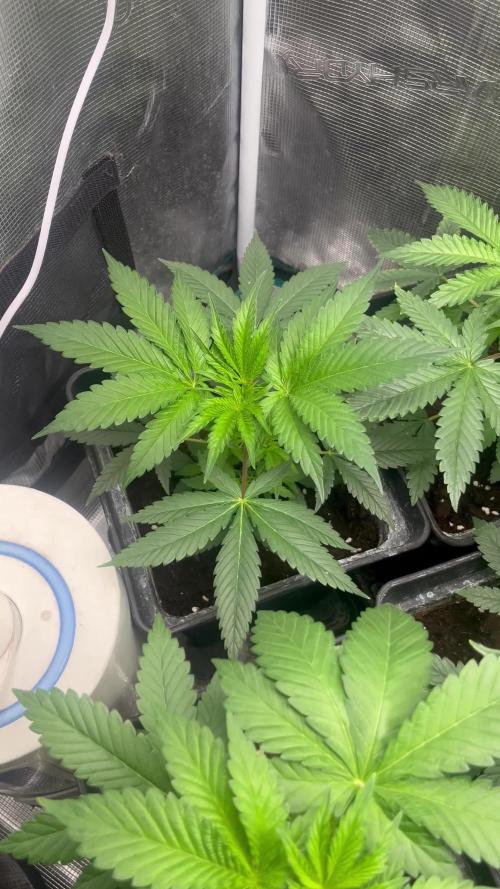
Venga familia que vamos con la quinta semana de vida de estas Toad Venum de Growers Choice.
Al lío, Las plantas están en macetas de 7 Litros, con tierra top crop mezclada con fibra de coco 90/10, y tienen un color verde espectacular.
El ph se controla en 6.5 la temperatura la tenemos entre 23/25 grados y la humedad ronda el 50% gracias al humidificador.
Los riegos actualmente se aplican 600 ml cada 48 horas, y suelo alimentar una vez a la semana.
El ciclo de luz se cambiará la próxima semana a 11/13 por probar algo distinto, el foco está al 65% de potencia.
Estoy utilizando preventivos una vez a la semana y coloque tiras de color azul y amarilla, no tengo plagas pero para prevenir que nunca se sabe.
- os dejo por aquí un CÓDIGO: Eldruida
Descuento para la tienda de MARS HYDRO.
https://www.mars-hydro.com
- los nutrientes directamente desde https://agrobeta.com/agrobetatiendaonline/36-abonos-canamo
Hasta aquí todo, Buenos humos 💨💨💨



@GarciasGarden
Follow
Week 2 of VEG plants are looking beautiful I’m growing in a lot smaller space than I am used to but it also gives me the opportunity to focus on the plants more and make sure they are all getting every little thing they need to thrive! I CANT WAIT to start showing you guys how these ladies grow and I’m happy I’m back ! See you next week !



@MrHaze
Follow
Hello my brothers))
The sun shine very powerfull and i decided to give them some water from stream that situated nearby... Now they have 9l on each plant))
Thanks,in touch...)



@Nebuloso420
Follow
21.03.2026
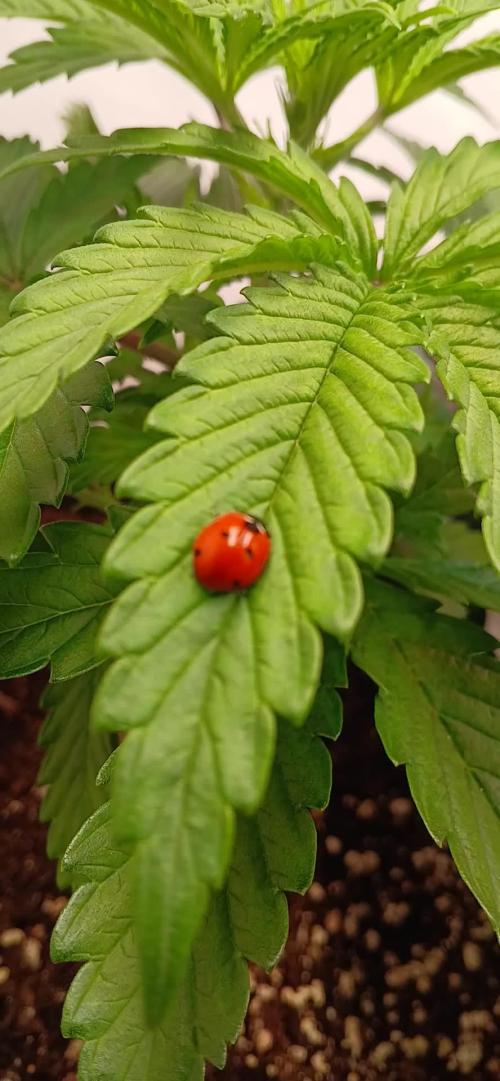
Little Buku is enjoying her bigger 11l pot with good nutrient rich soil.
She is looking good.
This week i am going to low-stress-train her.
And she has a ladybug buddy now.
The air humidity went a little up, to 40% . Still not perfect, but better.


@zzzzzzz064
Follow
On week 2 the woolrock got some mohoo, i fixed it by putting water mixed with "safe roots" from Hydrotek directly into the rockwool superfice.
After a couple days that problem was solved and the plant kept growing very well.
And also i started to train the plants (lst)





@blasterw32
Follow
Buds and sugar leaves started to get more and more trichomes. Some pistils are turning amber/brown, mostly in the tallest colas. I'm slightly worried about the distance between lights / flowers (~16-17"), but so far they don't present any symptoms of light burning. There's no vertical room left to bring the lights up, so I really can't do anything in that matter, just hope they have stopped growing lol.
I'm also about a bit worried about the amount of leaves. Not sure if I should do some prunning or leave as it is.




@RakonGrow
Follow
+
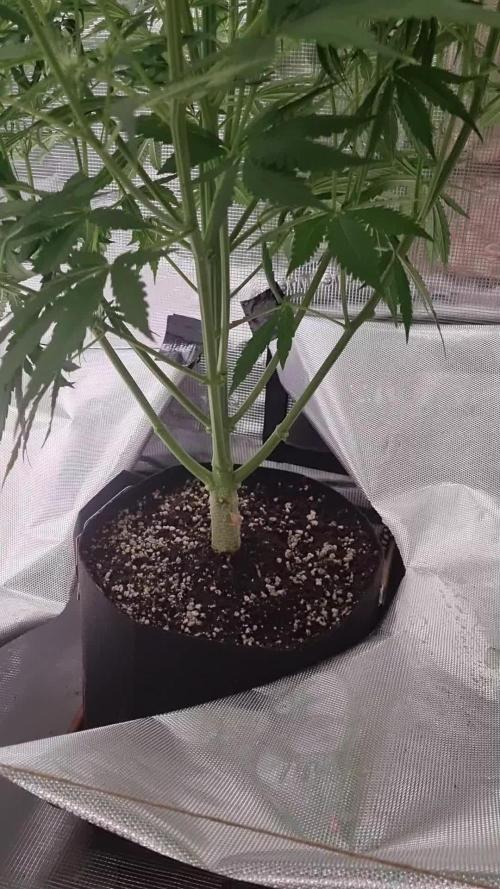
Day 51:
120cm , wow more rocket sience , 80cm is given
DayLight Cycle : 12h (about 970PPFD at canopy) + 4h (about 730PPFD at canopy) + 1h sunrise + 1h sunset
3.25L bottle water EC 0.35 + 0.3ml/L CalMag + Terra Flores 4.5ml/L Final PH 6.13
---------------------- all values are weight in grams ( assumption : 1000g = 1000ml.) -------------
Date Time..................Seed......messure..change...watering.....surplus.....DayLight.....Night.....within 24h
07.11.2025 06:00.....Wurlz...........4946.......-205.....................................................................-205................-1631
07.11.2025 07:00.....Wurlz...........8211.......3256.........3265..............88
07.11.2025 23:45.....Runtz...........6842.....-1369.................................................-1369
08.11.2025 06:00.....Runtz...........6627.......-215.......................................................................-215..............-1584
+


@Roberts
Follow
Well 85.9 grams of goodness. Has a great smell and flavor. Very head heavy smoke. If you like high thc or even fruity buds this is a good one to grow. If anyone is interested in any fast buds strains my affiliate link is
https://myfastbuds.com/?a_aid=60910eaff2419
If anyone is interested in a Viparspectra light I can send you to a affiliate link, and look for discounts though my affiliate program as well. Please direct messages me for more information please.
Thank you grow diaries community for the likes, follows, and subscriptions on my YouTube channel. I really appreciate the support. 🌱🌱🌱 happy growing 🍓🍌🍓🍌🍓🍌🍓🍌