Likes
Comments
Share
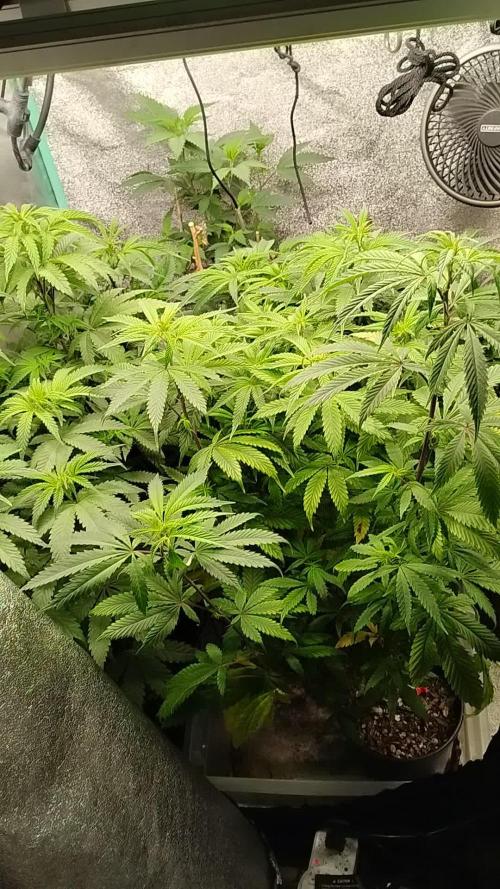
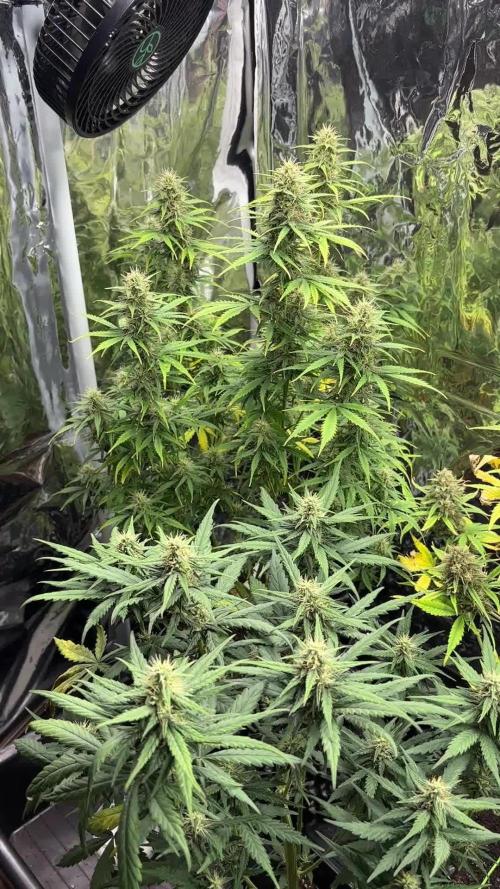
Veo que las plantas avanzan lentamente pero seguro, tengo buenas sensaciones. Hay 8 puntas por cada planta.
Likes
69
Share
@nonick123
Follow
Día 44 (15/07) Wow! No hay shock de trasplante! 😍💥😁 Todas las ramas se han estirado hacia arriba tras el ajuste de LST y se están formando nuevos nodos rápidamente Esta combinación de nutrientes de Lurpe + substrato de PRO-MIX HP es una maravilla 😍 Día 45 (16/07) Ayer tuvimos ola de calor (37 ºC) y han aguantado muy bien! A última hora de la tarde (cuando ya no había sol directo) les apliqué H2O en spray foliarmente para refrescar los estomas Hoy parece que vuelven las temperaturas estándar para esta época del año: 29 - 30 ºC en las horas centrales del día Riego con 1 litro de H20 pH 6,5 Día 46 (17/07) Pequeños ajustes de LST Hay algunas ramas inferiores que no se han formado / estirado mucho Lo más probable es que haga una buena limpieza este domingo, 7 días después del trasplante, para dejar solo los brotes por encima del 4º nudo Día 47 (18/07) Riego con 0,5 litro de H20 pH 6,5 Este domingo (día 50) haré limpieza de partes bajas y tal vez también de nuevo topping en las 4-6 ramas principales 😁 Día 48 (19/07) Día de muchísimo calor con 37 ºC. A ver como lo llevan! Riego con 0,5 litro de H20 pH 6,5 Día 49 (20/07) Para ayudarles a llevar mejor el calor de las horas centrales del día, coloca una malla de sombreo (70%) sobre el invernadero Lo cierto es que se nota que baja mucho la temperatura debajo de la malla! Van a estar más fresquitas! 😍 Riego con 0,5 litro de H20 pH 6,5 Día 50 (21/07) Training session! Hago limpieza del tercio inferior de la planta, de todas las ramas y nudos que no superan la línea del dosel marcada por el 4º nudo (1er topping) También hago topping (2º) a todas las ramas principales La idea es tener 12 ó 14 colas principales para que no se hagan muy altas De paso saco unos cuantos clones de las ramas inferiores eliminadas 😁💥 Para superar el estrés, hago las siguientes aplicaciones y riego: - Riego con 1 Litro de Té Vegetativo de Lurpe Solutions. Preparación: 24 horas con bomba de aire (oxigenación) con ingredientes: Green Sunrise 8 ml/L + Insect Frass 16 ml/L + Hummus Lombriz 8 ml/L + Melaza 1 ml/L + Kelp Hidrolizado 0,25 g/L - Aplicación foliar Kelp hidrolizado de Lurpe Solutions a 0,25 ml/l 💦Nutrients by Lurpe Solutions - www.lurpenaturalsolutions.com 🌱Substrate PRO-MIX HP BACILLUS + MYCORRHIZAE - www.pthorticulture.com/en/products/pro-mix-hp-biostimulant-plus-mycorrhizae
Likes
2
Share
67 days since April 16th, 2026 We become aware at such times of man's wonderful ability to bring seemingly unrelated elements into harmonic balance, and receive a glimpse into a world where everything exists in conscious sympathetic attunement to everything else. When we listen to a piece of music that seems to strike a beautiful chord somewhere inside us, or view a painting that simply glows with harmonic awareness well executed, we probably do not spare much time to contemplate the wonderfully intricate combination of vibrations that our sensors make it possible for us to perceive. We tend to appreciate the relationship between the parts of something by an awareness of the harmony or dissonance of the whole. This ability enables us to say "what a beautiful house!" instead of "analysis has proven that this collection of building materials exhibits certain elements of harmonic proportion." While this ability to instinctively appreciate the beauty of true harmony has an important role to play in evolution, a more analytical understanding of the laws involved can be most useful. This is especially so if we wish to create works of art where each part exists in true harmony, not only with the other part of that particular whole, but with the universe within which the creator and the created exist. Everything vibrates. From the most dense matter to the most subtle cosmic rays, everything which our senses allow our thoughts to become aware of, can be specified in terms of wavelength or frequency of vibration. These two terms define the same thing, but from different points of view. The following are the approximate wavelengths of various energy carriers: Cosmic rays 0.000,000,001 mm Gamma rays 0.000,000,1 mm X rays 0.000,500 mm Ultraviolet rays 0.003 mm Visible light 0.006 mm Infrared 0.01 mm Sound waves 1 meter Radio waves 300 meters Violet light 400 nm to 450 nm Blue light 450 nm to 500 nm Green light 500 nm to 570 nm Yellow light 570 nm to 590 nm Orange light 590 nm to 610 nm Red light 610 to 700 nm 1 nanometer (nm) = 0.000,000,1 cm = 1/10,000,000 cm If a guitar string is plucked and we hear a sound, it is not too difficult for the human mind to associate this sound with the vibration of the guitar string. With color it is quite different. It is difficult for us to conceive that the color of a substance is not an inherent property of the substance itself, but an indication picked up by our senses of that substance's ability to absorb or reflect the light which happens to be shining on it at that moment. Neither the matter nor the light is colored. What happens is that the brain learns to differentiate between the frequencies reflected or transmitted by the substance the eyes are focused on. The same thing happens with sound. When we say "Oh! Listen, they're playing my favorite song," what we really mean is: "My brain has stored within it a particular pattern of frequencies. I have compared the new information being received with this stored pattern and have deduced the answer that the two patterns are similar within certain specified tolerances." The 'pleasure' involved could have something to do with our running the pre-recorded pattern at the same time, in 'sympathy' with the new pattern as it is received. The word sympathy describes very well our ability to appreciate color and sound. It also describes the reason behind certain elements of harmony. For instance, if a substance vibrating at 100 cycles per second (tone 1) is in the proximity of another substance vibrating at 200 cycles per second (tone 2), we could perceive, if we had the right equipment, a certain sympathetic relationship between the two. We will see from this that there is a uniform doubling of the first tone seen in the second. At various points along the waves, the two are the same in amplitude. At other points, they are at opposite poles to each other. This doubled frequency has more points of similarity to the original than any other frequency except the original itself. If the equipment we had available for measuring these two frequencies was a soundboard amplifier and a pair of ears, then we would hear what would sound to us like one tone. If we had the opportunity to hear one at a time, we would hear that although they sound the same, one is higher in pitch than the other. This characteristic of 'the same but different in pitch', musicians have called the octave. Any two tones produced where one has exactly doubled the frequency of the other is called an octave. Speaking in ratios, an octave would appear then as the ratio 2:1 or 1:2, depending on whether we are talking of an octave up or down. A single note produced by almost any instrument will contain more than one wavelength or frequency. It will have a dominant frequency, the wavelength of which we would call the note's 'fundamental' or 1st harmonic. It will also have a varying number of upper harmonics, gradually fading in intensity into infinity or silence. Natural harmonics always have the same pattern of intervals between them. The interval between the 1st and 2nd harmonic is a perfect octave; between the 2nd and 3rd a perfect fifth; between the 3rd and 4th a perfect 4th; and so on, the intervals becoming smaller and smaller until they lose any relationship with the western 12 tone scale as it exists at the moment. Just as an octave has certain elements of sympathy with its fundamental, so some intervals have been noted to be more perfectly in sympathy with the fundamental than others. The ratio of the 'perfect 5th' or interval of 7 semitones, as it occurs in the harmonic series, is 3:2 or 2:3, while that of the 'perfect fourth" is 4:3 or 3:4. All the tones in the western 12 tone scale can be expressed in terms of the ratio between the upper tone and its fundamental. This would seem to be an ideal way of generating a scale from any given fundamental and several attempts have been made to do this, the Pythagorean system being probably the most well known. Although when working with a single tone instrument playing on its own, the Pythagorean formula works wonderfully well, if we had several instruments tuned this way together and asked them to play almost any western music, we would find that at times they sounded quite out of tune to each other. The lack of flexibility of the various scale systems based on the harmonic series has led to what is known as the 'tempered' scale. This uses as its primary unit of interval the ratio of the octave or 2:1. It then proceeds to divide the interval between any fundamental and its upper octave into 12 smaller intervals by applying the ratio: two to the one-twelfth power, to one (21/12:1). This equals 1.059463094, so by multiplying any frequency by this number, we will obtain the tempered semitone next up from our fundamental. We will also find that any tone twelve semitones up from any other tone, in a scale generated in this way, will have exactly double the frequency. If we took the note middle C on a piano and halved the wavelength, we would have the note C one octave above. If we halved this, we would have the C above, and so on. However, within about 6 octaves, we would find that although a 'sound' was being produced, no human ear could perceive it. If we kept on going, halving and producing upper octaves of our fundamental C, we would proceed through the infrared band, into the visible light spectrum. If we happened to be outside during the day, we would, for one octave only, see the note C with our eyes. The next octave above would already be in the ultraviolet band, and outside the eye's sensitivity range. If we can think of color as being an indication of a substance's vibratory rate or wavelength, we may begin to see a relationship that could exist between the color and sound spectrums. The logical extension of what has so far been said is that there exists a scale in the color spectrum that corresponds exactly to the scale in the sound spectrum, each color tone being an octave of the equivalent note in the sound range. This is not the end of the story but only the beginning. If we can for the moment accept that any wavelength in one band has upper and lower octave stretching out to infinity, then the next question is 'fine, but what shall we use as our fundamental? A particular color? A particular sound frequency?' The musicians among us will probably say 'A 440'. This means that the note A should vibrate at 440 Hertz, or 440 times per second. They would tell us that this is standard pitch has been adopted by most orchestras around the world; pianos are tuned to it, instruments are constructed to formulas based on it, and so to them it would probably seem the most appropriate place to begin. Some of these musicians may know of the battle that is still raging with regards to this being the standard, but few would know why A = 440 Hz was chosen except that it worked when it was set to be a suitable compromise between the many different pitches in use at the time. 432 Hz is said to be mathematically consistent with the patterns of the universe. Studies reveal that 432 Hz tuning vibrates with the universe’s golden mean PHI and unifies the properties of light, time, space, matter, gravity, and magnetism with biology, the DNA code, and consciousness. When our atoms and DNA start to resonate in harmony with the spiraling pattern of nature, our sense of connection to nature is said to be magnified. Another interesting factor to consider is that the A=432 Hz tuning correlates with the color spectrum, while the A=440 Hz is off. Audiophiles have also stated that A = 432 Hz music seems to be non-local and can fill an entire room, whereas A=440 Hz can be perceived as directional or linear in sound propagation. Once you adopt the idea that sound (or vibration in general) can have an equalizing and harmonizing effect (as well as a disturbing effect), the science of harmony can be applied to bring greater harmony into one's life or tune to specific energies. There is a form of absolute and relative harmony. Absolute harmony can, for example, be determined by the tuning of an instrument. The ancients tuned their instruments at an A of 432 Hz instead of 440 Hz - and for a good reason. There are plenty of music examples on the internet that you can listen to in order to establish the difference for yourself. Attuning the instrument to 432 Hz results in a more relaxing sound, while 440 Hz slightly tenses up the body. This is because 440 Hz is out of tune with both macro and micro cosmos. On the contrary, 432 Hz is in tune. To give an example of how this is manifested microcosmically: our breath (0,3 Hz) and our pulse (1,2 Hz) relate to the frequency of the lower octave of an A of 432 Hz (108 Hz) as 1:360 and 1:90. It is interesting to note that 432 Hz was the standard pitch of many old instruments and that it was only recently (19th and 20th century) the standard pitch was increased. This was done in order to be able to play for bigger audiences. Bigger audiences (more bodies) absorb more of the lower frequencies, so the higher pitch was more likely to “cut through”. One of the oldest instruments of the world is the bell ensemble of Yi Zeng (dated 423 BC), tuned to a standard F4 of 345 Hz, which gives an A= 432 Hz. The frequency of 345 Hz is that of the platonic year! Similarly, many old organs are tuned in A=432 as well; for example, St. Peter’s Capella Gregoriana, St. Peter’s Capella Giulia, S. Maria Maggiore in Rome. Maria Renold’s book “Intervals Scales Tones and the Concert Pitch C=128 Hz” claims conclusive evidence that 440 Hz and raising concert pitch above scientific “C” Prime=128 Hz (Concert A=432 Hz) disassociates the connection of consciousness to the body and creates anti-social conditions in humanity. The difference between concert pitch A=440 Hz and Concert A=432 Hz is only 8 cycles per second, but it is a perceptible difference of awareness in the human consciousness experience of the dream we share called existence.
Likes
189
Share
@InspireMe
Follow
Day 51: So today is my usual watering day but decided that I can do it in the evening instead of the morning. How wrong I was, blue dream at the back was deeply unhappy with that idea. I came to water and shed dropped like crazy. The other BD was ready eventhough she wasnt due until tomorrow, I feel as though I may have gotten a little complacent with the 3 day water. I'll be checking after 2 days now as I dont even bother to lift the pots to check. All back to normal after watering. (Watered plain PH 6.3 water) Photos arent quite as good tonight as I was rushing as my phone was going to die. Will get some better ones today Lastly, a big thanks to marshydro for sending me the tsw-2000! Girls are looking awesome under it 😏👌 Super easy to install, I've left at the same hight and set the brightness to about 50%. Using my cheap light measure it's a little more than what they were getting before. I'm getting a much better coverage with the tsw-2000 than what I had with the 2x viparspectra P1000s. I'm really happy with the light already, I'm sure the girls are going to love it just as much as I 😝. Day 52: all is good! Girls aren't dropping an hour before lights out so I have increased the light to 65%. Really good sign, maybe they like the mars light spectrum a little more than the VS. Checked on weight of the pot today, still feels real heavy.. I'll be shocked if I need to water tomorrow, maybe it was just a one off as it has been a little warm. We shall see tomorrow! Day 55: the older blue dream is showing a pretty heavy P deficiency. This is likely due to my laziness.. I've been feeding her the same as the others even though she looked like she could take some more nutes. Fed them all today 4L ph 6.4 530ppm 1ml/L big bud & bloom B 0.5ml/L b52 0.25ml/L cal mag Bads are starting to put on weight and pistils are browning a little roughly 30-40% are browning. Getting closer to harvest 😁 Day 58: watered 4L plain Ph 6.4 (All) Small defoliation of all 3 plants, increasing light penetration and airflow to the bud sites. Pistils are mostly brown, I'm going to start the flush and keep an eye on the trichomes! Time to get out the microscope for the next update 😁 Thanks for stopping by! 🙂👍
Likes
6
Share
@Groweedo
Follow
3 dernier jours avant rinçage, demain je met pour la dernière fois les nutriments, l’odeur est à tomber par terre surtout la runtz qui sent le bonbon 🍬 🍭
Likes
18
Share
Hey everyone ☺️. It gets more beautiful from week to week 😍👍. I have them all this week Sprayed again properly with neem oil in the veggie phase ☺️. There have been no trips for 2 weeks, but prevention is better 😀. Because of the neem oil, the plants look very dark and shiny, which I really like when they shimmer like that 😝. I didn't do any training these days, that will be done again the next few days 👌. it was watered twice this week with around 0.6 l per plant. The Ph / Ec measuring device was also recalibrated. Otherwise there is nothing to report for this week and we'll see you again with the next update ☺️👍. I wish you and your families a Merry Christmas 😊. Stay healthy and let it grow 🍀 You can buy this Strain at : https://sweetseeds.es/de/red-mandarine-f1-fast-version/ Type: Red Mandarine F1 Fast Version ☝️🏼 Genetics: Red Poison Auto®️ (SWS39) X Tangie (California Orange x Hybrid Skunk) 👍 Vega lamp: 2 x Todogrow Led Quantum Board 100 W 💡 Bloom Lamp : 2 x Todogrow Led Cxb 3590 COB 3500 K 205W 💡💡☝️🏼 Soil : Canna Coco Professional + ☝️🏼 Fertilizer: Green House Powder Feeding ☝️🏼🌱 Water: Osmosis water mixed with normal water (24 hours stale that the chlorine evaporates) to 0.2 EC. Add Cal / Mag to 0.4 Ec Ph with Organic Ph - to 5.5 - 5.8 .
Likes
3
Share
Since Dosidos flowered two weeks before all of my other outdoor, it was lacking in size from the veg cycle. Next year I could offset this by having a few more plants or veg inside for a month or two before bringing them out. Other than that this strain had the most resin production compared to everything else! The dried nug looks comparable to quality indoor.
Likes
4
Share
@Adam22
Follow
Needed to go in big pots will sort that tmro watered late today they will be fine again once in bigger pot these have been on 12/12 for a few days. Will pl out the gavita they need some hear for a week or 2 led lights not powerful enough now for the plant age it's not growing much now fed today water tmro with transplant
Likes
24
Share
Day one of week 7! Saturday 3rd Oct. Yay I made it to week 7!! First week of flower! Flipped the lights and the girls are getting their first 12 hours of darkness as I type. As soon as it’s lights go on I’m gonna get the next lot of nutes in as they seemed almost ready for a feed when I put them to bed. Getting a little nervous the temps are a still bit high as we go into flower but these girls seem hardy so staying positive! UPDATE: Day 2 of week 7, Sunday 4th Oct. Girls still looking strong and nutes gone in again today. Got a fan blowing onto the outside of my tent (which is helping lots) as the slightly lower humidity levels are really heating things up with the dehumidifier working harder inside the tent now, especially around watering time. Fan at full whack, if this doesn’t work I may have to get an intake fan but was trying to avoid extra costs. Keeping a close eye 👁️ UPDATE: Tuesday 6th October Day 4 of week 7 Nutes in again and a little more teasing with the LST to keep the girls low on the stretch. Think I found a little white hair 🤩🤩 (see pics).... It’s getting exciting.. 🤓 UPDATE: Thursday 8th October Day 6 of week 7 Ok great news today.. All four ladies have some pretty little pistils all over various bud sites and no hermies in sight! Phew! 😅 Nutes going in too 👌🏼 Happy growing and all that jazz! 🍃🍁👌🏼❤️
Likes
2
Share
Sooo, about three and a half weeks have passed since the last update - she should be around week 3.5 of flowering by now, and goddamn, I’m stunned, bro. I had some medical PM a few months ago, and the smell already reminds me so much of it. It’s also the stickiest stuff I’ve grown so far, and she’s not even halfway through flowering yet.
Likes
7
Share
Likes
11
Share
@w00tGrow
Follow
Here comes the last week, but i think they will need some extra time, will check later on mycroscope.
Likes
9
Share
@Hypnogrow
Follow
Alien tech, squanch queen and king tut left. Letting at and kt veg a while. Fed 4 times daily for 4 mins each 650ppms at 6.0 ph. Squanch is being flushed.
Likes
9
Share
@SanderG
Follow
Happy with the progress. Everything is still looking healthy and the ladies seem to be thriving so far. Love the citrus smell that is developing and am excited to see how the mystery plant develops.
Likes
42
Share
@MrGrow
Follow
8.03.2022 Proceduto al taglio e al lavaggio delle infiorescenze al 63 giorno di fioritura. Ottimo il risultato finale, in uno spazio di 1,2 m² ho prodotto un raccolto di 540 gr di cime secche e rifilate pronte da fumare💚 Con i ritagli delle foglie e dei fiori più piccoli sono riuscito a tirare fuori un po di kief di prima qualità. Aggiornerò tra qualche settimana con il rapporto sul fumo, dopo che avrò fatto maturare e ruttare le cime in barattoli di vetro.🙏💚
Likes
12
Share
Likes
58
Share
Hi everyone ☺️. Today the New Aeroponic Diary begins, as before with the wonderful variety Gelato from Zamnesia . This time I planned to leave the full 8 cuttings instead of 3 as in the last run. For test purposes I would like to give a very short vegi time this time. To be precise, I would like to switch them to flowering a few days after rooting. Since the growth is extremely extreme on Aero, I think that a few days will be enough to get 8 little trees 😋. Of course everything is documented and uploaded. Today the cuttings were cut, brushed with clone gel and placed in the aero system 😃. Of course, the entire system was cleaned very time-consuming with disinfectant after the last run, and all seals, pumps, etc. were checked for their function, so that the new run could start today 👌👍. As with the last Aero grow, the Canna Aqua range 😊 serves as nutrients. I wish you lots of fun when you start the diary, stay healthy 🙏🏻 and let it grow 🍀👌 You can buy This Strain at : www.Zamnesia.com ☝️🏼☝️🏼☝️🏼☝️🏼☝️🏼☝️🏼 Strain Gelato clone from mother (Zamnesia ) ☝️ Genetics: Wedding Cake x Gelato x Gelato 33 👍 Vega lamp: 2 x Todogrow LED CXB3590 COB 55 W 1 x Sanlight S2W 62 W 💡 Flower lamp : 2 x Todogrow LED CXB3590 COB 55 W 1 x Sanlight S2W 62 W 💡 ☝️ Grow Aero System : Growtool 0.8 ☝️ Fertilizer: Canna Aqua Vega A + B , Canna Aqua Flores A + B , Rizotonic, Cannazym, CANNA Boost, Pk 13/14, Canna Cal / Mag, Canna Ph - Grow, Canna Ph-Bloom ☝️🌱 Water: Osmosis water mixed with normal water (24 hours stale that the chlorine evaporates) to 0.2 EG. Add Cal / Mag to 0.4 Ec Ph with ph- to 5.2 - 5.8 💦 💧
Likes
3
Share
@Joaka
Follow
como preventivo aplique tierra de diatomea via foliar. solo realice un apical por variedad de semilla ya que las otras aun según mi criterio les faltaba. se espera realizar la otra semana apical en las otras dos para dejar 2 sin manejo para comparar.
Likes
16
Share
Esa familia, otra vez actualizamos, vamos con estas Blueberry Cheese de Zambezaseeds. Finalizamos la segunda semana de floración de esta genética, tienen buen color y buena ramificación y van progresando las futuras flores. No e comentado pero se les a practicado una defoliación de bajos a ver si podéis ver en el video Añadimos el BETASHARK de Agrobeta y esta semana no les dimos tetra 9. Agrobeta: https://www.agrobeta.com/agrobetatiendaonline/36-abonos-canamo Mars hydro: Code discount: EL420 https://www.mars-hydro.com/ Las maximas de temperatura no superan los 26 grados y las mínimas no bajan 20, así que no me puedo quejar. Los niveles de humedad también son los correctos van entre 50%/65% de humedad relativa. Por supuesto el Ph lo estamos dejando alrededor de 6. Hasta aquí es todo, buenos humos 💨💨💨