Likes
Comments
Share


@Skunky
Follow
Update from last week that I forgot: I gave her a final feed at 75%...
WEEK 25 DAY 1 ... omg... 😂😂😂
It really took me half a year to finish this one... unbelievable... 😅
Well, so far I'm still super happy. Everything seems to go just fine but I'll never do this again..haha.. (vegging under a 50W bulb xD)...
Soooo... looking at the trichs, I think the harvest window has just opened. There's still a lot of clear but the cloudy ones are starting to come and there's already a little amber on the leaves. I suppose I'm really close to harvest now. I'll be flushing her next time for sure.
First, I'll feed her a low nutrient solution, maybe around 25% and half of the usual water quantity because I'm not that sure about when she really finishes so she dries out more quickly. Next, I'll use Grotek Final Flush right before I'll chop her down. I don't want to use this right away because last time my plants were dying a bit too fast so.. not to be repeated ;)
Getting impatient now. Hopefully it will be a White Christmas...haha!
DAY 2
Gave her one last feed at 25%. Poured only half of the usual water quantity. Left the BloomComplex totally aside because she seems like she's doing a little 'clawing'. Maybe there's too much Nitrogene? Trichs are beginning to get cloudy, with a little amber in between.
I'll flush her with plain ph'd water tomorrow probably or should I wait some more days? What do you think? I'm never sure when the time is right... :/
DAY 3
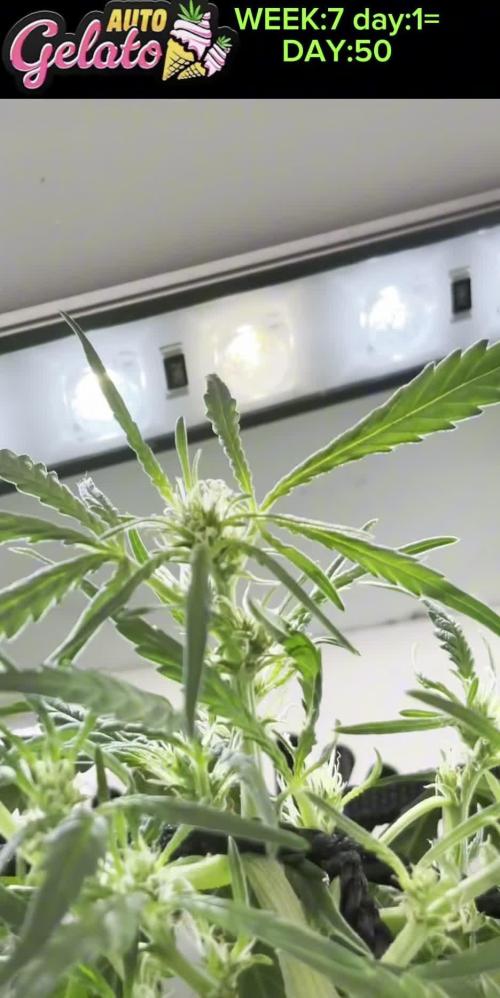
I just took some more pictures with a macro lens attached to my iPhone. Seems like the buds in the middle do have way more amber than the other ones around which have swollen more compared to the ones in the middle but have less amber. The last days, I didn't check the ones in the middle so I changed my mind. I just flushed her with Grotek Final Flush. I'll wait for some hours for the solution to break down the salts and then I'll flush again to get rid of the flushing solution.
I'm also gonna switch the timetable to 8/16. (16 hours of dark) and I'll drop the temperatures some 2 more degrees.


Likes
Comments
Share

@DogDoctorOfficial
Follow
👑 Godfather OG – Pheno B
Week 9 | Just Let Me Grow
Welcome back to another chapter of the 8×8 Adventure! 💚🌱
Some plants ask for attention.
Some plants demand it.
And then there are plants that simply look at you and say:
“I'm good. Just let me grow.” 😂
Godfather OG Pheno B is definitely one of those girls.
This week, she's happy.
She's growing.
She's adapting.
She's building flowers.
She's beautifully green.
And she's asking for absolutely nothing.
So what am I doing?
Exactly what she wants.
I'm letting her grow. 🌱
🌿 The Happy Girl in the Room
There is something incredibly satisfying about walking into a room full of more than twenty plants and finding one that simply looks completely comfortable in her surroundings.
Godfather OG Pheno B is giving me exactly that feeling.
She's not complaining.
She's not demanding anything.
She's not asking for a special intervention.
She's just continuing to do what she has been doing from the beginning:
growing beautifully.
And honestly, I love it.
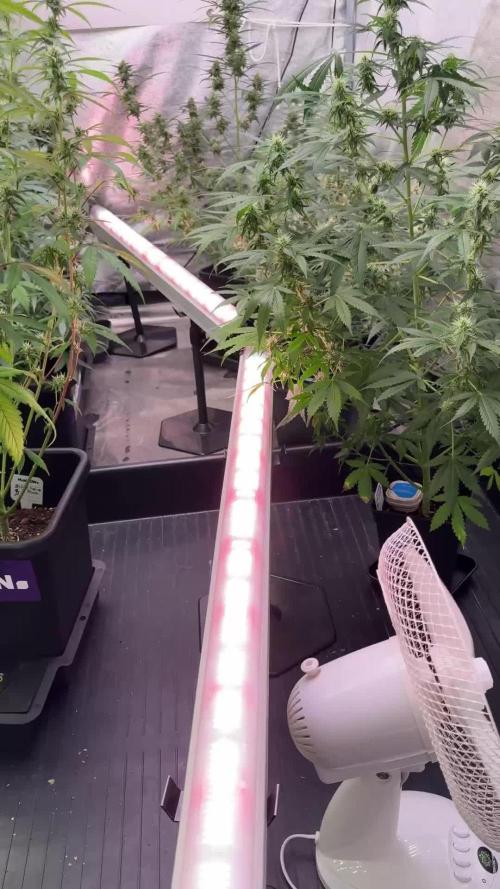
At around 160 cm, she's among the taller plants in the room.
But I want to make something clear.
This run isn't about producing gigantic plants.
We haven't been chasing enormous heights.
And that's something I'm actually very happy about.
The plants are growing into what I would consider a beautiful, manageable size, while still creating strong structures and plenty of flowering sites.
For me, that's a win.
👑 A Different Queen From Her Sister
And once again, her relationship with Godfather OG Pheno A makes the phenotype hunt even more interesting.
Same genetics.
Same room.
Same lighting.
Same irrigation.
Same reservoir.
Same general treatment.
Yet two very different personalities.
Her sister has been one of the demanding girls in the room.
Pheno B?
She's basically:
“Don't touch me. I've got this.” 😂
And I respect that.
That's exactly why I don't want to force every plant into the same behaviour.
The whole point of this experiment is to give the genetics the opportunity to express themselves.
And Godfather OG Pheno B is expressing herself beautifully.
🍃 That Lush Green
One of the first things I notice about her is the colour.
She's lush.
That beautiful, healthy green is still running throughout the plant, and it gives her a very strong visual presence.
The foliage looks happy.
The structure looks balanced.
The plant is carrying herself confidently.
And when I compare her to some of the more demanding phenotypes in the room, the contrast is fascinating.
She's not screaming for anything.
She's simply using what we're providing and turning it into growth.
That's the kind of response every grower loves to see.
🌸 The Buds Are Coming From Everywhere
And this week, the flowers are really beginning to take over the story.
The bud development is becoming much more obvious, and the structure is starting to show exactly where this plant is heading.
What I particularly love is the consistency of the flower formation from bottom to top.
We're not just seeing beautiful development at the highest points.
We're seeing flowering sites developing throughout the plant.
And this is where the lighting strategy becomes especially interesting.
The combination of the overhead lighting with the inner-canopy and under-canopy lighting is doing an outstanding job.
Light is reaching much deeper into the structure.
And we're getting flower development throughout that vertical space.
That makes me very curious about how these lower flowers will continue to develop as we move deeper into flowering.
💡 Above, Inside & Below
This is something I've been particularly happy with during this run.
The Future of Grow LED Black Series provides the main overhead light.
But we're not asking the top light to do absolutely everything.
The inner-canopy lighting and the LumiFlora under-canopy lighting are helping bring photons into areas that traditionally receive much less direct light.
And when you look at Godfather OG Pheno B...
you can see why that matters.
She's tall.
She's open.
She's got flowering sites distributed throughout her structure.
And now we're seeing that flower development progressing from the upper canopy down toward the lower areas.
That's exactly the kind of structure I wanted to see.
Not one giant flower-covered ceiling with forgotten branches underneath.
Instead:
light → leaves → flowers
from top to bottom.
And so far, it's looking beautiful.
🌱 No Need to Interfere
This week there was no reason for me to make major changes.
No dramatic training.
No unnecessary defoliation.
No attempt to reshape her.
No trying to make her behave differently.
She's already giving us exactly what we want.
So I'm following one of my favourite cultivation rules:
If it isn't broken, don't fix it.
Sometimes growers feel like they need to be doing something constantly.
But plants don't need our hands on them every day.
Sometimes the best thing you can do is observe.
Look.
Listen.
And leave the plant alone.
Godfather OG Pheno B is making that lesson very easy this week.
Twelve Genetics. One Ecosystem.
This is where the 8×8 Adventure continues to become more interesting every week.
We're running twelve different genetics and more than twenty plants in the same overall ecosystem.
They all have access to the same environmental conditions.
They share the same feeding strategy.
They share the same lighting philosophy.
And yet every plant finds its own way.
Some demand more.
Some demand less.
Some stay darker.
Some become lighter.
Some stretch aggressively.
Some stay compact.
Some become extremely aromatic.
And some...
just quietly get on with the job.
Godfather OG Pheno B belongs to that last group.
She's adapting.
She's comfortable.
And she's building.
🍽️ Feeding
The room continues with the shared flowering nutrition strategy:
🌱 Plagron Terra Bloom – 2.2 ml/L
🌱 Power Buds – 1 ml/L
🌱 Green Sensation – 1 ml/L
🌱 Sugar Royal – 1 ml/L
⚗️ Lemon Kick / pH Plus as required
The important part isn't simply the recipe.
It's the response.
And her response has been very clear:
She's happy.
She's growing.
She's flowering.
She's maintaining that beautiful green.
She's not asking us to change anything.
So we're not going to create changes just to feel like we're doing something.
Consistency remains the strategy.
🌡️ The Environment
The room continues running under stable conditions:
🌡️ Day temperature: 29°C
🌙 Night temperature: 25°C
💧 Relative humidity: 60%
⚗️ pH: 6.0
⚡ EC/TDS: approximately 2.0 mS/cm
💦 Solution temperature: 25°C
🌱 Substrate temperature: 26°C
💨 CO₂: 639 ppm
💡 Light schedule: 12/12
? Pot size: 15 L
💧 Watering: approximately 1.3 L/plant/24h
Again, the environment stays consistent.
And Pheno B is showing us that she likes it.
📸 Behind the Lens
This girl is becoming a photographer's pleasure.
The full-plant photographs show that elegant vertical structure.
The closer shots reveal the flowers developing throughout the plant.
And the foliage...
That green.
That beautiful, healthy green.
It's one of those plants where the longer you look, the more you notice.
First you see the overall structure.
Then the flowering sites.
Then the individual flowers.
Then the pistils.
Then the early resin development.
And suddenly you're standing there staring at one little flower for five minutes. 😂
That's the danger of growing.
You start with:
"I'll just check the plants."
And twenty minutes later you're photographing a single flower from seventeen different angles.
We've all been there. 😂📸
🌸 The Structure Is Speaking
One thing I really like about this phenotype is the overall structure.
She's tall without feeling awkward.
She's open without looking sparse.
She's producing flowering sites throughout the plant.
And she's maintaining enough foliage to support that development.
This is one of those plants where I don't feel the need to impose my own vision on her.
Her structure already makes sense.
She's doing her thing.
And she's doing it well.
That's what I mean when I say that the plants are telling us their own stories.
We just have to be patient enough to listen.
🔍 What I'm Watching Now
At this stage, my curiosity is shifting.
The question isn't really:
"Will she flower?"
We already know the answer.
She is.
The question now becomes:
How much will these flowers build?
How much density will they develop?
How much resin will accumulate?
How will those lower flowering sites respond as we move deeper into the cycle?
And what will this beautiful green plant look like when the flowering structure really starts to mature?
Those are the questions I'm interested in now.
And fortunately...
I don't need to do anything to answer them.
I just need to wait.
👑 Let Her Shine
There's something particularly satisfying about this phenotype.
She's not trying to be the biggest.
She's not trying to be the loudest.
She's not asking for special treatment.
She's simply doing her job.
Growing.
Adapting.
Flowering.
And looking beautiful while doing it.
She's around 160 cm, making her one of the taller ladies in the room, but that's exactly what I like about this run.
We haven't created a jungle of enormous plants.
We've created plants with beautiful proportions and beautiful structures.
And Godfather OG Pheno B fits into that picture perfectly.
💚 The Beauty of Doing Nothing
Sometimes cultivation is about knowing when to act.
And sometimes...
it's about knowing when not to.
This week, Godfather OG Pheno B doesn't need intervention.
She doesn't need correcting.
She doesn't need reshaping.
She doesn't need me trying to improve what is already working.
She needs time.
And I'm more than happy to give it to her.
Because every week, she's showing a little more of what she's capable of.
A little more flower.
A little more structure.
A little more resin.
A little more personality.
And now we're reaching the point where those little changes are starting to become very obvious.
🔮 Looking Ahead
Next week, I expect the flowers to continue building and becoming more defined.
The stretch should gradually become less important as the plant shifts more of her energy toward flower development.
I'm particularly interested in watching those lower and inner-canopy flowers.
With the combination of the overhead, inner-canopy and under-canopy lighting, we're giving those areas a much better opportunity to develop.
And so far...
they're responding beautifully.
So the plan?
Keep the environment stable.
Keep the reservoir consistent.
Keep observing.
Keep photographing.
And most importantly...
don't get in her way. 😂🌱
👑 Godfather OG Pheno B — Week 9
So here we are.
Another week.
Another chapter.
Another little piece of the phenotype story revealed.
She's around 160 cm.
She's among the taller plants in the room.
She's lush.
She's green.
She's healthy-looking.
Her flowers are developing beautifully.
Her structure is exactly the kind of structure I enjoy seeing.
And she's asking for nothing.
She's simply growing.
And perhaps that's the most beautiful thing about her right now.
She's comfortable enough in her environment that she doesn't need us constantly trying to intervene.
She's found her rhythm.
And now we're watching that rhythm turn into flowers.
🙏 Thank You
A huge thank you to everyone following the 8×8 Adventure.
This project keeps reminding me why growing multiple phenotypes together is so fascinating.
We can give them the same room.
The same light.
The same irrigation.
The same nutrition.
The same environmental conditions.
And they still find completely different ways to express themselves.
Godfather OG Pheno B is showing us the peaceful version of that story.
Her sister is asking questions.
This girl is answering them with flowers. 😂👑🌸
Thank you to GrowDiaries for providing the space where we can document, compare, learn and share these journeys.
Thank you to Zamnesia for the Godfather OG genetics.
Thank you to Plagron for the nutrition supporting the garden.
Thank you to Future of Grow LED for the powerful overhead lighting.
Thank you to LumiFlora for helping bring light into the lower canopy.
Thank you to TrolMaster for helping maintain environmental stability.
And finally...
thank you to everyone following along.
Every comment.
Every question.
Every observation.
Every person who stops by simply to watch these plants develop.
It means a lot.
This isn't just about reaching the finish line.
It's about seeing what happens along the way.
And Godfather OG Pheno B is giving us one of the most enjoyable stories in the room right now.
She's happy.
She's adapting.
She's beautiful.
She's building flowers from top to bottom.
She's getting more interesting every week.
And she has only one thing to say:
“Don't worry about me. I've got this.” 😂🌱👑
And you know what?
I believe her.
Growers Love, my friends, and I'll see you next week! 💚👑🌱
Likes
19
Share


@RDWCGrowing
Follow
Week 1 Day 1 - 8/12/2023
1st Water change Day! Such a special time it is when you remove the little bit of Nutes that you gave them as an appetizer and you give them their first real meal.
Added
39 Gallons of Water to my system
SILICA= .5mil/Gal = 19.5 = 20mil
Root Drip = 1mil/Gal = 39mil
Cal Mag= .25mil/Gal = 9.75 = 10mil
FLoraMicro= 3.0mil/Gal = 114mil
FloraGro = 2.0mil/Gal = 78mil
FloraBloom = 2.0mil/Gal =78mil
ORCA= .5mil/Gal = 19.5 = 20mil
Week 1 Day 2 - 8/13/2023
Everything is looking good the roots are making thier way to the water and the new grow is looking nice and green.
Week 1 Day 3- 8/14/2023
Everything is right on track, they are looking beautiful and in the praying postition all leaves happily lifting towards the light.
Week 1 Day 4- 8/15/2023
Looking beautiful today and looked like she could use her first haircut.. gave her a TOP off. Roots are laying in the water everything is looking right on track..
Week 1 Day 5- 8/16/2023
walked in and the humidity was under 60.... ohh noooooo.. So I added 2 humidifiers to the tent and attached them to my InkBird controller which is set to 62. She had roots nicely in the water.. this grow is on!!!
Week 1 Day 6- 8/17/2023
Humidity was a little low this morning, so I refilled the humidifiers. Other than that, the temp looks great, the PH looks great, the PPM looks good the plant is in the praying position and all damage from the little drowning seems to have been fixed. Happy Happy.
Week 1 Day 7- 8/18/2023
Yay.. week 1 in the books, roots in the water growth has started first hair cut given and both side nodes are growing. Everything is looking good and on track.. A lot better than week one of the last grow when I had them drowning week 1.
Really excited on how this grow is going to come out.
Likes
70
Share


@Insaniac_0
Follow
Notes for flower week 10 (12/22-12/28, days 63 to 69) Can't place side-by-side progressives since website update.... disappointed 😔
Lots of yellow and purple leaves now - SKOL Vikings! Watching the Terps every other day now and feeding reduced nute flush water until harvest. I dont plan to 'fully' remove the nutes, but drastically reduce.
Watering Days.
All feeds with nutes use either a whole ratio, or combination, of "Veg Mix" and "Bloom Mix"concentrates. These are/will be DILUTED in water until a total ppm of add-in is reached using a (Total Dissolved Solids) TDS Meter measured in PPM (parts per million). The "Veg Mix" concentrate will eventually be added-in larger, then smaller, ratios while the "Bloom Mix" concentrate will eventually replace the "Veg Mix" concentrate entirely. The ppm and ratios will be listed when I feed. Veg mix recipe is on week 3. Bloom Mix recipe is on week 5.
Day 137/67 (last feed was day 132/62)
Tested and Calibrated my ph pens. Fed 3 gallons of de-chlorinated tap (starting with 274ppm) mixed with 295ppm of 100% Bloom Mix Concentrate. Due to this soil showing a possible calcium deficit, I am still using 1ml per gallon add-in to test on all plants using this soil, so I added 3.0ml of CaliMagic (General Hydroponics 1-0-0) and then I ph balanced before feeding. The ph on this feed was balanced to 7.0 (6.8 last feed). I used knitting needles to help both aerate the soil and create new water pathways for the roots. I got ~19 cups of runoff (~17 cups last feed). Runoff was tested at 5.96ph and 1640ppm (6.0ph and 1710ppm last feed). Top soil tested at 6.53,6.58,6.57,6.50 for an avg of 6.545 (6.385 avg after last feed)


Likes
4
Share


@Rko41
Follow
6cm decstetch mais là fini je pense! Température 14-28 degrés plante fine et élancé

Likes
17
Share


@MagicGelato
Follow
I told everything in the pics, smell start to spread in my house so I'm planning buying a grow tent and plug it with a charcoal filter, I'm looking for the best atm
Likes
120
Share


@NugLife420
Follow
These ladies are really starting to stretch. Especially the Red Hot Cookies, holy cow they are getting big quick. Starting to see preflowers on all of the ladies. I will update throughout the week. 😀


Likes
200
Share


@Ferenc
Follow
Day 79, 28th of November 2020:
Hi there! Here we go let's say half way. Plants are pretty these Original Sensible Seeds genetics are fantastic! The 2 OG and the Runtz Gum is very strechy.
Black Ghost is pretty shorter bushier plant. Runtz Gum and Do-Si-Dos OG approx the same height Do-Si-Dos OG is taller a bit.
Wedding Gelato is really cool little, bushy anf nice buds forming not problem with her all she is quiet.
Do-Si-Dos OG has some deficiency and leaf gets dry but nothing very serious.....
Fertilization is still the same every second day with the rationand mixture above stated.
The lamp is on 11.15 min and off 12.45 min.
Last week was 15 min longer light cycle....
So every week 15 min shorter light cycle until the 5th week. So far -45 min. It switches on at 6 am and off at 17.15 pm.

Likes
12
Share

@D33jW
Follow
Day 27
I will switch the light to 12/12 so we will start flowering tomorrow.
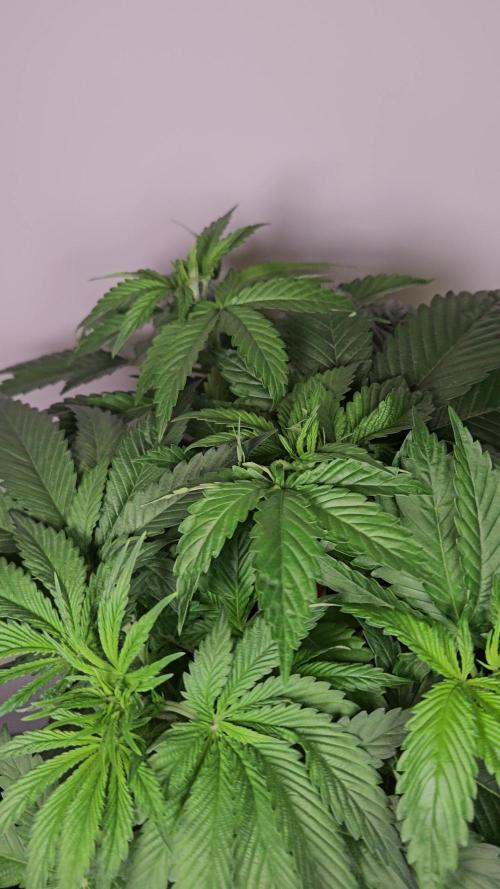
All is going well she growing very nice and no issues so far.
We are work on large strong stems 💪
VPD is setup on 1.1 now.
Watering 500ml everyday.

Likes
19
Share


@Gruenerfinger85
Follow
7 Blütewoche:
So liebe Grow Gemeinde wir sind jetzt in der 7 Blütewoche angelangt.
Leider musste ich bei 2 von 4 Pflanzen einen Mangan oder Magnesium Magel feststellen, 2 kann ich eigentlich schon fast ausschließen da ich mir Informationen eingeholt habe und diese dafür sprechen dass es ein Mangan Mangel ist der nicht oft bei Cannabis Pflanzen vorkommt.
Leider ist mein Ph Messgerät kaputt, und somit kann ich denn ph wert leider nicht ermitteln. Somit weiß ich nicht ob eine Nährstoff Sperre vorliegt die dafür verantwortlich ist das meine beiden Ladys kurz vor dem Ziel sowas erleiden müssen.
Ansonsten geht’s denn anderen beiden Pflänzchen gut sie wachsen prächtig und Mann kann sehen wie die Buds an Volumen zunehmen.
Ich hoffe das ich innerhalb 1 Woche das Problem in den Griff bekomme damit die anderen beiden auch noch an Volumen zunehmen können da Mangan für das Wachstum verantwortlich ist.
Danke für euer Interesse und das ihr bis hier hin gelesen habt, ich werde mich wieder melden wenn sich was ändern sollte.
P.S
Ich habe kurz mit dem Gedanken gespielt die beiden Ladys mit den Mangelerscheinungen früher zu fällen aber von diesen Gedanken bin ich wieder ab. Ich habe noch 14 Steckis von allen 4 Ladys die warten in die Blüte geschickt zu werden. Ich wünsche allen fette Buds und gutes Wachstum.
Likes
7
Share


@UrbanBoer
Follow
I cannot wait to see how this beautiful Queen is going to look at te end of the flowering stage, she’s the closet I’ve came to LST in a manner I wanted this baby to grow, loving how brunches twirl around the twig, l have stopped growing Christmas tree shaped babies. I LST from the seedling phase right through to flowering, you should not forget that this plant can take stress, imagine it was growing in the wild, some stress in your plant’s lie is critical for positive growth, from my point of view my trees are going to struggle with big buds, because it does not have this thick stems.
Likes
15
Share


@Lontra
Follow
Tag 36:
🌱: Eine neue Woche beginnt und die kleine Lady wächst und wächst.
💧: Die Erde ist immernoch feucht.
💡: Die Beleuchtung ist unverändert (DLI ~40-45, Abstand zur Pflanze ~35cm)
Tag 37:
🌱: Auch wenn es wohl nicht der beste Zeitpunkt dafür ist, wurde es mittlerweile doch sehr eng im Gebüsch. Daher habe ich mich entschieden heute doch noch ein mal etwas radikaler zu beschneiden und die schwächsten Triebe, vor allem aus der Mitte, zu entfernen. Zusätzlich wurden auch noch einige Fächerblätter entfernt die andere Blüten zu sehr verschatteten. Ich hoffe sie übersteht diese Tortur. (Beim nächsten mal muss ich die Triebe wohl früher und stärker selektieren...)
💧: Die Erde ist immernoch feucht.
💡: Die Beleuchtung wurde in die (mit Aufhänger) höchste Position gebracht, um den Abstand zur Pflanze aufrecht zu halten (~37cm) und die Intensität angepasst (DLI ~40-45).
🤔: Ein wenig verwundert bin ich, da ich heute plötzlich einige ziemlich violette Blattstiele, vor allem im oberen Bereich entdeckt habe. In Verbindung mit ersten sich leicht gelblich färbenden Blattspitzen, will sie mir wohl etwas mitteilen. Ich weiß nur noch nicht genau was....Sonnenbrand? Zu warm? Zu wenig Phosphor? Ich denke beim nächsten Gießen gibt es als ersten Lösungsversuch etwas mehr vom BioGrow und vom BioBloom.
Tag 39:
🌱: Das Blütenwachstum scheint gefühlt etwas gestört zu sein (kein Wunder bei dem Beschneidungsstress zwischendurch). Ansonsten scheint sie sich jedoch wohlzufühlen und noch etwas an Höhe zuzunehmen. Heute gab es daher kleinere LST Anpassungen umd etwas mehr Licht/Luft in die Pflanze zu bekommen und ein einheitlicheres Dach zu erzeugen.
💧: Die Erde war trocken. Gegossen wurden wieder ca. 3 Liter Nährstofflösung. Um etwaigen Mängeln (siehe violette Stiele) vorzubeugen, wurden Bio Grow, Bio Bloom und Top Max auf 100% Düngeschema gesteigert.
💡: Die Beleuchtung wurde in Ihrer Intensität leicht angepasst, bleibt aber weiterhin bei einem DLI von ca. 45
Tag 41:
🌱: Heute wurden einige Blätter aus der Mitte und ganz unten entfernt. Sie streckt sich weiterhin fleißig und arbeitet an ihren so beliebten Buds. Als kleines Extra kam heute auch wieder ein CO2-Beutel in die Box.
💧: Die Erde war noch feucht genug.
💡: Die Beleuchtung ist unverändert.
Tag 42:
🌱: Jeden Tag was neues: heute habe ich neben den violetten Blattstielen zum ersten Mal auch violette Stellen an einigen Trieben entdeckt 🤔 Ich hoffe einfach mal, dass dies aufgrund des Phenotyps / der Temperaturen geschieht.
💧: Die Erde war trocken. Gegossen wurden wieder ca. 3 Liter Nährstofflösung nach etwa 100% BioBizz Light Mix Schema.
💡: Die Beleuchtung ist unverändert.
Likes
69
Share


@nonick123
Follow
Día 80 (19/08) Riego 500 ml H2O pH 6,55
Día 81 (20/08) Riego 250 ml H2O pH 6,55
Día 82 (21/08) Riego 500 ml H2O pH 6,55
Día 83 (22/08) 💥Comienza la floración! 💥
No riego. Día nublado y de bajas temperaturas
Día 84 (23/08) Riego 500 ml H2O pH 6,55
Día 85 (24/08) No riego. Día nublado y de bajas temperaturas
Día 86 (25/08) Riego con 1 Litro de Té Floración de Lurpe Solutions. Preparación: 24 horas con bomba de aire (oxigenación) con ingredientes:
Healthy Harvest 8 ml/L + Insect Frass 16 ml/L + Hummus Lombriz 8 ml/L + Melaza 1 ml/L + Kelp Hidrolizado 0,25 g/L
💦Nutrients by Lurpe Solutions - www.lurpenaturalsolutions.com
🌱Substrate PRO-MIX HP BACILLUS + MYCORRHIZAE - www.pthorticulture.com/en/products/pro-mix-hp-biostimulant-plus-mycorrhizae

Processing
Likes
4
Share


Likes
162
Share


@DutchFarmer
Follow
She is reall fat now wow 😳🤩🤯
The smells is amazing real potent skunky
Likes
6
Share

@ShinWeed
Follow
.
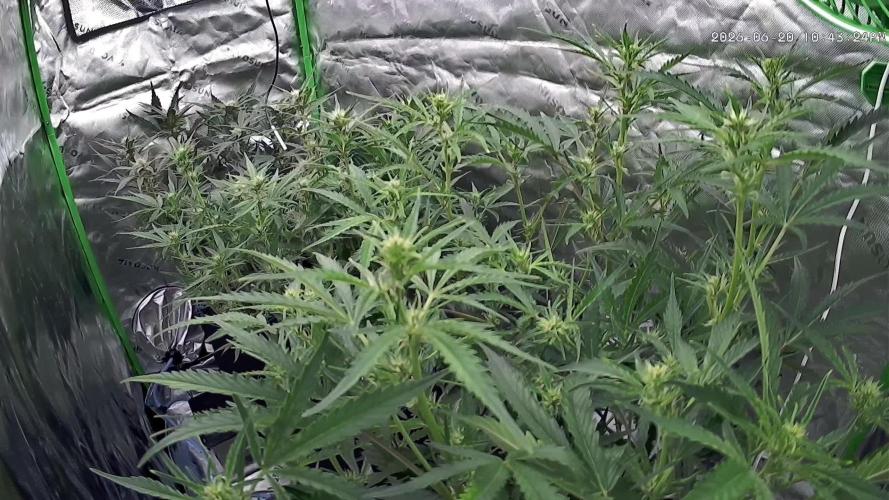
🌱 Tag 49 – Stretch abgeschlossen, Blütenstruktur im Aufbau
Seit dem letzten Update ist wieder eine Woche vergangen. Der Stretch ist bei uns abgeschlossen und der Fokus verschiebt sich klar in Richtung Blüte. Zwei Triebe hängen aktuell nur noch etwa 10 cm unter der LED, da wir in der Streckphase besonders stark an Höhe gewonnen haben. Der Abstand zur Lampe ist dadurch sehr gering, aber noch im kontrollierbaren Bereich. Die übrigen Pflanzen wachsen weiter ruhiger und gleichmäßig. Wir sind insgesamt drei Pflanzen, entwickeln uns trotz identischer Bedingungen jedoch unterschiedlich schnell: Eine von uns ist deutlich weiter, während die anderen beiden noch etwas hinterherhinken.
Wir merken, dass unser Wachstum sich verändert. Es geht nicht mehr nur darum, länger zu werden, sondern um den Aufbau der Blütenstruktur.
👨🌾 Gärtner: Auch in dieser Woche verlief alles sehr ruhig. Ich habe den Abstand zur Lampe leicht vergrößert, weil zwei unserer Haupttriebe jetzt sehr nahe an der LED stehen. Ansonsten wurde am Setup nichts verändert, da Temperatur und Luftfeuchte stabil bleiben und unsere Pflanzen weiterhin gesund wirken.
Likes
4
Share


@Drtomb
Follow
I'm 4 days into flower.
Topped all the plants nice and even. Then removed all bud sites below the top 4 on each branch. Leaving fan leaves intact. I allowed them to recover for 2 days. Then flipped the lights.
Blue Gelato 41 has filled in 2/3 of the tent well. Big leaves are forming and they continue to reach.