


Likes
Comments
Share


@jahredi
Follow
Day 36 today! It was a great week for the plants. Definitely starting to take shape. It’s cool to see the dominate Sativa and dominate Indica strains growing side by side on the same timeline and same regiment.
I actually only added .5 tsp of Tiger Bloom to 5 gallons of water last week. So they received two straight waterings of that, and I think they started to show minor signs of note burn. NBD. I did give them a healthy dose (1 gallon each) of straight water last time, and I will do the same (straight water) for at least the next watering. Then maybe a super small dose of Cha Ching after that. IDK. See how they look.
Did some LST this morning and by the evening photo shoot the ends were already pointing straight up. Love to see that vigor.
Honey Peach is a gnarly little rough and tough Indica strain. Coming in at a stout 15”, it’s the heavier of the two plants and I suspect it has a much more robust root mass (especially if what’s above the soil is any indication of what’s happening bellow). Looking very similar to when I grew it indoors. Compact, stinky and the leaves just go haywire all over the place. It’s definitely looking like it will produce a dense, substantial main cola and some solid spears off the side shoots again. I’m estimating 5-6 more weeks based off of what I saw on the indoor grow. I love this strain for ongoing daytime smoking. Great smell and a nice smooth flavor that gives me a mellow, relaxing high.
First time growing this Blue Dream and it’s looking true to the Sativa family. Topping out at a slender 25”, this plant has very symmetrical and even growth. It really stretched the past week. Personally, I have no idea what to expect, but I have seen a few other grows of this exact strain take substantially longer to mature than advertised (I think one went a full 16 weeks). It’s definitely moving slower than the Honey Peach, but that is to be expected as it is sativa dominate.
Definitely starting to smell! Time to hook those carbon filter up to the fans!


Likes
11
Share


@Organic_LarF
Follow
OG kush and hulkberry are nicely thickning,
Green gelato showing some deficiancies.
Keep up those green tumbs!!!

Likes
190
Share


@Burmese
Follow
Hi everyone,This time I can update right on time and this could be the last week update before harvest.I am planning to harvest Soil girl or may be both of them next week.Hope you guys enjoy the journey.Actually Soil girl is more mature than Coco girl.More in amber trichomes.Coco girl, She got mostly cloudy trichomes and only some amber.Still not sure it will be better or not if I chop both of them together.I start giving them water only and will flush Coco girl before harvest.
Let’s see if I change my mind to harvest together or not ... 😂 ✌️ 🇲🇲
Soil-Organic-LST
Day 120~126
Soil
RO water
pH- 7.0
ppm- 10
Run off
pH-6.6
ppm-550
Soil Potting Mixed Recipe
10gallon Pot
-Coco peat: 30%
-Soil Compost: 20%
(Soil,Sand,Cow manure,Ash)
-Bone meal: 10%
-Earthworm fertilizer: 10%
-Perlite: 15%
-Marble stone: 5%
-Crash egg shell: 3%
-Chicken manure: 3%
-Banana peels: 2%
-Gypsum: 2%
———————————————
Coco-Inorganic-ScrOG
Day 120~126
Coco
RO water
pH-7.0
ppm-10
Run off
pH-6.0
ppm-1000
Coco potting mixed recipe
10gallon Pot
Coco peat : 70%
Perlite : 30%
Transplanted from 1gallon coco/soil mixed pot at Day-42.
Scrog size
Area : 1ft x 1ft (30cm x 30cm)
Hole size : 2” (5 cm)
Material : iron welded by four steel pillars.
Height from base: 6” (15cm)
Happy Growing to you all... ✌️
Likes
15
Share


@Waveform
Follow
Day 17 (starting Aug. 2nd afternoon): Will water them with a lightly enhanced RO water that was imprinted with frequencies via a PEMF coli for about one day when their day starts.
After being away over the extended weekend, on day 20 ladies have grown very nicely. I topped nr# 1 and #2 after I took the photos and will give them a bit of water with Root Complex to compensate for the shock later. Sadly my brilliant control equipment has crashed completely and will not even take a photo currently. Yikes. Hope I can get it back alive this week again. Also turned the left light up by another 20%, now running at 40 W, and lifted it a bit. Eye inspection told me lights were lower here and ladies can get a bit more.
At the end of their day 20, they seem to have survived the topping well. I managed to cut right above the new nodes which are already growing. Ladies are at 20 cm height before going to sleep.
Day 21 shows great growth again, with lady #1 being at 22 cm now and lady #2, while being a bit less tall, extremely good side branch development. I hope that the rearranged lighting on the left side of the tent will make #1 grow a bit bushier too.
Besides from that, I am really happy I tested Hesi HPE. I had such enormous success with room plants that made me want to see how Cannabis plants react to it. It will not add much to salinity, so I dared to add it quite early. While the photos are processed to compensate the lighting, I did not add much to saturation, so leaves are indeed of a very vivid, luscious green and ladies looking extremely healthy. Speed of growth has increased too as the added video shows. It also tells me lighting is enough – they are turning their leaves away right at the end of their day. I am really uncertain if I will change to usual Hesi grow fertiliser at all …
Did a bit of LST to the lowest branches of lady #2 which spread almost to the border of her pot.
Both temporary girls will leave the tent soon, so that the competitors will have maximum space to develop.
Day 22, end of week 3:
Outside girl went to get fresh air from now on. Wishing her luck, good weather and not a single male in the vicinity.
I rearranged the lights and positioned them a bit higher. First preflower signs appeared on the ladies, so I will change the lighting phase when I return next week. Currently, I have them at 18/6, 45 cm above heads, with 80% running to a total of 80 W.
I wasn’t so lucky topping #2. She has only one "top side" branch now … But grows extremely well, so ok!

Likes
15
Share


@dank604
Follow
Both are growing strong, amazing the kind of growth my light creates, girls seem to be loving it! Hope to start LST on the older lady soon (Thelma). Happy growing y'all!
Processing
Likes
10
Share


@Barcelona_Farmers710
Follow
Empiezo lo bueno Farmers pasamos a la preflora... este cultivo probaremos Delta 9 para probar aumentar la resina!👌🏻
Likes
12
Share


@DaddyLauterbach
Follow
So i hatvested them on day 80, they got 24h of light before harvest.
I removed all fan leafes with no to verry little trichomes visible.
Both plants are now drying by ca. 21°C and 57% humidity.
This time i will dry them with lights on to be more efficient with my growing cycles. ( i think they will get at least 2-4 days darkness before the new seedlings move in the box )
Likes
1
Share


@Green_Peace
Follow
Buds are fattening nicely and the 2 plants are receiving nutrients well. Will stop the PK in the next few days before scaling back on the A/B next week before fluching for the last fortnight. looking forward to harvesting this clone as I've just ran out of the bounty from her mother. These plants are at the front and to the right in the timelapse videos.
Likes
9
Share


@AnnGeneLabs
Follow
Hey growdiaries! The plant's doing fabulously. Looks like it's finally done with its stretching spree, and all that good energy is channeling into beefing up the buds. 🌿🌸
Here's the latest update:
Stable Growth: My green amigo seems to have hit a sweet spot - less stretch, more bud boost. It's like it's found its zen in the bloom phase.
Moisture Sensor Calibration: Nailed the moisture sensor issue! I tweaked it with a temp correction, 'cause the temps were messing with the readings.
Now, the graphs are looking way more legit. 📈🌡️
Nutrition on Point: Still rolling with the bloom stage feeding schedule.
It's all about that balanced diet for peak flower power. 🥦💪
Ready for the next level? 'Cause here's what we're aiming for in the upcoming week. 🎯
Data Collection Fine-Tuning:
Gonna revamp the data gathering process for soil moisture. It's all about accuracy, right? So, I'm updating the 'dry' and 'watered' soil baseline values to get the real deal on the moisture front.
By refreshing those raw values, we'll have a solid ground (pun intended) for our moisture readings. No more guesswork, just pure, precise data. 🌱💧
Gearing up for a week of tweaks and triumphs. Let's get our hands dirty (in the cleanest way possible) and make sure our plant's living its best life! 🛠️🌻
That's the word from the green world, GD. Let's keep this bloom boom going! 🚀🌼
Likes
36
Share


@GreenHouseLab
Follow
Pics range from Day 14 to Day 21. Two very distinct phenos of the GLP. One coming in very purple early on and the other must hold distinct visual familiarities of her SFV OG. Will be top dressed with Gaia and EWC along with second application of Miicrobial Mass which has greatly aides in unlocking that Iron.

Likes
8
Share


@dwotTV
Follow
Starting my first grow in the new tent with my first Night Owl seeds. Grabbed these from seedslocker a few months ago and they've been sitting in my seed vault in the fridge since. Popped them in a glass of water at 8pm on 10/18. Broke out the AC Infinity propagation system and added a bit of RO water to some coco pucks. About 24 hours later they sunk in the glass and had opened up a bit with root peaking out, so into the pucks they went on the evening of 10/19. No real movement on 10/20, turned the heat pad off because they were a little warm. Morning of 10/21 the first Compound V was starting to pop through the soil, 2nd one followed a couple hours after and before noon all 3 were making their way out. Opened vents on the dome to let them breathe a bit more. 10/22 continuing to grow really strongly, looking good. 10/23 some roots out the bottom, time to go into the tent. Transplanted and seem happy, dialing in the temp and humidity and airflow, some odd higher temp days still around this time of year with some heavy fluctuations but it will normalize out.
The tent has been stood up and cooking a bit w/ the lights blazing and a dehumidifier running to dry out our soil a bit. Had issues with fungus gnats last grow and I'm trying to prevent that this time. Ordered some beneficial nematodes as a line of defense and sprayed soil with a good soak of neem oil as a precaution after drying out. Sticky traps show no gnats so far. Soil is Coast Of Maine Stonington Blend Aeration Formula, a 70 / 30 Coco / Perlite blend that I've used before. I have Coast of Maine dry nutrients and Fox Farm liquid nutrients, will likely try to stick to the dry nutrients unless fungus gnats emerge again. Soil is in 5 gallon fabric pots. I added 2/3 cup of Stonington Blend Plant Food and 1/3 cup of Wiscasset Blend Earthworm Castings to each pot along with some Mycorrhizal Fungi spores and worked it in.
I have been using the AC Infinity self watering bases but as I'm running 6 total plants this grow I've ordered the new Vivosun self watering bases to compare them.

Likes
1
Share


@Urunascar
Follow
Decided to harvest since i found some rotten buds and the plant wasn't gonna get better than that since it was under attack and I rather harvest a week earlier than losing a lot of my crop (last year I tossed it all because of powdery mildew)
Likes
9
Share


@Green4H
Follow
Hello growers, I haven't shown you my plants for three weeks, I'm ashamed, I don't know what they are like, I let one dry and it weighs 5.68g, which is ridiculous... The second is still blooming and I have the impression that nothing will happen to it. .
Processing
Likes
105
Share


@Green_Friends_Inc
Follow
Commencing Week 12 - 4th week of flowering - Day 78 from germination - Day 28 of 12/12 on January 9th
Garden is going great!
Only minor hold up is my pH and PPM meter has gone haywire today so I have one arriving in the mail tomorrow.
I used one of my flower bomb males and crossed the 818 number one and the Branch with a wire tie. Seeds coming soon :-)
"You can have change without progress but not progress without change"
I am trying a new nutrients called Mega crop. Currently I utilitize a very sterile and all chemical nutrients solution that contains no enzymes no amino acids and no beneficial bacteria and I have gotten great results, and I enjoy not having to do much work, literally no swap outs in this grow so far has saved my water bills and my back.
However as I stated there is no progress with change and in line with wanting to get better I am trying a new nutrient called Mega crop which contains many of the things that I have thus far stayed away from. Starting off very lightly and will see what happens either way I am anxious and excited for the next 4 weeks 🤩🤩🤩


Likes
18
Share


@DjDaveAtHome
Follow
This was the easiest to grow. Shook off light stress and hard water to produce more yield than any of the others. Will be growing again. Dense, golf ball size nuggets.

Likes
61
Share


@BlumenBot
Follow
3/29 - I'm not sure she needs another topping. I'm just going to spread out the current tall shoots and let her rip upwards!
Also swapped the light for the final veg lamp.
3/30 - training continues and she is taking up more water every day!
3/31 - feeding and defoliation of the larger and lower fan leaves
2L distilled water
5.9pH
65*F
780ppm
Grow 3.02g
Kelp 0.14g
Cal/Mag 0.56g
Amino Acids 0.48g
Enzymes 0.15g
Microbes Grow Stage 0.53g
Real Grows Recharge 0.1g
4/1 - Growth is significant since defoliation, I think it was well timed, she grew an inch overnight
4/2 - Great Friday! Another day of training and she is starting to look amazing!
4/3 - feeding day, took off some large fan leaves and trained just a bit more. I think this week she will be allowed to start growing vertically
2L distilled water
6.0pH
1040ppm
71*F
Grow 3g
Kelp 0.17g
Cal/Mag 0.56g
Amino Acids 0.5g
Enzymes 0.14g
Terpinator 5ml
Real Grows Recharge 1.26g
Great White 0.15g


Likes
3
Share


@Canaryweed_tf
Follow
Ya tenemos la cuarta semana de la HellfireOG del banco de Kannabiaseeds. En está semana las he trasplantado ha macetas de 7L. Tienen buen color, siguen creciendo muy bien y espero que sigan así. Pronto nuevas noticias 😘

Likes
10
Share


@Sadhus
Follow
Sa pousse tranquillement, toujours pas de signe de fleurs chez les boutures en 12/12 , quelques nouvelles bouture qui racines et la mère prête a envoyé plein de petits
#khalifa genetics
#madamegrow
#trolmaster

Likes
9
Share

@HUMO_Cultiva
Follow
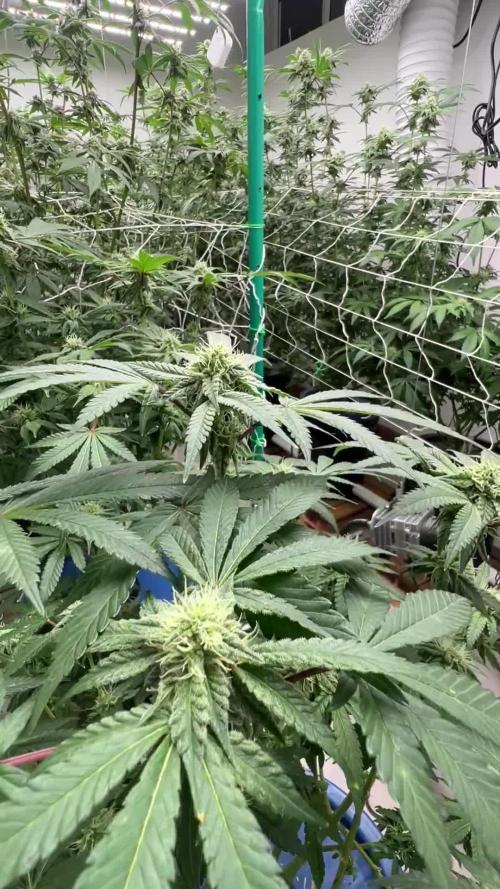
We start week 3 of bloom!! Goofiez 2 amor compound genetics it’s the champions!!

Processing
Likes
4
Share


@Canadian
Follow
Today They have pop in my new room is completely ready for a New girls season I am going to use a rosin press for a large quantity off all the flowers That we produce And I will be reviewing that brand ones it arrive