The Grow Awards 2026 🏆
Likes
6
Share
to view this lamp or any other marshydro product go to: https://instagram.com/marshydro_aliexpress?igshid=YmMyMTA2M2Y=
Likes
36
Share
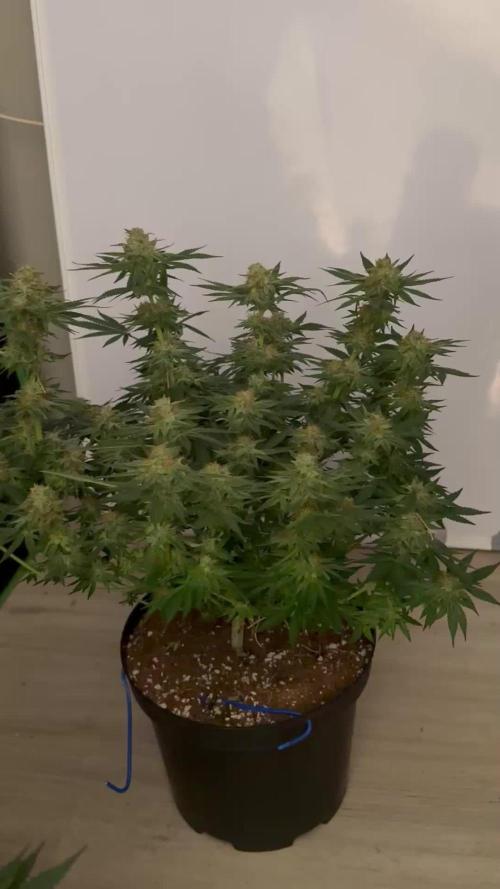
Week 14 Day 101 Flower Day 51, she's just about there. Going to apply Terra Powers finisher later during the week. She still has a lot of mycelium left on top and throughout her, I really dialed in the enzymes on this grow. My charts aren't updated properly I'll finish it this week, and will be showing root shots and hopefully we will be seeing a covered pot in roots and not just compacted soil. There's been a lot of fungi and mycelium, that is partly down to Terry Power mixing well with organic soil, it works well as a great soil conditioner. But it takes a while, I constantly fed this girl enzymes. And man O man, look at them buds. The colas are huge in length, and that's down to poor mainline practices and uneven energy distribution. As for left and right been similar, well, put it this way, you'd struggle to actually make something that's more uneven energy wise than this, there's nodes growing over nodes, nothing is even, really terrible mainline it the way it's meant to be done, the purpose was totally ditched here and it was very lazy. And to be honest, unknowingly is an understatement. And the fact I had such failures on my 2nd round with germination, I got to focusing the last few weeks, and pult it all back together and I've hit l got 2 pretty darn good looking phenos, (with no clones taken, another rookie mistake, if you find a pheno you should always have a clone tent and a few weeks into flowering if it's no good or hermies than ditch them, but if you get one like my SLH dwc with very low leaf to calyx ratio if you just have 1-2 clones, you are golden. So currently I have 5 different photos running and I'm pheno hunting. Anyways back to this grow. So, she's nice and fat, but nothing you'd really want to clone, there's nothing special about it. Medium-calyx ratio and good frosty bud. I'm happy with it. Thankfully I'm running a few of the New Green House Unreleased Strains for testing also for barneys so I think photos have stolen my attention. Keeping the RH between 40-45 temp is more stable atm at 28c not really getting low temperature as we are in the height of summer. But I don't care, I have the winter coming to do terpness. I've got 1 SLH left, I just hope she's a good pheno. The buds on this are monsters, and really happy with them. Lots of mycelium left so there's food left and then later in the week I'll apply the finsher. Just a low dose. D103 Sadly my mycelium got hit with some mold. Only 2 small spots, 90% most of the mycelium went through the norm, it degraded as organic matter and made for some heavy buds, she is struggling to hold herself up altogether now, am going to have to brace her to get the best out of the last 10days. She is done, but because of ALL the heavy minerals, that aren't organic, it has HAS to be flushed. Now I was on the ropes the last few weeks about flushing but I've been flushing both my SLH for the last 4 days and when you walk into my tent now, wow, the bang of 🍋 is so strong. I'm so glad I flushed these, As I was like, this is a multiple award winner, so I was like, its not from the smell of the bud as it stands but wow, its like she's at to been doing a 10k run and is sweating, the smell is so beautiful. Wow, wow, wow. I haven't been this excited to try some weed, ever. About the mold, its never a good thing. But as it started on actually fungus I'm not too worried about it. Now, if it had of just been there, I'd be like shit wtf, so I dug through some soil and scraped away the 2 bits of mold, DISCARDED, and mixed up the remaining mycelium into the soil with the spoon I use to mix my soil on top to help dry a little if over watered. Also it help let air into your plant, as your soil dries o2 gets sucked into your substrate and that. COUPON FOR MARSHYDRO use code GGS for discount at any mars site. Big thanks to my sponsors terra power nutrients and marshydro and to the 2 reps who I dealt with. Thanks for reading, Drop a like if you'd like me to visit your grows, either way thanks for dropping by.
Likes
2
Share
@Amboss
Follow
Strech is over … take a lot of leafs of …
Likes
38
Share
For LIQUIDS & NUTES ******GREEN BUZZ NUTRIENTS***** organic. Also i’m using their LIVING SOIL CULTURE in powder form! MARSHYDRO ⛺️ has large openings on the sides which is useful for mid section groom room work. 🤩 ☀️ MARSHYDRO FC 3000 LED 300W 💨MARSHYDRO 6” in-line EXTRACTOR with speed-variation knob, comes complete with ducting and carbon filter.
Likes
2
Share
@inversi0n
Follow
Hello, growers! 3) I changed the solution at the middle of the week 4) Decided to FIM this grow and see, where it goes. And it was very hard to do it,since new level didn't formed yet, but i didn't want to wait longer 7)By the end of week leaves showed nutrient, will fix. I suggest P
Likes
4
Share
Nach dem Umtopfen ging es direkt weiter mit einem ordentlichen Wachstumsschub – richtig schön anzusehen! Die Pflanzen haben den Wechsel super weggesteckt und legen jetzt ordentlich zu. Alles verläuft bisher nach Plan, ohne nennenswerte Komplikationen. Die Symptome des Calciummangels sind komplett verschwunden – die neuen Blätter sehen gesund und kräftig aus. Offensichtlich zeigt die angepasste Düngung Wirkung. Auch die Thripse scheinen erfolgreich bekämpft worden zu sein. Ich konnte bisher keine neuen Spuren entdecken – hoffentlich bleibt das so. Heute stand noch ein wenig Entlaubung auf dem Programm, um Licht und Luft besser ins Innere der Pflanze zu bringen und die Schimmelgefahr weiter zu minimieren.
Likes
3
Share
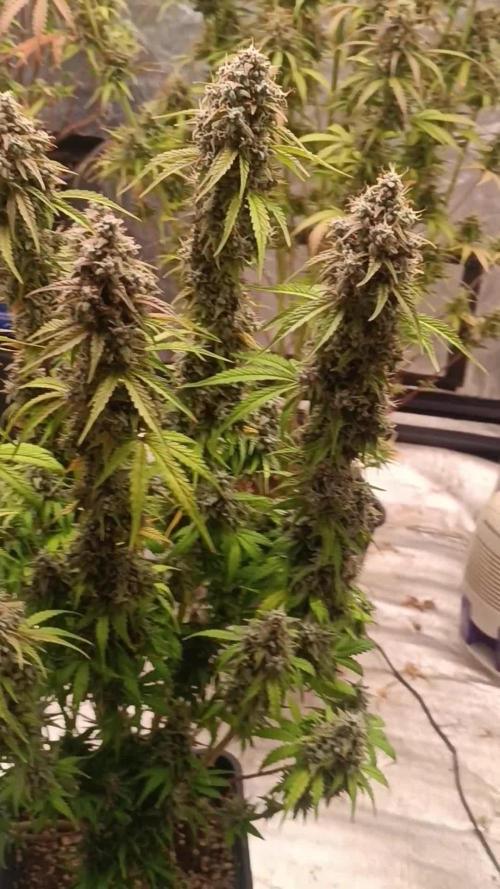
We’re now in the final stage of the grow. The plants are receiving plain water only, and we’re just watching and waiting for the right harvest window to open up. Trichomes are still showing some clear heads, so I estimate we’ve got around 10 days left, give or take. That would bring us to a total of 14 weeks from sprout to harvest, which is definitely on the longer side for modern autoflowers — but every strain is different! Leaves are fading fast, senescence is well underway, and everything is pointing towards the final phase. Now it’s all about patience, letting them finish strong to maximise flavour, smoothness, and yield. --- Grow Conditions (still consistent): 💧 Watering: 1500ml every third day 🌱 Nutrients: None (flushing, previously BioBizz schedule) 💡 Light Intensity: ~1000 PPFD 🌡️ VPD: ~1.82 kPa 🌞 Temp: ~28°C 💦 RH: ~50%
Likes
25
Share
Halli, Hallo, Hallöle liebe Growfreunde 🤗🤗, Heute ist BT 18 und ich habe heute mal entlaubt und ganz leicht gelollipoppt. Ich wollte nicht zuviel lollipoppen, da ich denke dass die Sanlight Lampen eine sehr gute Tiefenwirkung haben, vorallem weil die aüßeren schräg hängen und der Lichtstrahl sich quasi kreuzt. Die Entwicklung in dieser Woche war, genauso wie die letzten Wochen, sehr entspannt. Alles ist gut verlaufen und der stretch lässt sich jetzt auch endlich sehen. Die Gorilla Zkittlez ist leder nicht mehr viel gewachsen und die Sweet ZZ lässt auch zu wünschen übrig zwecks stretch, aber was solls, lecker ist es auf jedenfall
Likes
14
Share
@fivegrow
Follow
This was my first cycle in tent. The Autopot System is amazing ang brings autonomy. I used fert Plantprod, calcium nitrate, magnesium sulfate and MKP. PH around 6.0 and solution fert in tank 1200 PPM . This strain is fantastic. It withstood the intense heat of the southern hemisphere's tropical climate. It was easy to prune and defoliate to control the size. The smell is of tangerine and flowers produces a lot of resin. I am very satisfied with this harvest! Thank you Sweet-seeds!!
Likes
52
Share
Lacewings seemed to have mostly killed themselves by flying into hot light fixtures. I may have left the UV on which was smart of me :) Done very little to combat if anything but make a sea of carcasses, on the bright side its good nutrition for the soil. Made a concoction of ethanol 70%, equal parts water, and cayenne pepper with a couple of squirts of dish soap. Took around an hour of good scrubbing the entire canopy. Worked a lot more effectively and way cheaper. Scorched earth right now, but it seems to have wiped them out almost entirely very pleased. Attempted a "Fudge I Missed" for the topping. So just time to wait and see how it goes. Question? If I attached a plant to two separate pots but it was connected by rootzone, one has a pH of 7.5 ish the other has 4.5. Would the Intelligence of the plant able to dictate each pot separately to uptake the nutrients best suited to pH or would it still try to draw nitrogen from a pot with a pH where nitrogen struggles to uptake? Food for stoner thought experiments! Another was on my mind. What happens when a plant gets too much light? Well, it burns and curls up leaves. That's the heat radiation, let's remove excess heat, now what? I've always read it's just bad, or not good, but when I look for an explanation on a deeper level it's just bad and you shouldn't do it. So I did. How much can a cannabis plant absorb, 40 moles in a day, ok I'll give it 60 moles. 80 nothing bad ever happened. The answer, finally. Oh great........more questions........ Reactive oxygen species (ROS) are molecules capable of independent existence, containing at least one oxygen atom and one or more unpaired electrons. "Sunlight is the essential source of energy for most photosynthetic organisms, yet sunlight in excess of the organism’s photosynthetic capacity can generate reactive oxygen species (ROS) that lead to cellular damage. To avoid damage, plants respond to high light (HL) by activating photophysical pathways that safely convert excess energy to heat, which is known as nonphotochemical quenching (NPQ) (Rochaix, 2014). While NPQ allows for healthy growth, it also limits the overall photosynthetic efficiency under many conditions. If NPQ were optimized for biomass, yields would improve dramatically, potentially by up to 30% (Kromdijk et al., 2016; Zhu et al., 2010). However, critical information to guide optimization is still lacking, including the molecular origin of NPQ and the mechanism of regulation." What I found most interesting was research pointing out that pH is linked to this defense mechanism. The organism can better facilitate "quenching" when oversaturated with light in a low pH. Now I Know during photosynthesis plants naturally produce exudates (chemicals that are secreted through their roots). Do they have the ability to alter pH themselves using these excretions? Or is that done by the beneficial bacteria? If I can prevent reactive oxygen species from causing damage by "too much light". The extra water needed to keep this level of burn cooled though, I must learn to crawl before I can run. Reactive oxygen species (ROS) are key signaling molecules that enable cells to rapidly respond to different stimuli. In plants, ROS plays a crucial role in abiotic and biotic stress sensing, integration of different environmental signals, and activation of stress-response networks, thus contributing to the establishment of defense mechanisms and plant resilience. Recent advances in the study of ROS signaling in plants include the identification of ROS receptors and key regulatory hubs that connect ROS signaling with other important stress-response signal transduction pathways and hormones, as well as new roles for ROS in organelle-to-organelle and cell-to-cell signaling. Our understanding of how ROS are regulated in cells by balancing production, scavenging, and transport has also increased. In this Review, we discuss these promising developments and how they might be used to increase plant resilience to environmental stress. Temperature stress is one of the major abiotic stresses that adversely affect agricultural productivity worldwide. Temperatures beyond a plant's physiological optimum can trigger significant physiological and biochemical perturbations, reducing plant growth and tolerance to stress. Improving a plant's tolerance to these temperature fluctuations requires a deep understanding of its responses to environmental change. To adapt to temperature fluctuations, plants tailor their acclimatory signal transduction events, specifically, cellular redox state, that are governed by plant hormones, reactive oxygen species (ROS) regulatory systems, and other molecular components. The role of ROS in plants as important signaling molecules during stress acclimation has recently been established. Here, hormone-triggered ROS produced by NADPH oxidases, feedback regulation, and integrated signaling events during temperature stress activate stress-response pathways and induce acclimation or defense mechanisms. At the other extreme, excess ROS accumulation, following temperature-induced oxidative stress, can have negative consequences on plant growth and stress acclimation. The excessive ROS is regulated by the ROS scavenging system, which subsequently promotes plant tolerance. All these signaling events, including crosstalk between hormones and ROS, modify the plant's transcriptomic, metabolomic, and biochemical states and promote plant acclimation, tolerance, and survival. Here, we provide a comprehensive review of the ROS, hormones, and their joint role in shaping a plant's responses to high and low temperatures, and we conclude by outlining hormone/ROS-regulated plant-responsive strategies for developing stress-tolerant crops to combat temperature changes. Onward upward for now. Next! Adenosine triphosphate (ATP) is an energy-carrying molecule known as "the energy currency of life" or "the fuel of life," because it's the universal energy source for all living cells.1 Every living organism consists of cells that rely on ATP for their energy needs. ATP is made by converting the food we eat into energy. It's an essential building block for all life forms. Without ATP, cells wouldn't have the fuel or power to perform functions necessary to stay alive, and they would eventually die. All forms of life rely on ATP to do the things they must do to survive.2 ATP is made of a nitrogen base (adenine) and a sugar molecule (ribose), which create adenosine, plus three phosphate molecules. If adenosine only has one phosphate molecule, it’s called adenosine monophosphate (AMP). If it has two phosphates, it’s called adenosine diphosphate (ADP). Although adenosine is a fundamental part of ATP, when it comes to providing energy to a cell and fueling cellular processes, the phosphate molecules are what really matter. The most energy-loaded composition for adenosine is ATP, which has three phosphates.3 ATP was first discovered in the 1920s. In 1929, Karl Lohmann—a German chemist studying muscle contractions—isolated what we now call adenosine triphosphate in a laboratory. At the time, Lohmann called ATP by a different name. It wasn't until a decade later, in 1939, that Nobel Prize–-winner Fritz Lipmann established that ATP is the universal carrier of energy in all living cells and coined the term "energy-rich phosphate bonds."45 Lipmann focused on phosphate bonds as the key to ATP being the universal energy source for all living cells, because adenosine triphosphate releases energy when one of its three phosphate bonds breaks off to form ADP. ATP is a high-energy molecule with three phosphate bonds; ADP is low-energy with only two phosphate bonds. The Twos and Threes of ATP and ADP Adenosine triphosphate (ATP) becomes adenosine diphosphate (ADP) when one of its three phosphate molecules breaks free and releases energy (“tri” means “three,” while “di” means “two”). Conversely, ADP becomes ATP when a phosphate molecule is added. As part of an ongoing energy cycle, ADP is constantly recycled back into ATP.3 Much like a rechargeable battery with a fluctuating state of charge, ATP represents a fully charged battery, and ADP represents a "low-power mode." Every time a fully charged ATP molecule loses a phosphate bond, it becomes ADP; energy is released via the process of ATP becoming ADP. On the flip side, when a phosphate bond is added, ADP becomes ATP. When ADP becomes ATP, what was previously a low-charged energy adenosine molecule (ADP) becomes fully charged ATP. This energy-creation and energy-depletion cycle happens time and time again, much like your smartphone battery can be recharged countless times during its lifespan. The human body uses molecules held in the fats, proteins, and carbohydrates we eat or drink as sources of energy to make ATP. This happens through a process called hydrolysis . After food is digested, it's synthesized into glucose, which is a form of sugar. Glucose is the main source of fuel that our cells' mitochondria use to convert caloric energy from food into ATP, which is an energy form that can be used by cells. ATP is made via a process called cellular respiration that occurs in the mitochondria of a cell. Mitochondria are tiny subunits within a cell that specialize in extracting energy from the foods we eat and converting it into ATP. Mitochondria can convert glucose into ATP via two different types of cellular respiration: Aerobic (with oxygen) Anaerobic (without oxygen) Aerobic cellular respiration transforms glucose into ATP in a three-step process, as follows: Step 1: Glycolysis Step 2: The Krebs cycle (also called the citric acid cycle) Step 3: Electron transport chain During glycolysis, glucose (i.e., sugar) from food sources is broken down into pyruvate molecules. This is followed by the Krebs cycle, which is an aerobic process that uses oxygen to finish breaking down sugar and harnesses energy into electron carriers that fuel the synthesis of ATP. Lastly, the electron transport chain (ETC) pumps positively charged protons that drive ATP production throughout the mitochondria’s inner membrane.2 ATP can also be produced without oxygen (i.e., anaerobic), which is something plants, algae, and some bacteria do by converting the energy held in sunlight into energy that can be used by a cell via photosynthesis. Anaerobic exercise means that your body is working out "without oxygen." Anaerobic glycolysis occurs in human cells when there isn't enough oxygen available during an anaerobic workout. If no oxygen is present during cellular respiration, pyruvate can't enter the Krebs cycle and is oxidized into lactic acid. In the absence of oxygen, lactic acid fermentation makes ATP anaerobically. The burning sensation you feel in your muscles when you're huffing and puffing during anaerobic high-intensity interval training (HIIT) that maxes out your aerobic capacity or during a strenuous weight-lifting workout is lactic acid, which is used to make ATP via anaerobic glycolysis. During aerobic exercise, mitochondria have enough oxygen to make ATP aerobically. However, when you're out of breath and your cells don’t have enough oxygen to perform cellular respiration aerobically, the process can still happen anaerobically, but it creates a temporary burning sensation in your skeletal muscles. Why ATP Is So Important? ATP is essential for life and makes it possible for us to do the things we do. Without ATP, cells wouldn't be able to use the energy held in food to fuel cellular processes, and an organism couldn't stay alive. As a real-world example, when a car runs out of gas and is parked on the side of the road, the only thing that will make the car drivable again is putting some gasoline back in the tank. For all living cells, ATP is like the gas in a car's fuel tank. Without ATP, cells wouldn't have a source of usable energy, and the organism would die. Eating a well-balanced diet and staying hydrated should give your body all the resources it needs to produce plenty of ATP. Although some athletes may slightly improve their performance by taking supplements or ergonomic aids designed to increase ATP production, it's debatable that oral adenosine triphosphate supplementation actually increases energy. An average cell in the human body uses about 10 million ATP molecules per second and can recycle all of its ATP in less than a minute. Over 24 hours, the human body turns over its weight in ATP. You can last weeks without food. You can last days without water. You can last minutes without oxygen. You can last 16 seconds at most without ATP. Food amounts to one-third of ATP production within the human body.
Likes
12
Share
@L_Choppa
Follow
i feed with nutes last watering about two days ago my idea is to feed one more time before the two week flush not really sure yet i have at lease a week to figure it out being the end of the plants life cycle is soposed to end in another week idk master growers were yall at?????😅
Likes
4
Share
@nijuana
Follow
So beautiful , they need one more week 😜💚💎🙏
Processing
Likes
1
Share
Likes
10
Share
Bonjours à tous, nous entamons les deux dernières semaines de rinçage pour ces dames. La gorilla sherbet 1 a été récolter.
Processing
Likes
4
Share
Week 4 is now Here and running into some issue with bug spray really did a number on my girls. The XL Haze plant bounced back quick, Thank God for good gene. This week I will also raise the light a bit to get the girls to stretch a bit more. This week will also be the first day the girls get a some actual nuts
Likes
27
Share
Hi Growmies So here we have it , the end is nigh !. After and interesting 99 Days from seed and 70 days in their flowering phase of an expected 63. It is not unusual to pass the stated times and even early harvest on occasions so I am not hung up about the timing and is another reason that I use the trichromes as a guide to the right time to pull them. The #1 has definitely reached her harvest window now with some Amber tricks now being visible on checking. She looks so sweet now and I did begin to trim her up a little before I started the update pics. I do plan on using the bowl trimmer for speed this run and will video how it goes for the next update. I hate trim-jail so will use the spinner to help. Some of the buds look a bit small low down and I expect drying will shrink them to a Nug but all adds to final yield. I am not too stoked about the overall bud sizes and suspect the products did have an effect on that outcome for me but tje quality and number are its saving grace . The #2 Lady is looking chunkier than her sister although not as big in footprint. Her trichromes are beginning to cloud now so I expect at least another week before her harvest is due #3 is the most impressive for looks and appeal for sure. , she is covered in medium sized colas amd has some of the purpled leaves that the strain is known for. She is also as frosty as hell to highlight her even more. Like #2 she needs the ripening time now so I expect next update to be the final before harvest results. It has been a simple grow with no real dramas to contend with. Thanks for riding along with me. Be well.
Likes
7
Share
@Papabro2k
Follow
This plant was left in the corner and never had too much attention the toot system was not so good But! It’s very nice and dense with a potent smell of lime can’t wait to try. For sure Dutch passion is one of the best breeders I’ve used .. happy growing
Likes
5
Share
The strength this girl has is amazing she put up with alot of my mistakes and had been a real treat to grow so far.. The plant had a strong smell like fuel and fruit , citrus even .. The buds have been building up since her second week of flowering now .. can't wait to see how she does in the next couple weeks
Likes
4
Share
@babaweed
Follow
These kush are really beautiful and have huge peaks, they have 13 internodes and each of them is full of buds, quite large. They are really huge touch the ceiling, maybe one is too close to the lamps and I'm afraid you burn a little bit
Likes
6
Share
@GrowHero
Follow
Hi guys growing is going good, i think i can enjoy them ciured for December, smell is good, already can smell lemon cheese mixture its ver skunk, chocolate has most trichome production and the durban is the biggest plant. Lemon cheese is weak for feedeings i made little overdose on franko and ia had to flush, it feels good right now but i think i lost one cola (( a didnt cuted it but a cant see the difference in growing and the color is also yellowing, can anyone recommend something what to do with that cola, thanks guys, Happy growing