The Grow Awards 2026 🏆
Likes
Comments
Share
@Chucky324
Follow
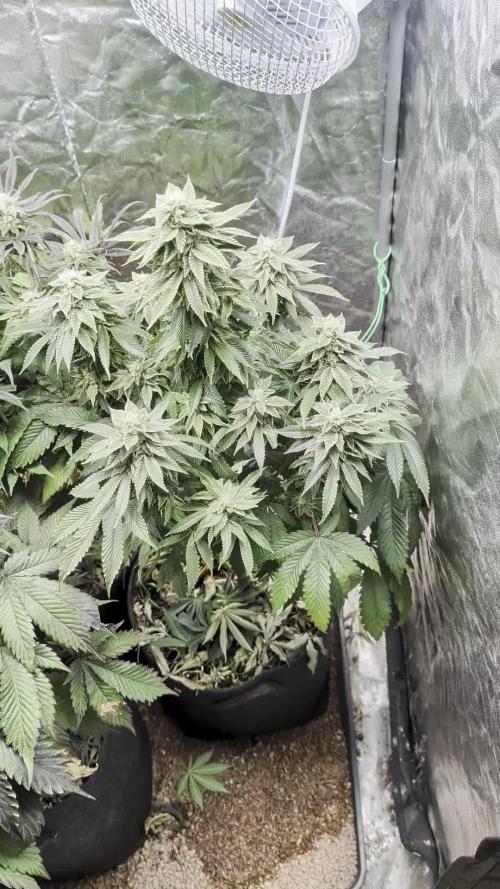
Hello. It 35 c. in the greenhouse today with 5 fans running. Stinkin hot in there. I hope the heat doesn't melt my THC crystals. It's suppose to be as warm tomorrow too. > I have not seen any powdery mildew on either Amnesia Lemon this year. >I have started my 2nd flush today. I' try for 4. But might have to cut a little earlier because>>> > AAHHH, I found a small patch of spider mites on the Amnesia Lemon. I only have a week to go so I decided to turn up the fans instead of spray. Yes they will progress, but slowly and they cant spin their webs in the wind, so it slows them down. And I don't mind smokin dried spider mites (isn't it extra protein). I'm blaming the house behind me, I looked through the fence and they have about 12 large pots growing cannabis, imagine that. >Starting to get some color on the Burmberry and the Sister Amnesia Lemon looks ready to be cut down. > I'll take some more pictures just before harvest and during and after. It took me 2 days to cut it down last year. I wet trim. I grew Dr. Green Thumb seeds Big Laughing last year. They made decent buds but they were not very strong, disappointed. Thought I'd try some stuff that did well inside and see what they did in the greenhouse. These plants were taken as clones, near the start of the year 2020. I moved them in the greenhouse when it was warm enough and did some training then. I started to flower them at the end of May. The tent worked great at forcing flowering at the brightest time of the year. Less chance of problems then trying to flush on a cold October day. I hope I helped makes it clearer in what I'm doing. Chuck.
Processing
Likes
9
Share
A bit of nute burn od on feeding dem girls getting loud
Likes
14
Share
DIREKTE I UNDERLAGET OG HAR OVERLEVET MINUS 2 grader og 0 grader! Og er startet op udendørs også jeg elsker denne konkurrence! Held og Lykke med det hele til alle sammen på growD! From Nicogreen the one and only REAL NICOGREEN 💚💚💚💚💛🖤💚💛
Likes
Comments
Share
@Buddler
Follow
Der geruch ist sehr stark geworden, ansosnsten lief alles nach plan und nun minimiere ich die düngerzugabe jedesmal
Likes
Comments
Share
@Kannisho
Follow
Results without automation; everything is done manually, from irrigation to the application of preventative measures
Likes
12
Share
Good harvest ! We’ll see the results after dryin
Likes
4
Share
@Greenbum
Follow
This was a solid week but my PH keeps dropping. PPM dropped from 780ish to 560 so I know she's eating. Buds are forming nice and compact for their first week of actually forming. Other than the PH problem that I'm correcting daily until my fresh res change, my tallest stalk in the back grew into the light so hopefully those buds don't bleach! Open to constructive criticism btw!
Likes
57
Share
The cannabis strain Grape Guava can be a purple strain, depending on its specific phenotype and genetic makeup. While not all phenotypes of Grape Guava are purple, some variations, such as the Zatix Grape Guava, are noted for their striking purple appearance due to the genetic expression of anthocyanin pigments. Grand Cru Genetics is a cannabis seed bank that emerged in 2018 from a group of breeders in Madrid to provide a satisfactory experience to all cannabis users. "If we do things, we do them well. Due to our experience in the sector and our taste for excellence, we know high quality and we seek it in everything we propose and do." "We have a “cultivate without giving up” philosophy that we apply to everything we do. We do not give up, we are friends of change, and we adapt as necessary in a still restricted sector." "We speak relaxed because we know how to relax. We are not intense or preachy; we accept everyone as they are, and we understand that farming is not for everyone. But for those who do, we are here to accompany you. We like to do it and tell it. We are experts in the field because we are the first to do it. We speak from experience and connect with others because we share the passion for cultivation." "Cannabis has the ability to show us a world of possibilities. When you cultivate and live its growth process, you enjoy a path full of emotions and not just the final destination. At Grand Cru we find beauty in small things. We are attentive, observant, detail-oriented and aware of everyday things, and we savor them without rushing." In a garden of green, Grape Guava gleams, With its fruity aroma, enchanting dreams. Clusters of grapes, guava's sweetness ignite, A strain so divine, in purple and white. Euphoria whispers, a lush fruity haze, Grape Guava's embrace, a tranquil daze. Off and away.@1400ppm. The increased CO2 allows plants to thrive at higher temperatures, which in turn necessitates higher humidity to maintain the ideal VPD for healthy growth and transpiration. 80F -5F = 75F LST with 70% RH = 0.72 kPa. Higher temperatures and humidity promote rapid growth, nutrient uptake, and photosynthesis while maintaining a lower stress level. Temperature influences the rate of enzymatic reactions involved in aerobic respiration. Enzymes, such as those involved in glycolysis, the Krebs cycle, and the electron transport chain, work most efficiently at an optimal temperature range. In low temperatures, enzymatic activity will slow down, thus reducing the rate of aerobic respiration. In high temperatures, enzymes can become denatured, thus impairing their function and stopping the process of aerobic respiration. Glucose is the primary fuel for aerobic respiration. The rate of aerobic respiration increases with the availability of glucose, as it is the starting point for glycolysis. If glucose levels are low, cells may rely on alternative energy sources such as fatty acids or amino acids , but these processes may yield less ATP or be less efficient. To determine this effect, carbon dioxide volume was measured (as carbon dioxide is an output of aerobic respiration) 18/6 with the 6 being IR. The near infrared (IR-a) borders around 700nm up to 1400nm @ photon par flux density of 1.8 instead of darkness, keeping temps overnight a neat 77F-80F. I think of my tent as a lung. What goes in must come out. When the rate of air going out exceeds the amount of air coming in, it creates a negative pressure. Tent concaves (bends in). If set up correctly, the RH will begin to drop slowly to the desired level I set, and the extraction turns off when it reaches the desired RH. The plant, as it performs cellular respiration, will always release more water into the air; therefore, the RH% of the tent overnight will increase, as long as oxidative phosphorylation is occurring. As soon as the RH% creeps back up to 55%, the extraction turns back on, over and over. This creates a strong pressure differential, which will work wonders with mass flow. Replicating high and low-pressure fronts in nature. Critical for oxygen diffusion at the critical time of peak cellular respiratory function.. Moisture will not transfer from a saturated atmosphere to another if that air is already at or above its saturation point, meaning the air can't hold any more water vapor. Once I understood that water is produced as a by product during cellular respiration, specifically at the very end of the electron transport chain (ETC) where electrons are finally transferred to molecular oxygen, the higher the RH of the air, the more resistance there is for more moisture to be added to that environment, and effects the ease with which it does so. But none of that water comes from the pot; it's pulled from the air. If you run high daytime RH, your medium/pot is 100% reliant on transpirational root pull to move water. ZERO evaporation happens across the atmosphere if the tent air has high RH%, the medium cannot release its water through evaporation. Once a canopy develops, light no longer slowly wicks and evaporates from the topsoil. The Soil-Plant-Atmosphere Continuum (SPAC) describes the continuous pathway and process of water movement, driven by a gradient in water potential, from the soil, through the plant's roots, stem, and leaves, and finally evaporating into the atmosphere through transpiration. There is evaporation, there is transpiration, and then there is evapotranspiration; Evapotranspiration (ET) is the combined total of two processes: evaporation (water lost directly from soil and surface water into the atmosphere) and transpiration (water released from plants to the atmosphere through their leaves). Evapotranspiration represents the total amount of water that moves from the medium into the air. There is no such thing as a medium with too much water, only a medium that retains too much for too long. The water must always flow efficiently from one atmosphere(Medium) to another(Air) in a timely manner. Moisture is a critical factor for bacterial growth and decay. Dictating how long it's allowed to sit in any one location for any given period is a key preferred control. To ensure a net reduction in a bacterial population, the rate of removal (ET) must exceed the rate of bacterial growth (decay rate), which is often modeled as a growth rate for the specific bacterium under the given conditions. By optimizing daytime VPD, we also optimize conditions for bacterial growth to explode exponentially above 77°F.. If water is allowed to sit in a medium without an escape within a timeframe, nothing good will happen. IF High RH is maintained overnight as well as during the day, placing 100% of water movement at the behest of daytime transpiration, roots can only pull where they can reach, and if soil is compressed above a certain point, moisture will become trapped in a medium with no way of moving day or night. This will begin the countdown for decay to take hold. When water stagnates in a medium, it loses oxygen, creating anaerobic conditions that foster the growth of harmful microorganisms like bacteria and fungi, which can produce toxins and disease vectors. Thigmomorphogenesis, the process by which plants respond to mechanical stimuli like touch by altering their growth and development, results in significant morphological changes to improve survival against mechanical perturbations. This complex response involves sensing touch and initiating physiological and genetic responses, leading to changes in form and structure over days or weeks. The process is triggered by physical forces such as wind, rain, or touch. Plants adapt to these stimuli by changing their shape and structure, which may include slower growth, thickened stems, or altered leaf development. Plants possess sophisticated mechanisms to detect even subtle mechanical stimuli and initiate responses. A variety of molecules, including calcium ions, jasmonates, ethylene, and nitric oxide, are involved in signaling these mechanical inputs. Touch can induce the expression of genes that encode proteins for calcium sensing, cell wall modification, and defense mechanisms. A plant exposed to constant wind may become shorter and sturdier. A plant that is touched frequently might grow more slowly to conserve energy and develop thicker cell walls. These changes increase a plant's resilience and ability to survive in harsh environments. Let's get Thiggy with it.
Likes
1
Share
@Zanto
Follow
Day 17 of flowering I applied the last dose of Delta 9. They reacted beautifully. Hope to see big colas and healthy buds.
Likes
Comments
Share
She’s a little slower growing but still no issues.
Likes
11
Share
🌱 White Widow – Week 3 | Structure, Strength & Setup Genetics: White Widow (Zamnesia Seeds) Light Schedule: 11/13 (Flower From Seed) Stage: Week 3 – Preflower (no signs yet) Structure: Compact, Healthy | Heading into 4th Node Feeding: Aptus Full Recipe Lighting: ThinkGrow Model One Bars + Future of Grow Black Series 600W Control: Full TrolMaster Ecosystem ⸻ Three Weeks In – Compact & Confident Here we are, Week 3, and White Widow is showing us her best early form. She’s: • Tight in internodal spacing • Vibrant in color and leaf health • Low & strong, with no stretching yet • Just pushing into her fourth node and still no signs of flowering, exactly what we’d hope in this phase, given our light cycle She’s not rushing—she’s setting her foundation. In an 11/13 light cycle, some might expect earlier preflower signs, but not all strains respond immediately. And honestly? I’m loving this slower, more intentional rhythm. She’s taking her time, and that usually means she’ll stack smart, not wild. ⸻ 💧 Feeding Routine – Gentle, Consistent Support Even though she’s rooted in a rich super soil blend, we’re continuing to assist her via the feed water with a light, targeted Aptus mix: Current Feed Recipe: • Aptus Regulator – 0.15 ml/L • CalMag Boost – 0.25 ml/L • All-in-One Liquid – 1 ml/L • Start Booster – 0.25 ml/L This isn’t about force-feeding, this is about helping the soil activate and harmonize, giving her what she needs before she starts asking for more. The mix keeps her cell structure strong, supports microbial life, and encourages consistent early root development. She’s loving it and it shows. ⸻ 💡 The Environment – Light & Movement This week, she’s been bouncing between two active grow zones, as we continue to refine the entire setup. It’s all managed within the TrolMaster ecosystem, offering precision control over both lighting and environment. She’s currently rotating between: • ThinkGrow Model One Bars – soft, powerful full-spectrum LED bars with excellent canopy penetration • Future of Grow Black Series 600W – full spectrum, deep reds for flowering intensity Both are synced and monitored through TrolMaster, giving us: • Consistent PPFD targets (250–400 µmol/m²/s for now) • Environmental tracking for temp, RH, and VPD • Freedom to adapt space as needed while the grow evolves 🎛️ Why this setup? Because we’re still dialing in the room and flexibility is everything. She’s adjusting beautifully to these shifts, showing no signs of stress. A real soldier. ⸻ 👀 What to Expect / What Not to Expect Expect: • More node development, maintaining compact shape • Flower pre-signs within the next 7–10 days • Slow, deliberate shift toward stretch (if she chooses to stretch at all) • Stronger feeding signals as roots fully colonize the pot Not to Expect (just yet): • Pistils or heavy flower behavior • Wild vertical growth • Deficiency signs (thanks to our balance and microbial boost) She’s exactly where she needs to be. ⸻ 🤝 Gratitude & Shoutouts Huge thanks to the partners helping this journey become a reality: 🌱 Zamnesia Seeds – for delivering timeless classics like White Widow and keeping the legacy alive 🔧 Aptus Holland – for the precision nutrients that support both living soil and direct feeding 💡 ThinkGrow – for elegant, pro-level light bar systems that keep our canopy even and calm 🚀 Future of Grow – for the Black Series 600W, bringing serious intensity and bloom readiness 🧠 TrolMaster – for letting us control every detail, from light to leaf, with precision and peace of mind ⸻ 💚 Final Thoughts – Week 3 This White Widow is more than just a plant, she’s a rebirth after a rough start, a solo performance, and now she’s writing her own pace into this grow. No rush. No shortcuts. Just care, balance, and a slow, steady climb toward bloom. We’re watching closely, learning daily, and adjusting with love. Thank you for walking this path with us. More to come soon 🌿 #WhiteWidow #ZamnesiaSeeds #Week3Update #ThinkGrow #FutureOfGrow #TrolMasterControlled #AptusPowered #GrowDiaries #11_13FromSeed #FlowerFromSeed #LEDGrow #CannabisCommunity #GrowYourOwn 📲 Don’t forget to Subscribe and follow me on Instagram and YouTube @DogDoctorOfficial for exclusive content, real-time updates, and behind-the-scenes magic. We’ve got so much more coming, including transplanting and all the amazing techniques that go along with it. You won’t want to miss it. • GrowDiaries Journal: https://growdiaries.com/grower/dogdoctorofficial • Instagram: https://www.instagram.com/dogdoctorofficial/ • YouTube: https://www.youtube.com/@dogdoctorofficial ⸻ Explore the Gear that Powers My Grow If you’re curious about the tech I’m using, check out these links: • Genetics, gear, nutrients, and more – Zamnesia: https://www.zamnesia.com/ • Environmental control & automation – TrolMaster: https://www.trolmaster.eu/ • Advanced LED lighting – Future of Grow: https://www.futureofgrow.com/ • Root and growth nutrition – Aptus Holland: https://aptus-holland.com/ • Nutrient systems & boosters – Plagron: https://plagron.com/en/ • Soil & substrate excellence – PRO-MIX BX: https://www.pthorticulture.com/en-us/products/pro-mix-bx-mycorrhizae • Curing and storage – Grove Bags: https://grovebags.com/ ⸻ We’ve got much more coming as we move through the grow cycles. Trust me, you won’t want to miss the next steps, let’s push the boundaries of indoor horticulture together! As always, this is shared for educational purposes, aiming to spread understanding and appreciation for this plant. Let’s celebrate it responsibly and continue to learn and grow together. With true love comes happiness. Always believe in yourself, and always do things expecting nothing and with an open heart. Be a giver, and the universe will give back in ways you could never imagine. 💚 Growers love to all 💚
Likes
19
Share
@Flavors
Follow
🌱 Week 14 Update (Veg) The girls are holding strong 🌿💪 with steady, lush growth 🍃✨. Canopy is filling in more each day 🌳🕸️ and they’re responding well to training ✂️
Likes
42
Share
girls grow up fast and very strong💪, they eat a lot👨‍🍳. truly satisfied with both genetics. start to see some magic ...😍 DAY 14 🧐made a small defoliation🍁 to allow the girls to breathe better and the light to penetrate more as they are growing very luxuriant 🌱💚and fast! 🔝very happy so far!👨‍🌾
Likes
4
Share
Somehow I miscalculated the days and started week 6 prematurely. I will just continue here thru to week 7 Day 32 From Seed NYD#2 Started LST. Pot was light, watered at 6.3 including Fish Sh!t. NYD#3 The pony tail backfired. The main is mangled. Despite small nodes, I started LST and watered at 6.3 including Fish Sh!t. Day 33 From Seed Did some research and found out the ponytail should only be used during the light cycle and removed for the dark period. I left it on, which caused the ugly. Lesson learned! Day34 Adjusted and added LST. Watered #2 at 6.5. #3 was still heavy, no water needed. Day 37 Watered, adjusted LST Day 39 From Seed Watered, adjusted LST. Found a bug that isn't a fungus gnats (NYD#3). Inspected both plants for more. Did a neem oil top drench and added Vicks Vapor Rub to the pot rims (bug deterrent). So raised light roughly 4 inches. Day 41 Light watering, adjusted LST ties, top drenched with Neem Oil. Added a few ounces of peroxide to the humidifier. They'll both need a top dress soon.
Likes
4
Share
40l bowls with new living soil mix 10% 4 plants in a tent with mars hydro FC-6500 4 plants in a tent with 2 SANlight 5 150 Ab heute laufen die Tests der Lampen die für zukünftige Grows benutz werden könnten