


Likes
Comments
Share


Likes
8
Share

@Sobreruedas
Follow
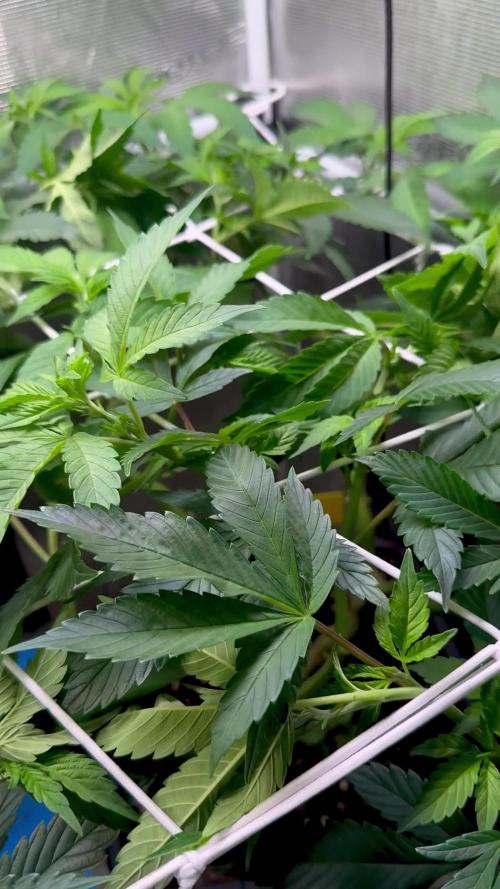
This week I focused only on bending and tucking the branches under the scrog net, trying to fill the entire space as evenly as possible.
No other changes were made — just guiding the growth and keeping the canopy level.
If everything continues like this, I might flip to flower next week 🌿💪

Likes
6
Share

@CheeRz
Follow
WEEK 10 - FLOWERING: Tropical Maturation
🌼 FLOWERING PROGRESS
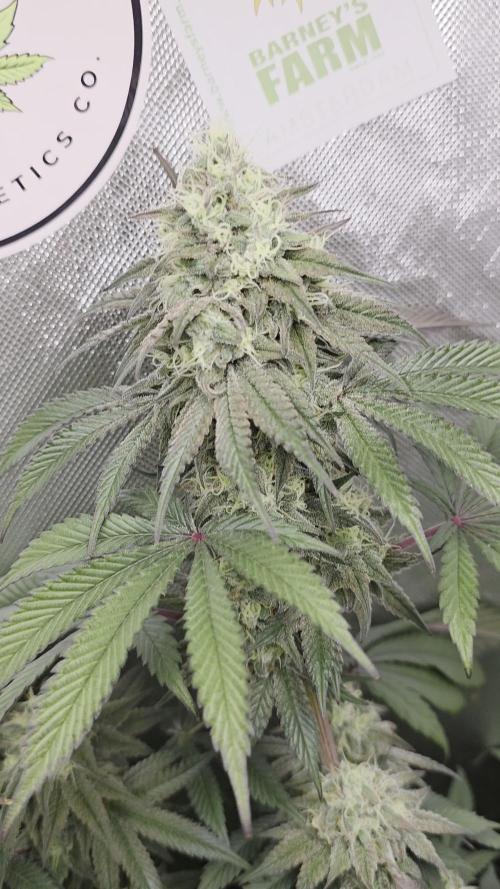
We are now in the 10th week (6th week of flowering), and the Papayton is showing impressive development. The buds are visibly gaining weight and density every day. The resin production is in full swing, covering the flowers in a thick, sticky layer of crystals. It’s great to see how the plant is putting all its energy into the final flower formation. ❄️
👃 TERPENES & AROMA
The tropical scent is becoming much more defined this week. There is a strong, sweet papaya aroma that dominates the tent, perfectly complemented by a creamy finish. The Top-Max is clearly doing its job in bringing out these exotic fruit notes as the plant matures. 🍦
💧 NUTRIENT FEEDING & WATERING
The feeding schedule remains at a high level to provide all the necessary building blocks for the final ripening process. The focus is on maximizing terpene development and resin output.
Current Feeding Schedule:
Calmag: 1.5 ml/l
Acti-Vera: 5 ml/l
Bio-Heaven: 5 ml/l
Bio-Bloom: 4 ml/l
Top-Max: 5 ml/l
Bio-Grow: 1 ml/l

Likes
2
Share


@GreenForMiles
Follow
A very colorful plant with some thick trichomes. She’s surviving in the solo cup well! I’m going to begin flushing with water and endgame microbes this week.


Processing
Likes
8
Share


@XanabaGrows
Follow
Same old, Same old. I know these images are horrible because of the lighting, i did not take these pictures with this website in mind. 😂🤷♂️🏽

Likes
12
Share


@TupSkyWalker
Follow
Última semana que dudo que llegue a ser completa de crecimiento. Las voy a pasar en breves a 12/12.
Algún arrugamiento de las hojas estamos sufriendo, regare con agua antes de pasar a floracion.
Que sigan creciendo.
23/02/2021 Actualizo
Se pasan ya hoy mismo a 12/12 no quiero que se me desmadre el armario.
Empieza lo bueno
Likes
2
Share


@Ultraviolet_
Follow
Nirvana is interpreted as awakening from the illusion of separation and the limitations of time and space, effectively "seeing" the underlying code of existence. In Buddhism, Nirvana is described as the "unconditioned" (asankhata), a reality beyond dependent origination (cause and effect). This aligns with the concept of a fundamental, timeless "code" that exists before material manifestation. Some interpretations equate the stillness of Nirvana with the quantum vacuum, a state of "zero energy" which, however, holds unlimited potential for manifestation.
In quantum mechanics, a quantum system remains a "wave" of possibilities until observed. The "on-demand" aspect is often linked to the ability of a highly developed, enlightened consciousness (a "pure observer") to collapse this wave into a desired state, interacting directly with the underlying quantum reality. This view implies that by breaking free from the ego and mental conditioning, one gains mastery over the energetic, or vibrational, foundation of reality. The feeling of oneness in nirvana is explained through [quantum entanglement], suggesting all things are connected, and therefore, an enlightened mind can interact with any point in the universe. Traditionalists might argue that Nirvana is not about gaining control or having the power to "manifest on demand" (which can be a function of ego), but rather the total cessation of craving and the surrender of the ego, bringing an end to the desire to control reality.
The spiritual path is an evolution from being controlled by the "code" (samsara/suffering) to understanding the code and, eventually, becoming the author of one's own. With the awareness of how "code" functions, one takes full responsibility for their life, making conscious choices rather than reacting impulsively. Thoughts, words, and actions are purposefully aligned with higher values (truth, love, purpose), effectively rewriting one's destiny.
Humidity of the air dictates the moisture in the medium, which dictates the rate of pull from the terracotta stakes, 16 in total.
Soil-Plant-Atmosphere Continuum (SPAC): An ecological concept referring to the pathway of water moving from the soil, through the plant, and into the atmosphere.
Terracotta (unglazed, low-fired clay) is highly porous, acting as a breathable, permeable membrane that transports water based on the moisture gradient between the potting medium (soil) and the surrounding air. White terracotta and brown terracotta often have different pore sizes and overall porosity, primarily driven by differences in clay composition, impurities, and firing temperatures. While both are considered porous, brown terracotta often has higher iron content and impurities that behave as fluxes, affecting how the pores form during firing, while white terracotta is generally derived from more refined clays, with smaller pores making it more suited to pure water.
This mechanism is driven by capillary action and evaporation. When the surrounding soil is dry, the terracotta acts as a wick, pulling water out of the pot and into the soil. If the soil is very saturated, the terracotta absorbs water from the soil and allows it to evaporate from its outer surface, increasing the drying rate of the soil. Terracotta tends to keep the potting mix at an optimal saturation point, wicking up more water when the outside surface evaporates water into the air. The greater the difference in moisture between the soil and the outside air, the faster the water transfers through the ceramic. In low humidity and hot weather, the evaporation rate from the terracotta surface is high, creating a rapid drying effect. Newer terracotta pots often have a denser, lighter-toned structure that is less porous than traditional, red-orange terracotta, slowing down the moisture transfer rate. Over time, dissolved salts from fertilizer or tap water build up and block the pores, reducing the permeability of the clay. Water is all that is used or needed, thanks to the biochar and the massive storage bank of nutrients. Just waiting until something creeps up.
Clay pot irrigation (Ollas), an ancient farming practice, utilizes this property by burying unglazed jars in the soil, allowing water to slowly seep into the surrounding soil only when the soil dries out.

Likes
76
Share


@Roberts
Follow
She has a strong sweet floral smell. This was a great grow with the Agrogardens nutrition under the Medic Grow Mini Sun-2. I didn't have any major growing issues during the grow. Everything looks great, and produced great. Thank you Medic Grow, Agrogardens, and Doctor's Choice. 🤜🏻🤛🏻🌱🌱🌱 the harvest video will be on my YouTube channel. 👍🏻🔥
Thank you grow diaries community for the 👇likes👇, follows, comments, and subscriptions on my YouTube channel👇. ❄️🌱🍻
Happy Growing 🌱🌱🌱
https://youtube.com/channel/UCAhN7yRzWLpcaRHhMIQ7X4g

Likes
8
Share


@Cdn_Chronic
Follow
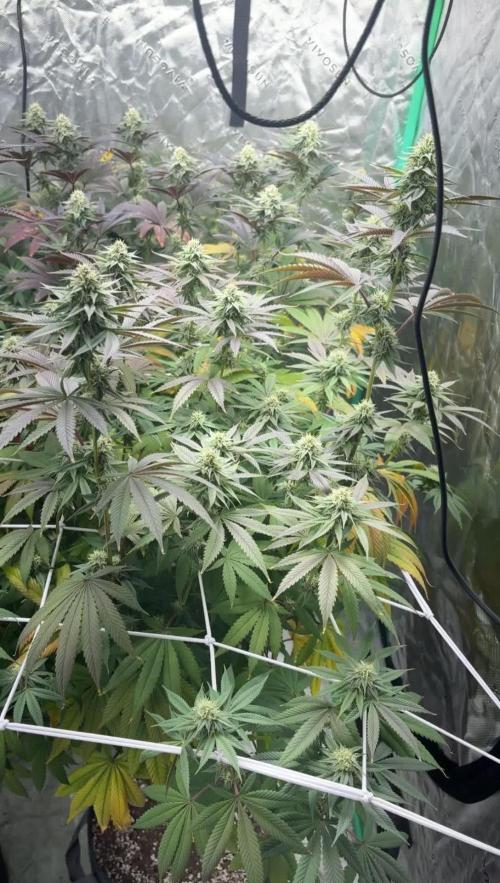
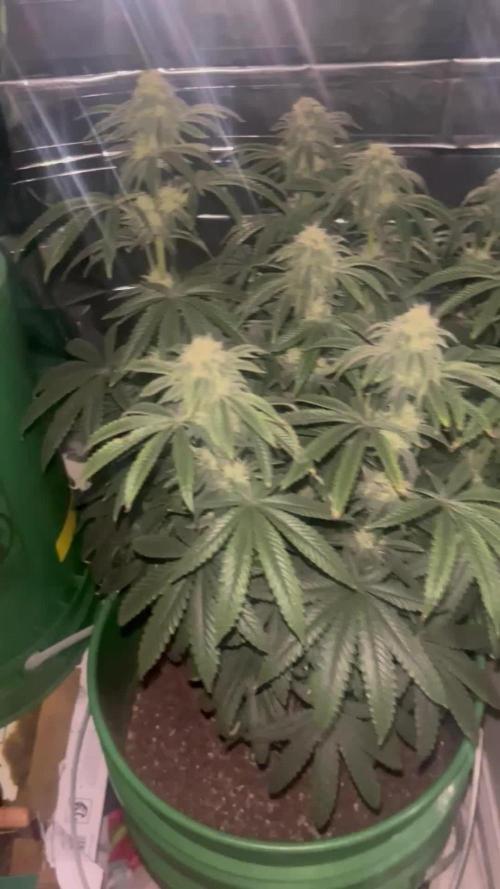
Pretty slow week, using about 1 gallon of water for all three every other day, I think are a little behind but they look good !






Likes
41
Share


@Compassionate_Gardener
Follow
2 GIRLS IN 1 CUP:
This round I have decided to grow the BANANA KRUMBLE from GREENHOUSE SEEDS. It is a cross of Banana Punch with the original OG-Kush and said to have a very strong effect, which makes it a good medicine against my chronic backpain! In the catalogue description of Greenhouse it says the buds grow compact with big colas and get a purple coloration. Since I LOVE PURPLE VARIETIES OF CANNABIS I decided to give this strain a go. 😃
I planned on doing 4 plants in a SCROG (=screen of green) with longer veg time to train the plants into my trellies, but all 10 seeds germinated well and grew into healthy seedlings, so I decided to keep 8 instead of 4 plants and do 2 plants per pot --> hence the title of the diary: 2 GIRLS IN 1 CUP ... 😉😜
In my HOMEBOX Ambient R120 growtent I use four 20 liter pots filled with soil amended with BIO TABS nutrient tablets (3 tablets per 20 liter container plus 100 gram Startrex, 6 gram Mycotrex, 2 gram Bacterex) and watered it with Orgatrex (5 ml/liter water).
The Bio TABS nutrients are VERY CONVENIENT, after amending the soil I only need to give pure tab-water for the rest of the cycle, which saves me a lot of time. Since the soil is self-regulating with BIO TABS I als do NOT need to measure the ph- or EC-value of my water and adjust the ph-value. No mattter what, pure tab-water is all thats needed from now on...yiiippie.
During veg. (4 weeks after germination) I use two SANlight Q4W-Gen.2 LED lamps, which are dimmed to 40% (=no green light on dimmer ON) for the first to weeks and then increased to 60% (week 3) and then to 80% (week 4).
At the beginning of flowering I add one Q3WL-Gen.2 in the center of my tent and increase the dimming slowly from 40% to 80% over the next few week.
The spectrum and the light intensity of the SANlight LEDs are OUTSTANDING and PERFECT FOR GROWING CANNABIS!
Unfortunately I didnt take any pics before week 12, therefore I described the setup here.
Now in week 12 (=week 8 of flowering) all 8 plants have developed HUGE colas, which are GLISTENING with TRICHOMES and already show a BEAUTIFUL purple coloration. 😍 You can see an nice overview in the video above.
The plants have a sweet smell (like cinnamon with banana) with a gassy and fuelly undertone from the Kush...simply DELICIOUS!

Likes
2
Share

@GingerGarageGrow420
Follow
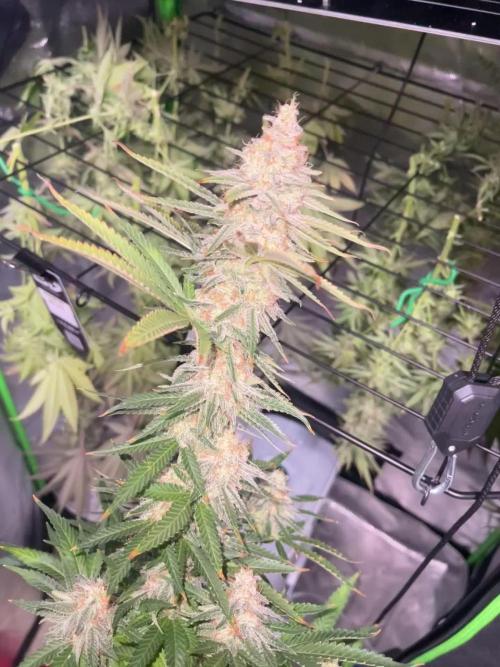
Strain: Chill Out OG F4
Harvest Day 64 Flower
Day: 113 from sprout
Medium: Fox Farm Ocean Forest
Light: Vivosun VS2000 at 100%
VPD: 1.5 kPa
Light Distance: 12 inches
Watering: By hand, ~oz daily
Nutrients: pH Perfect Advanced Nutrition Grow, Bloom, Micro 2 ml / L, 1 ml / L big bud
30 inches
Likes
1
Share


@Mr_Maes
Follow
This girls has grown to 2 feet tall in just 30 days. If she keeps at this pace we should see a very nice plant.

Likes
18
Share


@TheGreenLeopard
Follow
nice week , coming along great. put back the ones that went to rehab. they can flower and see what happens among the elite tent. nutrients this week i have added bio boost for flower. getting th winter air in at night as i want to see color as we develop here. hope everyone good. thai choc is a lanky plant. dowes ok tied. will see how it flowers

Likes
17
Share


@all_about_420
Follow
Der Moment der Ernte ist gekommen und die drei Amnesia Haze von @GanjaFarmerSeeds haben das Zelt mit einem betörenden Aroma verlassen. Die Qualität der Blüten ist durchweg beeindruckend: Während die mittlere und die große Pflanze mit ihren tiefen Purpletönen und massiven Bud-Strukturen bestechen, hat die kleinste Lady durch die drei zusätzlichen Tage Reifezeit massiv an Dichte und Trichombesatz aufgeholt. Alle drei Phänotypen sind nun perfekt ausgereift und zeigen eine klebrige, schwere Harzschicht, die die Scheren ordentlich fordert. Um die gesamte Reise dieser Genetik festzuhalten, habe ich ein Zeitraffer-Video von Tag 1 bis zum Ende hochgeladen, das die beeindruckende Transformation und Vitalität dieser Sorte dokumentiert. Jetzt geht es in die kontrollierte Trocknung, um die Terpenprofile optimal zu konservieren.

Likes
19
Share


@adam_pawloski87
Follow
What a fun run this was ! These Ogreberrys finished up from 81 days to 102 days with nice hints of gassy , sour purple , sweetness and glistening with frost! These ladies will cure up for a month an will be ready to test out ! So much fun , I highly recommend this strain if your looking for some oooy gooohy resiny grape smelling nugs !
