The Grow Awards 2026 🏆
Likes
19
Share
@Robin87
Follow
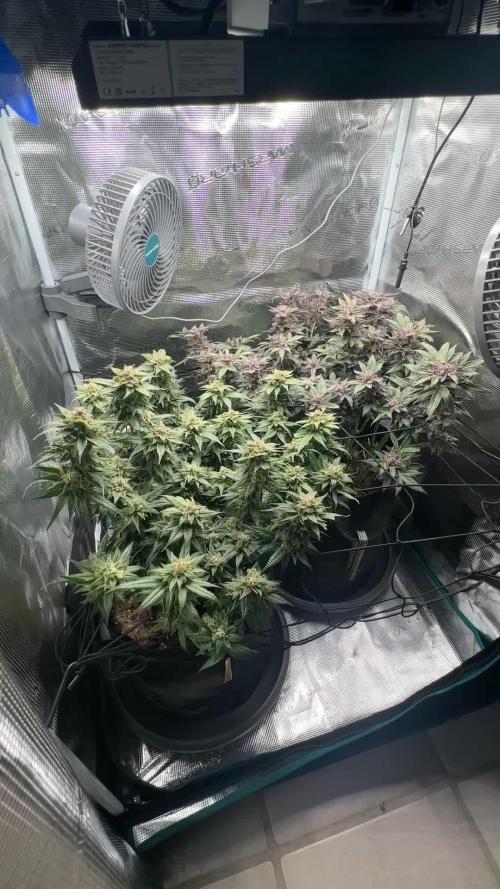
Day 35 of flower! Isn’t she beautiful! Not much else to say, environments been running perfect the last few weeks with day time temps sitting at 25 c with the rh at a lovely 55% and at night dropping to 21c, beautiful. , no other work has been applied to this girl, nothing but H2o
Likes
15
Share
Things are getting good now.i haven't had any issues this week.i p.h my water and feeding at 6.4.i did a little flush to get rid of any build up there might be in my soil .I did feed this week with advanced connessiour bloom a and b one time with some b52.
Likes
25
Share
Day 15 18/07/24 Thursday De-chlorinated tap water pH 6 with calmag 5ml -5L. I have scratched back surface soil, and topped up with canna terra pro and DyNoMyCo ✌️💚 Day 16 19/07/24 Friday Lite Feed today, 250ml each pot small run off. Seeing excellent start to these babies. Let's get it 👌💚 Day 18 21/07/24 Sunday De-chlorinated tap water pH 6 with calmag 5ml to 5L. Watering in 1L each day from now. Updated video Day 19 22/07/24 Monday Nothing new to report. Starting to see them beautiful fans appear that's all 😁✌️ Day 20 23/07/24 Tuesday Feed today, giving them straight all nutes Inc flowering nutes. I will update the dose as they grow and develop a bigger hunger. Video updates 👌💚 Day 21 25/07/24 Wednesday END OF WEEK Still no water or feed since Tuesday, it has been overcast last two days though so not a lot of energy been used. Still happy and healthy 💪💚
Likes
39
Share
@Randyb4
Follow
This was a good week we say alot of growth and they seem like they've all recovered from the bad ph. Day 29 I topped Plant B and day 31 I topped the rest of them. Gave them 4 cups of water with 1 ml of calmag in it. Ph was at 6.4. Trying to plant some of the tops because why not. If they grow they grow. Day 33 I Transplanted into 1 gallon pots because the roots were filling and coming out of the bottom of the solo cup. Still in fox farms happy frog soil. Sprinkled some "great white" mycorrhizea in the soil. Transplanted went good.
Likes
14
Share
Greeting! She fine! Decide to do an early LST to start shorting the growing stages.
Likes
4
Share
Plant is growing well. Transplanted them from a 1 gallon pot into a 3 gallon pot this week.
Likes
6
Share
First Week Of Flowering Switch To 12/12 Went Good Room Checked For Light Leaks And Ducting Leaks All Seems Ok. Will Stake In A Few Weeks When Stretch Has Finished.
Likes
8
Share
I defoliated and removed 30 or so leaves this week to make sure the flowers get plenty of airflow. I've not given any nutrients this week since it's in miracle grow and I worry about nitrogen toxicity. I upped the light to 100% power and the plant is liking it and rewarding me with faster growth. Hoping to just be 6 or 7 weeks from harvest.
Likes
6
Share
@Reidy_B
Follow
So far my confidence in this next go around is very high! 😃☀️ Putting the seeds straight into a jiffy pellet is the way I am going to proceed with germination going forward. You are just adding extra variables to what should be a simple equation (seed in sterile medium + warmth + moisture = seedling) unlike with the paper towel method, where you need to transfer them to the medium. But this is just one opinion of a rookie grower.
Likes
10
Share
Les colas commencent a gonflé j'ai enlevé les grosses feuilles pour une meilleure qualité lumineuse. Pas signe de surengraissage(les pointe des feuilles ne sont pas décolorés), plante petite mais compacte avec une odeur d'agrume verte laissons la dans sa course pour la coupe de DuctchPassion@ la suite au prochain épisode.
Likes
8
Share
Welcome to week 6 of my Tiny Pot Contest journal! Not much going on this week, just been watering everyday. Herbie continues to chill in the tent watching over all the beautiful ladies. It looks like stretch has been kept to a minimum. Going for one fat bud here! Buds are starting to get frosty by the weeks end.
Likes
8
Share
@Salokin
Follow
Plant has been developing nicely over the past 6 weeks. Fimming was not very successful, so I continued with super cropping the plant. She was switched to a 12/12 schedule a week ago and was fed flower nutes for the first time this week. She is definitely stretching, so I installed another scrod at 50 cm to distribute the canopy even further and add some support. She has been receiving ph balanced RO water and is at this stage continuously via drippers. Roots are al over the tank again, which has however proven as an advantage in the past.
Likes
45
Share
2nd net is up. Early bud formations are promising. holding up to the extremes pretty well, some leaves taking minor damage, but overall, she is holding up, gave her 1 night at 50F see how she would react, stressful. Not advised as it messes with her metabolism, but I want to see if it triggers any anthocyanin response. Love to see her purp up but no signs yet. My homework. Rubisco regeneration is intrinsically linked to nitrogen supply because Rubisco is a major sink for nitrogen in plants, typically accounting for 15% to over 25% of total leaf nitrogen. The regeneration phase itself consumes nitrogen through the synthesis of the Rubisco enzyme and associated proteins (like Rubisco activase), and overall nitrogen status heavily influences the efficiency of RuBP regeneration.Structural Component: Nitrogen is an essential building block for all proteins, and the sheer abundance of the Rubisco protein makes it the single largest storage of nitrogen in the leaf. Synthesis and Activity: Adequate nitrogen supply is crucial for the synthesis and maintenance of sufficient Rubisco enzyme and Rubisco activase (Rca), the regulatory protein responsible for maintaining Rubisco's active state. Nitrogen deficiency leads to a decrease in the content and activity of both Rubisco and Rca, which in turn limits the maximum carboxylation rate, Vmax, and the rate of RuBP regeneration Jmax, thus reducing overall photosynthetic capacity. Nitrogen Storage and Remobilization: Rubisco can act as a temporary nitrogen storage protein, which is degraded to remobilize nitrogen to other growing parts of the plant, especially under conditions of nitrogen deficiency or senescence. Nitrogen Use Efficiency (NUE): The allocation of nitrogen to Rubisco is a key determinant of a plant's photosynthetic nitrogen use efficiency (PNUE). In high-nitrogen conditions, plants may accumulate a surplus of Rubisco, which may not be fully activated, leading to a lower PNUE. Optimizing the amount and activity of Rubisco relative to nitrogen availability is a target for improving crop NUE. Photorespiration and Nitrogen Metabolism: Nitrogen metabolism is also linked to the photorespiration pathway (which competes with carboxylation at the Rubisco active site), particularly in the reassimilation of ammonia released during the process. To increase RuBisCO regeneration, which refers to the process of forming the CO2 acceptor molecule Ribulose-1,5-bisphosphate (RuBP) during photosynthesis, the primary methods involve optimizing the levels and activity of Rubisco activase (Rca) and enhancing the performance of other Calvin-Benson-Bassham (CBB) cycle enzymes. Biochemical and Environmental Approaches: Optimize Rubisco Activase (Rca) activity: Rca is a crucial chaperone protein that removes inhibitory sugar phosphates, such as CA1P (2-carboxy-D-arabinitol 1-phosphate), from the Rubisco active site, thus maintaining its catalytic competence. •Ensure optimal light conditions: Rca is light-activated via the chloroplast's redox status. Adequate light intensity ensures Rca can effectively maintain Rubisco in its active, carbamylated state. •Maintain optimal temperature: Rca is highly temperature-sensitive and can become unstable at moderately high temperatures (e.g., above 35°C/95F° in many C3 plants), which decreases its ability to activate Rubisco. Maintaining temperatures within the optimal range for a specific plant species is important. •Optimize Mg2+ concentration: Mg2+ is a key cofactor for both Rubisco carbamylation and Rca activity. In the light, Mg2+ concentration in the chloroplast stroma increases, promoting activation. •Manage ATP/ADP ratio: Rca activity depends on ATP hydrolysis and is inhibited by ADP. Conditions that maintain a high ATP/ADP ratio in the chloroplast stroma favor Rca activity. Enhance Calvin-Benson-Bassham (CBB) cycle enzyme activity: The overall rate of RuBP regeneration can be limited by other enzymes in the cycle. •Increase SBPase activity: Sedoheptulose-1,7-bisphosphatase (SBPase) is a key regulatory enzyme in the regeneration pathway, and increasing its activity can enhance RuBP regeneration and overall photosynthesis. •Optimize other enzymes: Overexpression of other CBB cycle enzymes such as fructose-1,6-bisphosphate aldolase (FBA) and triose phosphate isomerase (TPI) can also help to balance the metabolic flux and improve RuBP regeneration capacity. Magnesium ions, Mg2+, are specifically required for Rubisco activation because the cation plays a critical structural and chemical role in forming the active site: A specific lysine residue in the active site must be carbamylated by a CO2 molecule to activate the enzyme. The resulting negatively charged carbamyl group then facilitates the binding of the positively charged Mg2+ion. While other divalent metal ions like Mn2+ can bind to Rubisco, they alter the enzyme's substrate specificity and lead to dramatically lower activity or a higher rate of the non-productive oxygenation reaction compared to Mg2+, making them biologically unfavorable in the context of efficient carbon fixation. The concentration of Mg2+ in the chloroplast stroma naturally increases in the light due to ion potential balancing during ATP synthesis, providing a physiological mechanism to ensure the enzyme is activated when photosynthesis is possible. At the center of the porphyrin ring, nestled within its nitrogen atoms, is a Magnesium ion (Mg2+). This magnesium ion is crucial for the function of chlorophyll, and without it, the pigment cannot effectively capture and transfer light energy. Mg acts as a cofactor: Mg2+ binds to Rubisco after an activator CO2 molecule, forming a catalytically competent complex (Enzyme-CO2-Mg2+). High light + CO2) increases demand: Under high light (60 DLI is a very high intensity, potentially saturating) and high CO2, the plant's capacity for photosynthesis is high, and thus the demand for activated Rubisco and the necessary Mg2+ cofactor increases. Mg deficiency becomes limiting: If Mg2+ is deficient under these conditions, the higher levels of Rubisco and Rubisco activase produced cannot be fully activated, leading to lower photosynthetic rates and potential photo-oxidative damage. Optimal range: Studies show that adequate Mg2+ application can enhance Rubisco activation and stabilize net photosynthetic rates under stress conditions, but the required concentration is specific to the experimental setup. Monitoring is key: The most effective approach in a controlled environment is to monitor the plant's physiological responses e.g., leaf Mg2+ concentration, photosynthetic rate, Rubisco activation state, and adjust the nutrient solution/fertilizer to maintain adequate levels, rather than supplementing a fixed "extra" amount. In practice, this means ensuring that Mg2+ is not a limiting factor in the plant's standard nutrient solution when pushing the limits with high light and CO2. Applying Mg2+ through foliar spray is beneficial to Rubisco regeneration, particularly in alleviating the negative effects of magnesium (Mg) deficiency and high-temperature stress (HTS). While Mg can be leached from soil, within the plant it is considered a mobile nutrient, particularly in the phloem. Foliar-applied Mg is quickly absorbed by the leaves and can be translocate to other plant parts, including new growth and sink organs. Foliar application of: NATURES VERY OWN MgSO4 @ 15.0g L-1 in a spray bottle. Foliar sprays are often recommended as a rapid rescue measure for existing deficiencies or as a supplement during critical growth stages, when demand for Mg is high. Application in the early morning or late evening can improve absorption and prevent leaf burn. The starting point [of creativity] is curiosity: pondering why the default exists in the first place. We’re driven to question defaults when we experience vuja de, the opposite of déjà vu. Déjà vu occurs when we encounter something new, but it feels as if we’ve seen it before. Vuja de is the reverse—we face something familiar, but we see it with a fresh perspective that enables us to gain new insights into old problems. Come walk in the enchanted forest.
Likes
22
Share
@gr3g4l
Follow
Esta semana a los 73 dias de floracion decidí que ya tenia que cosecharlas. No podia dejar pasar mas dias puesto que se corria mucho riesgo de botritis y los tricomas estaban ya suficientemente maduritos, igual demasiado. Jamás me habia encontrado con unas jack con tanta cola de zorro pero de oler huelen a gloria. hasta el último dia estubieron siempre dentro del armario y posiblemente por la extracción no pude percibir el olor tan agradable que desprenden, intenso . Algo mas terroso de lo que pensaba. Cogollos duros como piedras, algo exsagerado. Con 74 dias al secadero, calefactor 80w más un par de ventiladores con ventilacion indirecta, extraccion, intraccion pasiva
Likes
5
Share
So since I had the mold and bud rot problems I had to divide my schedule of harvest and divide the product as well. - Healthy buds are ones belonging to branches where there are no signs of rot/mold. -Mid-healthy buds are untouched by disease but still belonging to a branch where there was some disease. -Last category are the salvaged ones, where I cut them from bigger buds that had disease or they were in some part affected. These 3 categories each have their own drying space and where harvested in this order to prevent spreading of spores and stuff. For the salvaged buds every time I removed a part with disease I cleaned the scissors with alcohol. I only removed the sun-leaves + penguin leaves and will be doing a dry trim for the sugar leaves later on.
Likes
65
Share
Day 65: Watered the plants 0.5L with nuts 722 ppm, 1534 us/cm, PH 6.4 Day 67: Did some defoliation Day 68: Watered the plants 0.5L with nuts 802 ppm, 1676 us/cm, PH 6.4 One plant showing signs of P and K deficiency (Gorilla Cookies)