Likes
109
Share
This run has come to a end. I'll be chopping these lady's down in the next 48 hours. I'll will do a Harvest update in a couple of weeks👍 Rock on Growmies 💚
Likes
10
Share
Very pleased with how these girls are growing. Foilar feed them some coconut water and aloe Vera and they been taking it well. Stay tuned all is growing well
Likes
35
Share
@Stinkfox
Follow
She’s bulking up and smelling nice! Couple more weeks and I’ll be in Blueberry heaven! I added some Cha-ching this week and I’ll be flushing from here.
Likes
Comments
Share
Likes
43
Share
Got some better shots without light and a little video my cam is a bit shit got a video of trichs also in there girls seem to be flushing well started flushing the quick one later than the others as wasn't as developed. Took the 2 tester buds of very bottom under the plants on the first day of flush to try estimate how long to flush for........last pic and vid before harvest next uploads will be harvest hopefully
Likes
25
Share
Qualche problema con il PH...risolto utilizzando 100% acqua piovana. Durante la prossima settimana aumento valore EC
Likes
3
Share
What’s up, Growmie! 🌱🔥 Since it was getting crowded in the grow space, I defoliated for better ventilation and lighting. I kept it conservative — not more than 10% of the leaf mass. While at it, I kept an eye on future bud sites and rerouted a few twigs with some LST using bonsai wire. Still looking good! 💪 Stats so far: 💧 Watering: 1,5L every other day 💦 Humidity: ~70% RH 🌡️ Temp (lights on): 26–28°C 🌡️ Temp (lights off): 20–22°C 📈 Avg. VPD (lights on): ~1.0 kPa
Likes
3
Share
W10F and the end is near. The bud sites are small and internodes are spaced far apart. I neglected them and let the light intensity get too high during stretch. They are pretty frosty though. Fade has started and they are displaying nice colours
Likes
Comments
Share
Week 5 topping and clean up and used top for a clone
Likes
42
Share
Flowering day 65 since time change to 12/12 Hey guys :-) . It is nearly time . Harvest next week :-) . Watering would be done twice this week with 1 l each (nutrients see table above) Otherwise it was checked and everything was cleaned. Have fun and stay healthy 💚🙏🏻 Flowering day 65 since time change to 12/12 Hey guys :-) . It is nearly time . Harvest next week :-) . Watering would be done twice this week with 1 l each (nutrients see table above) Otherwise it was checked and everything was cleaned. Have fun and stay healthy 💚🙏🏻
Likes
8
Share
First week under the Lumatek 600 Pro set to 50% and aporox 40cm away from canopy. Day 7 applied some pruning and supercropped the few taller girls to even out the canopy. I will add a CO2 bag next week as i increase the power to avoid potential light stress.
Likes
17
Share
Day 64 beginning of week 10, looking for a small but decent yield. 14th, day 66 budding up, prob a week for harvest. Day 68 will have to water soon, going to slow down nutes now. Zoom on the bud photo to see trichomes getting amber 18th Day 70, watered without any nutes yesterday, had some runoff.
Likes
2
Share
We become aware at such times of man's wonderful ability to bring seemingly unrelated elements into harmonic balance, and receive a glimpse into a world where everything exists in conscious sympathetic attunement to everything else. When we listen to a piece of music that seems to strike a beautiful chord somewhere inside us, or view a painting that simply glows with harmonic awareness well executed, we probably do not spare much time to contemplate the wonderfully intricate combination of vibrations that our sensors make it possible for us to perceive. We tend to appreciate the relationship between the parts of something by an awareness of the harmony or dissonance of the whole. This ability enables us to say "what a beautiful house!" instead of "analysis has proven that this collection of building materials exhibits certain elements of harmonic proportion." While this ability to instinctively appreciate the beauty of true harmony has an important role to play in evolution, a more analytical understanding of the laws involved can be most useful. This is especially so if we wish to create works of art where each part exists in true harmony, not only with the other part of that particular whole, but with the universe within which the creator and the created exist. Everything vibrates. From the most dense matter to the most subtle cosmic rays, everything which our senses allow our thoughts to become aware of, can be specified in terms of wavelength or frequency of vibration. These two terms define the same thing, but from different points of view. The following are the approximate wavelengths of various energy carriers: Cosmic rays 0.000,000,001 mm Gamma rays 0.000,000,1 mm X rays 0.000,500 mm Ultraviolet rays 0.003 mm Visible light 0.006 mm Infrared 0.01 mm Sound waves 1 meter Radio waves 300 meters Violet light 400 nm to 450 nm Blue light 450 nm to 500 nm Green light 500 nm to 570 nm Yellow light 570 nm to 590 nm Orange light 590 nm to 610 nm Red light 610 to 700 nm 1 nanometer (nm) = 0.000,000,1 cm = 1/10,000,000 cm If a guitar string is plucked and we hear a sound, it is not too difficult for the human mind to associate this sound with the vibration of the guitar string. With color it is quite different. It is difficult for us to conceive that the color of a substance is not an inherent property of the substance itself, but an indication picked up by our senses of that substance's ability to absorb or reflect the light which happens to be shining on it at that moment. Neither the matter nor the light is colored. What happens is that the brain learns to differentiate between the frequencies reflected or transmitted by the substance the eyes are focused on. The same thing happens with sound. When we say "Oh! Listen, they're playing my favorite song," what we really mean is: "My brain has stored within it a particular pattern of frequencies. I have compared the new information being received with this stored pattern and have deduced the answer that the two patterns are similar within certain specified tolerances." The 'pleasure' involved could have something to do with our running the pre-recorded pattern at the same time, in 'sympathy' with the new pattern as it is received. The word sympathy describes very well our ability to appreciate color and sound. It also describes the reason behind certain elements of harmony. For instance, if a substance vibrating at 100 cycles per second (tone 1) is in the proximity of another substance vibrating at 200 cycles per second (tone 2), we could perceive, if we had the right equipment, a certain sympathetic relationship between the two. We will see from this that there is a uniform doubling of the first tone seen in the second. At various points along the waves, the two are the same in amplitude. At other points, they are at opposite poles to each other. This doubled frequency has more points of similarity to the original than any other frequency except the original itself. If the equipment we had available for measuring these two frequencies was a soundboard amplifier and a pair of ears, then we would hear what would sound to us like one tone. If we had the opportunity to hear one at a time, we would hear that although they sound the same, one is higher in pitch than the other. This characteristic of 'the same but different in pitch', musicians have called the octave. Any two tones produced where one has exactly doubled the frequency of the other is called an octave. Speaking in ratios, an octave would appear then as the ratio 2:1 or 1:2, depending on whether we are talking of an octave up or down. A single note produced by almost any instrument will contain more than one wavelength or frequency. It will have a dominant frequency, the wavelength of which we would call the note's 'fundamental' or 1st harmonic. It will also have a varying number of upper harmonics, gradually fading in intensity into infinity or silence. Natural harmonics always have the same pattern of intervals between them. The interval between the 1st and 2nd harmonic is a perfect octave; between the 2nd and 3rd a perfect fifth; between the 3rd and 4th a perfect 4th; and so on, the intervals becoming smaller and smaller until they lose any relationship with the western 12 tone scale as it exists at the moment. Just as an octave has certain elements of sympathy with its fundamental, so some intervals have been noted to be more perfectly in sympathy with the fundamental than others. The ratio of the 'perfect 5th' or interval of 7 semitones, as it occurs in the harmonic series, is 3:2 or 2:3, while that of the 'perfect fourth" is 4:3 or 3:4. All the tones in the western 12 tone scale can be expressed in terms of the ratio between the upper tone and its fundamental. This would seem to be an ideal way of generating a scale from any given fundamental and several attempts have been made to do this, the Pythagorean system being probably the most well known. Although when working with a single tone instrument playing on its own, the Pythagorean formula works wonderfully well, if we had several instruments tuned this way together and asked them to play almost any western music, we would find that at times they sounded quite out of tune to each other. The lack of flexibility of the various scale systems based on the harmonic series has led to what is known as the 'tempered' scale. This uses as its primary unit of interval the ratio of the octave or 2:1. It then proceeds to divide the interval between any fundamental and its upper octave into 12 smaller intervals by applying the ratio: two to the one-twelfth power, to one (21/12:1). This equals 1.059463094, so by multiplying any frequency by this number, we will obtain the tempered semitone next up from our fundamental. We will also find that any tone twelve semitones up from any other tone, in a scale generated in this way, will have exactly double the frequency. If we took the note middle C on a piano and halved the wavelength, we would have the note C one octave above. If we halved this, we would have the C above, and so on. However, within about 6 octaves, we would find that although a 'sound' was being produced, no human ear could perceive it. If we kept on going, halving and producing upper octaves of our fundamental C, we would proceed through the infrared band, into the visible light spectrum. If we happened to be outside during the day, we would, for one octave only, see the note C with our eyes. The next octave above would already be in the ultraviolet band, and outside the eye's sensitivity range. If we can think of color as being an indication of a substance's vibratory rate or wavelength, we may begin to see a relationship that could exist between the color and sound spectrums. The logical extension of what has so far been said is that there exists a scale in the color spectrum that corresponds exactly to the scale in the sound spectrum, each color tone being an octave of the equivalent note in the sound range. This is not the end of the story but only the beginning. If we can for the moment accept that any wavelength in one band has upper and lower octave stretching out to infinity, then the next question is 'fine, but what shall we use as our fundamental? A particular color? A particular sound frequency?' The musicians among us will probably say 'A 440'. This means that the note A should vibrate at 440 Hertz, or 440 times per second. They would tell us that this is standard pitch has been adopted by most orchestras around the world; pianos are tuned to it, instruments are constructed to formulas based on it, and so to them it would probably seem the most appropriate place to begin. Some of these musicians may know of the battle that is still raging with regards to this being the standard, but few would know why A = 440 Hz was chosen except that it worked when it was set to be a suitable compromise between the many different pitches in use at the time. 432 Hz is said to be mathematically consistent with the patterns of the universe. Studies reveal that 432 Hz tuning vibrates with the universe’s golden mean PHI and unifies the properties of light, time, space, matter, gravity, and magnetism with biology, the DNA code, and consciousness. When our atoms and DNA start to resonate in harmony with the spiraling pattern of nature, our sense of connection to nature is said to be magnified. Another interesting factor to consider is that the A=432 Hz tuning correlates with the color spectrum, while the A=440 Hz is off. Audiophiles have also stated that A = 432 Hz music seems to be non-local and can fill an entire room, whereas A=440 Hz can be perceived as directional or linear in sound propagation. Once you adopt the idea that sound (or vibration in general) can have an equalizing and harmonizing effect (as well as a disturbing effect), the science of harmony can be applied to bring greater harmony into one's life or tune to specific energies. There is a form of absolute and relative harmony. Absolute harmony can, for example, be determined by the tuning of an instrument. The ancients tuned their instruments at an A of 432 Hz instead of 440 Hz - and for a good reason. There are plenty of music examples on the internet that you can listen to in order to establish the difference for yourself. Attuning the instrument to 432 Hz results in a more relaxing sound, while 440 Hz slightly tenses up the body. This is because 440 Hz is out of tune with both macro and micro cosmos. On the contrary, 432 Hz is in tune. To give an example of how this is manifested microcosmically: our breath (0,3 Hz) and our pulse (1,2 Hz) relate to the frequency of the lower octave of an A of 432 Hz (108 Hz) as 1:360 and 1:90. It is interesting to note that 432 Hz was the standard pitch of many old instruments and that it was only recently (19th and 20th century) the standard pitch was increased. This was done in order to be able to play for bigger audiences. Bigger audiences (more bodies) absorb more of the lower frequencies, so the higher pitch was more likely to “cut through”. One of the oldest instruments of the world is the bell ensemble of Yi Zeng (dated 423 BC), tuned to a standard F4 of 345 Hz, which gives an A= 432 Hz. The frequency of 345 Hz is that of the platonic year! Similarly, many old organs are tuned in A=432 as well; for example, St. Peter’s Capella Gregoriana, St. Peter’s Capella Giulia, S. Maria Maggiore in Rome. Maria Renold’s book “Intervals Scales Tones and the Concert Pitch C=128 Hz” claims conclusive evidence that 440 Hz and raising concert pitch above scientific “C” Prime=128 Hz (Concert A=432 Hz) disassociates the connection of consciousness to the body and creates anti-social conditions in humanity. The difference between concert pitch A=440 Hz and Concert A=432 Hz is only 8 cycles per second, but it is a perceptible difference of awareness in the human consciousness experience of the dream we share called existence.
Likes
7
Share
@HeavyHead
Follow
Nutrients and water this week ;p Starting to really get a sweet berry like smell to the room :) Will be dropping temps slightly at the end of this week.
Likes
2
Share
Plant seems to be growing well, she’s has some nice fans. I’ll be transplanting some time next week. Topped her this week too.
Likes
15
Share
Sour Diesel — The Little Survivor Harvest & Trimming Report — Part 1 Before starting this report properly, we once again want to apologize for dividing the harvest documentation into multiple parts. Even when plants are smaller than the giants we have shown recently, we still believe every genetic deserves proper documentation, proper explanation, and enough time to tell the full story from seed to final medicine. That means: - harvest, - drying, - trimming, - curing, - smoke review, - terpene analysis, - and final reflections all deserve their own moments. And honestly? That is exactly what GrowDiaries is about for us. Not just showing finished buds. But documenting the entire journey honestly. The beautiful parts. And also the difficult ones. --- This week, we are talking about the smallest and most unhappy girl from the room: Our Sour Diesel. And honestly… in a room full of different genetics sharing the same environment, same feeding schedule, same lighting, same humidity and same rhythm, it is impossible to make every single plant perfectly happy all the time. Some genetics thrive. Some tolerate. Some struggle. And this Sour Diesel definitely struggled more than the others during this run. Compared to the monsters surrounding her inside the 8x8 room, she stayed smaller, more sensitive, and clearly less comfortable with the overall conditions. But here is the important part: She never gave up. And neither did we. Sometimes the easiest thing to do is remove the weak plant and move on. But when we have: - the space, - the patience, - the time, - and the love for growing, sometimes it is worth allowing plants the opportunity to recover and finish their journey. And honestly? We are very happy we did. Because despite all the struggles, this little Sour Diesel still delivered beautiful medicine. --- By Week 15 from seed, she was finally ready. Not the biggest plant. Not the frostiest in the room. Not the highest yielder. But still beautiful in her own way. Dense little flowers. Strong aromas already developing. Beautiful trichomes. Classic Sour Diesel energy hidden underneath the stress she experienced. And because the entire room was coming down together, her time also arrived. Could she maybe have stayed another week? Possibly. But in a mixed-room environment, timing becomes a collective decision. And honestly, we were happy with where her trichomes stood: mostly cloudy, a few amber, still some clear heads, but overall exactly inside the window we personally enjoy harvesting our medicine. --- After harvest, we broke the plant down branch by branch and placed everything carefully onto drying racks. Drying conditions stayed similar to the rest of the room: around 20°C and 60% humidity. Slow. Controlled. Patient. Exactly how we like it. After roughly 7–10 days, once those little branch snaps finally gave us that beautiful “click” every grower loves hearing, trimming time arrived. And honestly? For a smaller plant, this became a very peaceful trimming session. Trim bin on stage. Gloves on. Zamnesia curved scissors ready. Mr. Baggy supervising operations as always. And one by one, we cleaned her carefully. Those curved scissors truly make a difference for us because they allow easy access deep into compact flowers while preserving structure and avoiding unnecessary damage to the buds. Small details matter during trimming. Especially with resinous flowers. --- And despite being a smaller harvest… this girl was still sticky. Very sticky. The gloves quickly started collecting resin, giving us beautiful finger hash that we rolled gently into small charas-style balls to enjoy later. And honestly? One of the most beautiful parts of hand trimming is exactly this connection. Feeling the resin. Feeling the texture. Understanding the plant directly through touch. No machine replaces that. The trim bin also collected a nice amount of resin-rich material through the screen, which we later gathered into another small hash ball. Not massive amounts. But beautiful medicine nonetheless. And honestly? That always makes us happy. --- Final dry result: 54.2 grams. And while some growers may look only at numbers, we honestly prefer looking at stories. Because this plant easily could have been discarded much earlier in the run. Instead, she recovered, finished, dried properly, trimmed beautifully, and now rests curing safely inside one of the Zamnesia vacuum metal containers. For smaller personal jars like this, we absolutely love these containers because: - they preserve aromas very well, - reduce unnecessary air exchange, - protect terpenes, - and keep special flowers separated for long-term enjoyment. This became one of those “open only sometimes” jars. The kind of medicine you revisit quietly from time to time. --- We also decided to press part of this Sour Diesel to explore her resin potential. But… we will save that entire conversation for Part 2. Because that story deserves its own moment. And honestly? There are lessons there worth sharing. --- For now, we simply close this chapter feeling grateful. Grateful that we kept her alive. Grateful that patience won. Grateful that even the “unhappy plant” still found a way to become beautiful medicine. Sometimes plants teach us more during struggle than during perfection. And this Sour Diesel definitely reminded us of that. --- Huge thanks once again to: Zamnesia for the genetics, Plagron for the nutrients, Future of Grow LEDs for the lighting, GrowDiaries for the platform, and every single person following these journeys. The OGs. The silent followers. The new growers. The skeptics. The lovers. The haters. The accidental visitors. If you are here reading this… you are part of the story too. And honestly? We appreciate all of you. Part 2 coming soon: Smoke review, curing evolution, terpene profile, rosin discussion, and final thoughts about this little survivor. The journey continues. As always, this is shared for educational purposes, aiming to spread understanding and appreciation for this plant. Let’s celebrate it responsibly and continue to learn and grow together. With true love comes happiness. Always believe in yourself, and always do things expecting nothing and with an open heart. Be a giver, and the universe will give back in ways you could never imagine. 💚 Growers love to all 💚 Quick little side note before closing this update: Apologies if some of the photo sequences appear slightly out of order or jump a bit between stages. With hundreds of files, multiple cameras, daytime/nighttime shots, trimming sessions, macros, and documentation spread across different moments, sometimes the gallery decides to dance left, right, up and down on its own 😄 But honestly… maybe that chaos is also part of the real grow room energy. Nothing here is over-polished or artificially perfect. Just real plants, real moments, real documentation and real passion for the craft. Thank you all for following along through every step of the journey 🌱
Likes
5
Share
@ZznPrv
Follow
Wow honesty i didn't think the SpiderFarmer SE3000 are this good and with right soil and nutrution the spark good especially this Purple Punch Auto from Barneys farm, i really look forward to see those buds finished. I defoliated a lot actually ill let the other plant with a lot of leaves but this one i wanted to try to start cutting the big leaves to give less shade and more energy for the buds, i didn't top it aswell. But then for the mistery pack seed from Fast buds is doing very good. Well for the marking on the thick Indica leaves i am impatient to see what will happen honestly. So not like the other one she got topped and had a slower growth but now its getting better, ill have 2 indicas ready to cho soon enough ! Now the Purple Punch nutrients will change to bloom and i will add calmag aswell, the other one will still have the veg nutes but now the leds are at 80 percent power which will push into flower so soon i will change the nutes again. Happy growing !
Likes
252
Share
💩Alrighty then Growmies We Are Back At it 💩 Well folks we just finished up the last run and so we are back to do it all over again 😁 So what do you say we have some fun 👈And what we got here folks is a Strawberry Blast 🍓 🍓 🍓 🍓 Strawberry 🍓 Gorilla , Strawberry 🍓 Banana 🍌 and there new release 🍓 Ztrawberriez 🍓 from FastBuds And we also got Strawberry 🍓 Cola from Exotic Seeds 👉 Well we are doing great so far for day 14 i have begun to pull them over and do some LST on all 4 plants 😮 So it's been another great week so far 👌 👉 just watered 👈 FC4800 from MarsHydro Lights being readjusted and chart updated .........👍I've added a RU45 to the mix 👍 www.marshydro.ca 👉I used NutriNPK for nutrients for my grows and welcome anyone to give them a try .👈 👉 www.nutrinpk.com 👈 NutriNPK Cal MAG 14-0-14 NutriNPK Grow 28-14-14 NutriNPK Bloom 8-20-30 NutriNPK Bloom Booster 0-52-34 I GOT MULTIPLE DIARIES ON THE GO 😱 please check them out 😎 👉THANKS FOR TAKING THE TIME TO GO OVER MY DIARIES 👈
Likes
10
Share
@Rangaku
Follow
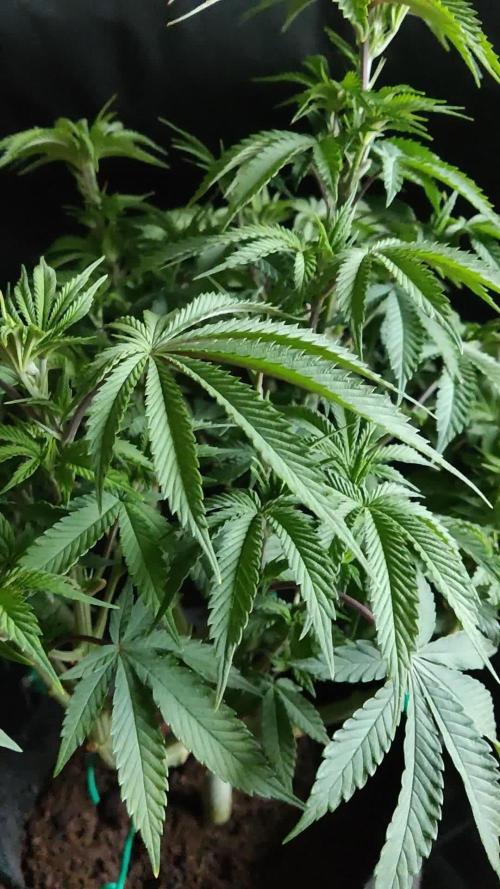
Settling in after transplanting loooking lush green and healthy maybe another two weeks of veg
Processing
Likes
38
Share
January 26, 2021 (Week 3, Day 22): Today ended up being an unexpectedly big day. This morning when I checked on the plants, they'd grown another 1.5" over the last 24 hours. They're basically growing out of control at this point. Every plant had a fully developed sixth node that was beginning to unfurl. So I decided to water the plants with 1000ml + 4ml pH Perfect Bloom + 4ml pH Perfect Grow + 1.5ml Cal-Mag Plus + 5 drops of pH down (6.5 pH solution). After that I took the plants out from the tent and began the topping process. I was pretty nervous about getting the snip in the right spot, but I think I've done it correctly. I topped each plant at the third node, then I cleaned all the growth below the node. After that I used rubber-coated garden wire to tie the growth sites to the fan leaves to promote lateral growth. Unknown 2 is definitely the runt of the group and my manipulation of the plant really pissed it off and it started to go kind of limp, so I decided to add a little extra support to the plant until it gets a bit hardier. I think it will take several days for it to recover from this process. The other plants however seem very strong and took the topping like a couple of champions. Gelato 1 and Unknown 1 seem to have great genetics and they haven't skipped a beat since germination. I decided to ditch Unknown 2's top but took clones of the other two plants. This process is flying by so far. Fingers crossed the plants continue to thrive even after my butchering. I've adjusted the humidity in the tent so were now averaging 65% rH and 77℉. Hopefully no other news today! January 27, 2021 (Week 3, Day 23): 24-hours post-top and all the plants have perked back up and I am already seeing growth from the two nodes I left on each plant. I added simple binder clips to the outside of my pot and redid the training on Unknown 2. Since topping, Unknown 2 went from pissed off to happier than ever. However, I have finally run into my first problem. The leaves on all three plants are starting to blotch. I touched one of the blotchy spots and it was crisp and began to crack. Soil is still moist from the watering yesterday. Other than irregular spots, I can't seem to find anything else wrong with the plants. I have a Vivosun pH meter which I've heard can be junk - so I am kind of suspecting my pH is too low. But I'm going to post up a grow question today to get a couple of other opinions. Plants still seem really healthy even with these blotchy patches on their leaves. Averaging 65% rH and 78℉. *Update: The damage on the leaves of the plants started to progress - so instead of waiting around watching my plants get crunchy, I decided to take action. I just flushed all three plants with 4 liters (1 gallon) each of filtered water pH'd to ~6.0. I am getting runoff of around ~6.5-6.6 which tells me the soil is too basic or alkaline. I had read this soil I am using is acidic, so I was feeding with a ~6.5pH solution. From now on I will feed with a ~6.0pH solution instead in an attempt to avoid these pH fluctuations. Before flushing with pH'd water, I tested the soil and all were sitting around ~7.1-7.2 pH. Obviously too high. Got tons of runoff by flushing. Here's to hoping we'll see a difference in leaf texture and color in the next 24-48 hours. This pH problem reared its head at an ugly time since I just decided to top the plants. I think I'll be sure to water with 10-20% runoff from now on so I can keep an eye on the pH regularly. January 28, 2021 (Week 3, Day 24): The last 24 hours were a little scary. As a new grower I wasn't really sure what to expect, and this was my first major challenge. All three plants are now scarred on the main fan leaves due to my inexperience. Gelato 1 looks like it took the worst of it. After flushing yesterday I noticed the progression of the leaf damage stopped almost immediately. Then the leaves began to fill in the crunchy green spots with bright orange around the edges with brown in the middle. It was really strange to watch. The leaves on all the plants are supple, they're just striped with ugly orange and brown scars. It also seems like even with the problems, the plants are continuing to thrive and grow at a surprising rate. Even with the fluctuation in pH and the flush I didn't see drooping from any of the plants. So they seem healthy despite their appearance. In fact, Unknown 1's fan leaves are so happy I've had to pin them down as I was getting too much vertical growth from the cola tips. I think I may have flushed at just the right time. I've never seen something progress on a plant so quickly before. The new growth on the plants seems perfectly healthy without any mottling or spotting. The second node of each growth tip on each plant is starting to unfurl already. All the stems are fattening up as well. It was the first night of 20/4 lighting schedule. Temperature dipped to 70℉ with the light off, but the humidity stayed constant. Average of 65% rH and 75℉. Hopefully we'll continue to see good progress with the new growth over the next several days. Once I top the second set of growth tips I'll most likely clip these ugly fan leaves so they'll stop taunting my inexperience every time I open my tent. 💀 January 29, 2021 (Week 3, Day 25): Seems like the plants are back to growing extremely fast. The scars are getting brighter and the brown parts in the middle have went from crispy to semi-supple. The new growth is bright green and even in color. I had to retrain every plant this morning to keep vertical growth from the growth sites tied against the fan leaf stem. I had to use a second set of ties to tie the second node down. So far my training seems to be working. All plants are working on their third nodes on both growth stems. I'll top once the fourth node begins to develop. The medium is still very moist from the flush two days ago. I don't anticipate having to water for two or three more days. I want the medium to dry out almost completely before I water again. I'll continue with light nutrients - but I'll make sure to run my pH down to 6.0 and I'll also be upping the feedings to 2.5-3l per plant to attain some testable runoff. My new Aperta pH meter showed up yesterday, so I hope to have more accurate readings going forward. Averaging 65% rH and 76℉. Nothing else for today. January 30, 2021 (Week 3, Day 26): Growth sites are stretching nicely along the fan leaf stem. Retrained in a few areas. Noticing slight blotching on Unknown 1's growth. Also seems very dark green with slight burn and dropping at the tips. Conducted soil slurry test and came back around ~6.8 pH. I am suspecting slight nitrogen excess. PPM was very high for this stage at around 1200. Next watering I will skip nutrients as I think the roots are beginning to expand through the pots extensively and may have access to too much nitrogen. Growth is still looking nice and fast. Plants are stretching a bit more with the 4 hours of darkness per night. Averaging 65% rH and 76℉. January 31, 2021 (Week 3, Day 27): The nodes on the main stem of every plant are beginning to swell considerably. Growth sites on all three plants are beginning to unfurl their third node. The nutrient burn on Unknown 1 isn't getting any better, but it also doesn't seem to be progressing. I'm hoping it's just a very slight excess, as it doesn't appear to be slowing down growth or causing any major issues. Gelato 1 and Unknown 2 are thriving and new growth looks perfect. I think the genetics on Unknown 1 may be a little more sensitive to nutrients. Unfortunately since I don't know what the plants are, it has made researching strain tips kind of difficult, so I've been treating every plant the same. The Gelato seems the healthiest of the three plants and is growing vigorously. Because of the training it's starting to look like a salad. I'll go for vertical growth after I perform the second topping. I don't plan on having these plants any taller than about 3 feet, so I anticipate having to switch to flower around week 6 or 7. If the growth keeps up, maybe even sooner. I retrained all the plants today and pinned down Unknown 1's fan leaves to encourage horizontal growth. The cola stems are getting huge and I was able to take off my first set of training braces. I also switched Unknown 1 and Unknown 2 in the tent to promote even growth. Medium is still moist from the flush several days ago. I'll water in a day or two. Averaging 65% rH and 75℉. February 1, 2021 (Week 3, Day 28): Medium was pretty dry this morning. Watered 6.0 pH 2 liters per plant with 2.5ml/l Cal-Mag + pH Down and without other nutrients. I think I'll hold off until flower to give nutrients to the plant again. I was getting very high PPM readouts during my flush, so I think the plants have plenty of food to get through the next three weeks. Just giving a small Cal-Mag supplement each feeding. Got about 10% runoff per plant. Runoff sitting around ~6.7-6.8 pH. Still pretty high, but I am hoping continually watering with a 6.0 pH solution will slowly lower the pH of the root-zone. Plants are growing quickly and I had to pin down the third node on each stem today. All of them are looking more like a salad every day. Fourth node is almost completely out - I'll wait for it to unfurl and top either tomorrow or the next day. Plants are looking good. Unknown 1 still looks to have a slight nitrogen toxicity, but doesn't seem to be affecting the plant's health much. Averaging 65% rH and 77℉ Nothing else to report. Looking forward to next week - the second and last topping will happen in the next few days. After the stems grow horizontally enough I'll switch to vertical growth. I'll aim for about 14" tall and then switch over to flower. Hoping that will be around week 6. Just picked up some awesome flowering powder I am excited to try in a few weeks. Plants are chugging right along! Happy growing everyone! 👽