Likes
Comments
Share
Likes
6
Share
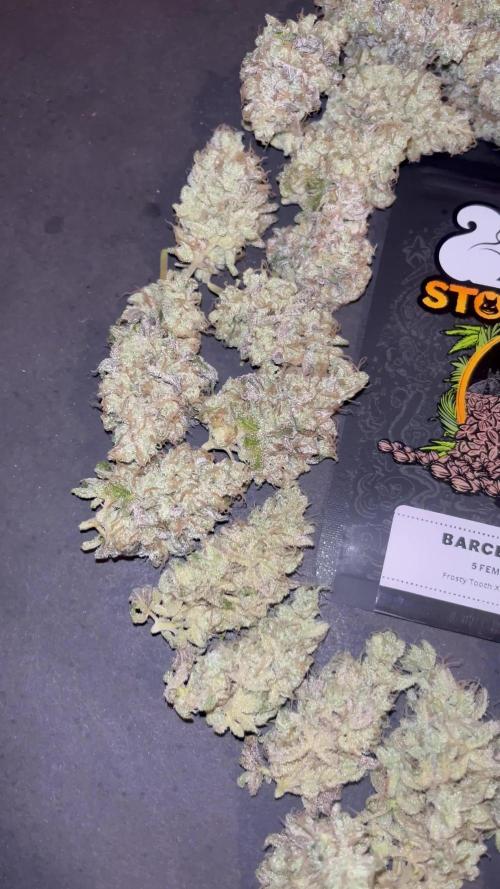
Vamos familia cosecha de Original de GrowBarato. La verdad que el secado muy bien 7 días en Malla y a los botes, 40% humedad y 24 grados es la temperatura ambiental que han tenido en el secado. Por lo demás de miedo os la recomiendo. Gracias Agrobeta y Mars hydro , sin ellos este proyecto no sería igual 🙏. Agrobeta: https://www.agrobeta.com/agrobetatiendaonline/36-abonos-canamo Mars hydro: Code discount: EL420 https://www.mars-hydro.com/ Buenos humos.
Likes
4
Share
La planta crece bien al lado de una "dance Hall" que acabo de transferir desde tierra. La maceta funciona muy bien, la planta crece de manera óptima, las raíces están bien blancas. Hago este test con una planta. Hago podas para aprovechar todo el espacio disponible. Es una planta que crece muy rápido.
Likes
15
Share
Die letzten 26h bevor die Ernte ist keine tripse mehr kein düngen nur noch flush mit 6.3 Leitungswasser sie werden in dryfembags getrocknet.
Likes
1
Share
Remember that, however you are played, or by whom, your soul is in your keeping alone. Even though those who presume to play you be kings or men of power, when you stand before God, you cannot say, 'But I was told by others to do thus,' or that virtue was not convenient at the time. This will not suffice. Remember that. Day:18 84°F and 65% RH (VPD) for the vegetative stage. Approximately 1.15kPa(assuming leaf temperature is about 2°F cooler than the air), which falls right into the ideal vegetative sweet spot (0.8kPa to 1.2kPa). At 1.15kPa, plants can draw water and nutrients efficiently without risking stress or wilting. It keeps the leaf pores (stomata) open, allowing for ideal carbon dioxide intake and maximizing vegetative growth. VPD is determined by the leaf's temperature, not just the ambient air. Because leaves usually run 1° to 3°F cooler than room air under bright grow lights, my actual VPD will be slightly lower, closer to the 1.0kPa mark. As she transitions from vegetative growth to flowering, one can gradually lower the humidity (to around 45–60%) and drop temperatures slightly to prevent disease from settling inside dense buds when they appear. Night:6 At 70°F and 60% relative humidity, Vapor Pressure Deficit (VPD) is 0.86 kPa. This is right on the cusp of whats optimal for the vegetative stage. During the nighttime, plants generally close their stomata and undergo cellular respiration rather than photosynthesis. Transpiration slows to a near stop, making VPD less critical at night than during the day. However, maintaining a nighttime VPD between 0.8 and 1.0 kPa is highly beneficial in that it ensures the air is dry enough to prevent powdery mildew or bud rot, but moist enough to keep the plant from undergoing unnecessary stress. This range keeps the environment comfortable for cellular processes and prevents large atmospheric swings. Keeping it all flowing. (Not pushing them yet, these are photoperiods) The optimal soil (root zone) temperature for cellular root respiration and nutrient uptake in cannabis is between 68F & 72F This narrow range balances biological energy production (cellular respiration) with the dissolved oxygen levels in the soil, maximizing plant growth and health. Warmer soils hold significantly less dissolved oxygen. When soil temperature exceeds 74F oxygen depletion occurs, inhibiting cellular respiration almost entirely, At 68-72F root cells generate optimal adenosine triphosphate (ATP) via respiration to power root-tip elongation and the active transport of water and nutrients. Too Hot (Above 78F) Root respiration increases, demanding more oxygen, while the water's oxygen-carrying capacity drops. This creates a prime environment for anaerobic pathogens and Pythium (root rot). Too Cold (Below 60F) Root metabolism and cellular respiration slow to a crawl. This severely impairs nutrient and water absorption, leading to yellowing, wilting, and phosphorus deficiencies. A lot depends on whether it's automatic or photoperiod; with photoperiod, there is not as much of a need to push "hard" as the real countdown only begins once the flower is initiated. Automatics, on the other hand, the chronological "clock" begins ticking the moment the seed germinates. It is of critical importance that the seedling growth gets off to the races, understanding that early growth is like compound interest, which will pay off come harvest. This reality is why getting autoflowers "off to the races" early on yields such exponential benefits. The "compound interest" is directly related to the surface area of the leaves. Larger, faster-growing seedlings process more light and build bigger root networks early on, which translates into an explosion of vertical and lateral growth during their short vegetative window. The margins for error are so thin with autoflowers; this early-stage momentum depends on several critical practices. Seedlings exposed to increased atmospheric CO2 levels early in life will develop at an increased rate. To effectively "extend" or optimize the capacity of Photosystem II (PSII) for increased photosynthetic efficiency. In standard oxygenic photosynthesis, Photosystem II (PSII) is naturally limited to the red-light spectrum, peaking at 680nm. Extending its light-harvesting capacity past 700nm into the far-red region requires bypassing the natural limits of standard chlorophyll a. Adding 730 nm (far-red) LEDs alongside standard red/blue lights has been shown to increase canopy photosynthesis by 20–30% in several crops by acting synergistically with shorter wavelengths. However, the limitation is that excessive, pure IR/Far-red light (without accompanying red light) can trigger the "shade avoidance response," causing plants to grow tall, weak, and spindly rather than robust. Utilizing infrared light (specifically the 700-750 nm far-red range) is a viable method to boost photosynthetic efficiency. It acts as a bridge to allow PSII to utilize a broader spectrum of light, breaking the traditional 700 nm barrier. UVR8-mediated signaling (often in conjunction with CRY proteins) triggers protective mechanisms that maintain the stability of the photosynthetic apparatus (including LHCII and reaction center proteins), thus ensuring that the efficiency of Photosystem II remains higher in UV-B-exposed plants compared to plants lacking this receptor. ΦPSII indictates the rate of electron transfer from water to plastoquinone, which drives the production of ATP and NADPH. There is a close link between ΦPSII and the true rate of CO2 fixation (Φ*co2). ETR stands for Electron Transport Rate. It measures the speed at which electrons are moved through the thylakoid membranes in a plant's chloroplasts during the light-dependent reactions of photosynthesis. Infrared light (particularly Near-Infrared or NIR) improves cellular energy by interacting directly with the electron transport chain (ETC) in mitochondria. This process boosts adenosine triphosphate production, which acts as a metabolic coefficient multiplier by accelerating enzyme activity dramatically. Extend then multiply. Far-Red photons interact with plant photoreceptors to accelerate the plant’s biological "clock" or trigger a shade-avoidance response. Autoflowers don't use the plant's biological clock, although the IR will initiate a shade avoidance and make them stretchy. You can just add equal measures of 660nm-680nm to negate the shade avoidance effect. Replacing nights' "darkness" with a combination of IR+ and 660nm. Because autoflowers don't require a dark period to flower, many growers just blast them with light. 18/6 24/0. However, this ignores the plant's metabolic rhythms, where daytime photosynthesis (light reactions) must be perfectly balanced with nighttime carbon fixation and assimilation (Calvin cycle) to avoid bottlenecking plant development. Cellular respiration is a 24/7 process, but it can only function while the plant has the free oxidative capacity to do so. A 100% photosynthetically active leaf cannot perform cellular respiration. The viral trend of defoliation of every leaf that isn't "getting enough light" is of great detriment overall, putting 100% of the cellular respiratory "workload" and responsibility on the 0/4/6 hours of darkness in sub-optimal conditions for enzymatic activity. Photosynthesis captures nearly 100% of the initial energy as carbon, while cellular respiration is the process that unlocks 90% of that captured energy into usable ATP so the plant can use it. Respiration is considered roughly 30% to 40% efficient. It captures enough of the potential energy in glucose to synthesize around 30 to 38 ATP molecules per glucose molecule. The remaining 60% to 70% of the energy in the sugar is not captured in ATP; instead, it naturally escapes into the environment as heat, which helps regulate plant temperature. In plants, the primary enzymes of the Electron Transport Chain (ETC) and the ATP synthase complexes are typically adapted to function optimally in warmer temperatures (roughly 25°C to 35°C depending on the specific plant strain). As temperatures rise within this physiological range, molecular collisions increase, speeding up respiration and ATP production. The cannabis plant has a branched respiratory pathway. During heat or cold stress, plants activate Alternative Oxidase (AOX). AOX burns sugars to dissipate energy as heat rather than coupling it to ATP production. This pathway actually functions optimally at elevated temperatures to help protect the cell from the damaging build-up of Reactive Oxygen Species (ROS) during heat stress. Enzyme activity generally scales with heat; there is a strict biological limit. If canopy temperatures in a grow room exceed 40°C, the enzymes and their supporting lipid membranes lose stability. Not saying you need to go crazy, just optimize nights the same as we optimize days. Phosphorus is the driving force behind early seedling development. It acts as the "energy hub" of the plant, directly driving cell division, robust root growth, and the creation of DNA. Without an adequate, easily accessible supply early on, the plant's overall growth potential and final yield can suffer permanently. E=MC2 looks like a simple multiplication problem; it describes a fundamental physical truth: mass and energy are the same thing. The equation doesn't just calculate a value; it reveals that mass is effectively "congealed" energy. Energy is just numbers. Energy isn't a physical "substance" you can hold or touch. It is essentially an abstract, calculated number that we assign to a system to predict how it will change, interact, or move. A numerical label we attach to matter to track how it behaves. Because the universe runs on laws of symmetry (specifically, that the laws of physics don't change over time), a single global number must be conserved. We call that number "energy". We don't grow; we facilitate energy conversion. How well a seedling grows is essentially down to how much knowledge one can acquire to increase the level of conversion to occur. Applying knowledge effectively requires intuition, which comes from hands-on experience. A seasoned stoner learns to read subtle signs—like a slight change in leaf turgor (stiffness), subtle color shifts, or the specific texture of the soil—before a textbook diagnosis can be made. Ultimately, growing is the application of botanical science blended with active observation. Knowledge dictates your potential, but adaptability and attentiveness to the plant's immediate environment determine your results. 1.618 nature mathematically optimizes quantum energy transfer and light absorption efficiency within the photosynthetic machinery, as it naturally dictates energy scaling hierarchies and resonance dynamics. External vibration or electromagnetic wave that perfectly matches a plant's natural frequency directly influences plant growth. Low-frequency sound waves and targeted electromagnetic fields stimulate cellular processes and boost photosynthetic efficiency Does it produce better yields? How long is a piece of string? As long as you cut it. But isssss the juice worth the squeeze? The quantum framework of the IVM seems to think so. Good enough for the quantum firmware, good enough for the DNA software. Genetics are not dictated; they are expressed; the rate of that expression is dictated by the environment in which growth occurs. Quantum Coherence in Photosynthesis occurs When a photon of sunlight strikes a leaf, the energy it carries must travel to a reaction center to be converted into chemical energy. This process operates at nearly 100% efficiency. If the energy moved in a traditional "bunching" or random hopping manner, a large portion of it would be lost as heat. Instead, plants utilize quantum superposition. The energy particle (exciton) doesn't just take one path; it exists in a wave state and explores multiple pathways simultaneously. It essentially "chooses" the most efficient route to the reaction center simultaneously. Research shows that molecular vibrations and the specific network arrangements of chlorophyll molecules (like the naturally evolved Chlorophyll A & B ratios) actively protect against energy overflow, optimizing light capture across different light intensities. Enzymes are the biological catalysts that speed up chemical reactions within a plant's cells, allowing them to grow, metabolize, and repair. Rather than relying solely on the classical kinetic energy of molecules colliding, plants use quantum tunneling. Subatomic particles like electrons and protons (hydrogen ions) can literally "teleport" through energy barriers that they normally wouldn’t have the energy to climb over. This makes vital metabolic reactions happen far faster than classical physics could ever explain. Chloryphyll b has peak absorption at 460nm (Blue) and at 647nm(Red). If we take the blue peak wavelength 460nm and a UV-B, UVR8 peak absorption wavelength 285nm, Tryptophan-285 (W285) Sensing protein. 460/285=1.618 Φ If we take chlorypyhll b's Red absorption peak 647nm and a UV-A of 400nm, we get 647/400=1.618 Φ. "Structure of light". The cryptochrome photoreceptor (CRY) is a UV-A/blue light receptor that shares this dual sensitivity with several other biological structures and functions, including significant sequence similarity and a common evolutionary ancestor with DNA photolyase enzymes. These are light-activated enzymes that use blue/UV-A light to repair DNA damage caused by UV-B radiation in plants. Synergistic. But Shhh, it's a secret. Effective quantum efficiency of photosystem II, often denoted as ΦPSII, represents the proportion of light absorbed by Photosystem II (ΦPSII) that is actually used in photosynthetic electron transport. It is a key indicator of how efficiently a plant is using light for photosynthesis, as opposed to losing it as heat or fluorescence. ΦPSII (effective quantum yield of photosystem II) functions primarily as a "multiplier" (a coefficient of efficiency) rather than an additive factor when estimating the overall photosynthetic electron transport rate (ETR). Multipliers are considered far more beneficial than additions because they generate exponential growth, leverage existing resources to their full potential, and create sustainable, self-multiplying capacity, rather than just incremental, linear increases. This fascinating observation is rooted in the intersection of subatomic geometry, fractal scaling, and quantum dynamics. In specific molecular arrangements—such as in conjugated polymer networks or biomolecular architectures—the Golden Ratio (PHI) naturally dictates energy scaling hierarchies and resonance dynamics. Mathematically tied to the fine-structure constant, which defines the strength of the electromagnetic interaction. The Golden Ratio can be mapped geometrically as the Golden Angle (137.5 degrees) in atomic structures, linking the charge of the electron to fundamental quantum constants like Planck's constant. Electromagnetic. The Golden Angle (137.5): This angle is derived from the Golden Ratio (1.618). It is the smaller of two angles created when a circle is divided such that the ratio of the arcs equals the Golden Ratio.
Processing
Likes
9
Share
7/6: Heavy thunderstorms last night and half the day today, so they won't be ready to eat again for a few days. I went out to the site about an hour after it quit raining today and saw HUNDREDS of tiny little green grasshoppers feasting on my girls!!! I immediately sprayed them all down with pyrethrins, and did it again right before dark. I've got the fan blowing across the pots to try to dry them out faster. I started using TPS One (one part nute solution) the other day, and the plants seem to love it. Really growing well, but I'm glad I amended their soil with some happy frog fruit and flower granular fertilizer this time. They get fed whether it's too wet or not. 7/7: More grasshoppers this morning..I sprayed with pyrethrins. Very cloudy day...glad I've got 470w of supplemental light above them all day/every day (and another 200w in reserve)😎
Likes
38
Share
I have bad news friends. A grief happened. After I updated my diary a few days ago, there was a hurricane on the street and there was a strong ice hail. The size of the ice balls reached several centimeters. That is why I am forced to do diary updates ahead of time. As you could already imagine after an ice hail that lasted 10-15 minutes. Because of this, the plants are very much affected. From the beginning, it became very dark on the street, as if night had begun during the day, after which there was thunder and thunderstorm and freezing rain began. I immediately began to worry about my plants, but I couldn’t get to them. Hurricane and hail began as suddenly as it ended. When I came to the place today, firstly I saw that the whole reed fell to the ground, so my secret passage to the secret place became open, and my buckets became visible from far, through the fallen reed. Most likely I will be forced to move the plants even further into the depths of the swamp, but now I can’t do it, because it has flooded a little, but my plants are on an island. I know that the reed will recover and rise when the weather is sunny. The second problem was when I saw the plants after the ice hail, it is that they were very badly damaged. Two plants managed to survive the ice hail with minimal losses, they lost only a few leaves. The third plant was interrupted by a central one on the crown. And the fourth plant suffered the most. His central stem was interrupted, and almost all lateral processes and leaves were broken, and only 3 branches remained on it. Broken parts of the plant lay below. This is very sad, since I wanted to try these plants most of all. Unfortunately, I could not do anything against the weather and the sudden ice hail. You won’t argue against the Russian weather. With grief, I drank vodka. I am extremely sad because of this at heart. Where they grow, the sun is not too much for the plants to completely recover. Part of their potential will be lost forever. They will survive, but they will not be able to give a full crop in the areaBut despite this, I will continue to keep this diary, as part of the plants remained alive and safely survived the ice hail. From the very beginning, after the ice hail passed, I thought that the plants would be completely dead, since it was almost impossible to survive under such a hail, even people ran away from the street. The fact that several plants remained unscathed, and two though they suffered damage, but everything grows evenly, is a real miracle. The city was very strong and big. Therefore, with your support and my love, I hope that they will show what these plants are capable of under the given conditions. If you are interested in following the adventures of weed in Russia, subscribe to my diaries and leave your comments. ------------------------------------------------------------------------------------------------------------------------------------------------------ У меня плохие новости друзья. Произошло горе. После того как я обновил несколько дней назад свой дневник на улице произошел ураган и был сильный ледяной град. Размеры ледяных шариков достигали нескольких сантиметров. Именно поэтому я вынужден сделать обновления дневника раньше времени. Как вы уже могли себе представить после ледяного града который продолжался 10-15 минут. Из-за этого растения очень сильно пострадали. С начало на улице очень сильно стемнело, как будто днём началась ночь, после чего был гром и гроза и начался ледяной дождь. Я сразу начал переживать за свои растения, но никак не мог к ним попасть. Ураган и град начался так же внезапно, как и закончился. Когда я пришёл сегодня на место, во первых я увидел что весь тростник повалило на землю, поэтому мой тайный проход в секретное место стал открытым, а мои ведра стало видно из далека, сквозь поваленный камыш. Вероятней всего я буду вынужден перенести растения ещё дальше в глубь болота, но сейчас я не могу это сделать, так как его немного затопило, но мои растения находиться на островке. Я знаю, что тростник восстановиться и поднимется когда будет солнечная погода. Второй проблемой было когда я увидел растения после ледяного града, это то, что они очень сильно пострадали. Двум растениям удалось пережить ледяной град с минимальными потерями, они лишились всего лишь нескольких листиков. У третьего растения была перебит центральным на макушке. А четвёртое растение пострадало сильнее всех. У него был перебит центральный стебель, а так же сломаны практически все боковые отростки и листья, на нём осталось всего лишь 3 веточки. Отломанные части растения лежали внизу. Это очень печально, так как именно эти растения я хотел попробовать больше всего. К сожалению, против погоды и внезапного ледяного града я не смог ничего сделать. Против Русской погоды спорить не станешь. С горя я напился водки. Мне крайне печально из-за этого на душе. Там где они растут, солнца не слишком много чтоб растения успели полностью восстановиться. Часть их потенциала будет потеряна безвозвратно. Они выживут, но уже не смогут дать полноценный урожай в данной местности. Но несмотря на это, я буду продолжать вести данный дневник, так как часть растений осталась жива и благополучно пережила ледяной град. С самого начала, после того как прошёл ледяной град, я думал, что растения будут полностью мертва, так как выжить под таким градом было практически невозможно, даже люди убегали с улицы. То, что несколько растений остались невредимыми, а два хоть и понесли урон, но всё ровно растут - это реальное чудо. Град был очень сильны и большой. Поэтому с вашей поддержкой и моей любовью, я надеюсь что они покажут, то на что эти растения способны в данных условиях. Если вам интересно следить на приключениями травки в России, подписывайтесь на мои дневники и оставляйте свои комментарии.
Processing
Likes
5
Share
@HERBBEANZ
Follow
Okay so I came up with this incredible method of training that I call "root lining".I figured this out years ago in outdoor season when a deer bulldozed through my med crop and knocked a sweet lady over, that started it all. The plant was completely parallel to the ground with roots growing out of the nodes where contact was made with the ground at the stock. Long story short she ended up being a 14 footer with 6 foot whale dicks! That gave me this little idea that's been non stop producing top quality fat resinous buds. This method increases nutrient uptake and makes a huge difference in quality and size. I essentially main line, really low to the ground, until the stock makes full contact with the ground. I then gently rub the downside of the stock with the back of a butter knife to speed things up and break down the chlorophyll layer. Then I add remo roots gel (see all videos). I then add a sprinkle of coco on top just to barely cover the stock (dont add to thick of a layer as this might "choke" and rot the stock) and mist that spot 2-3 times a day. 3 days later and boom! She'll be pumping out roots and go into full beast mode. Give it a try and you'll never go back!
Processing
Likes
225
Share
Found this bad ass GG#4 from Canuk Seeds . Let the fun begin ! This is an all new experience for me . I've learned lots from watching some of the people on this site and now its time to put my knowledge to the test ! I hope these ladies turn out lovely !!!
Likes
4
Share
5.20.25. 3rd week of flower! Plant is starting to fill in nice after rough start and being stressed out! Putting on nice new healthy growth! Watering everyday about 3/4 gallon! Thanks for checking out !
Likes
17
Share
Welcome back growfessors to another episode of growfessor theatre! 👽🌳💚 Week 8F begins for the ladies of the 4x8, last round of feeding before the flush. LSD has gone crazy over the last week, insane bulk-up in her buds, from top to bottom, in by the stock and out to the tips, she's just bulky, dense, sticky, frosty and incredible! By far, the best looking results from any of my LSD grows. Green Crack also looks incredible and the rest of the ladies, while doing awesome, will be their final grow in my garden. Thanks for stopping by growfessors, tune in next week for another episode! 👽🌳💚
Likes
4
Share
I’m back!! And sorry I’m using my videos I posted on YouTube..😞😞 I will make sure not to in my posts to come!! Popped seeds Jun 27 Temps inside some at 80 degrees F Humidity is at 75-80% 8 seeds planted and all 8 made it!
Likes
4
Share
@Finsfan
Follow
Finally in full flower mode. Ready to start putting on some serious size. I turned the lights up to 80% a couple days ago and they both are taking it well. No light burn yet that I notice. I'm not sure if I should start bringing the lights closer at 80% or keep the distance but instead Increase power to 90%. Going to feel it out as we go. Happy so far for sure. Update: increased light to 100% . No lead burns or weird looking leaves yet.. Just bulking up and very thirsty! Doing a nutrient/nutrient/water feeding schedule now.
Likes
Comments
Share
@gr3g4l
Follow
Inicio de semana tranquila. Final de semana tocaria poda de bajos y de chupópteros pero se dejó para el siguiente dia, dia 22 . Da gusto cultivar semillas bien estabilizadas, que todas parezcan sacadas de un mismo patron como si fueran estas esquejes de una misma madre. Me encanta xd. Por ahora un crecimiento muy parejo, veremos si seguiran igual de parejas a partir de la poda de hojas y chupópteros que hay que hacerles.
Likes
1
Share
Holky jsou na začátku 7 týdne květu. Začínají silně vonět a palice jsou krásně pocukrované . Trichomi většina ještě průhledná.
Likes
1
Share
Likes
28
Share
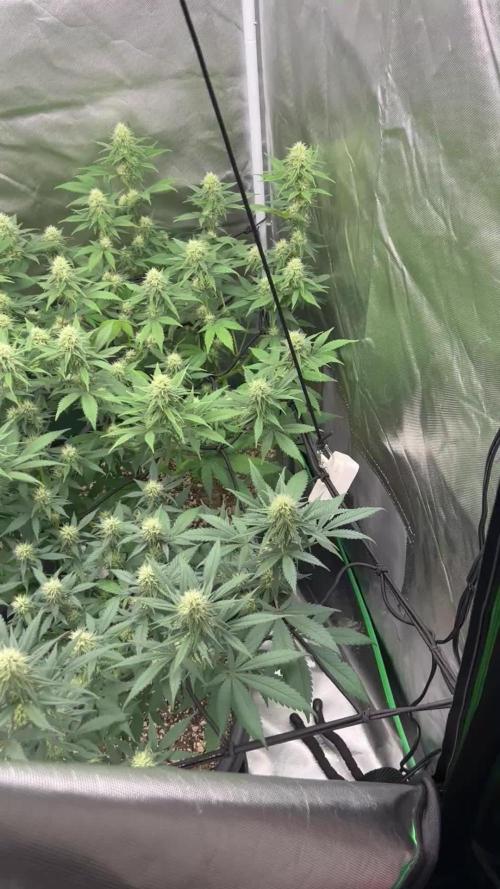
What's up Growmies🤟🏽. Week # 8 is in the books🙌🏾 Hello week #9💪🏾 I went a little overboard on pictures this week, they are so happy and healthy that I got carried away. I know we are supposed to post pictures with the lights off, however it's something about the contrast it gives with the lights on that makes it look sexy to me😁. I have had to tie the stalks of both White LSD plants due to heavy sagging. I'm noticing with this strain the stalks seem to topple over even though the buds are far from fully developed. A trellis net probably would be ideal however I hate them. They are easy to put on but very difficult to take off come harvest. I use garden wire and string them as if they are puppets being controlled by the puppet master🤪. I continue my feeding schedule with the recommended "bloom" concoction using general hydroponics Flora series trio. I give them 1 liter every 3 days. I have them on a 2 to 2 cycle (feed them twice with nutes and then twice with plan water) I keep the p.h. around 6.1 to 6.6. Temps and humidity are in the perfect range I'm enjoying it while it last because spring and summer in VA makes it difficult to keep the humidity in check. All in all everything is going well for me and my ladies. I hope the same for all of you. Until next week my friends Happy Growing 🤟🏽 and may the grow goddesses bless you all with a bountiful harvest 💪🏾