




Likes
12
Share


@GanjaFarmer101
Follow
Into week 8 - I think I've managed to time these well... yes, they've had 40C+ temps - but only in the really final weeks and I bunched them towards the wall so they got more shade and less of the infernal sunshine. Sometimes you can have too much of a good thing... the heat is good but it sends them crazy and stunts their growth really badly.
Feed schedule is mostly the same except in the last 10 days I've skipped the feed on 2 nights because I wanted to make sure they've extracted all they can from the soil/water/nutrients. It's also a bit of an experiment to see if it pushed the calyxes to swell a (little) bit more?
I've got some photos running alongside these and I might make a diary for them as well.
The very last plant in the video above is the Sweet Seeds "Gorilla Girl XL" - amazing colours that the camera can't pick up properly. My pick of the bunch aesthetically, she exploded beautifully.
The very first plant is the Barney's "Gorilla Glue" auto - this and one of the "Sweet Mimosa XL's" seem to be a week slower than the others. Still a lot more furry than finished :)


Likes
3
Share

@NyBushDr
Follow
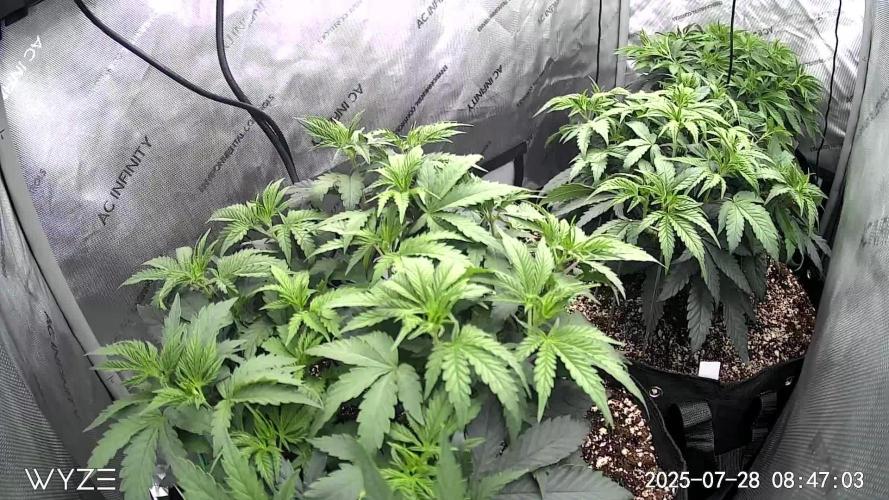
Sorry on vacation so a couple of pics from the cam and a time lapse is all I can give you! See you for a detailed update next week as we get close to flip :)
Likes
15
Share


@tribe4tix
Follow
flowering day 59/"FD59" (flowering week #9 since 12/12): ... the final 1-2 weeks with only water/no feeding :)
flowering day 60/"FD60" (flowering week #9 since 12/12): i just uploaded a video 😎
flowering day 61/"FD61" (flowering week #9 since 12/12): early today i spotted four banans/nanners (first row right) und two banans/nanners (first row left) in the 80x80 240W tent on two plants in the (closest to the camera) first row. Cause they are nearly finished i decided to crop these 2 plants.
They look really beautiful and purpled very much., I think the reason for the purple is that that they where the closest plants for the fresh air within the airflow and it was sometimes a little bit cold.
I am a little bit frustrated cause the quantity could be 50% more but this time i am pretty sure that the LED panel was too close and/or too much power (95% powered 2x 120W panels). Next time i will use a new tent and plan to spend more time for the hole air and carbon filter setup. This time i had not enough space to raise the panel higher... Maybe the spide mites attack in the early flowering stage was also a factor.
flowering day 65/"FD65" (flowering week #9 since 12/12): just a few shots before the final crop in ~1-4 days 😎
Summary for the next grow:
1. next time i will raise the LED-panels distance higher and reduce the power to 80% in the late flower
2. buying a better 80x80 tent
3. i will use poison in the last days of the vegetative phase again to be 100% sure that mites&thrips have no chance
4. four plants in 11L pots are enough in the 80x80., Otherwise it is hard to keep care of the plants in the last row. This will make the veg-phase longer (training) but i think the better airflow and more space are really better
5. next time i will use a scrog-net again... handling to stabilize the buds every day is too much work 😂

Likes
4
Share


@Phatlad187
Follow
Week 2 of flower plants are growing perfect with no problems small buds starting to form struggled with heat abit but they still going strong nice and green one of them at streched more than others
@growerchoice @SHOGUN COCO A 4ml/L
160ml
@SHOGUN COCO B 4ml/L. 160ml
@SHOGUN ACTIVE BOOST 2ml/L. 40ml
@SHOGUN CAL MAG 1ml/L 20ml
@SHOGUN ZENZYM 2.5ml/L. 100ml
@SHOGUN KATANA ROOTS 0.2ML/ 8ML


Likes
115
Share

@squalino
Follow
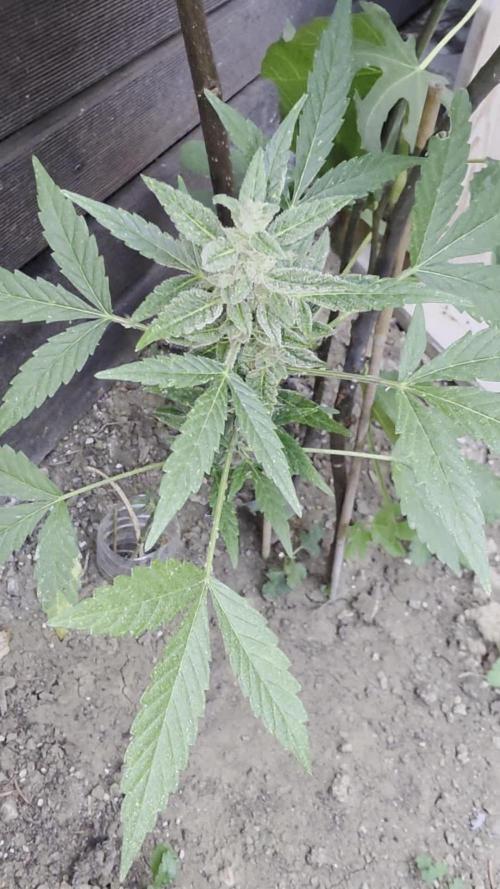
Frostbanger est toujours présente, même si, soyons honnêtes, elle ne ressemble à rien ! 🤣🤣
❤️❤️❤️❤️❤️❤️❤️❤️❤️❤️❤️❤️❤️❤️❤️❤️❤️❤️❤️❤️❤️
Elle aura vraiment tout vécu et a survécu héroïquement au mauvais temps. Malgré sa petite taille et même si la récolte s'annonce particulièrement infime 🤣🤣, son glaçage en trichomes est tout simplement surprenant ! ❤️❤️❤️❤️❤️❤️❤️❤️❤️❤️❤️❤️❤️❤️❤️❤️❤️❤️❤️❤️❤️❤️
De plus, lorsqu'on la touche, elle dégage une odeur incroyable de citron.❤️❤️❤️❤️❤️❤️❤️❤️❤️❤️❤️❤️❤️❤️❤️❤️❤️❤️❤️❤️❤️❤️❤️❤️❤️❤️❤️
Un grand merci à tout le monde d'avoir suivi sa miséricordieuse vie et ses aventures rocambolesques depuis le début !
Je vous souhaite à tous de superbes cultures ! ❤️☺️

Likes
4
Share


@Ninjabuds
Follow
It’s been hot out. A perfect time to dry buds. I love when it’s super hot or super cold when it’s time to dry buds. When it’s hot the ac makes the humidity nice and low and when it’s really cold out the heater makes the humidity nice and low

Processing
Likes
22
Share


@CenturionGrower
Follow
26/07/20 (Sunday)
Plants were starting to exhibit signs of light burn so I switched back to the 75W bulb. SVG never seemed to recover from having it's cotyledon damaged so I decided to take a risk and fed all of the seedlings 20-20-20 nutrients except the D.R. which I thought would've suffered shock, so I just watered it.
27/07/20
Decided to mist the plants with a homemade pesticide mix today because they're readying to be introduced as full time outdoor plants in a week or two so their sun basks are getting longer.
28/07/20
Noticed what looks like new growth from the first true leaves of the SVG, fingers crossed it's making progress.
29/07/20
The new growth from the SVG has split into two on both sides leading me to theorize that it's abandoned it's main stem (for now at least) and started two new stems. All other plants are working on new nodes and are showing a steady growth of .5cm a day. I've decided to revert to the 100W bulb because I believe I've misdiagnosed the light burn.
30/07/20
Today I left them outside for their longest sunbask to this point; 7 of their 18 total hours was provided by sunlight. The SVG now has two new 3-leaf true leaves on each new stem confirming my theory. Also starting to see signs of a minor mite problem on one of the leaves of my TT plant (Though it's new growth that wasn't sprayed with my homemade concoction.)
31/07/20
New growth has already begun sprouting from between the new true leaves of the SVG with no visible progress on the 'abandoned' main stem. Also had a power outage for 2 of the plants 18 hours.
01/08/20
Today the plants again stayed out in the sun for longer than previously making 8 hours in direct sunlight. I've decided to keep them in the grow tent for a further week because when I went to retrieve them the Jam was blown down flat by winds and had started to grow bent towards the light, so I doubt it's stem is ready for that daily beating. I raised the soil level and massaged it back into shape and it seems to be back on track. The D.R. is slowly beginning to bounce back from being stunted in the seedling tray and from it's third node (from the bottom up) of 3 leaf true leaves has turned into 5 leaf leaves. The SVG has made a major recovery and seems to be on it's way to even surpassing the others by the end of the week. The TT is officially the sturdiest of the younger seedlings and it's growing right behind the Jam in terms of node development. All in all this week was an overall success growth wise and I'm looking forward even more to week 3.
Likes
18
Share

@BennyBud2210
Follow
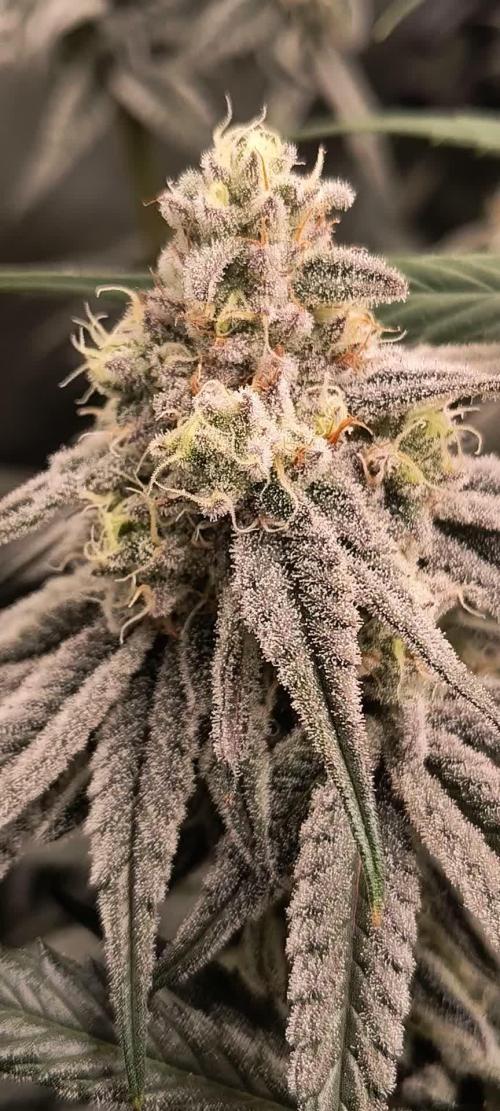
Alles entwickelt sich so wie es soll?🍀🔥
Trauermücken sind nicht mehr sichtbar.
Immer noch ohne Dünger oder Booster unterwegs.
Das einzige was in das Leitungswasser kommt ist Biobizz CalMag und Biobizz PH- ...
Ich denke die Super Lemon Haze wird in den nächsten Tagen eine Düngung mit einem Bloom Dünger bekommen.



Likes
66
Share


@UnorthadoxDude
Follow
I've dropped to weekly updates on Bertha as a stunted plant she doesn't hold much interest for me, she is only alive because I am not desperate for the space.
Here she is on day 49 end of week 7. I will take multiple photos and a video once a week until she is chopped.
Processing
Likes
34
Share


Likes
1
Share


@MrPerlite89
Follow
Very satisfied with this week girls looking strong and healthy going into Bloom also ethos genetics get back at me I need to know if you ever had a problem with one of your seeds just won’t to know no fussing it’s all lov


Likes
50
Share


@CapitanKush
Follow
been a slow week i think. had a problem with my power going out for 8-9 hours sunday (rcd tripped)
before i opened the tent to 98% rh and water covering the leaves but turned all my fans up and it dried quick so all is good now
UPDATE: done some defoliation to get more light through, lets see how that goes


Likes
31
Share


@BruWeed
Follow
La Etapa de Enraizamiento la desarrollo perfectamente igual que en crecimiento y en Floración, de 10 todo. Pensé que iba hacer difícil de cultivar ya que no es fácil esta genética.
Recomiendo como ya dije al banco de semillas BSF y a Top Crop por los buenos productos!
El 26/07 corte la planta para ya iniciar su etapa en secado, vamos a ir viendo como va surgiendo.

Likes
55
Share


@Ganjagrandaddy
Follow
Day 28 Flowering: Good afternoon growmies. I hope we are all well and sane while this world silliness plays out.
Here we are at the fun side of growing again. The stretch is well finished and they are now beginning to stack the colas on their long stems.
Six-shooter has remained fairly small and is not a very attractive looking girl at all. lol A bit like the spotty teen about to emerge the butterfly I am hoping !.. She is a really odd looking girl with a scruffy appearance even after a little defol. She looked underwatered in veg a few times too but was not the case. She has a really sticky build up of resin already and smells quite strong of urine.lol I think she will be a late bloomer but not dissapointing.
Strawberry Pie is looking huge and lanky now her stretch has done. Her node lengths are a little wider than I had hoped but I get the impression she will still join them up for some very long colas. Her trich build up has started already and is very productive too. Sticky fingers that smell of sweet fruity candy at the moment. She is around a foot tall with lots of room to swell and get air around her frame too.
Mexican Airline is the star of the bunch right now, she is huge already. Her bud stacking is really beginning to take form and with the size and amount of them, she will be a great yielder. She has filled her space nicely now and will benefit once I harvest some other the other plants i have running. The potential for the two bigger ladies to gain plenty of size is certainly there and without me doing the l.s.t early on in veg , I think they would be very tall plants . The attempt i made to try to tie the 5th node up while the others caught up was beaten by her determination to keep growing it and even after I totally bent and created a knuckle to again try to hold her down , she powered herself through and carried on with her plans for the flowering cycle.... It did help to create a nice crown of Buds though which should fill our rje whole structure of her.
Feeding every 2 days and showing no issues to worry about besides a slight tip burn which is down to the pk warrior strength. A decrease in dilution will sort this quickly.
The Fungus gnats are now under total control , by this I don't meant have started training them to do aerial displays like the "Red Arrows" or fly patrols of the grow room but that they are no longer an issue. Still the odd one of two to keep mindful of but the sticky traps are a help too.
So there we have it for this update. All going well and the harvest date is not so far away now.. Be well and safe.
Likes
10
Share


@theplantdaddy
Follow
Super citrusy, high yeild compared to the other strains. Was mostly responsible for filling out the space. I'd give it a 7 out of 10 in terms of smoke cause it was nothing special but definitely potent stuff. Just not for me tho

Likes
26
Share


@Rooflower
Follow
Week 8
D1
First day NO NUTES day for my garden .
They got a bit more than a liter of water each with a bit more run off than usual..
That’s it . I personally don’t over acting with flushing liters of water through my medium . Just a bit more plain pHed water than normal . 💦
Buds are getting weight and already thinking how I could support some of them if needed during those two last weeks.
Buds are super dense in both phenotypes .
Pheno 1 , the more stretchy one, turns yellow-deep purplish 😅 color on the leaves and on some calyxes . 🔥🍁
Pheno 2 , I really can’t say anything about it , I’m amazed with the structure of the plant and of those dense AF and thick heavy Buds ...ITS THE ONE I GERMINATED LAST ONE ☝️
her monstercroped clones still in rooting dome and wish I see some roots soon , I really want this Pheno alive ✌️✌️
D4
Plants swelling nicely and they full of trichomes
Couldn’t resist touching them a bit to feel the density , rock hard and sticky AF 👌
Small video update from my garden tonight , take a look at that frost guys , can’t wait to smoke those beauties 🌺🖤
D5
Got some Macro shots again with that phone lens , good enough to notice some of the trichomes colors .
Getting amber , mostly cloudy but still some new clear ones 👌
Seems like there gonna be ready till the end of next week , W9