


Likes
Comments
Share


@Med_in_Tropic
Follow
Granddaddy plant in week 6 of flowering. She is in full bloom.
Bugs Issue:
There are some old caterpillar holes on leaves but I think bugs situation improved. The smell from plant dropped last week after first round of insecticide spray. Smell is like plant crying out in pain after being attack by bugs.
I sprayed spinetoram one more time in the beginning of the week. Late in the week, I used a USB microscope to check. And there was a Protoss tank patrolling a leaf on plant 2. On the bigger plant, I just saw carcass of dead mites strewn around.
Prepping plant 2 for an early harvest. I am always happy on harvest day. Trim her and let the pot dry out for a couple of days.
And plan to spray my garden with third and last round of spinetoram. Next week, I am going back to microbes.
Plant 1 is doing fine. She is bigger and handles pests better. Her flowering cola’s also smell nicer. Plant 1 phenotypes is much better than plant 2. And I removed some leaves.
This past week, I fed both plants with half strength potassium based orchid fertilizer. Plant 2 shows slight tip burn. So, this is the feeding limit. Plant 1 leaves are nice and green. A few leave started to yellow but I am not bothered by that issue at late flowering stage.
Next week I’ll just give plant 1 a dose of yogurt and start pre-harvest preparations. Trimming, flushing, and all that.
Transplanted a clone to 25-liters basket. She started to put our pistil. This is one issue with Mycorrhiza. It over stimulate the root. And root tips put our too much cytokinin that signals flowering.

Likes
28
Share

@foxbberg
Follow
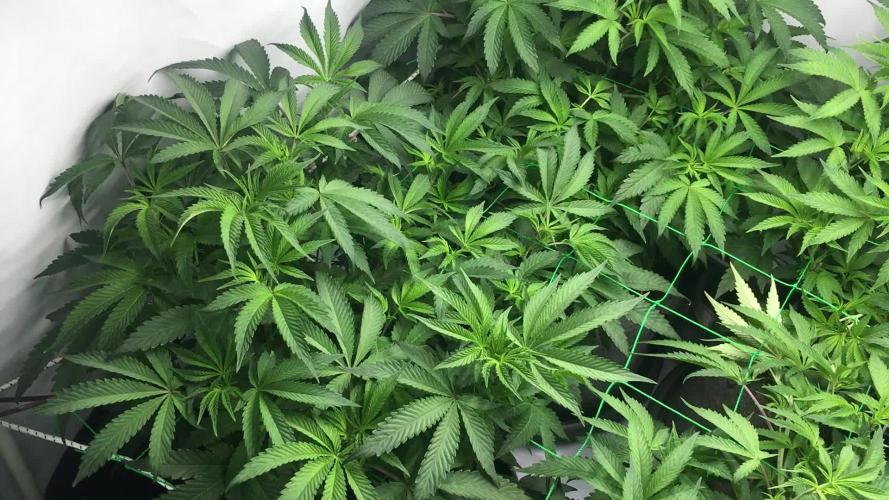
Flipped to 12/12 at day 43.
Raised light-intensity from 60 to 90 %.
Now +70% of the net is filled and i can see potential to make it an evenly shaped bowl full of fruits:-)
The deep, dark colour has turned to a juicy green, shoots everywhere....... everything fine but two little things:
1) run-off-pH is a bit high...... 6.6-6.9. will feed rather acidic next time....
2) Main Colas get a bit tall..... will supercrop them as soon, as the rest of the cannopy is organzied to a clean scrog.
Nutritionwise i lowered N, raised K and gave an extra P-shot (0,05 g/L BLOSSOM-BOOST) on days 43 and 44.
Day 45
fed pH 5.8 - readings immediatly dropped to 6.3 to 6.5 👍
Vigorous stretch.....!!! Mounted some more hooks to get the scrog even - works perfectly now! +80% of the net is filled......and the colas in the corner almost make plants of their own - i will supercrop them, as soon as they don't stretch any more.
Day 46
fed pH 6.1 today..... readings still good (average 6.4)
took out some more leafs today, to give a little more light to young shoots.
Smell is getting stronger, but no visible signs of flowering yet.
Likes
3
Share


@Carpangler
Follow
Ahoj.Začíná nám druhý týden květu.Je to prales.Ohýbám zatím listy pod sebe.Ať to roste,přátelé. :)

Likes
81
Share


@m0use
Follow
SPONSORED DIARY===SPONSORED DIARY===SPONSORED DIARY
TRANSPLANT #3 THIS WEEK!!!!
Big week, did the last transplant of the grow before she enters flower. I decided to skip out on the 3gal and upgraded to a 4.97 or 5gal container. The plastic is cheep and looks like it was going to break but its all the grow store had in stock at the time. Was talking to them about going from a 2gal to 3gal and how it did not do much for the plant but stress it out. They also gave me a free sample of a bokashi fertilizer, I divided that in between the two plants. It looks identical to the regular non fertilizer branded bokashi, and I feel its the same but with a mist of NPK on it or something.
Plants are doing well, Dynomyco had a slighter bigger root ball upon transplant and the plant its self is a tiny bit more robust. Given all the other soil boosters and microorganisms I have added into this, I don't feel I will see the true potential of just Dynomyco vs soil nothing else added. I just can't not add the others as it feel like a massive step backwards and end of day a big healthy plant is worth it. This diary may not have massive contrast in favour of Dynomyco but I will still use it none the less and I think its helps plus its not over just yet.
Would love to hear what y'all think about this, hit me up in the comments and I'd try and get back to yea as fast as I can.
I like how the dead Blue Cindy plant looks like a biophage, sifi like alien thing.
SPONSORED DIARY===SPONSORED DIARY===SPONSORED DIARY
This is my diary entry into the Dynomyco Show Us What You Got Contest!
#DynomycoShowUsWhatYouGot!
@DynomycoShowUsWhatYouGot!
@Dynomyco
Big Shoutout to @Dynomyco for picking me in their contest. Happy to be involved and as a user of Dynomyco I am curious to see this side by side with my own eyes. I will be honest I am a little skeptical it will show any major differences. but we will see what happens. Some disclaimers, I am still using LABS serum I made, This is also beneficial to the root mass however it's a bacteria based product and not fungal or mycorrhizae like Dynomyco.
https://growdiaries.com/giveaways/DYNOMYCO_Show_Us_What_You_Got
Likes
38
Share


@DomanAtrik
Follow
The scent is getting sweet and pungent. The flowers are sticky to the touch. Everything g is coming along so perfectly. I love Growing Marijuana.

Likes
19
Share


@Eauderay
Follow
Hello dear cannabis lovers,
Did nothing this week but watering with little Epsom salt added because water is soft around here.
She is beginning to puff up, and grow those buds, smelling flowery and sweet with some pine and earthy smell.
Very easy to grow and those 2 sisters looks and smell exactly the same, solid lineage!

Likes
4
Share


@Gisbert
Follow
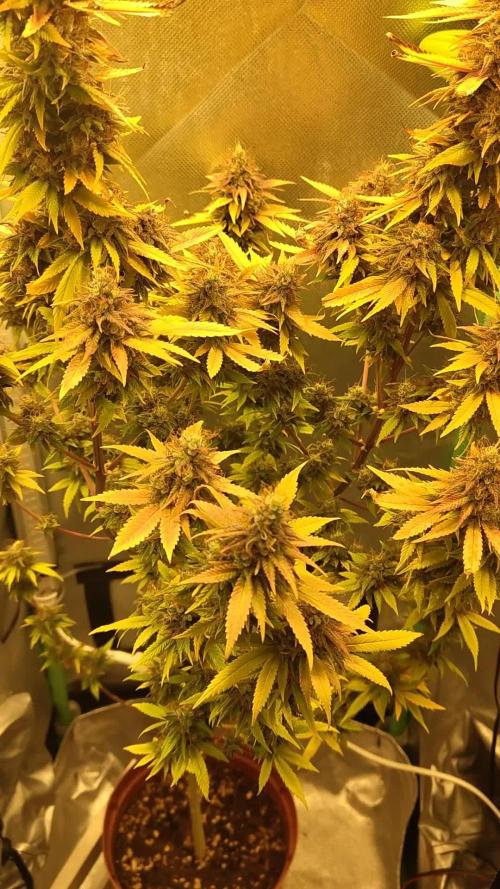
Die Damen entwickeln sich weiterhin Prächtig, zwar gibt es kein Höhenwachstum mehr aber Lady 1 wird richtig buschig nach dem Topping. Lady 2 entwickelt wunderschöne Buds! Laut Hersteller sollte die 2. Lady in ca. 5 Wochen fertig werden. Purple Bud macht mir bisher große Freude, schöner Wuchs und tolles Terpenprofiel. Fehlt nur noch das namensgebende Purple😁


Likes
2
Share

@grownerd94
Follow
Bin maximal gespannt was diese Test Strain zu bieten hat! Vom Ertrag schon mal maximal zufrieden bisher! 🔥
Likes
3
Share


@Canadian_Bud
Follow
09-12-2019
I had to harvest her she was crying out and i couldn't take it no more. I also needed the room for bigger things. I have one seed left of this strain so she will return. I enjoyed my time with her but for now it's time to move to Greener Grows. Scales come in a few weeks but now expecting much as the buds were soft and loose. Thanks everyone for watching!😎


Likes
2
Share


@Alejandroalvez123
Follow
Fueron 3 plantas que compartían espacio con otras 5 en un espacio de 1m2

Likes
13
Share


@Terpz_Hunter
Follow
Been just over a week and I mreally happy with the growth, she is packing on the pistals and has grown nearly 10 inches, can't wait to see how she develops through flowering, really impressed with her, I can see a nice yield on the cards 🤞


Likes
90
Share


@1Right_Angle
Follow
23rd of July
- Attempting to let the soil get “dry”. See what Mother N has to say about that. Day 3 w/no rain ! The Soil is still very moist
- Last fed on the 20th
- Foliar Spray in the a.m. just to tease
- boy does the audio sound bad on the phones Video !!
Kinda historic, sorryboutthat
24th,
- added some Epsom Salts to todays feed, magnesium and sulfate for the Soil. GOOD READING AVAILABLE...
- went ahead and fed on day 5, iffy weather all around. GO
- only 2 gallons used
25th,
- killer day finally after more rain lst nite
- re-positioned two questionable side-branches, down low and in front. Whole plant is open. Not a leaf to remove. Anybody thats done this style of grow, let me know if theres a hole in the program.
*** smoked some of the Beaver Seeds; Maui Wowie Autoflower that I recently grew, you know, while tending the plant today… well laugh at the fact that the 15% thc of the famous dope truly kicks Butt; seriously good weed
- “next” Meal posted above, beginning the transition to bloom nutrients !
- activity at the Bud-sites is picking-up
26th,
- amended the plant base w/ 2 cups of liquid phish-poop lol
- next proper meal posted above ~eta 30th or 31st
- anxious to get the Bloom nutes in & running
29th
- big, long, burp, after sliding 3 gallons of “transition-food” into Jack
- Meal is posted above with no Molasses today; TDS 1400ppm
- started a MONTHLY inclusion of dissolved Epsom Salts. I will be including it in Foliar applications as well, w/ Fulvic Acid.

Likes
14
Share


@Kreewl
Follow
Una planta que dude mucho si crecería bien por un pequeño problema con el humificador, pero le sirvió para hacerse fuerte y al final ha sido la ganadora en peso de las 3. Recomiendo cultivarla por la fuerza que me ha demostrado tener ante el problema que tuvo de humedad, y unas temperaturas altas de 32 de máxima. Es además una planta que se ha cultivado muy fácilmente.
Likes
5
Share


@Bluethum94
Follow
All and all I popped 19 seeds lost one after it came above ground 5 of those I will be posting on here which are mandarin cookie crossed with zweet og they are regular photoperiod plants so I will have to sex them it is a small pheno hunt looking for something to keep as a mother plant didn’t use any nutes for the first week
Likes
Comments
Share


@Hazeworld444
Follow
Slight nute burn this week! Did a heavy defoliation and now I’m low on fan leaves. Any thoughts?
Likes
77
Share


@Basementganja
Follow
I love the sativa shaped nug-towers! When my plants grow big, I like to grow them until the very end of their cycle! That's why the extended flower period.
Video of Measurement of yield: T=Tops(92grams), M=Mids(59.1 grams), L=Lowers(58.6grams)
Total: 209.7 grams (1-2 grams worth, was taste-tested prior to scaling.)

Likes
19
Share


@adam_pawloski87
Follow
Let’s go Day 46 from seed!! What a great week it’s been, girls structured up real nice veg has been huge for us, looking super healthy an catching a nice smell ! This will be the last week of feeding them the veg schedule, next we will be dipping right into bloom, starting Monday yall We will be in full bloom !! Can’t wait to watch these ladies stack over the next few weeks 😍! I hope you all enjoy an have an amazing productive day an week ! Peace love an positive vibes y’all Cheers 😶🌫️💨💨💨💨💨🤙🏻

Processing
Likes
26
Share


@eldruida_lamota
Follow
De nuevo, actualizamos la séptima semana de floración y es que estas skunk están preciosas, es una Indica muy conocida y típica entre nosotros los cultivadores, muy sencilla de cultivar.
El ph, la humedad y la temperatura son correctos, zambezaseeds está haciendo muy buen trabajo con sus variedades gente, os lo aseguro que ya son varios los cultivos con ellos. Hasta la semana que viene.